



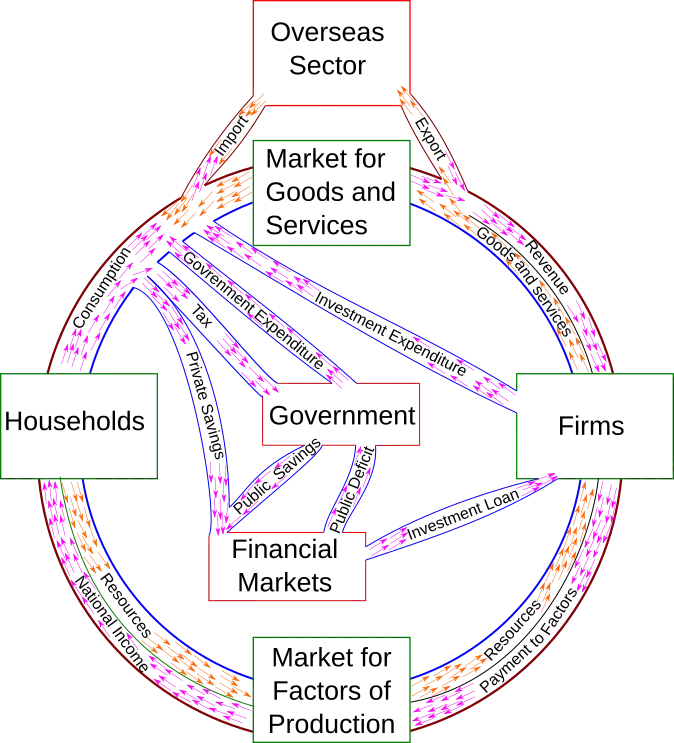
Circular flow model
The circular flow model helps explain how money moves through an economy.
The main components of the model are:
- National income
- Consumption
- Investments
- Exports
- Savings
- Taxation
- Imports
- Government expenditure
These components are all connected, and money flows between them continuously. The diagram below shows how households, firms, government, and the rest of the world interact within the circular flow.
The diagram above shows the full circular flow model in one picture. To better understand how it works, we can break the model into two main types of flows: injections and withdrawals.
Injections and withdrawals
In the circular flow model, money is constantly moving through the economy. Some activities add money into the system, while others remove it. These are known as injections and withdrawals.
These flows appear in specific parts of the economy. The main types are:
Injections (add money into the economy):
- Government expenditure
- Exports
- Investments
Withdrawals (remove money from the economy):
- Savings
- Taxation
- Imports
Consumption
A common way to describe how consumption changes as income changes is the marginal propensity to consume (MPC). It measures the fraction of an income change that is spent.
Because income can be either spent or saved, consumption and savings are closely linked: when households spend less of their income, they save more.
We usually assume MPC depends on income: when income rises, people tend to spend more; when income falls, people tend to cut spending.
Example:
Musa earns per year and spends . His salary then rises to , and his spending increases to . Based on this information, calculate Musa’s marginal propensity to consume (MPC).
- Change in consumption =
- Change in income =
Use the formula:
The marginal propensity for Musa is:
This means Musa spent of his increase in income. If his income decreased, you’d typically expect the opposite pattern: he would likely reduce spending more carefully.
Steps taken:
- Find the change in consumption
- Find the change in income
- Substitute into the formula
- Simplify
What affects consumption?
Consumption does not stay constant. It changes based on several key economic factors that influence how much households are willing and able to spend.
Consumption is affected by the following:
Income level:
- If households earn more income, they are likely to spend more. If income decreases, spending usually decreases as well.
Inflation:
- Inflation can have different effects. If consumers expect prices to rise in the future, they may spend more now to avoid paying higher prices later.
Cost of credit:
- In many countries, especially developed ones, access to credit encourages higher consumption. For example, the USA has a GDP of around trillion. However, if credit becomes more expensive or less available, consumption may decrease, particularly for luxury goods that often rely on credit purchases.
Level of wealth:
- Countries with higher levels of wealth tend to have higher spending. Wealthier consumers are generally less restricted in their spending compared to those with lower income or wealth.
Government policies (fiscal and monetary):
- Government actions can influence consumption. Higher taxes typically reduce spending, while lower taxes can increase it. Governments can also adjust interest rates, borrowing, and spending to influence consumer behavior.
Savings
Savings have a direct relationship with consumption. If households spend less, they save more, and if they spend more, they save less.
Investments
Investment can be long-term or short-term. This area is covered much in BA3; however, the basics are:
- Non-current assets: Long-term investments such as buildings, machinery, and equipment.
- Current assets (working capital): Short-term investments such as inventory and other day-to-day business assets.
What increases investment?
Investment levels in an economy are influenced by several key factors. These factors affect how confident businesses feel and how capable they are of expanding production.
Some of the most important influences are outlined below:
Key economic effects
These two important concepts play a major role in the circular flow model. They help explain how changes in spending and investment can lead to larger effects across the economy.
In other words, a small increase in demand or investment can trigger a chain reaction, increasing income, output, and overall economic activity.
Example:
A government launches a housing project worth billion. The effects extend well beyond housing:
- Construction workers spend wages on goods and services in other industries.
- Suppliers hire more workers or increase production to meet demand.
- Additional income earned is spent again, creating further rounds of spending.
This chain reaction is the multiplier effect — an injection into the economy can raise national income by more than the initial amount. Withdrawals (savings, taxes, imports) reduce how much is re-spent each round, which is why they appear in the formula:
Note that (marginal propensity to save), so withdrawals are built into the calculation.
[IMAGE NEEDED]
Worked example:
The Grogu government injects billion through housing projects. The marginal propensity to consume is . What is the total increase in national income?
The total increase in national income is billion.
In summary, the lower the marginal propensity to save, the better for economic growth.
Steps taken:
- Identify the MPC and substitute into the multiplier formula.
- Calculate the multiplier.
- Multiply the result by the initial injection to find the total increase in national income.
Factors affecting aggregate demand
For the BA1 exam, aggregate demand is affected by exactly five factors:
- Consumption
- Investment
- Government expenditure
- Exports
- Imports
If an exam question references something that falls within one of these five areas, it will affect aggregate demand. Anything outside them will not.
Each factor can affect the demand for goods and services either positively or negatively. At this stage, you should be able to reason through what an increase or decrease in, say, investment would mean for the demand side of the economy. Note that exports have a positive impact on the economy while imports have a negative impact. This will be explored further under the balance of payments in the next chapter.