



Aggregate supply
This reflects an economy’s capacity to supply goods and services to meet current demand trends or even exceed them, thereby increasing exports.
Aggregate supply is affected by changes in the factors of production such as:
- Raw material prices (if they rise, aggregate supply is affected negatively; if they fall, aggregate supply is affected positively)
- Technological advancements
- Government subsidies (when a government offers incentives to local firms - e.g., free electricity or grants - to help lower production costs)
- Labour costs (if they increase, aggregate supply is affected negatively; if they decrease, aggregate supply is affected positively)
- Availability of capital
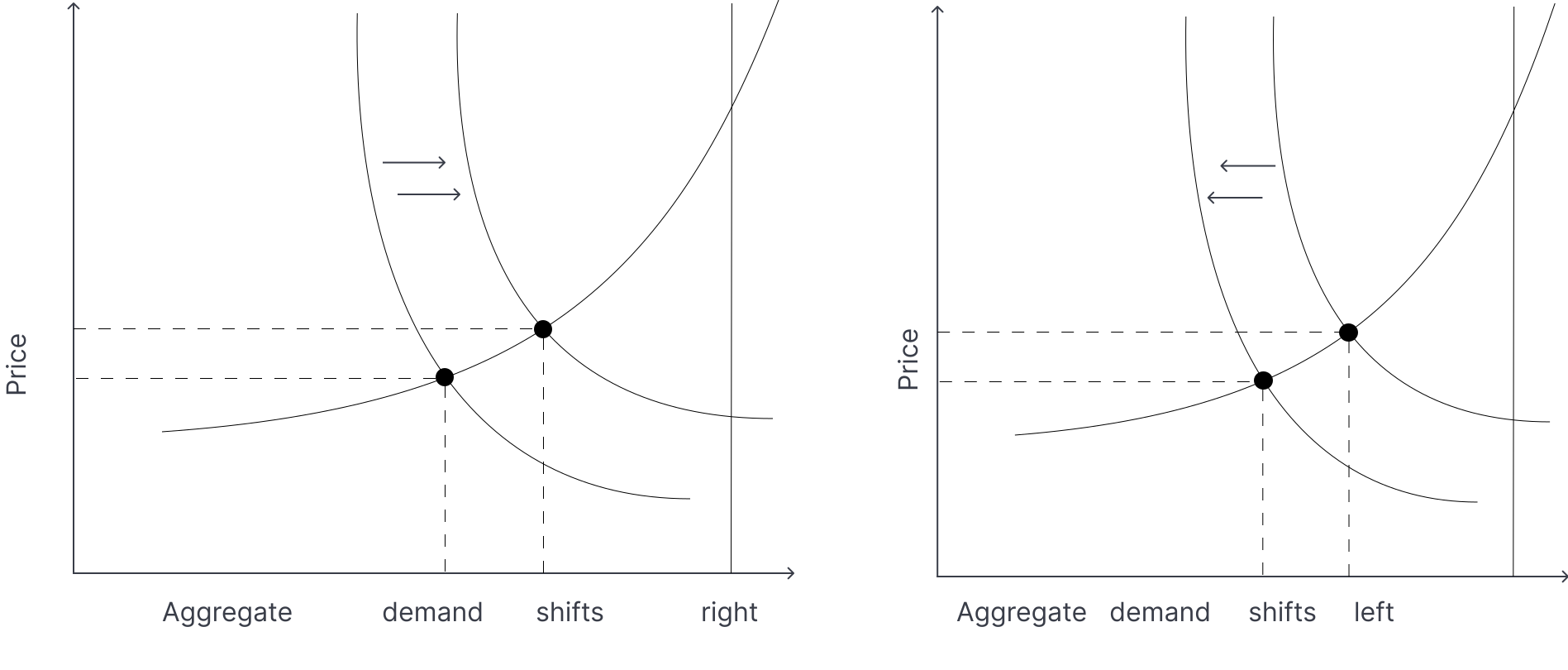
A shift in aggregate demand is caused by the demand-side factors mentioned earlier. A shift to the right (outward) is considered positive because it means higher demand at each price level. A shift to the left (inward) is considered negative because it means lower demand at each price level.
Example:
- If consumption increases, households buy more goods and services, so aggregate demand shifts outward.
- If income decreases, households buy fewer goods and services, so aggregate demand shifts inward.
The aggregate supply curve shifts when supply-side conditions change (such as the factors of production listed above). A shift to the right is considered positive because it means firms can produce more at each price level, often due to lower production costs. A shift to the left is considered negative because it means firms produce less at each price level, often due to higher production costs.
Real-world example:
If raw material prices increase (such as fuel), aggregate supply shifts to the left. If raw material prices decrease, aggregate supply shifts to the right.
When answering questions, clearly distinguish between aggregate demand factors and aggregate supply factors. They influence different curves, and confusing them is a common source of error.
The trade cycle
We have already examined the overall movement of the economy earlier in this chapter and explored the components of the cycle. We will now analyze each stage in greater detail.
| Stage on the trade cycle | Characteristics | Causes | Policy responses |
| Trough | Higher unemployment, Loss of jobs, Decline in business sales, Lower credit availability, Deflationary pressures | The causes are similar to those of a recession, as the trough occurs after a recession; it ends when recovery begins. | Raise expansionary policies to move the country out of this position. |
| Recovery | Output and income begin to rise Unemployment is falling, but gradually A better recovery on public finances (less spending on grants, etc.) Lower inflationary pressures |
Return of better economic conditions (e.g., post COVID 19) Government influences through favorable fiscal and monetary policies Rising demand |
The government will aim to maintain expansionary policy but must avoid a rapid rise which could lead to a boom and a burst. |
| Boom | High output and high employment rates High inflationary pressures High and rising imports (due to consumers having more income) Surplus in government spending due to low expenditure and more income flowing in through taxes |
High and rising aggregate demand because of high spending habits of consumers High and rising investments Exports |
Put in place negative fiscal and monetary policies to reduce demand Restrictions on importation of products |
| Recession | Falling income and output Rising unemployment rates Increase in public/government spending (due to employee benefits and grants) to help cope with falling output Could lead to a better balance of payment if imports decrease at a high rate than the rate at which exports may decrease at Decrease in prices due to a rise in deflationary pressure |
Reduction in aggregate demand (e.g., an estimate of 600 cars were sold in South Africa in April of 2020 instead of the average 4000 cars due to COVID 19) Natural causes e.g., COVID 19 |
Increase aggregate demand by applying favorable monetary and fiscal policies. |
| Stagflation | Fall in output and income Rising inflationary pressure (suffered by countries like Zimbabwe) |
Supply side problems, such as the closure of firms in a country. Note: This is solely caused by negative supply side policies. |
Positive supply side policies, such as rebuilding falling industries and providing incentives to suppliers to keep up the production capacity. |
Why is the understanding of a business cycle important for businesses?
Understanding the business cycle helps a business decide how to respond as economic conditions change. A useful starting point is to identify where your country is in the cycle by comparing current conditions to the stages in the table above.
A business that sells luxury brands may do well during recovery and boom phases. During stagflation, trough, and recession, it may struggle because falling output and income often reduce demand for expensive “nice-to-have” products.
A business that sells substitute products may do well in difficult times (for example, during a recession). During boom phases, it may struggle because households can afford higher-priced alternatives as incomes rise.
Some companies may think the cycle doesn’t affect them, especially if they sell basic goods or addictive products. However, even these markets can be influenced by the cycle. For example, if demand is inelastic (as with basic goods like bread or addictive products like alcohol), a boom phase may allow firms to raise prices and increase revenue because consumers have higher incomes.
The government can also gain insight by analyzing the trade cycle, especially when deciding which policy responses are appropriate at each stage.