



Phlebotomy procedures
Phlebotomy is performed primarily to do the following:
- Assist the provider in diagnosing disease
- Monitor a patient’s condition, treatment, or medication levels
- Document the existing good health of a patient
According to the American Society of Clinical Pathologists (ASCP), nearly 80% of providers base at least part of their diagnostic decisions on the results of laboratory tests. The most common specimen used in the laboratory is blood. Phlebotomy is the process of acquiring blood from a patient. The most common method of obtaining a blood specimen is by venipuncture, which is when blood is taken directly from a surface vein. The vein is punctured with a needle, and the blood is collected directly into a stoppered vacuum tube or a syringe and then transferred into the vacuum tube. The procedure is safe when performed by a trained professional, but it must be performed with care. Practice is required to become skilled and confident in the technique of venipuncture.
When it comes to phlebotomy, safety is an important concern. Several bloodborne viral diseases can be spread by exposure to infected blood and body fluids. The viruses identified as possible bloodborne pathogen risks are hepatitis B virus (HBV), hepatitis C virus (HCV), and human immunodeficiency virus (HIV). These viruses are not the only diseases that can be spread by contaminated blood or body fluids, but they are considered a risk for healthcare workers and public safety personnel (such as firefighters, police, and other first responders). The high standards necessary for the safe practice of phlebotomy led to the creation of the Bloodborne Pathogens Standard (overseen by the Occupational Safety and Health Administration [OSHA]) and by different organizations that develop additional standards for training.
Training and certification
Medical assistants are trained to perform phlebotomy as part of their education. They can choose to become certified phlebotomists by completing additional training, coursework, and passing a national certification examination. The following is a list of phlebotomy certifying agencies:
- American Society of Clinical Pathologists (ASCP)
- American Allied Health, Inc.
- American Certification Agency for Healthcare Professionals (ACA)
- American Medical Technologists (AMT)
- American Society of Phlebotomy Technicians (ASPT)
- National Center for Competency Testing (NCCT)
- National Healthcareer Association (NHA)
- National Phlebotomy Association (NPA)
Continuing education often is required to maintain a phlebotomy certification. Phlebotomy authority is delegated under each state’s medical practice act and board guidance rather than a single national rule, so it is important for medical assistants to become familiar with the guidelines of the states where they work because not all states require a certificate to perform phlebotomy.
Venipuncture equipment
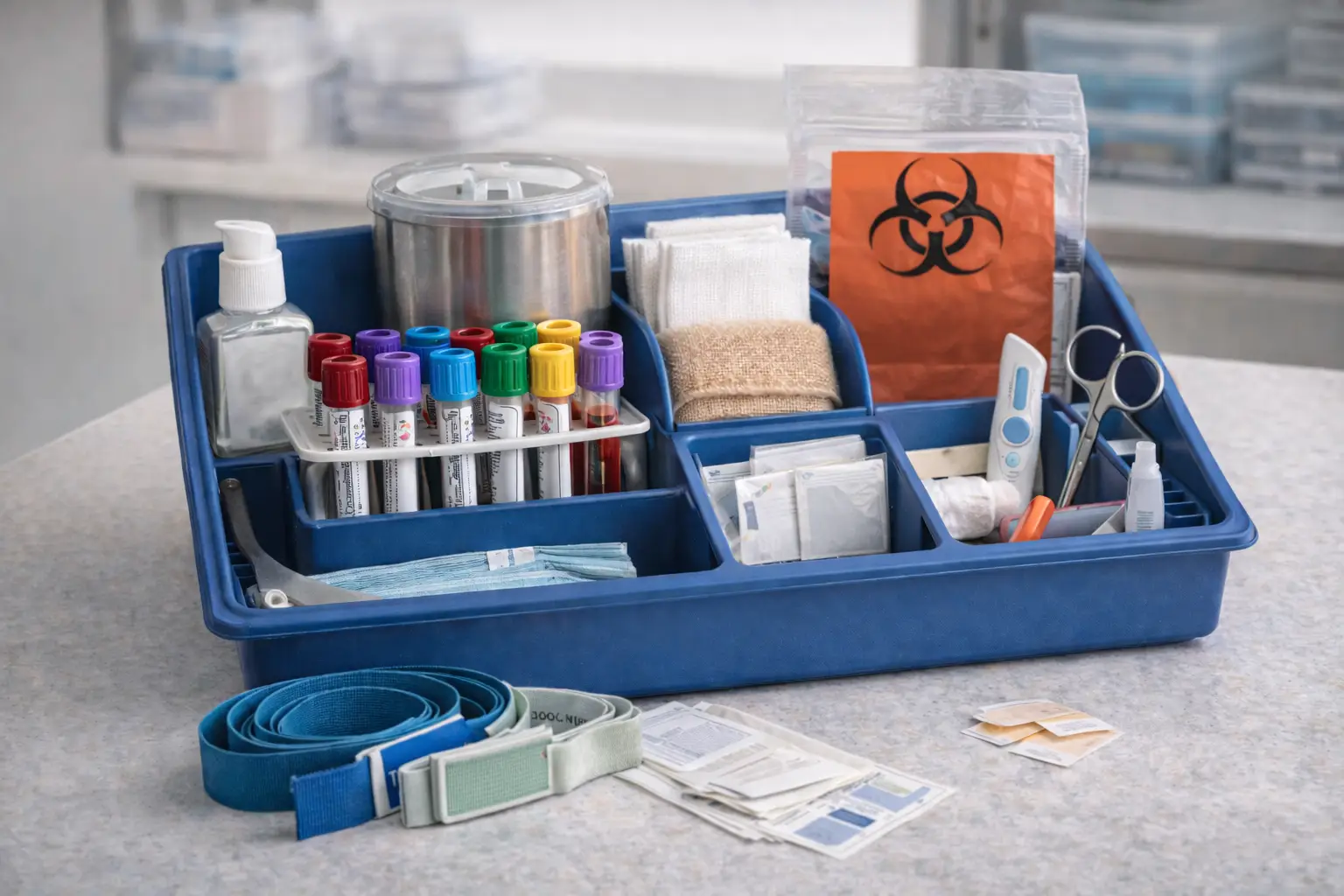
Proper collection of blood requires specialized equipment. Phlebotomists in hospitals generally carry the equipment in a portable tray. A physician’s office laboratory (POL) often has a permanent location where the same supplies are stored, and venipuncture is performed. In such cases, you may use a phlebotomy chair with an adjustable locking armrest to protect patients if they should faint. However, if a patient has a history of syncope (fainting), it is best to perform phlebotomy while they are lying on an examination table or in a reclining phlebotomy chair.
Equipment used in routine venipuncture
- Personal protective equipment (PPE): gloves, fluid-impermeable lab coat, protective eyewear, or face shield (if necessary)
- Permanent marker
- Alcohol wipes
- Gauze
- Hypoallergenic self-stick wrap, tape, or bandages
- Nonlatex tourniquets
- Double-pointed safety needles
- Winged infusion sets (butterfly needles)
- Disposable needle holders
- Evacuated, stoppered tubes
- Syringes and removable needles with safety devices
- Biohazard sharps container
- Biohazard waste container
Personal protective equipment
Employers must provide employees with personal protective equipment (PPE), such as gloves, disposable fluid-impenetrable lab coats, protective eyewear, and face shields. All facilities must stock only latex-free supplies because of the potential for allergic responses in workers and patients. Some people with latex allergies can have life-threatening reactions to latex exposure.
OSHA requires healthcare workers to wear gloves during venipuncture. Because veins can be difficult to locate with gloved fingertips, the site may be palpated before gloves are put on, as long as the hands have been washed or sanitized. To help yourself find the vein after the area has been cleansed, make note of any skin markers, such as creases, freckles, or scars.
Tourniquets
Before blood can be drawn, a vein must be located. Most venipunctures are done in the antecubital region or inner bend in front of the elbow. Application of a tourniquet is very helpful for locating veins in the antecubital region and any other area that may be drawn for venipuncture. Tourniquets prevent the venous blood flow from the site, causing the veins to bulge or plump up. If the antecubital area is drawn, a tourniquet is tied around the upper arm so that it is tight but still comfortable and can be easily released with one hand. Single-use, non latex tourniquets are available and currently are recommended to do the following:
- Reduce cross-contamination between patients and healthcare workers
- Help prevent nosocomial infections
- Prevent latex exposure
Other types of tourniquets with quick-release closures are available, but they must be disinfected after each use.
Tourniquets are applied 3 to 4 inches above the elbow immediately before the venipuncture procedure begins. Tourniquets are also used when blood is drawn from hand and foot veins and tied on the wrist or ankle, respectively.
Tourniquets can be uncomfortable for patients, especially those with heavy-set or hairy upper arms if they are not applied correctly. Make sure the tourniquet is flat against the skin, and, if necessary, tie it over the clothing if it is causing the patient discomfort. This may be especially important when blood is drawn from an older adult because of the thinness or fragility of the skin.
Antiseptics
A venipuncture site must be cleansed with an antiseptic to prevent infection. The most commonly used antiseptic is 70% isopropyl alcohol, also known as rubbing alcohol. Prepackaged alcohol wipes are the product used most often. An alcohol wipe is used to clean the puncture site, which is then allowed to air dry. Alcohol does not sterilize the skin but kills many existing bacteria that might contaminate the sample. The alcohol should remain on the skin for 30 to 60 seconds and allowed to air dry to be most effective. As the alcohol dries, it breaks open the bacterial cells and kills the bacteria. Alcohol wipes should not be used when collecting a blood alcohol sample. Sterile soap pads, benzalkonium chloride, or povidone-iodine (Betadine) can be used instead.
If a provider suspects a fever of unknown origin (FUO), a blood culture is frequently ordered. Additional preparation is needed at the venipuncture site to eliminate contaminating bacteria. First, 70% isopropyl alcohol wipes are used to clean the area, which is allowed to air dry. Then an iodine solution is used, such as povidone-iodine. Chlorhexidine gluconate or benzalkonium chloride can be used for patients who are allergic to iodine. The iodine prep is also allowed to air dry. Once the venipuncture site is properly prepared, the blood cultures must be drawn into a sterile tube or bottle specifically designed for the test.
The order in which multiple tubes are filled - and why drawing them out of sequence lets one tube’s additive contaminate the next and skew results - is covered in the next chapter, Evacuated collection tubes and order of draw.