



Phlebotomy needles and supplies
Needles and supplies used in phlebotomy
A critical part of phlebotomy is knowing which needle and tube, or syringe, should be used in each situation. All needles used in phlebotomy are sterile and have a safety device that is activated immediately after withdrawal from the vein. The needle is then discarded in a biohazard sharps container. Each needle is housed in a protected cover, which should be inspected before use to ensure that sterility has not been compromised (i.e., the seal should be intact) and the needle has no manufacturing defects, such as burs, nicks, or bends.
Needles have two parts: the hub and the shaft. The hub of the needle is designed to attach the needle to the vacuum tube needle holder or a syringe. Shafts differ in length, ranging from ¾ inch to 1½ inches. Shaft length doesn’t affect blood flow rate or the risk of hemolysis - those depend on the gauge, not the length. Instead, shaft length is chosen based on the depth of the patient’s vein and the patient’s anatomy: a longer needle may be needed to reach a deeper vein, while a shorter needle can put an anxious patient more at ease. One end of the shaft is cut at an angle and forms the bevel, which creates a very sharp point. The bevel of the needle makes the entry into the skin much smoother.
The bore, or hollow space, inside the needle is called the lumen. Lumen size is important and is referred to as the gauge. A numeric value designates the gauge of the needle. The higher the gauge number, the smaller the lumen. Be sure to match the needle gauge to the size of the tube. A large vacuum tube is more likely to hemolyze the blood if a high-gauge needle (i.e., small lumen) is used. For example, blood banks use a large, 16-gauge needle to collect pints of blood for transfusions. The lumen is wide, which reduces the chance of hemolysis. A small, 23-gauge needle is used to collect blood from small or fragile veins, such as those in older adults and very young patients. Routine adult venipuncture requires a 20- to 21-gauge needle.
Multisample needles
Multisample needles are commonly used in routine adult venipuncture. They are used when several tubes need to be drawn during a single venipuncture. These needles are double pointed. One point enters the patient’s vein, and the other punctures the stopper of the collection tube. The point that enters the tube is sheathed with a retractable rubber sleeve that allows tubes to be changed without blood leaking into the needle holder or tube holder.
Needle holders
Double-pointed needles must be firmly placed into a needle holder. Usually, needle holders are translucent cylinders, and they come in different sizes to accommodate different-sized tubes. The holders often have a ring that indicates how far the tube can be pushed onto the needle without losing the vacuum. To prevent accidental needlesticks, OSHA requires that the needle holder, with its safety-activated needle still attached, must be discarded into a biohazard sharps container immediately after completing the venipuncture.
Syringes
Syringes are used when there is concern that the strong vacuum in a stoppered vacuum tube might collapse the vein. The syringe needle fits on the end of the syringe barrel. Syringe needles also come in different gauges. The amount of blood drawn into the syringe barrel depends on how much blood needs to be collected for testing. Once the blood is drawn, the syringe needle’s safety device must be activated and the needle discarded in the sharps container. A special transfer device is then attached to the top of the syringe; it contains an enclosed needle that punctures the vacuum tube’s stopper and delivers the blood into the tube. This transfer must happen right away - blood that sits in the syringe barrel can begin to clot, which would ruin the sample.
Winged infusion sets (butterfly assembly)
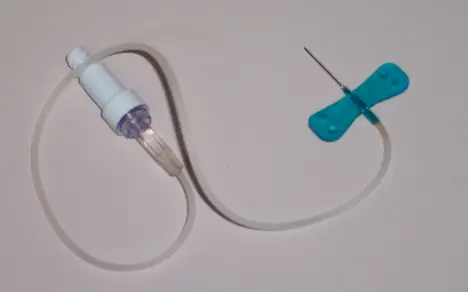
Butterfly assemblies are designed for use on small veins. Butterfly needles are often used to draw veins in the back of the hand or when drawing a pediatric patient. The most common butterfly needle size is a 22 or 23 gauge with a needle length of ½ to ¾ inch. A butterfly needle has a plastic, flexible, butterfly-shaped grip attached to a short length of tubing. The hub end is fitted into a syringe or a needle holder tube adapter. Syringes are frequently paired with butterfly needles because the syringe can create a gentle vacuum that the phlebotomist can easily control. The syringe blood sample must be transferred to the evacuated tubes using the transfer device described previously.