



Semiconductors
Semiconductor
A semiconductor is anything that conducts electricity at times. Different types of semiconductors have specific thresholds that must be met for electricity to pass.
Types of Semiconductor
P-N junction
These are the building blocks for semiconductors.
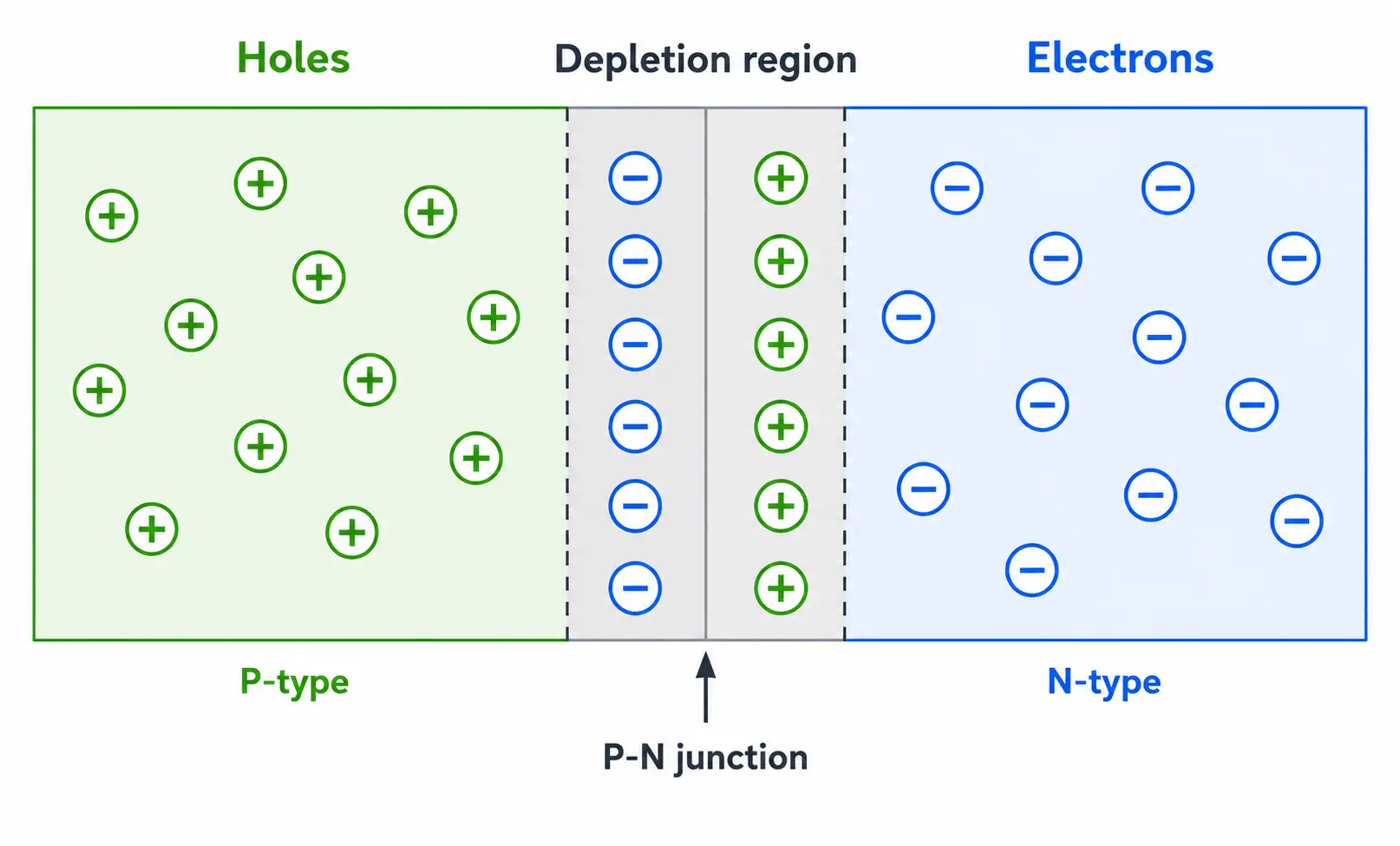
N-type semiconductors have extra electrons, which carry a negative charge.
P-type semiconductors have “holes” where electrons are missing. These holes behave like positive charge carriers.
When joined, P-type and N-type materials form a P-N junction, which controls the flow of electrical current.
Diodes
A two-terminal semiconductor device made from a single P-N junction. It allows current to flow in only one direction, blocking it in the opposite direction.
When voltage is applied in one direction, called forward bias, the negative charges in the N-type material and the positive holes in the P-type material are pushed toward the junction, where they meet and allow current to flow across it. When voltage is applied in the other direction, called reverse bias, those charges are instead pulled away from the junction, widening the gap between them and blocking current from flowing. This is what allows a diode to conduct current in only one direction.
Diodes are commonly used to convert AC to DC in a process called rectification. Though vacuum tubes were once widely used in electronic devices to control current flow, many devices now use diodes instead. Unlike vacuum tubes, diodes do not need any warm-up time to begin working. Diodes are also smaller, lighter, more durable, run cooler, have a longer lifespan, and need less operating power than vacuum tubes do.
In this diagram, we see a P-N junction up close. Holes (positive charge carriers) fill the P-type material, while electrons (negative charge carriers) fill the N-type material. Where the two meet, some electrons cross into the P-type side and fill in nearby holes, leaving a thin depletion region with no free charge carriers left to conduct current. This depletion region is what a diode must overcome before current can flow.
Transistors
A three-terminal semiconductor device that can act as a switch or an amplifier for electrical current.
A transistor is built from three layers of semiconductor material arranged in an NPN or PNP pattern, similar to two P-N junctions placed back to back. However, a transistor is not simply two diodes wired together. The middle layer, called the base, is extremely thin and shared between both junctions, which allows a small current or voltage applied to the base to control a much larger current flowing between the other two terminals.
This ability to control a large current with a small one is what allows a transistor to amplify signals or act as an electronic switch. Like diodes, transistors also replaced vacuum tubes in most electronic devices, since they can perform the same switching and amplifying functions while being smaller, more efficient, and more reliable. Transistors are the foundation of modern electronics: a single modern computer chip can contain billions of them, working together to process information.