


This browser is too old to run Achievable.

Update it, or open this page in a current version of Chrome, Safari, Firefox or Edge. On an iPhone or iPad, update iOS: every browser there runs on the version of Safari that comes with it.

Achievable logoAchievable logo
ASVAB
Sign in
Sign up
Purchase
Textbook
Practice exams
Support
How it works
Resources
Exam catalog
Mountain with a flag at the peak
Textbook
Introduction
1. Word Knowledge
2. Mathematics Knowledge
3. Paragraph Comprehension
4. Arithmetic Reasoning
5. General Science
6. Mechanical Comprehension
7. Electronics Information
7.1 Electricity Basics
7.2 Circuits
7.3 Electrical Power
7.4 Electromagnetism
7.5 Semiconductors
8. Shop Information
9. Auto Information
10. Assembling Objects
Wrapping up
Achievable logoAchievable logo
7.4 Electromagnetism
Achievable ASVAB
7. Electronics Information
Our ASVAB course is currently in development and is a work-in-progress.

Electromagnetism

4 min read
Font
Discuss
Share
Feedback

Magnetic Fields

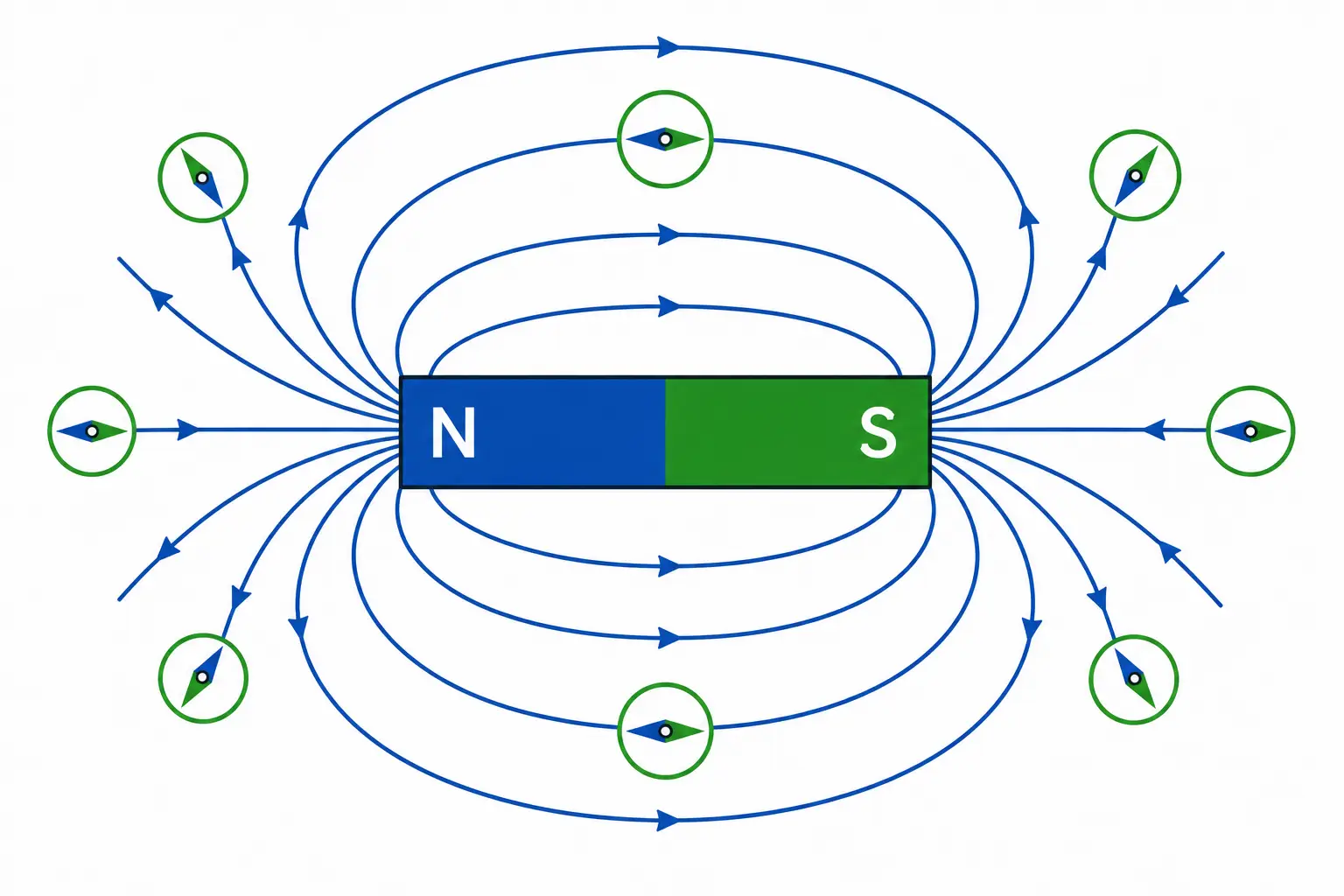
A magnetic field is the region around a magnet or an electric current where magnetic force can be detected.

Magnetic field lines around a bar magnet, running from the north pole around the outside of the magnet into the south pole, with compass needles following the lines.
Magnetic Field
Achievable

Here we can see the magnetic field lines around a bar magnet, running from the north pole, around the outside of the magnet, and into the south pole.

Running current through a wire creates a magnetic field around it. This is how electromagnets work: a coil of wire carrying current generates a magnetic field, just like a permanent magnet would.

Electromagnetic induction

Electromagnetic induction is the process of converting magnetic energy into electrical energy by moving a conductor through a changing magnetic field. One way you can change a magnetic field to create induction is by moving a magnet through wire coils.

Electromagnetic induction is the principle that makes inductors, transformers, and generators work, which we will cover next.

Inductors

An electrical device that converts electrical energy into a magnetic field, then releases that energy back into the circuit when needed. It is the electrical equivalent of a flywheel. Just as a flywheel resists changes in rotational speed, an inductor resists changes in current.

Inductors are typically made from a coil of wire, often wound around a metal core. Inductance is measured in Henries (H).

Transformers

Transformers are two inductors, like the ones we just covered, that transfer energy from one coil to another through electromagnetic induction. A transformer has a primary coil and a secondary coil, wrapped around a shared core. As AC flows through the primary coil, it creates a changing magnetic field. That changing field induces a current in the secondary coil, transferring energy between the two circuits without a direct electrical connection. Transformers only exist in AC, since a steady DC would not create the changing magnetic field induction requires.

A transformer that raises AC voltage is called a step-up transformer, while a transformer that lowers the voltage is called a step-down transformer. The change in voltage allows energy to be transmitted over long distances, which requires high voltage, but then lowers the voltage for home safety.

Motors

An electrical device that converts electric or electromagnetic energy into rotational mechanical energy.

A basic motor works by running current through a coil of wire that sits inside a magnetic field. The interaction between the current and the magnetic field produces a force that spins the coil, converting electrical energy into rotational motion.

Sidenote
Motors

We will talk more about motors in Auto Information.

Generators

A device that takes rotational energy and converts it into electrical energy through electromagnetic induction. As a coil of wire, or a magnet, rotates within a magnetic field, the changing field induces a current in the wire. This is the same principle covered above in electromagnetic induction, just driven by mechanical rotation instead of a moving magnet.

Motors and generators are essentially the same device used in opposite directions. A motor takes in electricity and produces rotation, while a generator takes in rotation and produces electricity. In fact, many motors can act as generators if you spin them by hand, and generators can act as motors if you run current through them.

Magnetic Fields

  • Region around magnet/current where force is detectable; field lines run north pole → around outside → south pole
  • Current through wire creates magnetic field → basis of electromagnets

Electromagnetic Induction

  • Converts magnetic energy into electrical energy via conductor moving through changing magnetic field (e.g., magnet moving through coils)
  • Core principle behind inductors, transformers, and generators

Inductors

  • Convert electrical energy into magnetic field, release it back to circuit
  • Like a flywheel: resists changes in current
  • Coil of wire (often on metal core); inductance measured in Henries (H)

Transformers

  • Primary/secondary coils share a core, transfer energy via induction
  • AC only (DC has no changing field to induce current)
  • Step-up raises voltage (long-distance transmission); step-down lowers voltage (home safety)

Motors and Generators

  • Motor: electrical energy → rotational motion (current in coil within magnetic field spins it)
  • Generator: rotational energy → electrical energy (rotating coil/magnet induces current)
  • Reverse functions of each other; each can act as the other

Sign up for free to take 5 quiz questions on this topic

Previous
Next  | 7.5 Semiconductors
All rights reserved ©2016 - 2026 Achievable, Inc.

Electromagnetism

Magnetic Fields

A magnetic field is the region around a magnet or an electric current where magnetic force can be detected.

Here we can see the magnetic field lines around a bar magnet, running from the north pole, around the outside of the magnet, and into the south pole.

Running current through a wire creates a magnetic field around it. This is how electromagnets work: a coil of wire carrying current generates a magnetic field, just like a permanent magnet would.

Electromagnetic induction

Electromagnetic induction is the process of converting magnetic energy into electrical energy by moving a conductor through a changing magnetic field. One way you can change a magnetic field to create induction is by moving a magnet through wire coils.

Electromagnetic induction is the principle that makes inductors, transformers, and generators work, which we will cover next.

Inductors

An electrical device that converts electrical energy into a magnetic field, then releases that energy back into the circuit when needed. It is the electrical equivalent of a flywheel. Just as a flywheel resists changes in rotational speed, an inductor resists changes in current.

Inductors are typically made from a coil of wire, often wound around a metal core. Inductance is measured in Henries (H).

Transformers

Transformers are two inductors, like the ones we just covered, that transfer energy from one coil to another through electromagnetic induction. A transformer has a primary coil and a secondary coil, wrapped around a shared core. As AC flows through the primary coil, it creates a changing magnetic field. That changing field induces a current in the secondary coil, transferring energy between the two circuits without a direct electrical connection. Transformers only exist in AC, since a steady DC would not create the changing magnetic field induction requires.

A transformer that raises AC voltage is called a step-up transformer, while a transformer that lowers the voltage is called a step-down transformer. The change in voltage allows energy to be transmitted over long distances, which requires high voltage, but then lowers the voltage for home safety.

Motors

An electrical device that converts electric or electromagnetic energy into rotational mechanical energy.

A basic motor works by running current through a coil of wire that sits inside a magnetic field. The interaction between the current and the magnetic field produces a force that spins the coil, converting electrical energy into rotational motion.

Sidenote
Motors

We will talk more about motors in Auto Information.

Generators

A device that takes rotational energy and converts it into electrical energy through electromagnetic induction. As a coil of wire, or a magnet, rotates within a magnetic field, the changing field induces a current in the wire. This is the same principle covered above in electromagnetic induction, just driven by mechanical rotation instead of a moving magnet.

Motors and generators are essentially the same device used in opposite directions. A motor takes in electricity and produces rotation, while a generator takes in rotation and produces electricity. In fact, many motors can act as generators if you spin them by hand, and generators can act as motors if you run current through them.

Key points

Magnetic Fields

  • Region around magnet/current where force is detectable; field lines run north pole → around outside → south pole
  • Current through wire creates magnetic field → basis of electromagnets

Electromagnetic Induction

  • Converts magnetic energy into electrical energy via conductor moving through changing magnetic field (e.g., magnet moving through coils)
  • Core principle behind inductors, transformers, and generators

Inductors

  • Convert electrical energy into magnetic field, release it back to circuit
  • Like a flywheel: resists changes in current
  • Coil of wire (often on metal core); inductance measured in Henries (H)

Transformers

  • Primary/secondary coils share a core, transfer energy via induction
  • AC only (DC has no changing field to induce current)
  • Step-up raises voltage (long-distance transmission); step-down lowers voltage (home safety)

Motors and Generators

  • Motor: electrical energy → rotational motion (current in coil within magnetic field spins it)
  • Generator: rotational energy → electrical energy (rotating coil/magnet induces current)
  • Reverse functions of each other; each can act as the other

More from Electronics Information

  • Electricity Basics
  • Circuits
  • Electrical Power
  • Semiconductors