


This browser is too old to run Achievable.

Update it, or open this page in a current version of Chrome, Safari, Firefox or Edge. On an iPhone or iPad, update iOS: every browser there runs on the version of Safari that comes with it.

Achievable logoAchievable logo
ASVAB
Sign in
Sign up
Purchase
Textbook
Practice exams
Support
How it works
Resources
Exam catalog
Mountain with a flag at the peak
Textbook
Introduction
1. Word Knowledge
2. Mathematics Knowledge
3. Paragraph Comprehension
4. Arithmetic Reasoning
5. General Science
6. Mechanical Comprehension
7. Electronics Information
7.1 Electricity Basics
7.2 Circuits
7.3 Electrical Power
7.4 Electromagnetism
7.5 Semiconductors
8. Shop Information
9. Auto Information
10. Assembling Objects
Wrapping up
Achievable logoAchievable logo
7.1 Electricity Basics
Achievable ASVAB
7. Electronics Information
Our ASVAB course is currently in development and is a work-in-progress.

Electricity Basics

5 min read
Font
Discuss
Share
Feedback

Atomic structure

As we discussed in Chemistry, the atom contains 3 parts: electrons, neutrons, and protons. In simplest terms, electricity is all about how electrons move.

All matter has an electrical charge, which can be neutral, positive, or negative. Most atoms (and the matter they combine to form) have a neutral charge because the negative charge of their electrons balances with the positive charge of their protons. However, when matter interacts with other matter, the two objects can exchange electrons. This exchange alters the charge of both objects, making one object have a net negative charge and the other a net positive charge. This is the same reason you sometimes feel a shock after walking across a carpet and touching a doorknob.

Conductors, insulators & semiconductors

Conductor: a material that allows electrons to flow through it easily. Most metals, like copper and silver, are good conductors, which is why they’re used to make electrical wires.

Insulator: a material that blocks the flow of electricity. Rubber, glass, and plastic are common insulators, which is why they’re used to coat wires and build tools that are safe to handle near electricity.

Semiconductor: a material that can act as both a conductor and an insulator, depending on the conditions. Silicon is the most common semiconductor, and its ability to switch between conducting and insulating is what makes it possible to build the transistors and microchips found in computers and other electronics.

Ohm’s Law

A helpful way to picture voltage, current, and resistance is to imagine water flowing through a pipe.

Voltage: the electrical pressure that pushes electrical current through a wire, similar to the water pressure pushing water through a pipe. Voltage is measured in Volts (V).

Current: the flow of electrical current through a wire, similar to the flow rate of water through a pipe. Current is measured in Amps (A).

Resistance: an object’s opposition to the flow of electrical current, similar to how a narrow pipe restricts the flow of water. Resistance is measured in Ohms (Ω).

Sidenote
Resistors

Resistors : A device meant to limit the flow of electric current

Fixed resistors : A device that has a fixed resistance. It will always present the same resistance to the circuit.

Variable resistors : The resistance can be mechanically adjusted to change the resistance in a circuit. This is helpful if you want to change the brightness of a light, slow a motor, or change the volume of a speaker. This type of variable resistor is commonly called a potentiometer, or “pot” for short. You’ll find one inside most volume knobs and dimmer switches.

Ohm’s Law is the basis for electronics and describes the relationship between voltage, current, and resistance. It states that:

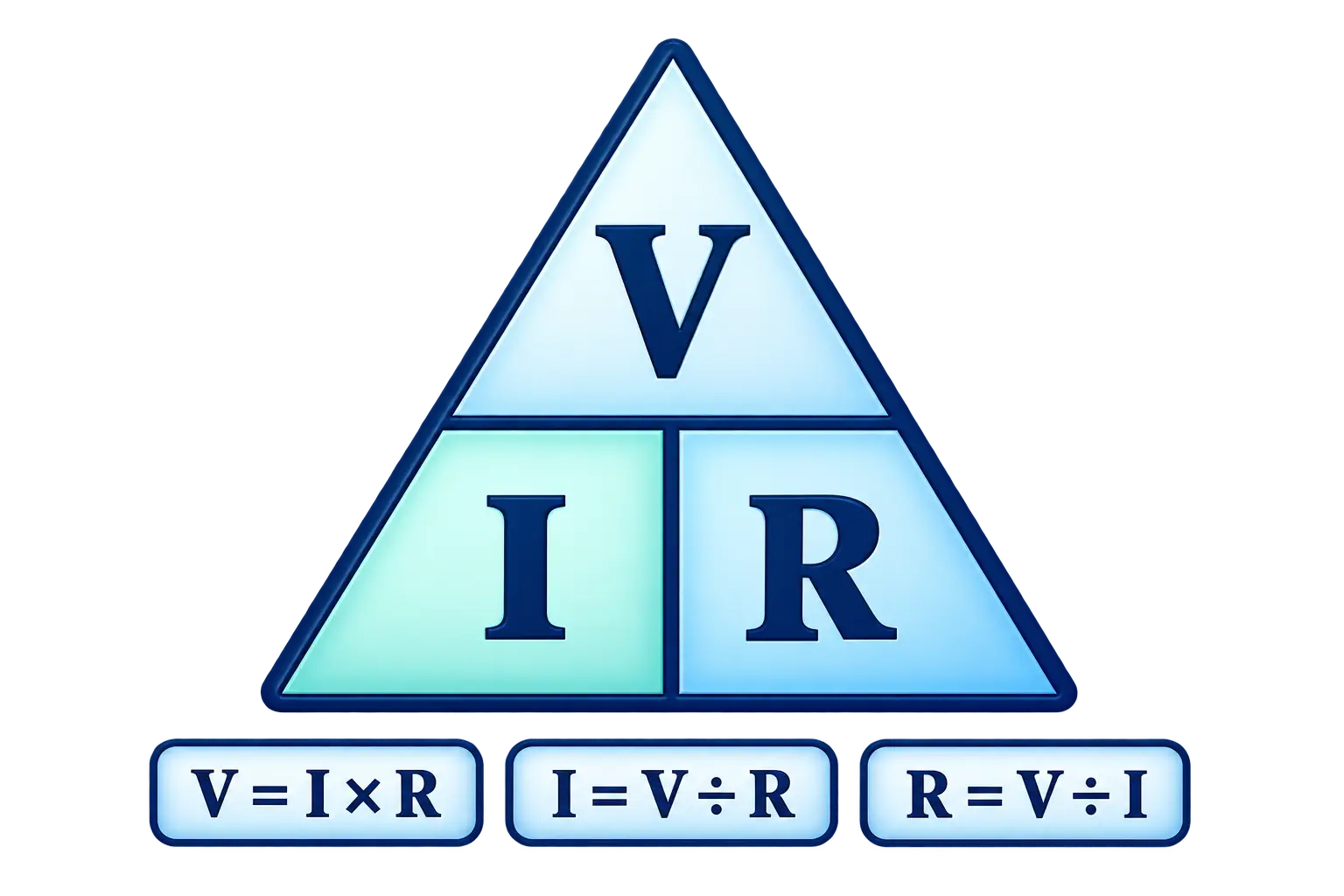
Triangle divided into V on top and I, R on bottom, giving Ohm's Law forms: V = I x R, I = V / R, R = V / I
Ohm’s Law Triangle
Achievable

Voltage = Current * Resistance

V=I∗R

Let’s work through an example.

A circuit has a current of 2 amps and a resistance of 5 ohms. To find the voltage, we plug those numbers into the formula:

V=I∗R

V=2∗5

V=10 volts

Sometimes you’ll be given the voltage and need to solve for current or resistance instead. You can rearrange Ohm’s Law to solve for any of the three variables:

I=RV​

R=IV​

Knowledge Check If a circuit has a voltage of 12 volts and a resistance of 4 ohms, what is the current?

(spoiler)

3 amps

Sidenote
The Ohm's Law Triangle

A helpful way to remember how to rearrange Ohm’s Law is to picture a triangle with V on top and I and R side-by-side on the bottom. Cover up the variable you’re solving for, and the triangle shows you the formula: cover V to see I × R, cover I to see V ÷ R, and cover R to see V ÷ I.

Measuring Instruments

Now that we’ve covered voltage, current, and resistance, let’s look at the tools used to measure them in a real circuit.

Voltmeter: measures voltage. A voltmeter is connected in parallel with a component of the circuit, since voltage is measured across two points.

Ammeter: measures current. Unlike a voltmeter, an ammeter must be connected in series with a component, since current has to flow through the meter to be measured.

Ohmmeter: measures resistance. An ohmmeter sends its own small current through a component and calculates its resistance from that, so it should only be used on a component that’s disconnected from any power source.

Multimeter: a single device that combines a voltmeter, ammeter, and ohmmeter into one tool, letting you measure voltage, current, or resistance without needing three separate instruments. Most multimeters can be switched between these modes.

Atomic structure & charge

  • Atoms = electrons, neutrons, protons; electricity centers on electron movement
  • Neutral charge: electron/proton balance; charge imbalance occurs when matter exchanges electrons (e.g., static shock)

Conductors, insulators & semiconductors

  • Conductor: lets electrons flow easily (e.g., copper, silver) — used in wires
  • Insulator: blocks electron flow (e.g., rubber, glass, plastic) — used for safety coatings
  • Semiconductor: switches between conducting/insulating (e.g., silicon) — basis of transistors/microchips

Ohm’s Law

  • Water-pipe analogy: Voltage (V, pressure) drives Current (A, flow rate) against Resistance (Ω, restriction)
  • Core formula: V=I×R; rearrange as I=RV​ and R=IV​
  • Ohm’s Law triangle (V on top, I & R below) helps recall rearrangements by covering the unknown variable
  • Resistors limit current flow:
    • Fixed resistor: constant resistance
    • Variable resistor (potentiometer/“pot”): adjustable resistance, used in volume knobs/dimmers

Measuring Instruments

  • Voltmeter: measures voltage; connected in parallel
  • Ammeter: measures current; connected in series
  • Ohmmeter: measures resistance; used only on disconnected/unpowered components
  • Multimeter: combines all three functions into one switchable tool

Sign up for free to take 5 quiz questions on this topic

Previous
Next  | 7.2 Circuits
All rights reserved ©2016 - 2026 Achievable, Inc.

Electricity Basics

Atomic structure

As we discussed in Chemistry, the atom contains 3 parts: electrons, neutrons, and protons. In simplest terms, electricity is all about how electrons move.

All matter has an electrical charge, which can be neutral, positive, or negative. Most atoms (and the matter they combine to form) have a neutral charge because the negative charge of their electrons balances with the positive charge of their protons. However, when matter interacts with other matter, the two objects can exchange electrons. This exchange alters the charge of both objects, making one object have a net negative charge and the other a net positive charge. This is the same reason you sometimes feel a shock after walking across a carpet and touching a doorknob.

Conductors, insulators & semiconductors

Conductor: a material that allows electrons to flow through it easily. Most metals, like copper and silver, are good conductors, which is why they’re used to make electrical wires.

Insulator: a material that blocks the flow of electricity. Rubber, glass, and plastic are common insulators, which is why they’re used to coat wires and build tools that are safe to handle near electricity.

Semiconductor: a material that can act as both a conductor and an insulator, depending on the conditions. Silicon is the most common semiconductor, and its ability to switch between conducting and insulating is what makes it possible to build the transistors and microchips found in computers and other electronics.

Ohm’s Law

A helpful way to picture voltage, current, and resistance is to imagine water flowing through a pipe.

Voltage: the electrical pressure that pushes electrical current through a wire, similar to the water pressure pushing water through a pipe. Voltage is measured in Volts (V).

Current: the flow of electrical current through a wire, similar to the flow rate of water through a pipe. Current is measured in Amps (A).

Resistance: an object’s opposition to the flow of electrical current, similar to how a narrow pipe restricts the flow of water. Resistance is measured in Ohms (Ω).

Sidenote
Resistors

Resistors : A device meant to limit the flow of electric current

Fixed resistors : A device that has a fixed resistance. It will always present the same resistance to the circuit.

Variable resistors : The resistance can be mechanically adjusted to change the resistance in a circuit. This is helpful if you want to change the brightness of a light, slow a motor, or change the volume of a speaker. This type of variable resistor is commonly called a potentiometer, or “pot” for short. You’ll find one inside most volume knobs and dimmer switches.

Ohm’s Law is the basis for electronics and describes the relationship between voltage, current, and resistance. It states that:

Voltage = Current * Resistance

V=I∗R

Let’s work through an example.

A circuit has a current of 2 amps and a resistance of 5 ohms. To find the voltage, we plug those numbers into the formula:

V=I∗R

V=2∗5

V=10 volts

Sometimes you’ll be given the voltage and need to solve for current or resistance instead. You can rearrange Ohm’s Law to solve for any of the three variables:

I=RV​

R=IV​

Knowledge Check If a circuit has a voltage of 12 volts and a resistance of 4 ohms, what is the current?

(spoiler)

3 amps

Sidenote
The Ohm's Law Triangle

A helpful way to remember how to rearrange Ohm’s Law is to picture a triangle with V on top and I and R side-by-side on the bottom. Cover up the variable you’re solving for, and the triangle shows you the formula: cover V to see I × R, cover I to see V ÷ R, and cover R to see V ÷ I.

Measuring Instruments

Now that we’ve covered voltage, current, and resistance, let’s look at the tools used to measure them in a real circuit.

Voltmeter: measures voltage. A voltmeter is connected in parallel with a component of the circuit, since voltage is measured across two points.

Ammeter: measures current. Unlike a voltmeter, an ammeter must be connected in series with a component, since current has to flow through the meter to be measured.

Ohmmeter: measures resistance. An ohmmeter sends its own small current through a component and calculates its resistance from that, so it should only be used on a component that’s disconnected from any power source.

Multimeter: a single device that combines a voltmeter, ammeter, and ohmmeter into one tool, letting you measure voltage, current, or resistance without needing three separate instruments. Most multimeters can be switched between these modes.

Key points

Atomic structure & charge

  • Atoms = electrons, neutrons, protons; electricity centers on electron movement
  • Neutral charge: electron/proton balance; charge imbalance occurs when matter exchanges electrons (e.g., static shock)

Conductors, insulators & semiconductors

  • Conductor: lets electrons flow easily (e.g., copper, silver) — used in wires
  • Insulator: blocks electron flow (e.g., rubber, glass, plastic) — used for safety coatings
  • Semiconductor: switches between conducting/insulating (e.g., silicon) — basis of transistors/microchips

Ohm’s Law

  • Water-pipe analogy: Voltage (V, pressure) drives Current (A, flow rate) against Resistance (Ω, restriction)
  • Core formula: V=I×R; rearrange as I=RV​ and R=IV​
  • Ohm’s Law triangle (V on top, I & R below) helps recall rearrangements by covering the unknown variable
  • Resistors limit current flow:
    • Fixed resistor: constant resistance
    • Variable resistor (potentiometer/“pot”): adjustable resistance, used in volume knobs/dimmers

Measuring Instruments

  • Voltmeter: measures voltage; connected in parallel
  • Ammeter: measures current; connected in series
  • Ohmmeter: measures resistance; used only on disconnected/unpowered components
  • Multimeter: combines all three functions into one switchable tool

More from Electronics Information

  • Circuits
  • Electrical Power
  • Electromagnetism
  • Semiconductors