


This browser is too old to run Achievable.

Update it, or open this page in a current version of Chrome, Safari, Firefox or Edge. On an iPhone or iPad, update iOS: every browser there runs on the version of Safari that comes with it.

Achievable logoAchievable logo
ASVAB
Sign in
Sign up
Purchase
Textbook
Practice exams
Support
How it works
Resources
Exam catalog
Mountain with a flag at the peak
Textbook
Introduction
1. Word Knowledge
2. Mathematics Knowledge
3. Paragraph Comprehension
4. Arithmetic Reasoning
5. General Science
6. Mechanical Comprehension
6.1 Forces and Motion
6.2 Work, Energy and Power
6.3 Simple Machines
6.4 Compound Machines
7. Electronics Information
8. Shop Information
9. Auto Information
10. Assembling Objects
Wrapping up
Achievable logoAchievable logo
6.4 Compound Machines
Achievable ASVAB
6. Mechanical Comprehension
Our ASVAB course is currently in development and is a work-in-progress.

Compound Machines

4 min read
Font
Discuss
Share
Feedback

Mechanical Advantage

Mechanical advantage measures how much a machine or tool multiplies force, allowing you to move a load with less input force.

Mechanical Advantage = Output Force (FO​) ÷ Input Force (FI​)

MA=FI​FO​​

Mechanical advantage does not have a unit. It is a ratio of the forces.

Let’s look at an example

Find the mechanical advantage of a machine with an input force of 20N and an output force of 100N.

MA=FI​FO​​

MA=20100​

MA=5

You can increase mechanical advantage by increasing the distance over which the force is applied.

In practical terms, this is lengthening a lever arm, increasing the number of pulleys in a system, or increasing the gear ratio.

Ideal vs actual

Ideal Mechanical Advantage (IMA) is the theoretical mechanical advantage of a machine, assuming 100% efficiency and no energy lost to friction. 

Efficiency: Because of friction, the work done by a machine is always less than the work done on it; therefore, machines are always less than 100% efficient.

Actual Mechanical Advantage (AMA) is the real-world mechanical advantage of a machine that accounts for friction.

Decreasing friction will increase the actual mechanical advantage of a machine.

Compound (Complex) Machines:

A combination of two or more simple machines working together.

Identifying Simple Machines in Compound Machines

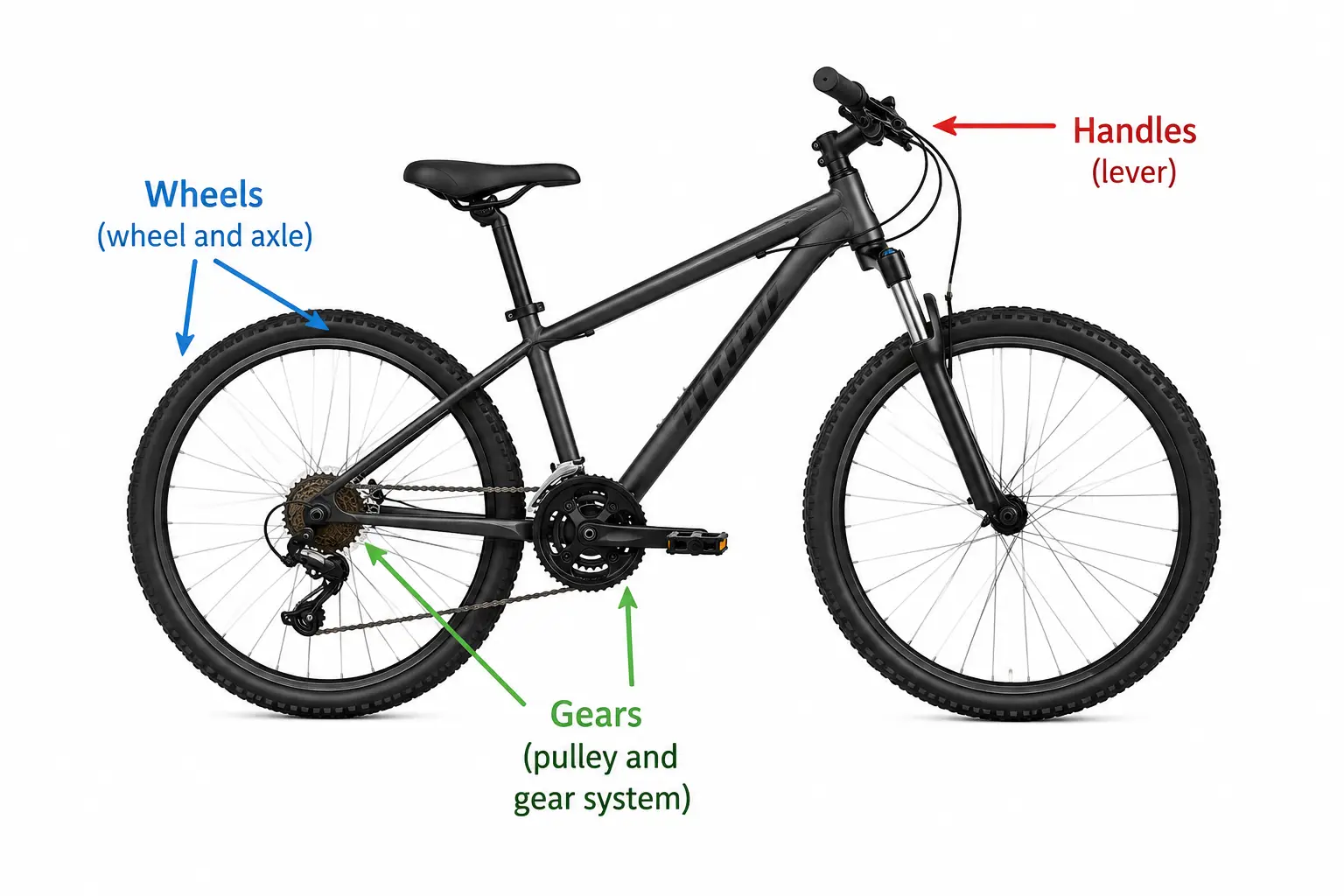
Bicycle: Wheels (wheel and axle), handlebars (class 1 lever), gears (wheel and axle).

Bicycle with its wheels (wheel and axle), handlebars (lever) and gears (pulley and gear system) labeled.
Bicycle: Wheels (wheel and axle), handles (lever), gears (pulley and gear system).
Achievable

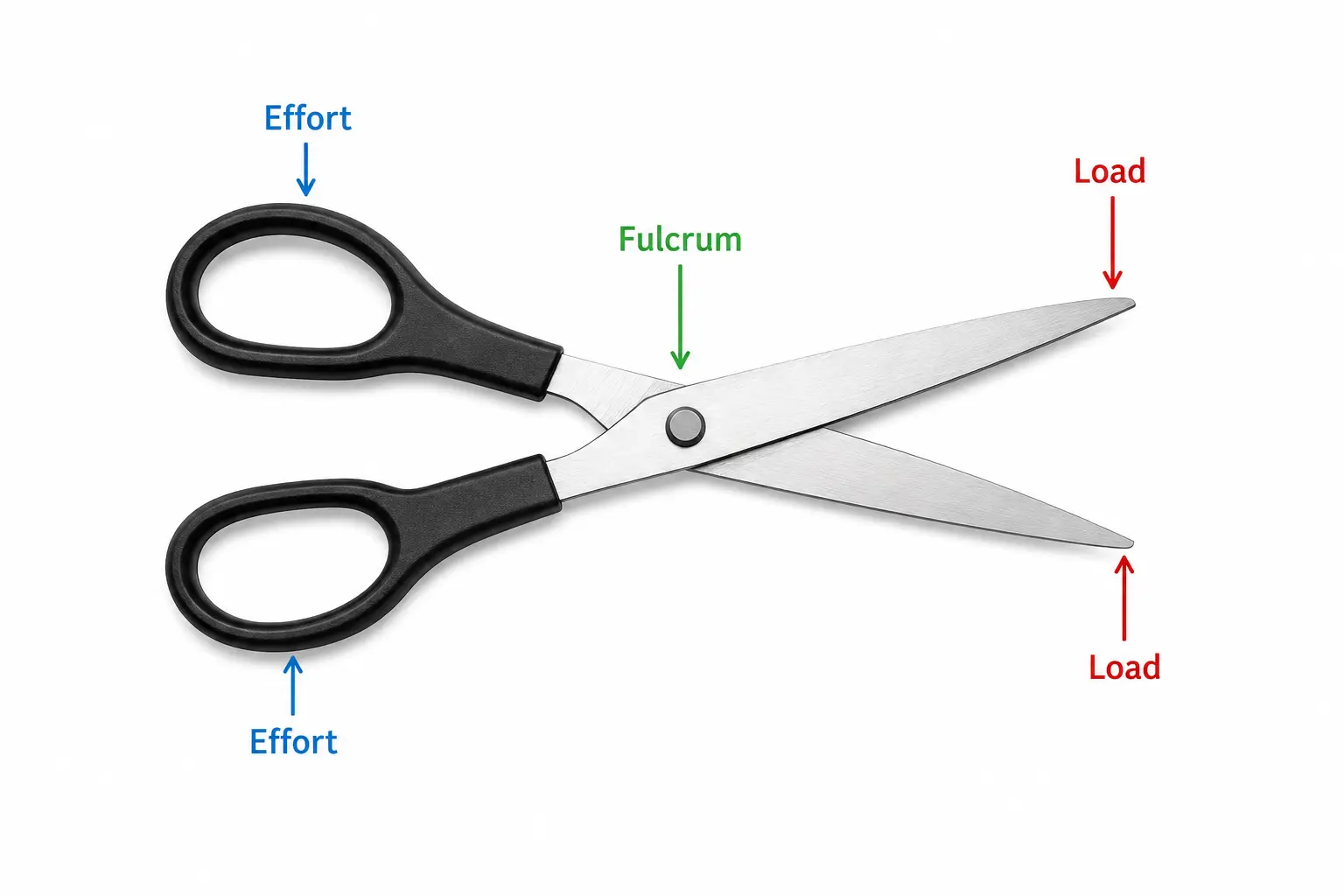
Scissors: handles and blades (class 1 lever), blades (wedge)

Scissors as a first-class lever: effort at the handles, the fulcrum at the pivot, and the load at the blades.
Scissors: each blade is a lever
Achievable

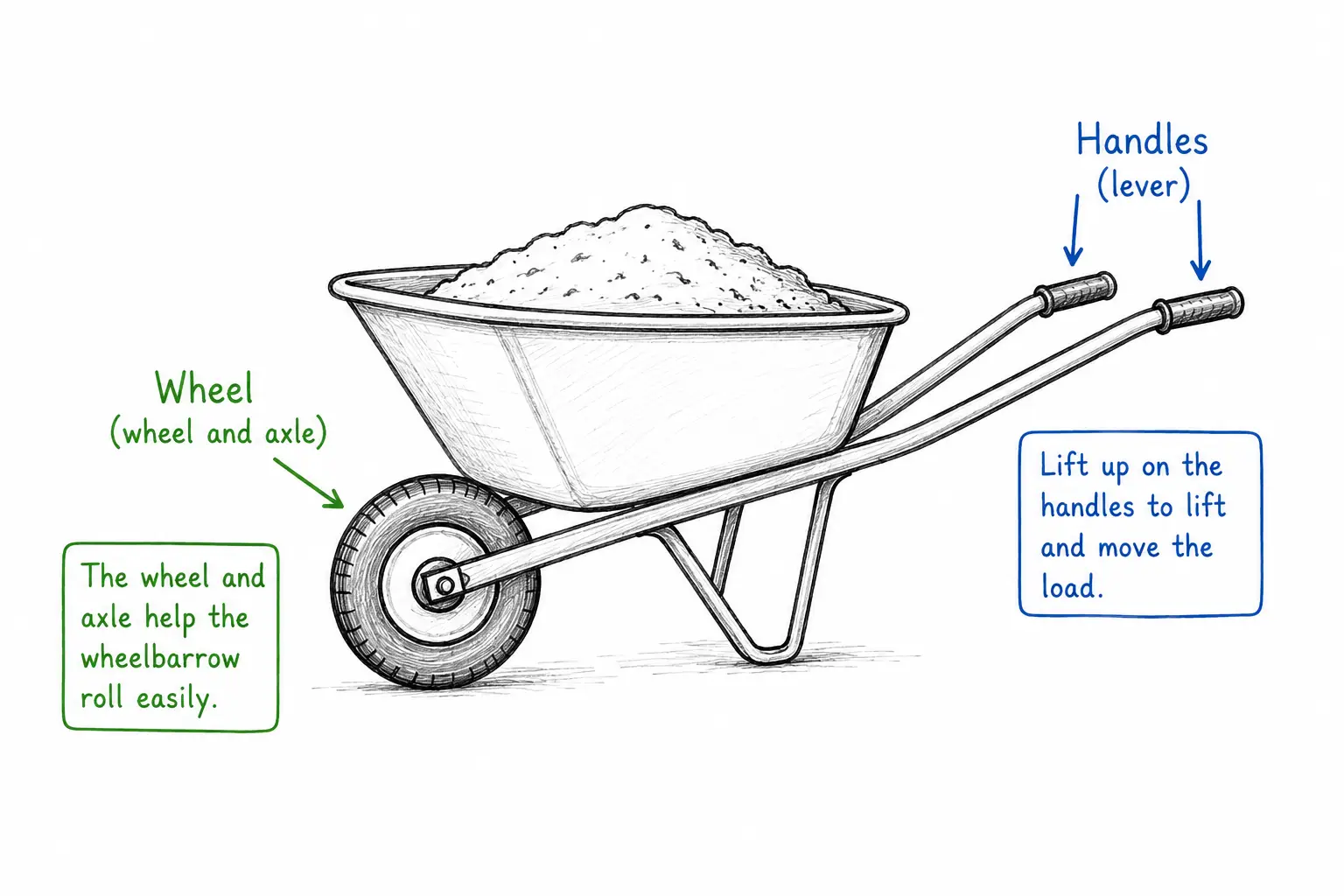
Wheelbarrow: Handles (class 2 lever), wheel (wheel and axle).

Wheelbarrow with its handles (lever) and wheel (wheel and axle) labeled.
Wheelbarrow: Handles (lever), wheel (wheel and axle).
Achievable

Calculating Combined Mechanical Advantage

While you gain force by combining machines, you lose speed due to the increased distance.

To calculate combined mechanical advantage, we simply multiply the mechanical advantage of each machine together.

Total MA = MA1​∗MA2​∗...

Let’s look at an example together.

A machine has two parts. The first part has a mechanical advantage of 3. The second part has a mechanical advantage of 4. Find the total mechanical advantage.

Total MA = MA1​∗MA2​

Total MA = 3∗4

Total MA = 12

Mechanical Advantage Basics

  • MA=FI​FO​​ (output force ÷ input force)
  • Unitless ratio describing force multiplication
  • Increase MA by increasing distance force is applied (e.g., longer lever arm, more pulleys, higher gear ratio)

Ideal vs. Actual Mechanical Advantage

  • IMA: theoretical value assuming 100% efficiency, no friction
  • AMA: real-world value, reduced by friction
  • Machines are never 100% efficient; reducing friction raises AMA toward IMA

Compound Machines

  • Combination of two or more simple machines working together
  • Common examples:
    • Bicycle: wheel and axle (wheels), lever (handlebars), wheel and axle/pulley system (gears)
    • Scissors: class 1 lever (handles/blades) + wedge (blades)
    • Wheelbarrow: class 2 lever (handles) + wheel and axle (wheel)

Combined Mechanical Advantage

  • Gaining force trades off with speed (greater distance needed)
  • Total MA = product of individual machine MAs: MAtotal​=MA1​×MA2​×...
  • Example: MA1​=3, MA2​=4 → Total MA =12

Sign up for free to take 5 quiz questions on this topic

Previous
Next  | 7.1 Electricity Basics
All rights reserved ©2016 - 2026 Achievable, Inc.

Compound Machines

Mechanical Advantage

Mechanical advantage measures how much a machine or tool multiplies force, allowing you to move a load with less input force.

Mechanical Advantage = Output Force (FO​) ÷ Input Force (FI​)

MA=FI​FO​​

Mechanical advantage does not have a unit. It is a ratio of the forces.

Let’s look at an example

Find the mechanical advantage of a machine with an input force of 20N and an output force of 100N.

MA=FI​FO​​

MA=20100​

MA=5

You can increase mechanical advantage by increasing the distance over which the force is applied.

In practical terms, this is lengthening a lever arm, increasing the number of pulleys in a system, or increasing the gear ratio.

Ideal vs actual

Ideal Mechanical Advantage (IMA) is the theoretical mechanical advantage of a machine, assuming 100% efficiency and no energy lost to friction. 

Efficiency: Because of friction, the work done by a machine is always less than the work done on it; therefore, machines are always less than 100% efficient.

Actual Mechanical Advantage (AMA) is the real-world mechanical advantage of a machine that accounts for friction.

Decreasing friction will increase the actual mechanical advantage of a machine.

Compound (Complex) Machines:

A combination of two or more simple machines working together.

Identifying Simple Machines in Compound Machines

Bicycle: Wheels (wheel and axle), handlebars (class 1 lever), gears (wheel and axle).

Scissors: handles and blades (class 1 lever), blades (wedge)

Wheelbarrow: Handles (class 2 lever), wheel (wheel and axle).

Calculating Combined Mechanical Advantage

While you gain force by combining machines, you lose speed due to the increased distance.

To calculate combined mechanical advantage, we simply multiply the mechanical advantage of each machine together.

Total MA = MA1​∗MA2​∗...

Let’s look at an example together.

A machine has two parts. The first part has a mechanical advantage of 3. The second part has a mechanical advantage of 4. Find the total mechanical advantage.

Total MA = MA1​∗MA2​

Total MA = 3∗4

Total MA = 12

Key points

Mechanical Advantage Basics

  • MA=FI​FO​​ (output force ÷ input force)
  • Unitless ratio describing force multiplication
  • Increase MA by increasing distance force is applied (e.g., longer lever arm, more pulleys, higher gear ratio)

Ideal vs. Actual Mechanical Advantage

  • IMA: theoretical value assuming 100% efficiency, no friction
  • AMA: real-world value, reduced by friction
  • Machines are never 100% efficient; reducing friction raises AMA toward IMA

Compound Machines

  • Combination of two or more simple machines working together
  • Common examples:
    • Bicycle: wheel and axle (wheels), lever (handlebars), wheel and axle/pulley system (gears)
    • Scissors: class 1 lever (handles/blades) + wedge (blades)
    • Wheelbarrow: class 2 lever (handles) + wheel and axle (wheel)

Combined Mechanical Advantage

  • Gaining force trades off with speed (greater distance needed)
  • Total MA = product of individual machine MAs: MAtotal​=MA1​×MA2​×...
  • Example: MA1​=3, MA2​=4 → Total MA =12

More from Mechanical Comprehension

  • Forces and Motion
  • Work, Energy and Power
  • Simple Machines