


This browser is too old to run Achievable.

Update it, or open this page in a current version of Chrome, Safari, Firefox or Edge. On an iPhone or iPad, update iOS: every browser there runs on the version of Safari that comes with it.

Achievable logoAchievable logo
ASVAB
Sign in
Sign up
Purchase
Textbook
Practice exams
Support
How it works
Resources
Exam catalog
Mountain with a flag at the peak
Textbook
Introduction
1. Word Knowledge
2. Mathematics Knowledge
3. Paragraph Comprehension
4. Arithmetic Reasoning
5. General Science
6. Mechanical Comprehension
6.1 Forces and Motion
6.2 Work, Energy and Power
6.3 Simple Machines
6.4 Compound Machines
7. Electronics Information
8. Shop Information
9. Auto Information
10. Assembling Objects
Wrapping up
Achievable logoAchievable logo
6.3 Simple Machines
Achievable ASVAB
6. Mechanical Comprehension
Our ASVAB course is currently in development and is a work-in-progress.

Simple Machines

9 min read
Font
Discuss
Share
Feedback

Six Simple Machines:

1. Inclined plane

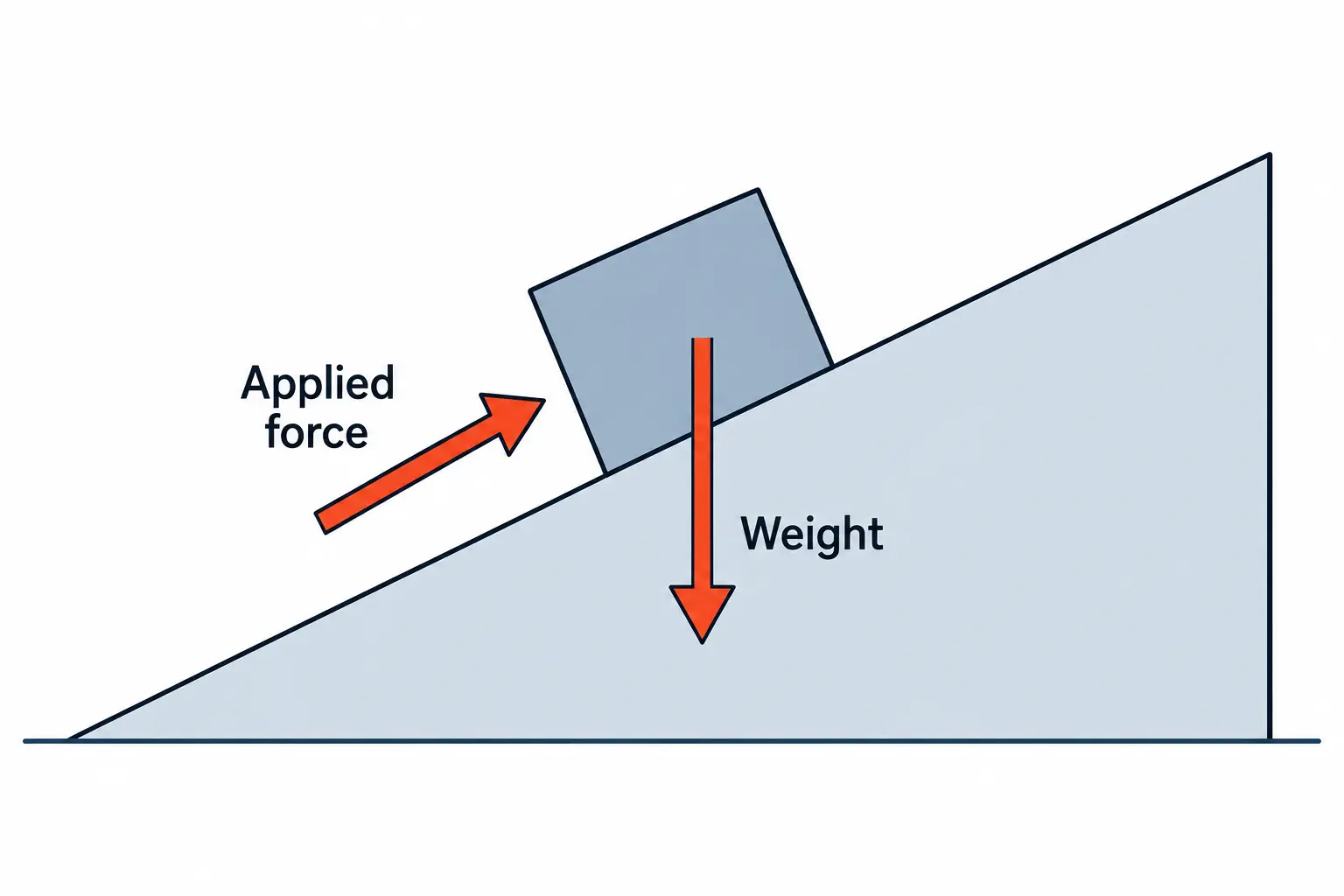
A flat slanted surface, connecting a lower level to a higher level. It reduces the force needed to raise an object. Ramps and staircases are examples of inclined planes.

A block sits on a ramp, with an arrow labeled Applied force pushing it up along the slope and a vertical arrow labeled Weight pulling it straight down.
Inclined plane
Achievable

2. Wedge

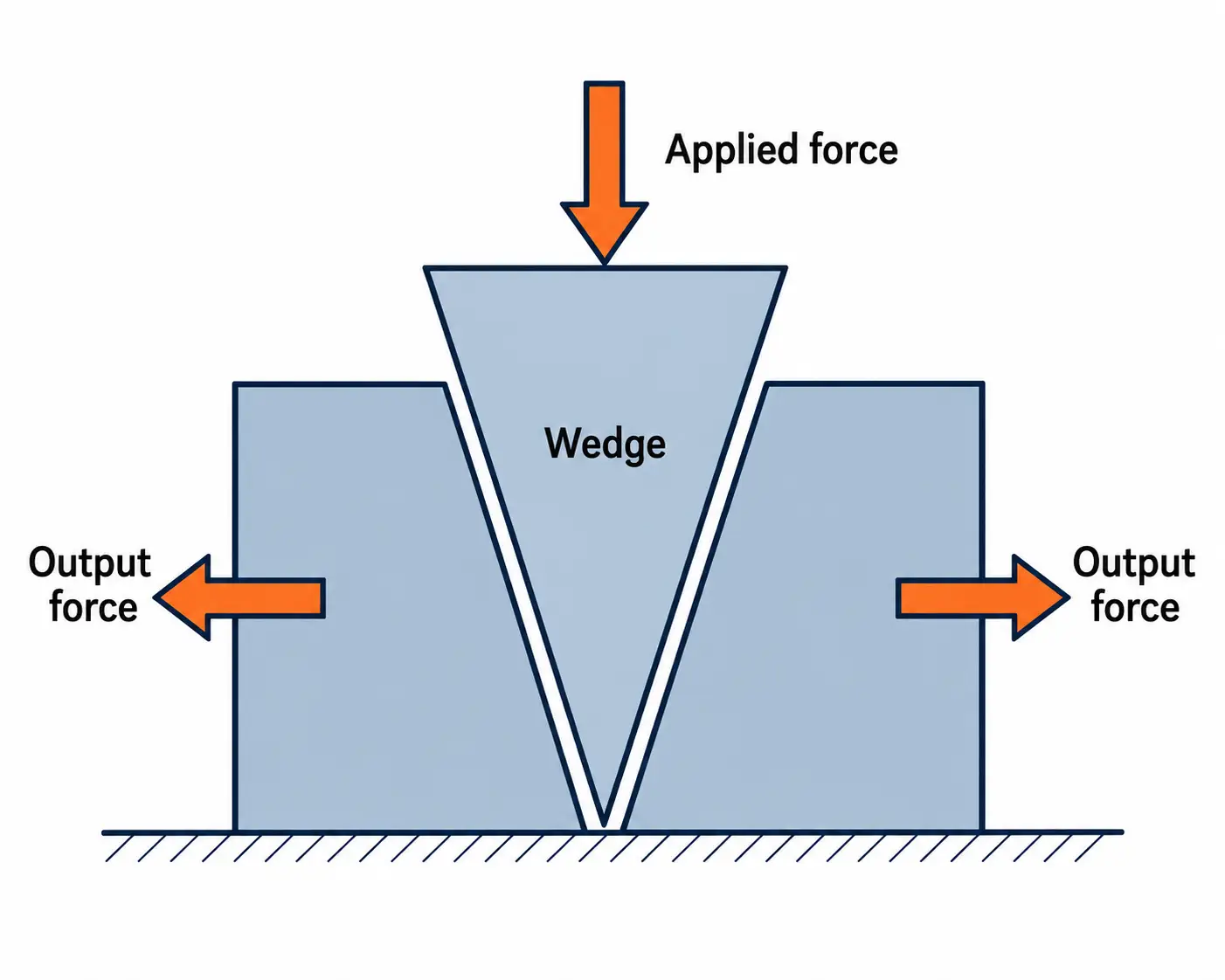
Two inclined planes joined together to create a sharp edge. It is typically used to split or separate objects. Knives and chisels are examples of wedges.

A downward applied force on top of a wedge splits a block apart, pushing the two halves outward as opposing horizontal output forces on the left and right.
Wedge
Achievable

3. Screw

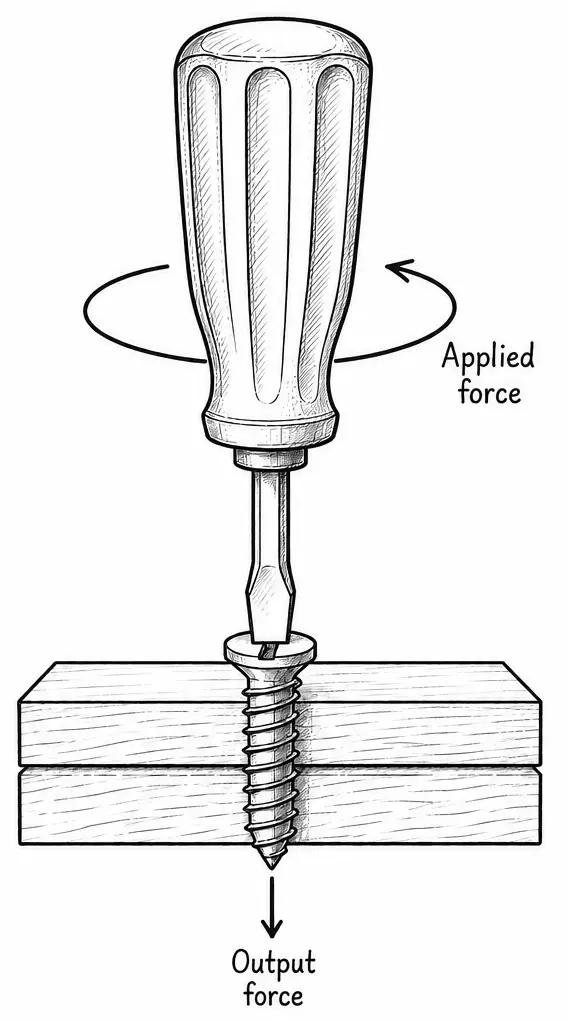
An inclined plane wrapped around a cylinder. Screws convert rotational motion into linear motion, which can be used to fasten objects together. Bolts and jar lids are examples of screws.

A screwdriver turning a screw into wood, with a curved arrow labeled Applied force showing rotation at the handle, and a downward arrow labeled Output force at the screw tip driving it into the material.
Screw
Achievable

4. Lever

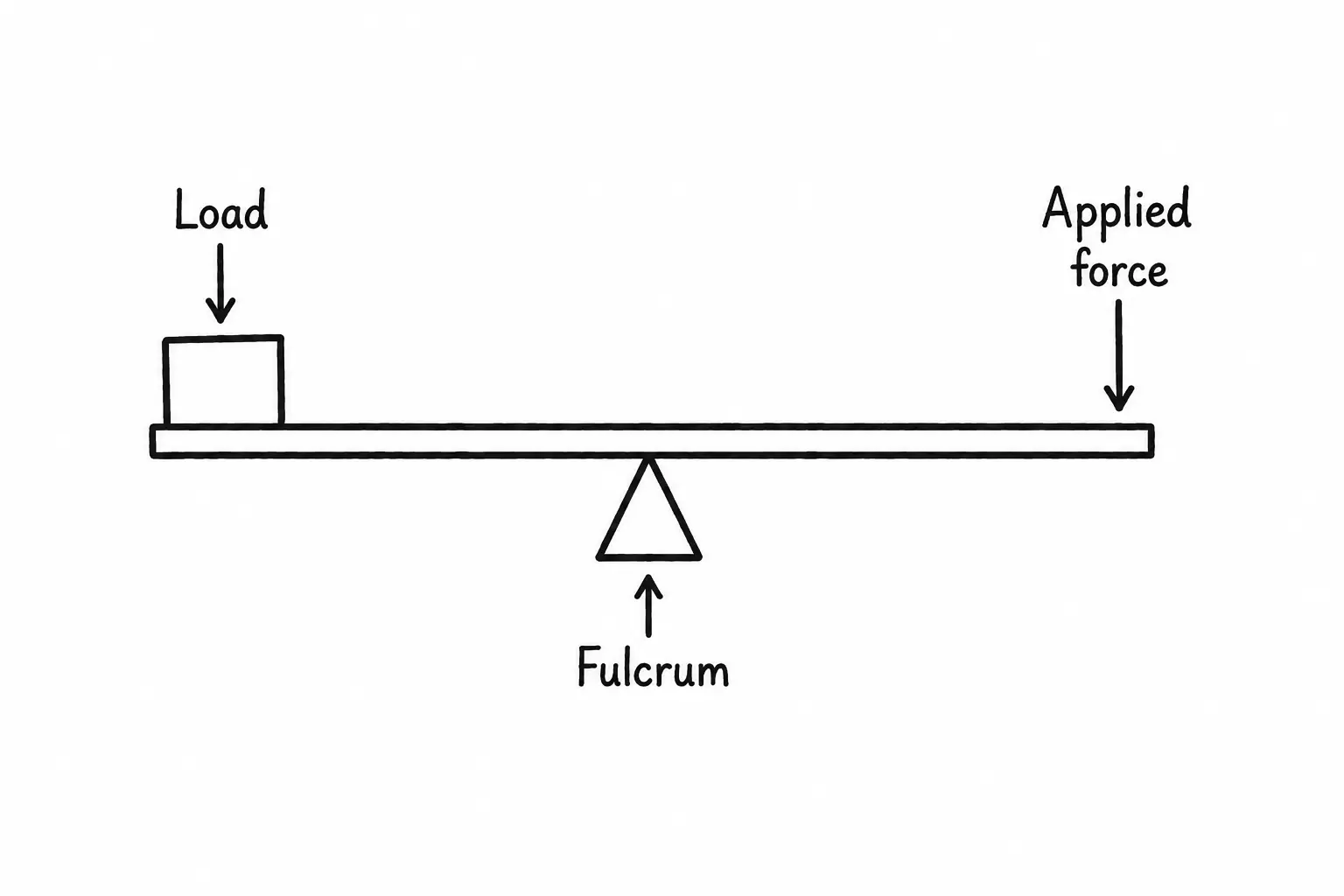
A rigid beam resting on a pivot point, called the fulcrum.

A lever bar rests on a triangular fulcrum near its center; a load block sits on the left end pressed down, while an applied force arrow pushes down on the right end.
Lever
Achievable

There are three classes of levers. The easiest way to determine which class of lever you are looking at, is by determining what is in the middle.

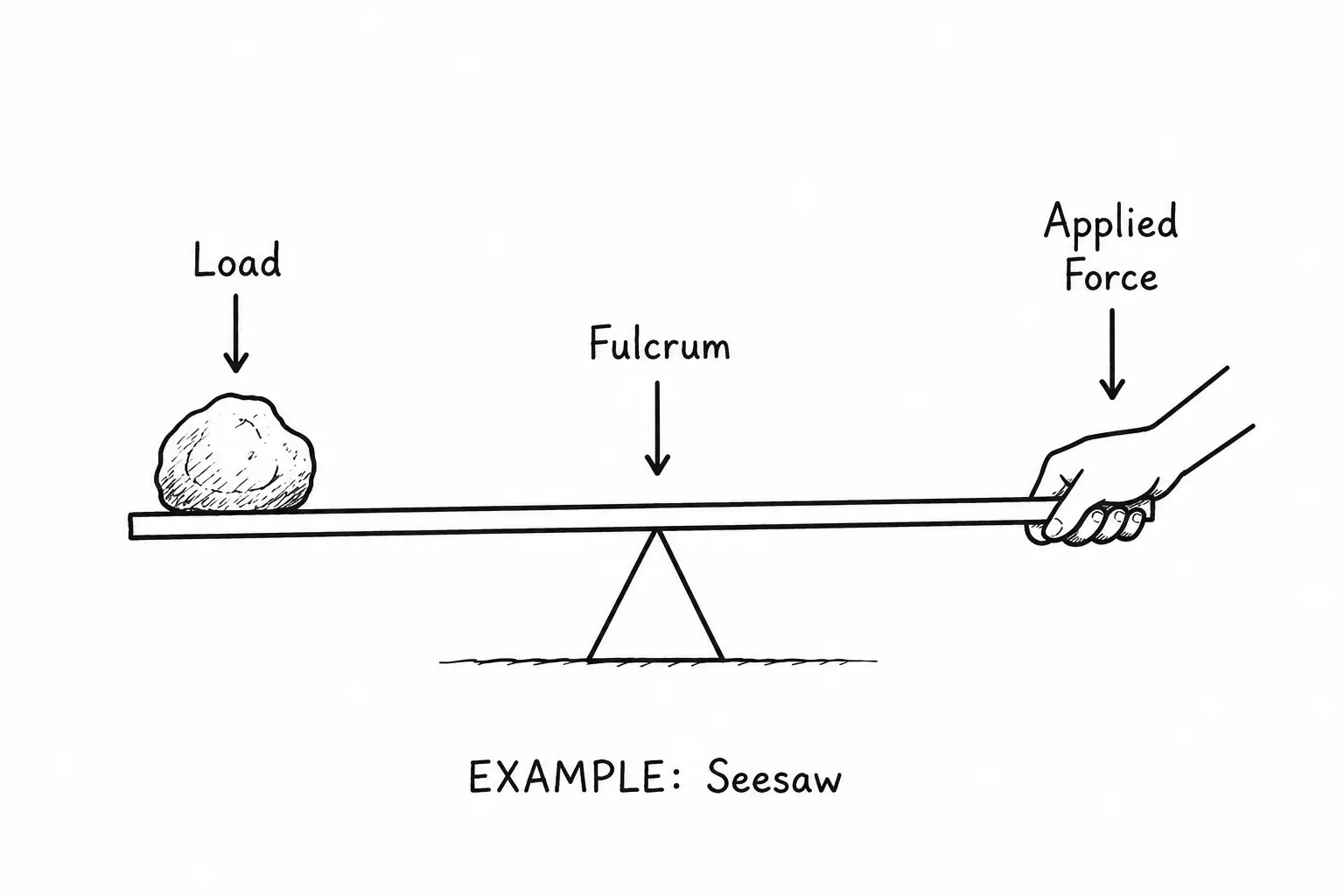
Class 1: Fulcrum is in the middle (classic lever) Examples: scissors, seesaw, pry-bar (crowbar)

First-class lever with the fulcrum between the load and the applied force, as on a seesaw.
Lever Class 1
Achievable

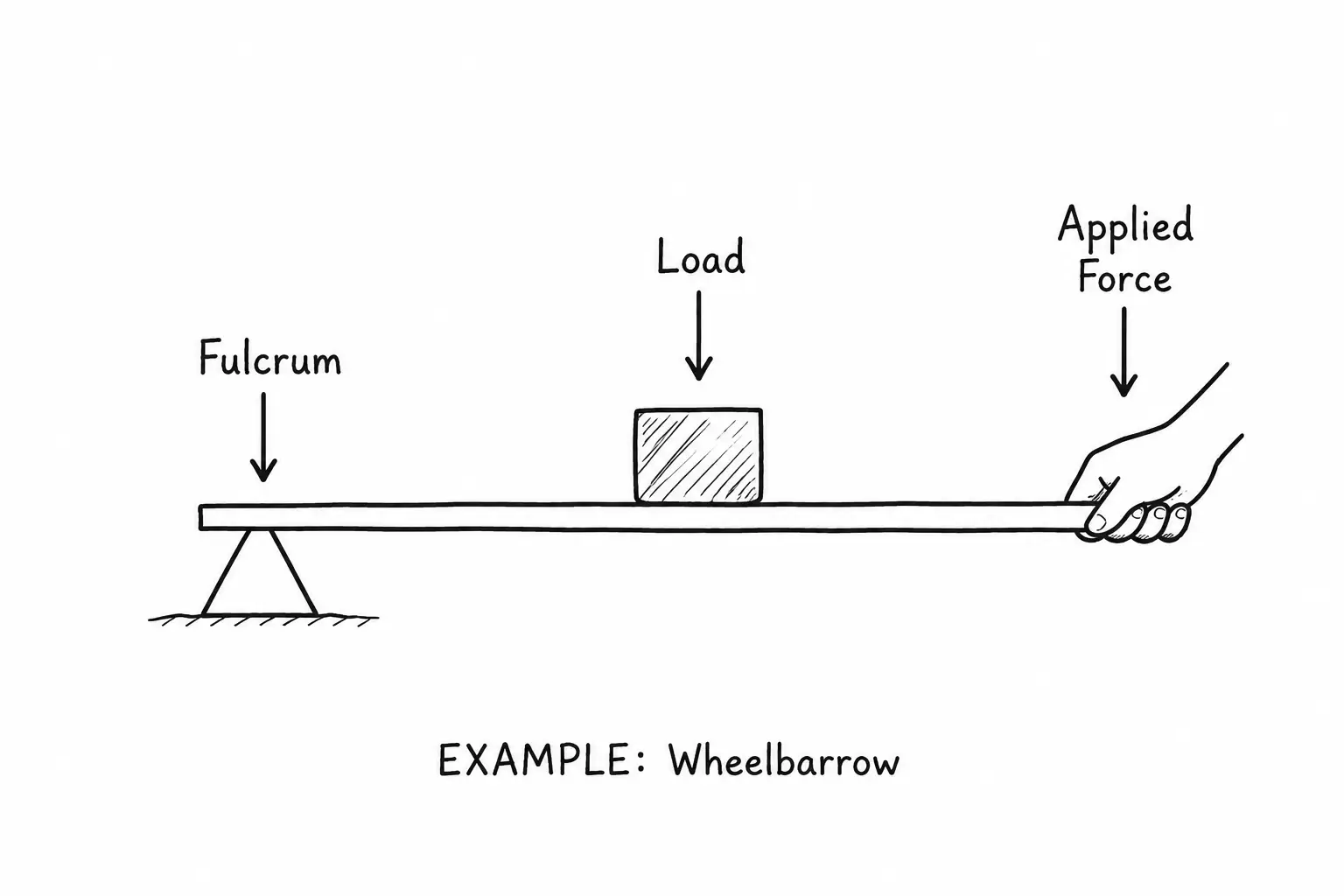
Class 2: Load is in the middle Examples: wheelbarrow, bottle opener, nutcracker

Second-class lever with the load between the fulcrum and the applied force, as in a wheelbarrow.
Lever Class 2
Achievable

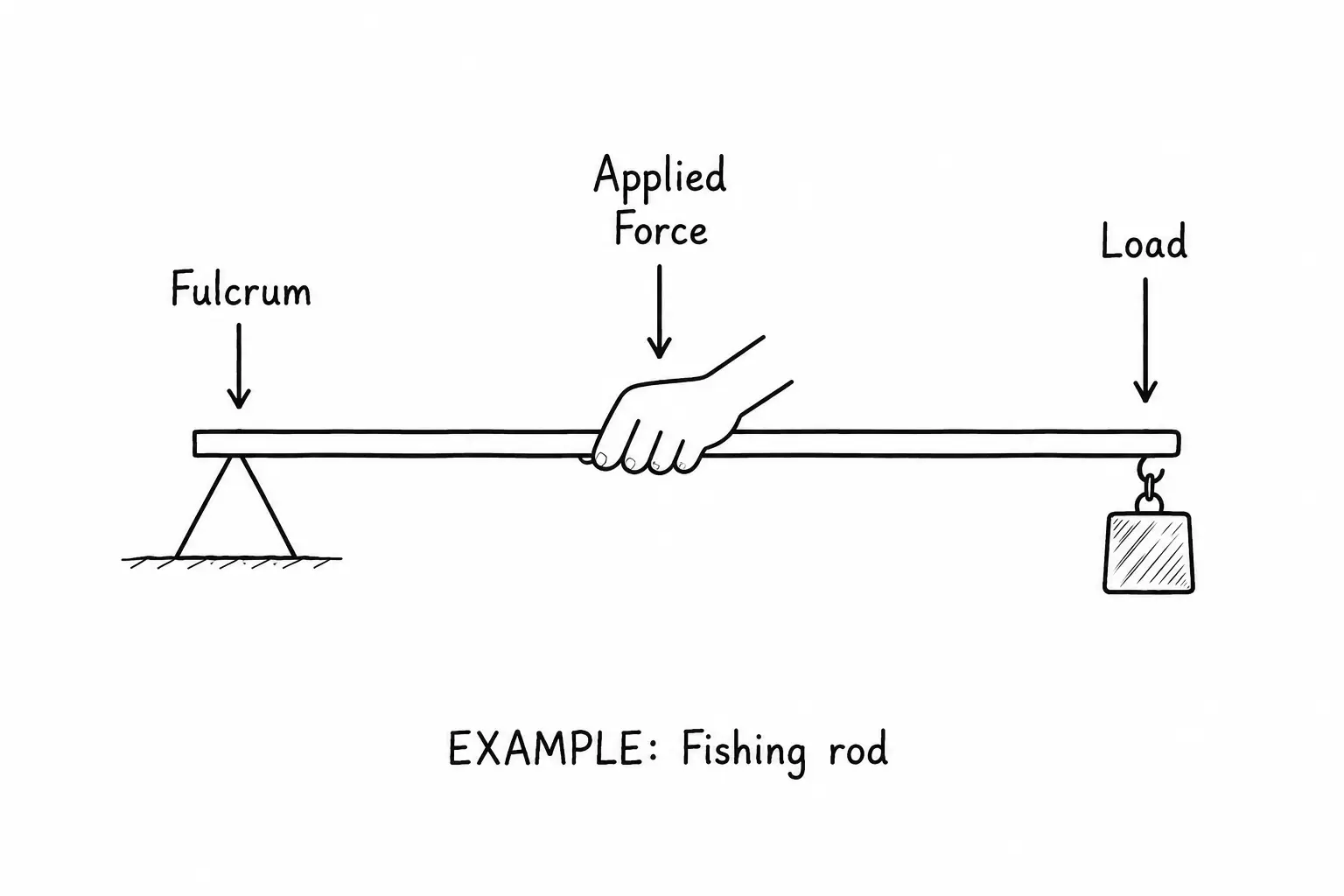
Class 3: Effort is in the middle Examples: shovel, broom, human arm

Third-class lever with the applied force between the fulcrum and the load, as in a fishing rod.
Lever Class 3
Achievable

5. Wheel & axle

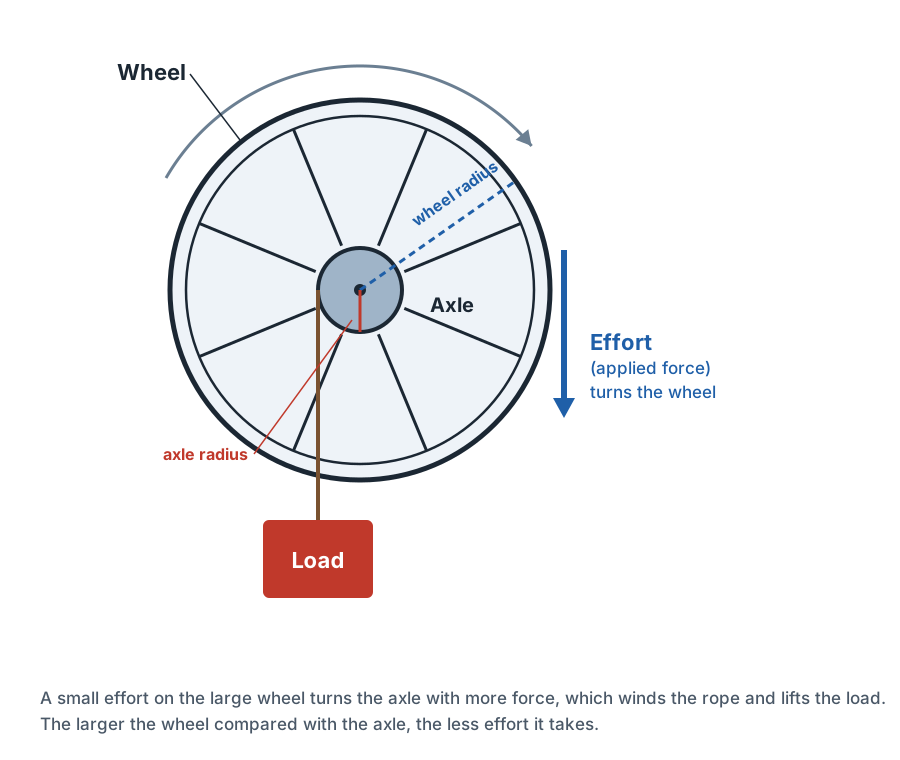
A wheel attached to a rod known as the axle. Turning the wheel applies torque to the axle. Because the wheel has a larger radius than the axle, it increases the torque applied to the axle, making it easier to move or lift objects with less force. Steering wheels and doorknobs are examples of a wheel and axle machine.

A large wheel fixed to a small axle. The effort pulls down on the rim of the wheel and turns it, and a rope wound on the axle lifts the load. The wheel’s radius is much larger than the axle’s.
Wheel & Axle
Achievable

Gears

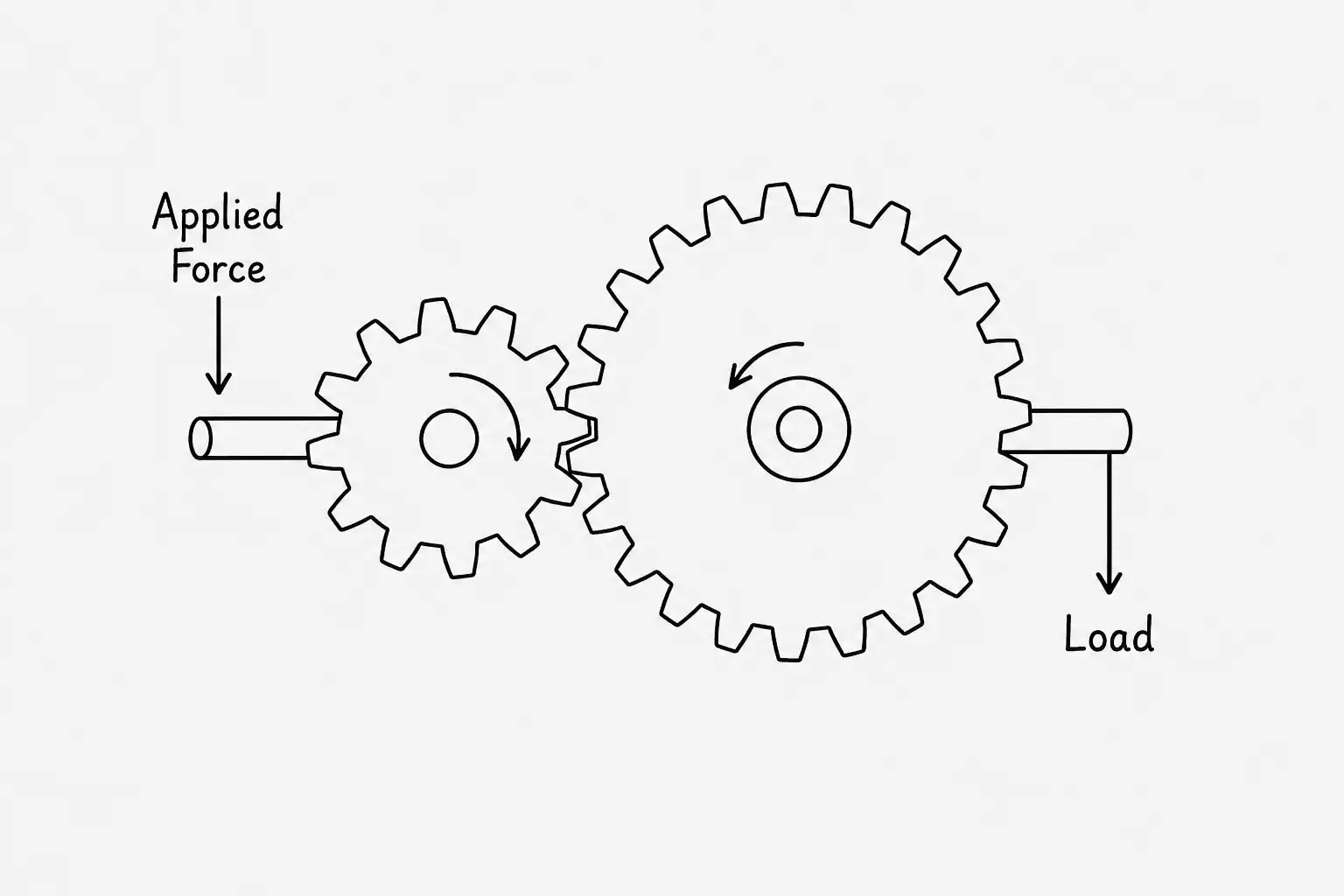
Gears are a specialized type of wheel-and-axle machine. They use interlocking teeth to change the speed, direction, or torque of a machine. A large gear propelling a smaller gear provides more speed and less torque. A small gear propelling a larger gear provides less speed and more torque.

Interlocking gears used to transfer rotational motion.
Gear
Achievable

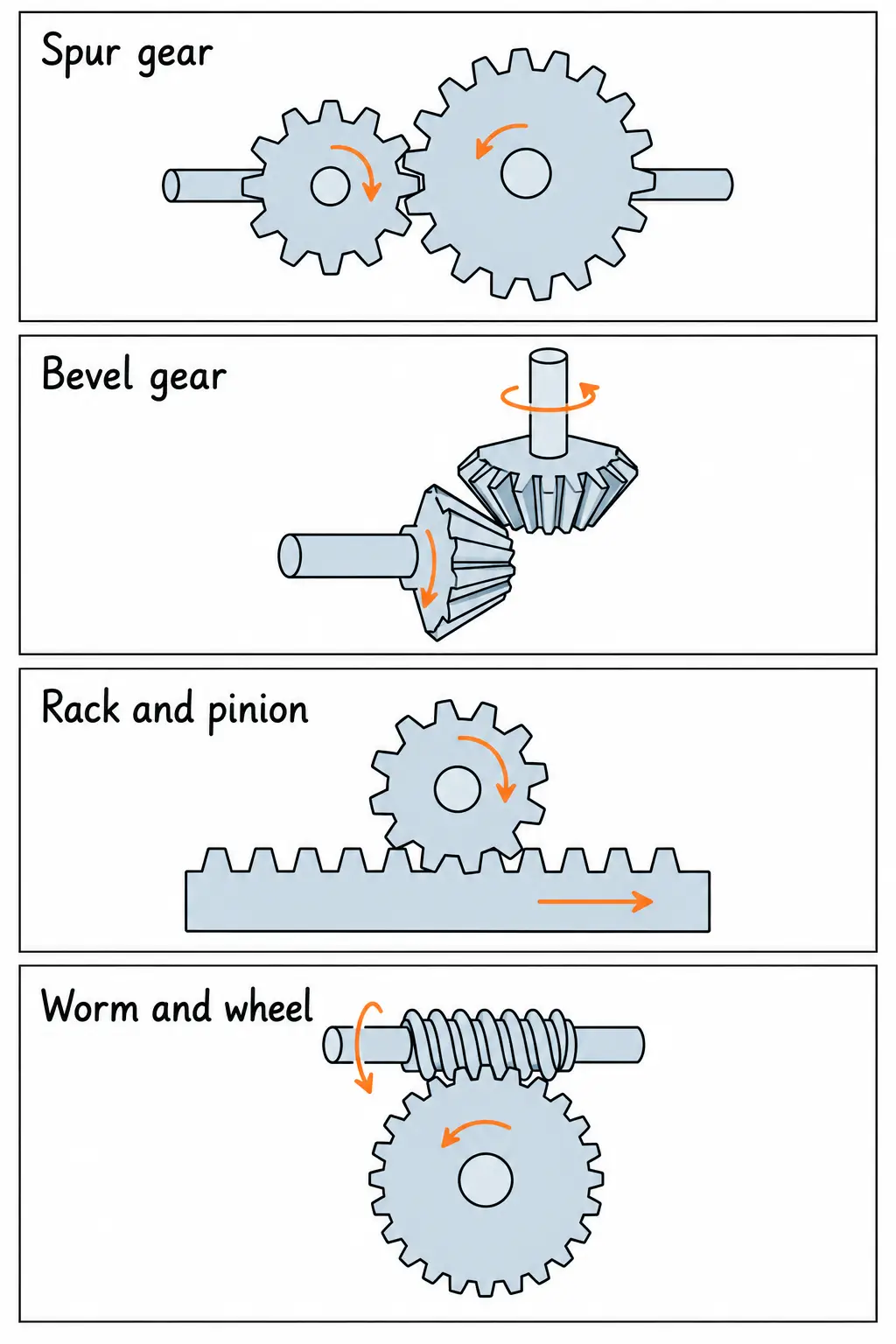
There are four common types of gears:

  1. Spur gear: straight teeth on parallel shafts, the most common type. Each gear that meshes with another reverses the other’s direction of rotation.

  2. Bevel gear: teeth cut at an angle, used to transfer rotation between shafts that meet at an angle. An example is the inside of a hand drill.

  3. Rack and pinion: a round gear (the pinion) meshes with a flat, straight gear (the rack), converting rotational motion into linear motion. Used in steering systems.

  4. Worm and wheel: a screw-shaped gear (the worm) turns a toothed wheel. It allows a large speed reduction, and the wheel cannot turn the worm backward, which makes it useful for locking mechanisms.

The ratio of teeth between two gears controls the tradeoff between speed and torque: more teeth on the driven gear means more torque but less speed; fewer teeth means more speed but less torque.

Four gear types: spur gears mesh two parallel-shaft gears turning opposite directions; bevel gears connect perpendicular shafts turning at an angle; rack and pinion converts a rotating gear into straight-line motion of a toothed bar; worm and wheel has a threaded shaft turning a perpendicular toothed wheel.
Gear types
Achievable

6. Pulley

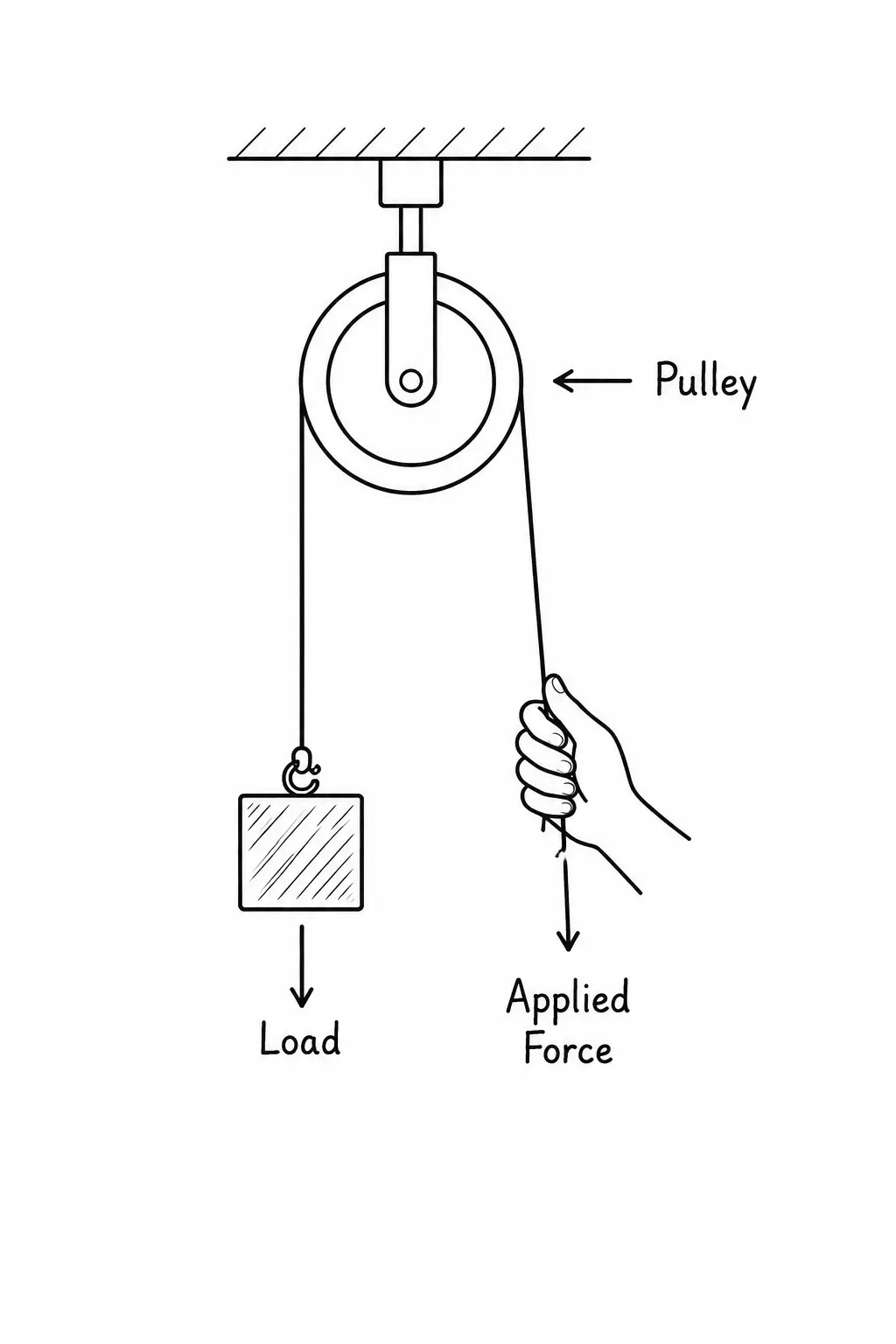
A wheel with a rope around it. Pulleys can change the direction of applied force. They can also be combined to reduce the amount of force needed to drag or lift an object.

A single fixed pulley hanging from a ceiling: a hand pulls down on one end of the rope to lift the load on the other end.
Pulley
Achievable

Fixed pulley Changes the direction of applied force, but does not reduce the amount of force needed.

Movable pulley Reduces the amount of force needed by supporting the load with multiple sections of rope.

Compound pulley A combination of fixed and movable pulleys used to create mechanical advantage and reduce the force needed to move heavy loads.

Inclined plane, wedge & screw

  • Inclined plane: slanted surface reducing force needed to raise objects (ramps, stairs)
  • Wedge: two inclined planes joined to a sharp edge; splits/separates objects (knives, chisels)
  • Screw: inclined plane wrapped around a cylinder; converts rotational motion into linear motion to fasten (bolts, jar lids)

Lever

  • Rigid beam pivoting on a fulcrum
  • Classified by what sits in the middle:
    • Class 1: fulcrum in middle (scissors, seesaw, pry-bar)
    • Class 2: load in middle (wheelbarrow, bottle opener, nutcracker)
    • Class 3: effort in middle (shovel, broom, human arm)

Wheel & axle and gears

  • Wheel attached to axle; larger wheel radius vs. axle increases torque, easing movement (steering wheel, doorknob)
  • Gears are specialized wheel-axle machines using interlocking teeth to change speed, direction, or torque
    • Large gear → small gear: more speed, less torque
    • Small gear → large gear: less speed, more torque
  • Four gear types:
    • Spur: straight teeth, parallel shafts, reverses rotation direction
    • Bevel: angled teeth, transfers rotation between angled shafts (hand drill)
    • Rack and pinion: converts rotational to linear motion (steering systems)
    • Worm and wheel: large speed reduction; worm can’t be turned backward by wheel (locking mechanisms)
  • Tooth ratio determines speed/torque tradeoff: more teeth on driven gear = more torque, less speed (and vice versa)

Pulley

  • Wheel with rope; changes direction of force and/or reduces force needed
  • Fixed pulley: changes direction only, no force reduction
  • Movable pulley: reduces force needed via multiple rope sections supporting load
  • Compound pulley: combines fixed + movable for maximum mechanical advantage

Sign up for free to take 5 quiz questions on this topic

Previous
Next  | 6.4 Compound Machines
All rights reserved ©2016 - 2026 Achievable, Inc.

Simple Machines

Six Simple Machines:

1. Inclined plane

A flat slanted surface, connecting a lower level to a higher level. It reduces the force needed to raise an object. Ramps and staircases are examples of inclined planes.

2. Wedge

Two inclined planes joined together to create a sharp edge. It is typically used to split or separate objects. Knives and chisels are examples of wedges.

3. Screw

An inclined plane wrapped around a cylinder. Screws convert rotational motion into linear motion, which can be used to fasten objects together. Bolts and jar lids are examples of screws.

4. Lever

A rigid beam resting on a pivot point, called the fulcrum.

There are three classes of levers. The easiest way to determine which class of lever you are looking at, is by determining what is in the middle.

Class 1: Fulcrum is in the middle (classic lever) Examples: scissors, seesaw, pry-bar (crowbar)

Class 2: Load is in the middle Examples: wheelbarrow, bottle opener, nutcracker

Class 3: Effort is in the middle Examples: shovel, broom, human arm

5. Wheel & axle

A wheel attached to a rod known as the axle. Turning the wheel applies torque to the axle. Because the wheel has a larger radius than the axle, it increases the torque applied to the axle, making it easier to move or lift objects with less force. Steering wheels and doorknobs are examples of a wheel and axle machine.

Gears

Gears are a specialized type of wheel-and-axle machine. They use interlocking teeth to change the speed, direction, or torque of a machine. A large gear propelling a smaller gear provides more speed and less torque. A small gear propelling a larger gear provides less speed and more torque.

There are four common types of gears:

  1. Spur gear: straight teeth on parallel shafts, the most common type. Each gear that meshes with another reverses the other’s direction of rotation.

  2. Bevel gear: teeth cut at an angle, used to transfer rotation between shafts that meet at an angle. An example is the inside of a hand drill.

  3. Rack and pinion: a round gear (the pinion) meshes with a flat, straight gear (the rack), converting rotational motion into linear motion. Used in steering systems.

  4. Worm and wheel: a screw-shaped gear (the worm) turns a toothed wheel. It allows a large speed reduction, and the wheel cannot turn the worm backward, which makes it useful for locking mechanisms.

The ratio of teeth between two gears controls the tradeoff between speed and torque: more teeth on the driven gear means more torque but less speed; fewer teeth means more speed but less torque.

6. Pulley

A wheel with a rope around it. Pulleys can change the direction of applied force. They can also be combined to reduce the amount of force needed to drag or lift an object.

Fixed pulley Changes the direction of applied force, but does not reduce the amount of force needed.

Movable pulley Reduces the amount of force needed by supporting the load with multiple sections of rope.

Compound pulley A combination of fixed and movable pulleys used to create mechanical advantage and reduce the force needed to move heavy loads.

Key points

Inclined plane, wedge & screw

  • Inclined plane: slanted surface reducing force needed to raise objects (ramps, stairs)
  • Wedge: two inclined planes joined to a sharp edge; splits/separates objects (knives, chisels)
  • Screw: inclined plane wrapped around a cylinder; converts rotational motion into linear motion to fasten (bolts, jar lids)

Lever

  • Rigid beam pivoting on a fulcrum
  • Classified by what sits in the middle:
    • Class 1: fulcrum in middle (scissors, seesaw, pry-bar)
    • Class 2: load in middle (wheelbarrow, bottle opener, nutcracker)
    • Class 3: effort in middle (shovel, broom, human arm)

Wheel & axle and gears

  • Wheel attached to axle; larger wheel radius vs. axle increases torque, easing movement (steering wheel, doorknob)
  • Gears are specialized wheel-axle machines using interlocking teeth to change speed, direction, or torque
    • Large gear → small gear: more speed, less torque
    • Small gear → large gear: less speed, more torque
  • Four gear types:
    • Spur: straight teeth, parallel shafts, reverses rotation direction
    • Bevel: angled teeth, transfers rotation between angled shafts (hand drill)
    • Rack and pinion: converts rotational to linear motion (steering systems)
    • Worm and wheel: large speed reduction; worm can’t be turned backward by wheel (locking mechanisms)
  • Tooth ratio determines speed/torque tradeoff: more teeth on driven gear = more torque, less speed (and vice versa)

Pulley

  • Wheel with rope; changes direction of force and/or reduces force needed
  • Fixed pulley: changes direction only, no force reduction
  • Movable pulley: reduces force needed via multiple rope sections supporting load
  • Compound pulley: combines fixed + movable for maximum mechanical advantage

More from Mechanical Comprehension

  • Forces and Motion
  • Work, Energy and Power
  • Compound Machines