


This browser is too old to run Achievable.

Update it, or open this page in a current version of Chrome, Safari, Firefox or Edge. On an iPhone or iPad, update iOS: every browser there runs on the version of Safari that comes with it.

Achievable logoAchievable logo
ASVAB
Sign in
Sign up
Purchase
Textbook
Practice exams
Support
How it works
Resources
Exam catalog
Mountain with a flag at the peak
Textbook
Introduction
1. Word Knowledge
2. Mathematics Knowledge
2.1 Foundational math
2.1.1 Basic operations with whole numbers
2.1.2 Fractions and advanced operations
2.1.3 Core math concepts
2.2 Pre-algebra
2.3 Algebra I
2.4 Geometry basics
2.5 Algebra II
2.6 Advanced geometry
2.7 Math strategies
3. Paragraph Comprehension
4. Arithmetic Reasoning
5. General Science
6. Mechanical Comprehension
7. Electronics Information
8. Shop Information
9. Auto Information
10. Assembling Objects
Wrapping up
Achievable logoAchievable logo
2.1.3 Core math concepts
Achievable ASVAB
2. Mathematics Knowledge
2.1. Foundational math
Our ASVAB course is currently in development and is a work-in-progress.

Core math concepts

7 min read
Font
Discuss
Share
Feedback

Order of operations

When an expression has multiple operations (like addition, multiplication, and division), you need a consistent order to solve it correctly. This prevents different people from getting different answers.

The order of operations is often remembered with the acronym PEMDAS:

  • Parenthesis
  • Exponents
  • Multiplication
  • Division
  • Addition
  • Subtraction

Multiplication and division are the same “level,” so you work left to right and do whichever comes first. The same is true for addition and subtraction.

P - Parenthesis
E - Exponents
M & D - Multiplication and Division
A & S - Addition and Subtraction

Follow this order until the expression is simplified. Let’s work through an example.

Solve.

(3+2÷2×6−4)×3

Step 1: Look at the expression and identify which operations appear: parentheses, addition, division, multiplication, subtraction, and another multiplication.

Step 2: Parentheses come first in PEMDAS, so focus on what’s inside:

(3+2÷2×6−4)

Step 3: Inside the parentheses, division and multiplication are the same level — work left to right. Divide first:

2÷2=1

(3+1×6−4)

Step 4: Now multiply:

1×6=6

(3+6−4)

Step 5: Add and subtract from left to right:

3+6=9

9−4=5

Step 6: Finally, multiply the result by 3:

5×3=15

Now written as one stacked solution:

(3+2÷2×6−4)×3(3+1×6−4)×3(3+6−4)×3(9−4)×3(5)×315​

Knowledge check: Solve

(8+7)×540​+2

(spoiler)

122

Prime numbers

Definitions
Prime number
A whole number greater than 1 that is only divisible by 1 and itself
Composite number
A whole number greater than 1 that has more than two factors.

Prime numbers are whole numbers greater than 1 whose only factors are 1 and the number itself. Examples of prime numbers are 2,3,5,7, and 11. A number that has more than two factors is called a composite number. For example, 6 is not prime because it can be divided by 1,2,3, and 6.

Knowing prime numbers is useful for factoring because it helps you recognize when a number (or polynomial) is fully factored.

Inequalities

Sidenote
Symbols to know
  • Less than: <
  • Greater than: >
  • Less than or equal to: ≤
  • Greater than or equal to: ≥

An inequality compares two values that are not necessarily equal. Instead of showing that two sides are the same, it shows that one side is larger or smaller than the other.

When working with inequalities, start by identifying the symbol:

  • < means less than
  • > means greater than
  • Adding the line underneath means “or equal to,” so < becomes ≤, and > becomes ≥

Example:

3<5

This means 3 is less than 5.

You solve most inequalities the same way you solve equations, with one key exception: If you multiply or divide by a negative number, you must flip the inequality sign

Sidenote
Making math easier!

Sometimes it’s difficult to remember the exact name of the inequality symbol. A helpful trick is that the open side points to the larger number. Also, remember to flip the sign when you multiply or divide by a negative.

Your goal is to get the variable by itself, just like solving an equation.

Example:

−2x>12

Start by isolating x. The −2 is multiplied by x, so divide both sides by −2.

−2​−2​x​>−212​

Because you divided by a negative number, flip the inequality sign to keep the inequality true.

x<−6

Steps taken:

  • Divide both sides by -2
  • Flip the inequality sign
  • Simplify to get the final answer

Knowledge check: Solve

−5(2x+6)+6≥136

(spoiler)

x≤−16

Conversions

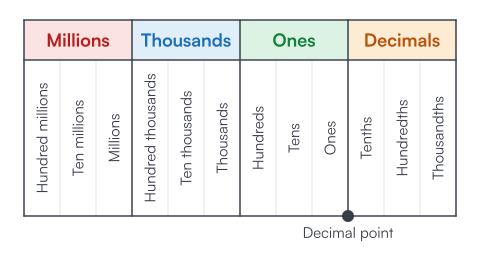
Because you can’t use a calculator on the ASVAB, you’ll want to be comfortable converting between decimals, percentages, and fractions by hand. Understanding place value will help you see how decimals relate to fractions and percents.

A place value chart from hundred millions to thousandths, grouped into millions, thousands, ones and decimals, with the decimal point between the ones and the tenths.
Place value chart
Achievable

All three forms—decimal, fraction, and percent—represent the same value, just written in different ways.

For example:

0.51=10051​=51%

  • 0.51 means 51 hundredths, which is why it can be written as 10051​
  • A percent means “out of 100,” so 10051​ is the same as 51%

Let’s break down each type of conversion.

Decimal to percent

Percent means “per 100,” or “out of 100.” To convert a decimal to a percent, multiply by 100.

A quick way to do this is to move the decimal two places to the right.

0.25×100=25%

  • 0.25 means 25 hundredths
  • Multiplying by 100 turns it into 25 out of 100
  • This is why it becomes 25%

Decimal to fraction

Decimals can be written as fractions because they represent parts of a whole based on place value. Use place value to determine the denominator.

The position of the decimal tells you what the denominator should be:

  • One place to the right = tenths → denominator is 10
  • Two places to the right = hundredths → denominator is 100
  • Three places to the right = thousandths → denominator is 1000

If the decimal is in the tenths place (one place value to the right of the decimal), write it over 10:

0.2=102​

If the decimal is in the hundredths place (two places to the right of the decimal), write it over 100:

0.25=10025​

If the decimal is in the thousandths place (three places to the right of the decimal), write it over 1000:

0.255=1000255​

The number of digits after the decimal tells you how many zeros go in the denominator.

Knowledge check: Write 0.47 as a fraction.

(spoiler)

10047​

Fraction to percent

To convert a fraction to a percent, first convert it to a decimal by dividing the numerator by the denominator. Then convert the decimal to a percent by multiplying by 100. This works because a fraction represents division.

Sidenote
Long division refresher!

Don’t remember how to do long division? Not to worry! We’ll cover that in the next section, Pre-Algebra.

Example:

Start with the fraction:

41​

Divide the numerator by the denominator:

1÷4=0.25

Convert the decimal to a percent:

0.25×100=25%

So,

41​=0.25=25%

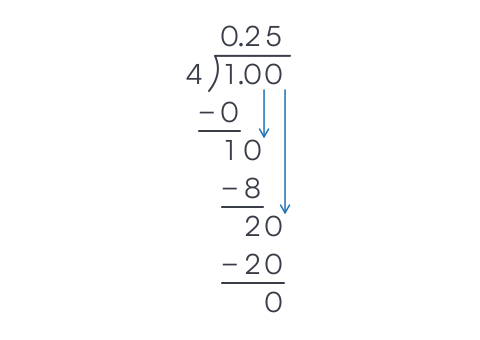
Long division of 1.00 by 4. The quotient is 0.25: 4 into 1 is 0, bring down 0 to make 10, 4 into 10 is 2 with 2 left, bring down 0 to make 20, 4 into 20 is 5 with 0 left.
Long Division for 1/4
Achievable

Steps taken:

  • Divide the numerator by the denominator
  • Convert the decimal to a percent
  • Write the final answer

Knowledge check

Convert 53​ to a percent.

(spoiler)

60%

Order of operations (PEMDAS)

  • Sequence: Parentheses, Exponents, Multiplication/Division, Addition/Subtraction
  • Multiplication/Division are equal level — work left to right; same for Addition/Subtraction
  • Simplify step-by-step until expression is fully solved

Prime and composite numbers

  • Prime number: whole number >1, only divisible by 1 and itself (e.g., 2,3,5,7,11)
  • Composite number: whole number >1 with more than two factors (e.g., 6)
  • Useful for recognizing when factoring is complete

Inequalities

  • Symbols: < less than, > greater than, ≤ less than or equal, ≥ greater than or equal
  • Open side of symbol points to larger number
  • Solve like equations, but flip the inequality sign when multiplying/dividing by a negative number

Decimals, fractions, and percents

  • All three represent the same value in different forms, e.g. 0.51=10051​=51%
  • Decimal → percent: multiply by 100 (move decimal 2 places right)
  • Decimal → fraction: use place value for denominator
    • tenths → 10, hundredths → 100, thousandths → 1000
  • Fraction → percent: divide numerator by denominator to get decimal, then multiply by 100

Sign up for free to take 6 quiz questions on this topic

Previous
Next  | 2.2.1 Long division and division with decimals
All rights reserved ©2016 - 2026 Achievable, Inc.

Core math concepts

Order of operations

When an expression has multiple operations (like addition, multiplication, and division), you need a consistent order to solve it correctly. This prevents different people from getting different answers.

The order of operations is often remembered with the acronym PEMDAS:

  • Parenthesis
  • Exponents
  • Multiplication
  • Division
  • Addition
  • Subtraction

Multiplication and division are the same “level,” so you work left to right and do whichever comes first. The same is true for addition and subtraction.

P - Parenthesis
E - Exponents
M & D - Multiplication and Division
A & S - Addition and Subtraction

Follow this order until the expression is simplified. Let’s work through an example.

Solve.

(3+2÷2×6−4)×3

Step 1: Look at the expression and identify which operations appear: parentheses, addition, division, multiplication, subtraction, and another multiplication.

Step 2: Parentheses come first in PEMDAS, so focus on what’s inside:

(3+2÷2×6−4)

Step 3: Inside the parentheses, division and multiplication are the same level — work left to right. Divide first:

2÷2=1

(3+1×6−4)

Step 4: Now multiply:

1×6=6

(3+6−4)

Step 5: Add and subtract from left to right:

3+6=9

9−4=5

Step 6: Finally, multiply the result by 3:

5×3=15

Now written as one stacked solution:

(3+2÷2×6−4)×3(3+1×6−4)×3(3+6−4)×3(9−4)×3(5)×315​

Knowledge check: Solve

(8+7)×540​+2

(spoiler)

122

Prime numbers

Definitions
Prime number
A whole number greater than 1 that is only divisible by 1 and itself
Composite number
A whole number greater than 1 that has more than two factors.

Prime numbers are whole numbers greater than 1 whose only factors are 1 and the number itself. Examples of prime numbers are 2,3,5,7, and 11. A number that has more than two factors is called a composite number. For example, 6 is not prime because it can be divided by 1,2,3, and 6.

Knowing prime numbers is useful for factoring because it helps you recognize when a number (or polynomial) is fully factored.

Inequalities

Sidenote
Symbols to know
  • Less than: <
  • Greater than: >
  • Less than or equal to: ≤
  • Greater than or equal to: ≥

An inequality compares two values that are not necessarily equal. Instead of showing that two sides are the same, it shows that one side is larger or smaller than the other.

When working with inequalities, start by identifying the symbol:

  • < means less than
  • > means greater than
  • Adding the line underneath means “or equal to,” so < becomes ≤, and > becomes ≥

Example:

3<5

This means 3 is less than 5.

You solve most inequalities the same way you solve equations, with one key exception: If you multiply or divide by a negative number, you must flip the inequality sign

Sidenote
Making math easier!

Sometimes it’s difficult to remember the exact name of the inequality symbol. A helpful trick is that the open side points to the larger number. Also, remember to flip the sign when you multiply or divide by a negative.

Your goal is to get the variable by itself, just like solving an equation.

Example:

−2x>12

Start by isolating x. The −2 is multiplied by x, so divide both sides by −2.

−2​−2​x​>−212​

Because you divided by a negative number, flip the inequality sign to keep the inequality true.

x<−6

Steps taken:

  • Divide both sides by -2
  • Flip the inequality sign
  • Simplify to get the final answer

Knowledge check: Solve

−5(2x+6)+6≥136

(spoiler)

x≤−16

Conversions

Because you can’t use a calculator on the ASVAB, you’ll want to be comfortable converting between decimals, percentages, and fractions by hand. Understanding place value will help you see how decimals relate to fractions and percents.

All three forms—decimal, fraction, and percent—represent the same value, just written in different ways.

For example:

0.51=10051​=51%

  • 0.51 means 51 hundredths, which is why it can be written as 10051​
  • A percent means “out of 100,” so 10051​ is the same as 51%

Let’s break down each type of conversion.

Decimal to percent

Percent means “per 100,” or “out of 100.” To convert a decimal to a percent, multiply by 100.

A quick way to do this is to move the decimal two places to the right.

0.25×100=25%

  • 0.25 means 25 hundredths
  • Multiplying by 100 turns it into 25 out of 100
  • This is why it becomes 25%

Decimal to fraction

Decimals can be written as fractions because they represent parts of a whole based on place value. Use place value to determine the denominator.

The position of the decimal tells you what the denominator should be:

  • One place to the right = tenths → denominator is 10
  • Two places to the right = hundredths → denominator is 100
  • Three places to the right = thousandths → denominator is 1000

If the decimal is in the tenths place (one place value to the right of the decimal), write it over 10:

0.2=102​

If the decimal is in the hundredths place (two places to the right of the decimal), write it over 100:

0.25=10025​

If the decimal is in the thousandths place (three places to the right of the decimal), write it over 1000:

0.255=1000255​

The number of digits after the decimal tells you how many zeros go in the denominator.

Knowledge check: Write 0.47 as a fraction.

(spoiler)

10047​

Fraction to percent

To convert a fraction to a percent, first convert it to a decimal by dividing the numerator by the denominator. Then convert the decimal to a percent by multiplying by 100. This works because a fraction represents division.

Sidenote
Long division refresher!

Don’t remember how to do long division? Not to worry! We’ll cover that in the next section, Pre-Algebra.

Example:

Start with the fraction:

41​

Divide the numerator by the denominator:

1÷4=0.25

Convert the decimal to a percent:

0.25×100=25%

So,

41​=0.25=25%

Steps taken:

  • Divide the numerator by the denominator
  • Convert the decimal to a percent
  • Write the final answer

Knowledge check

Convert 53​ to a percent.

(spoiler)

60%

Key points

Order of operations (PEMDAS)

  • Sequence: Parentheses, Exponents, Multiplication/Division, Addition/Subtraction
  • Multiplication/Division are equal level — work left to right; same for Addition/Subtraction
  • Simplify step-by-step until expression is fully solved

Prime and composite numbers

  • Prime number: whole number >1, only divisible by 1 and itself (e.g., 2,3,5,7,11)
  • Composite number: whole number >1 with more than two factors (e.g., 6)
  • Useful for recognizing when factoring is complete

Inequalities

  • Symbols: < less than, > greater than, ≤ less than or equal, ≥ greater than or equal
  • Open side of symbol points to larger number
  • Solve like equations, but flip the inequality sign when multiplying/dividing by a negative number

Decimals, fractions, and percents

  • All three represent the same value in different forms, e.g. 0.51=10051​=51%
  • Decimal → percent: multiply by 100 (move decimal 2 places right)
  • Decimal → fraction: use place value for denominator
    • tenths → 10, hundredths → 100, thousandths → 1000
  • Fraction → percent: divide numerator by denominator to get decimal, then multiply by 100

More from Foundational math

  • Basic operations with whole numbers
  • Fractions and advanced operations