





Long division and division with decimals
Long division
Long division is a step-by-step process for breaking larger division problems into smaller, manageable parts. The same repeating cycle works whether you’re dealing with whole numbers, remainders, or decimals — once you learn the pattern, you can apply it to any division problem.
Example:
What is ?
This is asking: “How many times does go into , and what is left over?”
First, set up long division with inside the division bracket and outside.
Start by dividing:
Since is too large, use . This means goes into three times. Write on top.
Multiply the quotient digit by the divisor to find how much of has been used:
Subtract to find what is left over:
There are no more digits to bring down. Since cannot go into , the division stops with a remainder.
Our final answer:
A remainder can also be written as a fraction: means , since the remainder sits over the divisor.
Long division with larger numbers
The steps stay the same when working with larger numbers, but you may need to look at more than one digit at a time. If the divisor cannot go into the first digit, use the first two digits to begin the division process. From there, continue the same cycle: divide, multiply, subtract, and bring down.
Example:
Now let’s try long division with a larger number.
What is ?
Set up the problem with outside and inside.
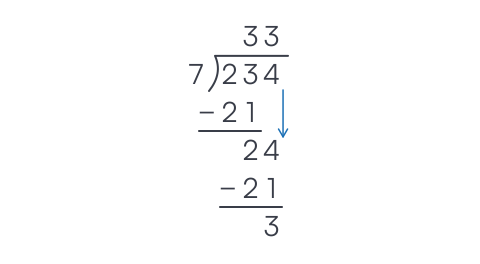
- can’t go into , so use .
- goes into three times because . Write on top.
- Write under and subtract:
Now bring down the next digit.
- Bring down the to make .
- goes into three times because . Write another on top.
- Write under and subtract:
There are no more digits to bring down, and can’t go into , so is the remainder.
Our final answer:
Long division with decimals
Sometimes you want the quotient written as a decimal instead of using a remainder. Writing the answer as a decimal lets you keep dividing past the ones place to get a more precise answer.
To do that, add a decimal point and zeros to the number inside the division bracket. When you add a decimal to the dividend, also place a decimal point in the quotient above. Each time you “bring down,” you can bring down another . The division is complete when the remainder is , or when a remainder starts repeating — then the quotient’s digits repeat too (for example, ), so stop at the place value the answer choices use.
Example:
What is
Start the same way you would if you were stopping with a remainder.
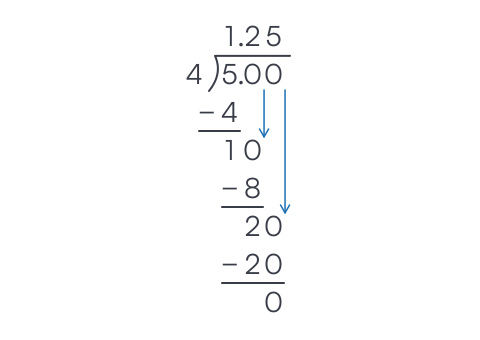
- goes into one time, so write on top.
- Multiply: We multiply
- Subtract: We subtract
At this point you have a remainder of , but we’ll keep going by switching to decimals.
- Place a decimal in the quotient and after the (so you’re working with ).
- Bring down the to make .
Now repeat the cycle:
- Divide: goes into two times.
- Multiply: .
- Subtract: .
Bring down another :
- Bring down to make .
- Divide: goes into five times.
- Multiply: .
- Subtract: .
A remainder of means the division is finished.
Our final answer:
Once the whole-number digits run out, add a decimal point and bring down zeros, repeating the cycle.
Division also works the same way when the divisor itself has a decimal, like . Before dividing, the divisor needs to be a whole number: shift its decimal point to the right, and shift the dividend’s decimal point the same number of places. Then divide as usual, lining the quotient’s decimal point up directly above the dividend’s.
Example:
What is ?
Move the decimal point one place to the right in both numbers so the divisor becomes a whole number: and .
Now divide normally: goes into fifteen times, with nothing left over.
Answer: