




This browser is too old to run Achievable.

Update it, or open this page in a current version of Chrome, Safari, Firefox or Edge. On an iPhone or iPad, update iOS: every browser there runs on the version of Safari that comes with it.

Achievable logoAchievable logo
ASVAB
Sign in
Sign up
Purchase
Textbook
Practice exams
Support
How it works
Resources
Exam catalog
Mountain with a flag at the peak
Textbook
Introduction
1. Word Knowledge
2. Mathematics Knowledge
2.1 Foundational math
2.2 Pre-algebra
2.2.1 Long division and division with decimals
2.2.2 Multiplication and fraction conversions
2.3 Algebra I
2.4 Geometry basics
2.5 Algebra II
2.6 Advanced geometry
2.7 Math strategies
3. Paragraph Comprehension
4. Arithmetic Reasoning
5. General Science
6. Mechanical Comprehension
7. Electronics Information
8. Shop Information
9. Auto Information
10. Assembling Objects
Wrapping up
Achievable logoAchievable logo
2.2.1 Long division and division with decimals
Achievable ASVAB
2. Mathematics Knowledge
2.2. Pre-algebra
Our ASVAB course is currently in development and is a work-in-progress.

Long division and division with decimals

7 min read
Font
Discuss
Share
Feedback

Long division

Definitions
Long division
A multi-step process for dividing numbers, especially when the quotient isn’t a whole number.
Partial products
Intermediate results you get while multiplying in a multi-step multiplication problem.

Long division is a step-by-step process for breaking larger division problems into smaller, manageable parts. The same repeating cycle works whether you’re dealing with whole numbers, remainders, or decimals — once you learn the pattern, you can apply it to any division problem.

Divide, Multiply, Subtract, Bring Down!

Here’s what each step does:

  • Divide to choose the next digit of the quotient.
  • Multiply to find the amount represented by that quotient digit.
  • Subtract to see what remains.
  • Bring down the next digit (or a 0 if you’re continuing into decimals) so you can repeat the cycle.

Example:

What is 13÷4?

This is asking: “How many times does 4 go into 13, and what is left over?”

First, set up long division with 13 inside the division bracket and 4 outside.

13 divided by 4 set up for long division: 13 inside the division bracket and 4 outside.
13/4
Achievable

Start by dividing:

4×14×24×34×4​=4=8=12=16​

Since 16 is too large, use 12. This means 4 goes into 13 three times. Write 3 on top.

Multiply the quotient digit by the divisor to find how much of 13 has been used:

3×4=12

Subtract to find what is left over:

13−12=1

There are no more digits to bring down. Since 4 cannot go into 1, the division stops with a remainder.

Long division of 13 by 4: 3 on top, 12 subtracted from 13, leaving a remainder of 1.
Division with remainder
Achievable

Our final answer:

13÷4=3r1

Steps taken:

  • Divide to find how many times the divisor fits
  • Multiply the quotient digit by the divisor
  • Subtract to find the remainder
  • Write the remainder

Knowledge check: What is 15÷4?

(spoiler)

3r3

Long division with larger numbers

The steps stay the same when working with larger numbers, but you may need to look at more than one digit at a time. If the divisor cannot go into the first digit, use the first two digits to begin the division process. From there, continue the same cycle: divide, multiply, subtract, and bring down.

Example:

Now let’s try long division with a larger number.

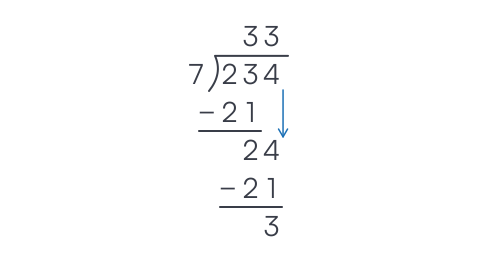
What is 234÷7?

Set up the problem with 7 outside and 234 inside.

  • 7 can’t go into 2, so use 23.
  • 7 goes into 23 three times because 7×3=21. Write 3 on top.
  • Write 21 under 23 and subtract:

23−21=2

Now bring down the next digit.

  • Bring down the 4 to make 24.
  • 7 goes into 24 three times because 7×3=21. Write another 3 on top.
  • Write 21 under 24 and subtract:

24−21=3

There are no more digits to bring down, and 7 can’t go into 3, so 3 is the remainder.

Long division of 234 by 7: 33 on top. 21 is subtracted from 23, leaving 2; the 4 is brought down to make 24; 21 is subtracted again, leaving a remainder of 3.
Division with remainder (Hard)
Achievable

Our final answer:

234÷7=33r3

Steps taken:

  • Divide to find how many times the divisor goes into the number
  • Multiply the quotient digit by the divisor
  • Subtract to find what remains
  • Bring down the next digit
  • Repeat the process until no digits remain
  • Write the remainder

Knowledge check 1: What is 156÷8?

(spoiler)

19r4

Knowledge check 2: What is 412÷6?

(spoiler)

68r4

Long division with decimals

Sometimes you want the quotient written as a decimal instead of using a remainder. Writing the answer as a decimal lets you keep dividing until the remainder becomes 0.

To do that, add a decimal point and zeros to the number inside the division bracket. When you add a decimal to the dividend, also place a decimal point in the quotient above. Each time you “bring down,” you can bring down another 0. The division is complete when the remainder is 0.

Example:

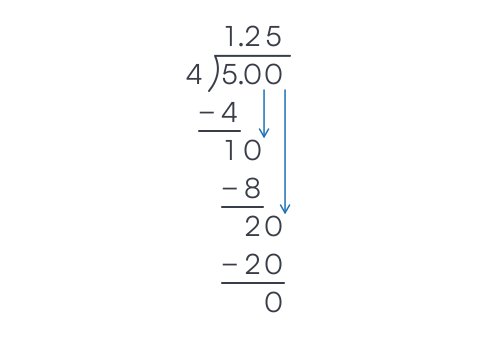
What is 5÷4?

Start the same way you would if you were stopping with a remainder.

  • 4 goes into 5 one time, so write 1 on top.
  • Multiply: We multiply 1×4=4
  • Subtract: We subtract 5−4=1

At this point you have a remainder of 1, but we’ll keep going by switching to decimals.

  • Place a decimal in the quotient and after the 5 (so you’re working with 5.0).
  • Bring down the 0 to make 10.

Now repeat the cycle:

  • Divide: 4 goes into 10 two times.
  • Multiply: 2×4=8.
  • Subtract: 10−8=2.

Bring down another 0:

  • Bring down 0 to make 20.
  • Divide: 4 goes into 20 five times.
  • Multiply: 5×4=20.
  • Subtract: 20−20=0.

A remainder of 0 means the division is finished.

Long division of 5.00 by 4, with 1.25 on top. 4 is subtracted from 5, leaving 1; a 0 is brought down to make 10, and 8 is subtracted, leaving 2; another 0 is brought down to make 20, and 20 is subtracted, leaving 0.
Division with decimals
Achievable

Our final answer:

5÷4=1.25

Steps taken:

  • Divide to find how many times the divisor goes into the number
  • Multiply the quotient digit by the divisor
  • Subtract to find the remainder
  • Add a decimal and bring down a zero
  • Repeat the process until the remainder is 0

Knowledge check: What is 7÷4? Write your answer as a decimal.

(spoiler)

1.75

Long division basics

  • Core cycle: Divide, Multiply, Subtract, Bring Down — repeat until done
  • Divide: find how many times divisor fits; Multiply: quotient digit × divisor; Subtract: find remainder; Bring down: next digit (or a 0)
  • If no digits remain and divisor doesn’t fit remainder, result is written with remainder (e.g., 13÷4=3r1)

Long division with larger numbers

  • If divisor can’t divide the first digit, use the first two digits to start
  • Same divide-multiply-subtract-bring down cycle repeats for each new digit brought down
  • Example: 234÷7=33r3

Long division with decimals

  • To avoid a remainder, convert to decimal: add a decimal point and zeros to the dividend, place matching decimal point in quotient
  • Each “bring down” step can use an added 0; continue cycle until remainder equals 0
  • Example: 5÷4=1.25

Sign up for free to take 5 quiz questions on this topic

Previous
Next  | 2.2.2 Multiplication and fraction conversions
All rights reserved ©2016 - 2026 Achievable, Inc.

Long division and division with decimals

Long division

Definitions
Long division
A multi-step process for dividing numbers, especially when the quotient isn’t a whole number.
Partial products
Intermediate results you get while multiplying in a multi-step multiplication problem.

Long division is a step-by-step process for breaking larger division problems into smaller, manageable parts. The same repeating cycle works whether you’re dealing with whole numbers, remainders, or decimals — once you learn the pattern, you can apply it to any division problem.

Divide, Multiply, Subtract, Bring Down!

Here’s what each step does:

  • Divide to choose the next digit of the quotient.
  • Multiply to find the amount represented by that quotient digit.
  • Subtract to see what remains.
  • Bring down the next digit (or a 0 if you’re continuing into decimals) so you can repeat the cycle.

Example:

What is 13÷4?

This is asking: “How many times does 4 go into 13, and what is left over?”

First, set up long division with 13 inside the division bracket and 4 outside.

Start by dividing:

4×14×24×34×4​=4=8=12=16​

Since 16 is too large, use 12. This means 4 goes into 13 three times. Write 3 on top.

Multiply the quotient digit by the divisor to find how much of 13 has been used:

3×4=12

Subtract to find what is left over:

13−12=1

There are no more digits to bring down. Since 4 cannot go into 1, the division stops with a remainder.

Our final answer:

13÷4=3r1

Steps taken:

  • Divide to find how many times the divisor fits
  • Multiply the quotient digit by the divisor
  • Subtract to find the remainder
  • Write the remainder

Knowledge check: What is 15÷4?

(spoiler)

3r3

Long division with larger numbers

The steps stay the same when working with larger numbers, but you may need to look at more than one digit at a time. If the divisor cannot go into the first digit, use the first two digits to begin the division process. From there, continue the same cycle: divide, multiply, subtract, and bring down.

Example:

Now let’s try long division with a larger number.

What is 234÷7?

Set up the problem with 7 outside and 234 inside.

  • 7 can’t go into 2, so use 23.
  • 7 goes into 23 three times because 7×3=21. Write 3 on top.
  • Write 21 under 23 and subtract:

23−21=2

Now bring down the next digit.

  • Bring down the 4 to make 24.
  • 7 goes into 24 three times because 7×3=21. Write another 3 on top.
  • Write 21 under 24 and subtract:

24−21=3

There are no more digits to bring down, and 7 can’t go into 3, so 3 is the remainder.

Our final answer:

234÷7=33r3

Steps taken:

  • Divide to find how many times the divisor goes into the number
  • Multiply the quotient digit by the divisor
  • Subtract to find what remains
  • Bring down the next digit
  • Repeat the process until no digits remain
  • Write the remainder

Knowledge check 1: What is 156÷8?

(spoiler)

19r4

Knowledge check 2: What is 412÷6?

(spoiler)

68r4

Long division with decimals

Sometimes you want the quotient written as a decimal instead of using a remainder. Writing the answer as a decimal lets you keep dividing until the remainder becomes 0.

To do that, add a decimal point and zeros to the number inside the division bracket. When you add a decimal to the dividend, also place a decimal point in the quotient above. Each time you “bring down,” you can bring down another 0. The division is complete when the remainder is 0.

Example:

What is 5÷4?

Start the same way you would if you were stopping with a remainder.

  • 4 goes into 5 one time, so write 1 on top.
  • Multiply: We multiply 1×4=4
  • Subtract: We subtract 5−4=1

At this point you have a remainder of 1, but we’ll keep going by switching to decimals.

  • Place a decimal in the quotient and after the 5 (so you’re working with 5.0).
  • Bring down the 0 to make 10.

Now repeat the cycle:

  • Divide: 4 goes into 10 two times.
  • Multiply: 2×4=8.
  • Subtract: 10−8=2.

Bring down another 0:

  • Bring down 0 to make 20.
  • Divide: 4 goes into 20 five times.
  • Multiply: 5×4=20.
  • Subtract: 20−20=0.

A remainder of 0 means the division is finished.

Our final answer:

5÷4=1.25

Steps taken:

  • Divide to find how many times the divisor goes into the number
  • Multiply the quotient digit by the divisor
  • Subtract to find the remainder
  • Add a decimal and bring down a zero
  • Repeat the process until the remainder is 0

Knowledge check: What is 7÷4? Write your answer as a decimal.

(spoiler)

1.75

Key points

Long division basics

  • Core cycle: Divide, Multiply, Subtract, Bring Down — repeat until done
  • Divide: find how many times divisor fits; Multiply: quotient digit × divisor; Subtract: find remainder; Bring down: next digit (or a 0)
  • If no digits remain and divisor doesn’t fit remainder, result is written with remainder (e.g., 13÷4=3r1)

Long division with larger numbers

  • If divisor can’t divide the first digit, use the first two digits to start
  • Same divide-multiply-subtract-bring down cycle repeats for each new digit brought down
  • Example: 234÷7=33r3

Long division with decimals

  • To avoid a remainder, convert to decimal: add a decimal point and zeros to the dividend, place matching decimal point in quotient
  • Each “bring down” step can use an added 0; continue cycle until remainder equals 0
  • Example: 5÷4=1.25

More from Pre-algebra

  • Multiplication and fraction conversions