



Basic operations with whole numbers
Basics review
Let’s start with a quick refresher on adding and subtracting.
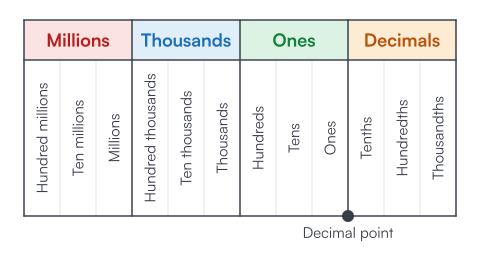
When you’re adding or subtracting, line up the numbers by place value:
- Decimals under decimals
- Ones under ones
- Tenths under tenths
- And so on
Addition
When you add numbers, you combine them to find a total. This total is called the sum.
Example:
. Set it up like this:
Because the ones place, decimal point, and tenths place are aligned, you can add as you normally would.
Subtraction
You can think of subtraction in two ways:
- Removing a number
- Adding the negative of that number
This can make subtraction easier when working with negative numbers. The result of subtraction is called the difference.
Example:
Both expressions give the same result. In the second line, the becomes negative, and the problem is rewritten as addition.
This idea can be especially helpful when negatives are involved:
Both forms are correct; choose the one that makes the steps clearest.
Multiplication
The next refresher is on multiplication and division. Multiplication is repeated addition. The result of a multiplication problem is called the product. Multiplication can be thought of as repeated addition.
Example:
means you can add either:
- Three groups of , or
- Four groups of
So you can write:
Or:
Either way, the product is .
Division
Division is the reverse of multiplication. It breaks a number into equal-sized groups. The result of division is called the quotient. The quotient tells you how many equal groups you have.
Example:
asks: how many ’s add up to ?
So , because contains groups of .
Factors
Integers are the whole numbers and their negatives, like and so on (no decimals or fractions). Factors are whole numbers that divide a number evenly without leaving a remainder. You can think of factors as numbers that multiply together to make another number.
Example:
The factors of are . It often helps to list them in pairs: