


This browser is too old to run Achievable.

Update it, or open this page in a current version of Chrome, Safari, Firefox or Edge. On an iPhone or iPad, update iOS: every browser there runs on the version of Safari that comes with it.

Achievable logoAchievable logo
ASVAB
Sign in
Sign up
Purchase
Textbook
Practice exams
Support
How it works
Resources
Exam catalog
Mountain with a flag at the peak
Textbook
Introduction
1. Word Knowledge
2. Mathematics Knowledge
2.1 Foundational math
2.1.1 Basic operations with whole numbers
2.1.2 Fractions and advanced operations
2.1.3 Core math concepts
2.2 Pre-algebra
2.3 Algebra I
2.4 Geometry basics
2.5 Algebra II
2.6 Advanced geometry
2.7 Math strategies
3. Paragraph Comprehension
4. Arithmetic Reasoning
5. General Science
6. Mechanical Comprehension
7. Electronics Information
8. Shop Information
9. Auto Information
10. Assembling Objects
Wrapping up
Achievable logoAchievable logo
2.1.2 Fractions and advanced operations
Achievable ASVAB
2. Mathematics Knowledge
2.1. Foundational math
Our ASVAB course is currently in development and is a work-in-progress.

Fractions and advanced operations

7 min read
Font
Discuss
Share
Feedback

Fractions

Definitions
Fractions
Numbers that represent parts of a whole
Numerator
Top of a fraction
Denominator
Bottom of the fraction
Reciprocal
A fraction flipped upside down
Improper fraction
A fraction where the numerator is larger than the denominator
Mixed fraction
A fraction that contains whole numbers and a fraction

Fractions represent parts of a whole. You may also see fractions written in different forms, such as improper fractions or mixed numbers. These will be covered in more detail later.

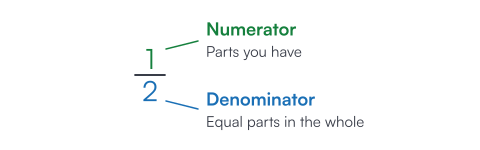
  • The numerator (top) tells you how many parts you have.
  • The denominator (bottom) tells you how many equal parts make up the whole.

For example, in the fraction 43​, the whole is divided into 4 equal parts, and you have 3 of those parts.

The fraction 1/2. The numerator, 1, is the parts you have; the denominator, 2, is the equal parts in the whole.
Fraction parts
Achievable

You’ll use a few core fraction skills such as adding, subtracting, multiplying, dividing, working with reciprocals, and converting between fractions, decimals, and percents.

These skills help you solve a wide range of problems, from basic calculations to more complex equations, so it’s important to understand how and when to use each one.

Adding and subtracting fractions

To add or subtract fractions, the denominators must match. The denominator tells you the size of each part, so you can only combine fractions when the parts are the same size.

That means you first need to find a common denominator (a common multiple of the denominators). Then:

  • Rewrite each fraction with that denominator
  • Add or subtract the numerators
  • Keep the denominator the same

Example:

21​+31​

Start by listing multiples of each denominator:

2:2,4,6,8,10

3:3,6,9,12

The least common denominator is 6. To change a fraction without changing its value, multiply the top and bottom by the same number.

To rewrite 21​ with denominator 6, multiply by 33​. To rewrite 31​ with denominator 6, multiply by 22​. Multiplying by 33​ or 22​ doesn’t change the value of the fraction because you’re multiplying by 1.

2×31×3​=63​

3×21×2​=62​

Now add the numerators and keep the denominator:

63​+62​=65​

Steps taken:

  • Find a common denominator
  • Rewrite each fraction
  • Add the numerators
  • Keep the denominator the same
Sidenote
Common denominators

You can always just multiply the denominators by each other for a quick way to get a common denominator. This method might not give you the least common denominator but it will always give you a common denominator.

Knowledge check: Solve 87​−54​?

(spoiler)

4035​−4032​=403​

Multiply fractions

To multiply fractions, multiply straight across. This means you multiply the top numbers together and the bottom numbers together. You do not need a common denominator.

  • Numerator times numerator
  • Denominator times denominator

32​×31​=92​

Think of it as multiplying two parts of a whole. You’re finding a part of a part.

Dividing fractions

Before dividing fractions, it helps to know the reciprocal. The reciprocal is the fraction flipped.

43​→34​

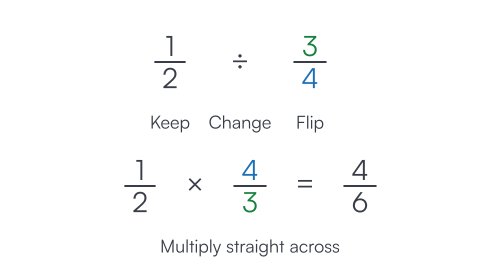
To divide fractions, keep the first fraction the same and multiply by the reciprocal of the second fraction (often called keep-change-flip). This works because dividing by a fraction is the same as multiplying by its reciprocal.

Keep, change, flip: 1/2 ÷ 3/4. Keep 1/2, change ÷ to ×, and flip 3/4 to 4/3, then multiply straight across: 1/2 × 4/3 = 4/6.
Dividing fractions
Achievable

Keep, change, flip

Let’s break down how to solve this example. Use the method shown in the graphic above: keep, change, flip.

21​÷43​

  • Keep the first fraction the same
  • Change division to multiplication
  • Flip the second fraction (take the reciprocal)

21​×34​

Now multiply straight across (top times top, bottom times bottom):

64​

Simplify the fraction:

32​

Simplifying fractions

After solving a fraction problem, you usually simplify your answer. This means writing the fraction in its simplest form.

Fractions can be written in different ways while representing the same value. This is why we simplify. For example, 21​ is the same as 42​ or 84​.

In most math work, you write the final answer in simplest (most reduced) form. That means the numerator and denominator have no common factor other than 1.

To simplify a fraction:

  1. Find the greatest common factor of the numerator and denominator.
  2. Divide both by that factor.

Example 1:

If we have the fraction 104​, we want to see if the fraction can be reduced by looking at the factors for both the numerator and the denominator.

4:1,2,4

10:1,2,5,10

Since both numbers share the common factor of 2, divide both the numerator and denominator by 2.

104​=10÷24÷2​=52​

So the most reduced form of 104​ is 52​.

Example 2:

Reduce the following fraction:

3514​

14:1,2,7,14

35:1,5,7,35

3514​=35÷714÷7​=52​

Steps taken:

  • Find common factors
  • Divide numerator and denominator by the same number
  • Write the simplified fraction

Converting fractions

Now let’s apply what we’ve learned about simplifying and converting fractions. To convert a fraction to a percent, first write it as a decimal by dividing the numerator by the denominator. Then multiply by 100.

Example:

Convert 41​ to a percent:

First, divide the numerator by the denominator to get a decimal:

41​=1÷4=0.25

Next, convert the decimal to a percent by multiplying by 100:

0.25×100=25%

So,

41​=0.25=25%

Steps taken:

  • Divide the numerator by the denominator
  • Convert the decimal to a percent by multiplying by 100
  • Write the final answer

Knowledge check: Convert 164​ to a percent

(spoiler)

25%

Fraction basics

  • Fraction = parts of a whole; numerator (top) = parts you have, denominator (bottom) = total equal parts
  • Key terms: reciprocal (flipped fraction), improper fraction (numerator > denominator), mixed fraction (whole number + fraction)
  • Core skills: add, subtract, multiply, divide, use reciprocals, convert between fractions/decimals/percents

Adding and subtracting fractions

  • Denominators must match before combining
  • Steps: find common denominator (multiples or multiply denominators together) → rewrite fractions → add/subtract numerators → keep denominator same
  • Example: 21​+31​=63​+62​=65​

Multiplying and dividing fractions

  • Multiply: multiply straight across (numerator×numerator, denominator×denominator); no common denominator needed
    • 32​×31​=92​
  • Divide: use “keep, change, flip” — keep first fraction, change ÷ to ×, flip (reciprocate) second fraction, then multiply across
    • 21​÷43​=21​×34​=64​=32​

Simplifying fractions

  • Final answers should be in simplest form (no common factor besides 1 between numerator/denominator)
  • Steps: find greatest common factor (GCF) of numerator and denominator → divide both by it
    • Example: 104​=52​ (GCF=2); 3514​=52​ (GCF=7)

Converting fractions to percents

  • Steps: divide numerator by denominator to get decimal → multiply by 100 to get percent
    • Example: 41​=0.25=25%

Sign up for free to take 6 quiz questions on this topic

Previous
Next  | 2.1.3 Core math concepts
All rights reserved ©2016 - 2026 Achievable, Inc.

Fractions and advanced operations

Fractions

Definitions
Fractions
Numbers that represent parts of a whole
Numerator
Top of a fraction
Denominator
Bottom of the fraction
Reciprocal
A fraction flipped upside down
Improper fraction
A fraction where the numerator is larger than the denominator
Mixed fraction
A fraction that contains whole numbers and a fraction

Fractions represent parts of a whole. You may also see fractions written in different forms, such as improper fractions or mixed numbers. These will be covered in more detail later.

  • The numerator (top) tells you how many parts you have.
  • The denominator (bottom) tells you how many equal parts make up the whole.

For example, in the fraction 43​, the whole is divided into 4 equal parts, and you have 3 of those parts.

You’ll use a few core fraction skills such as adding, subtracting, multiplying, dividing, working with reciprocals, and converting between fractions, decimals, and percents.

These skills help you solve a wide range of problems, from basic calculations to more complex equations, so it’s important to understand how and when to use each one.

Adding and subtracting fractions

To add or subtract fractions, the denominators must match. The denominator tells you the size of each part, so you can only combine fractions when the parts are the same size.

That means you first need to find a common denominator (a common multiple of the denominators). Then:

  • Rewrite each fraction with that denominator
  • Add or subtract the numerators
  • Keep the denominator the same

Example:

21​+31​

Start by listing multiples of each denominator:

2:2,4,6,8,10

3:3,6,9,12

The least common denominator is 6. To change a fraction without changing its value, multiply the top and bottom by the same number.

To rewrite 21​ with denominator 6, multiply by 33​. To rewrite 31​ with denominator 6, multiply by 22​. Multiplying by 33​ or 22​ doesn’t change the value of the fraction because you’re multiplying by 1.

2×31×3​=63​

3×21×2​=62​

Now add the numerators and keep the denominator:

63​+62​=65​

Steps taken:

  • Find a common denominator
  • Rewrite each fraction
  • Add the numerators
  • Keep the denominator the same
Sidenote
Common denominators

You can always just multiply the denominators by each other for a quick way to get a common denominator. This method might not give you the least common denominator but it will always give you a common denominator.

Knowledge check: Solve 87​−54​?

(spoiler)

4035​−4032​=403​

Multiply fractions

To multiply fractions, multiply straight across. This means you multiply the top numbers together and the bottom numbers together. You do not need a common denominator.

  • Numerator times numerator
  • Denominator times denominator

32​×31​=92​

Think of it as multiplying two parts of a whole. You’re finding a part of a part.

Dividing fractions

Before dividing fractions, it helps to know the reciprocal. The reciprocal is the fraction flipped.

43​→34​

To divide fractions, keep the first fraction the same and multiply by the reciprocal of the second fraction (often called keep-change-flip). This works because dividing by a fraction is the same as multiplying by its reciprocal.

Keep, change, flip

Let’s break down how to solve this example. Use the method shown in the graphic above: keep, change, flip.

21​÷43​

  • Keep the first fraction the same
  • Change division to multiplication
  • Flip the second fraction (take the reciprocal)

21​×34​

Now multiply straight across (top times top, bottom times bottom):

64​

Simplify the fraction:

32​

Simplifying fractions

After solving a fraction problem, you usually simplify your answer. This means writing the fraction in its simplest form.

Fractions can be written in different ways while representing the same value. This is why we simplify. For example, 21​ is the same as 42​ or 84​.

In most math work, you write the final answer in simplest (most reduced) form. That means the numerator and denominator have no common factor other than 1.

To simplify a fraction:

  1. Find the greatest common factor of the numerator and denominator.
  2. Divide both by that factor.

Example 1:

If we have the fraction 104​, we want to see if the fraction can be reduced by looking at the factors for both the numerator and the denominator.

4:1,2,4

10:1,2,5,10

Since both numbers share the common factor of 2, divide both the numerator and denominator by 2.

104​=10÷24÷2​=52​

So the most reduced form of 104​ is 52​.

Example 2:

Reduce the following fraction:

3514​

14:1,2,7,14

35:1,5,7,35

3514​=35÷714÷7​=52​

Steps taken:

  • Find common factors
  • Divide numerator and denominator by the same number
  • Write the simplified fraction

Converting fractions

Now let’s apply what we’ve learned about simplifying and converting fractions. To convert a fraction to a percent, first write it as a decimal by dividing the numerator by the denominator. Then multiply by 100.

Example:

Convert 41​ to a percent:

First, divide the numerator by the denominator to get a decimal:

41​=1÷4=0.25

Next, convert the decimal to a percent by multiplying by 100:

0.25×100=25%

So,

41​=0.25=25%

Steps taken:

  • Divide the numerator by the denominator
  • Convert the decimal to a percent by multiplying by 100
  • Write the final answer

Knowledge check: Convert 164​ to a percent

(spoiler)

25%

Key points

Fraction basics

  • Fraction = parts of a whole; numerator (top) = parts you have, denominator (bottom) = total equal parts
  • Key terms: reciprocal (flipped fraction), improper fraction (numerator > denominator), mixed fraction (whole number + fraction)
  • Core skills: add, subtract, multiply, divide, use reciprocals, convert between fractions/decimals/percents

Adding and subtracting fractions

  • Denominators must match before combining
  • Steps: find common denominator (multiples or multiply denominators together) → rewrite fractions → add/subtract numerators → keep denominator same
  • Example: 21​+31​=63​+62​=65​

Multiplying and dividing fractions

  • Multiply: multiply straight across (numerator×numerator, denominator×denominator); no common denominator needed
    • 32​×31​=92​
  • Divide: use “keep, change, flip” — keep first fraction, change ÷ to ×, flip (reciprocate) second fraction, then multiply across
    • 21​÷43​=21​×34​=64​=32​

Simplifying fractions

  • Final answers should be in simplest form (no common factor besides 1 between numerator/denominator)
  • Steps: find greatest common factor (GCF) of numerator and denominator → divide both by it
    • Example: 104​=52​ (GCF=2); 3514​=52​ (GCF=7)

Converting fractions to percents

  • Steps: divide numerator by denominator to get decimal → multiply by 100 to get percent
    • Example: 41​=0.25=25%

More from Foundational math

  • Basic operations with whole numbers
  • Core math concepts