



Circular flow model
Our entry point for macroeconomics is the circular flow model. We start by imagining a world that only has two types of actors, households and businesses. There is no government and no banks or other financial intermediaries such as the stock market. This is also a closed economy, or an economy with no trade or movements of money across borders. All of these elements will be discussed in the future, but for now they would only distract from the key lessons of this model.
So businesses and households deal with each other directly, in two types of markets.
Final goods and services are defined to be those that are sold directly to households, and thus have no part in any further steps of production. What is not included are intermediate inputs or capital goods. Examples of intermediate inputs are corn in making cornmeal, lumber in making furniture, an engine in making a car or an airplane. Intermediate inputs are pieces of making something larger that can only be used once. The same good can be a final good or another intermediate good depending on who buys it. This will be a critical detail in future discussions.
As a factor of production capital refers to money. It is the savings of households which is lent to businesses. Capital goods (physical capital) refers to items that are used to make other goods and services, but are not used up in the process. That includes things such as tools, delivery vehicles, and factories. Land is often split off as its own category, because while it is generally used to produce but not used up like capital there is only a fixed amount available.
Labor is households providing work. Sometimes it is more than just if someone is working or not. The number of hours someone works is sometimes important as is the level of knowledge they have. Knowledge can be built up with experience or education and is sometimes defined as human capital, since it can be carried over from year to year. Labor markets will be a key point of discussion on their own later on.
Finally, there is entrepreneurship, our way of saying that one way or another all businesses are owned by households. Loosely this is the value of ideas, inventions of new products, ways to produce, ways to transport and ways to sell. Any sort of idea that contributes to the ability of a firm to make money that is not part of the other factors of production.
Circular flow diagram
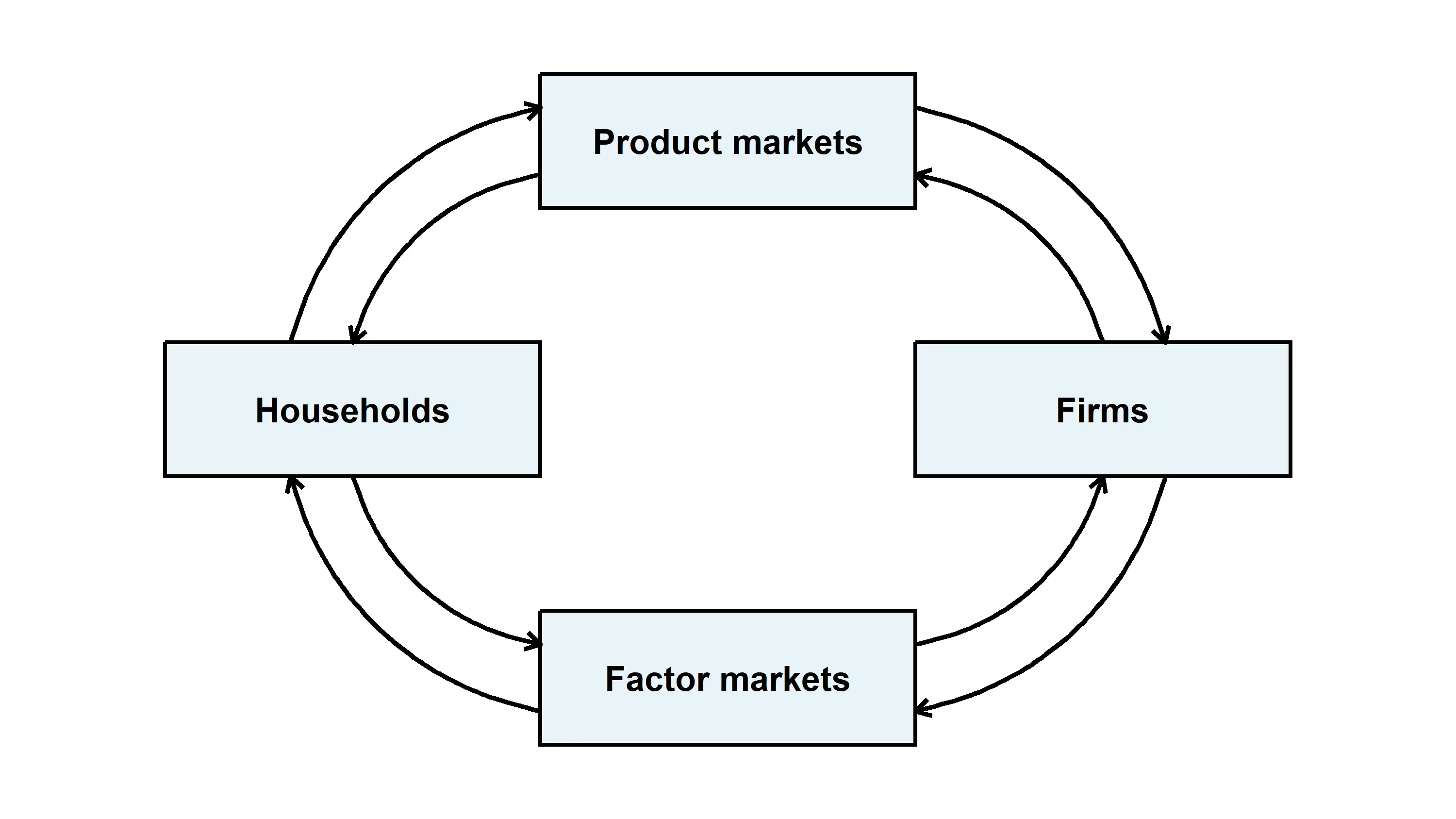
With our two actors, households and businesses, and two markets, product and factor, we now present the circular flow diagram.
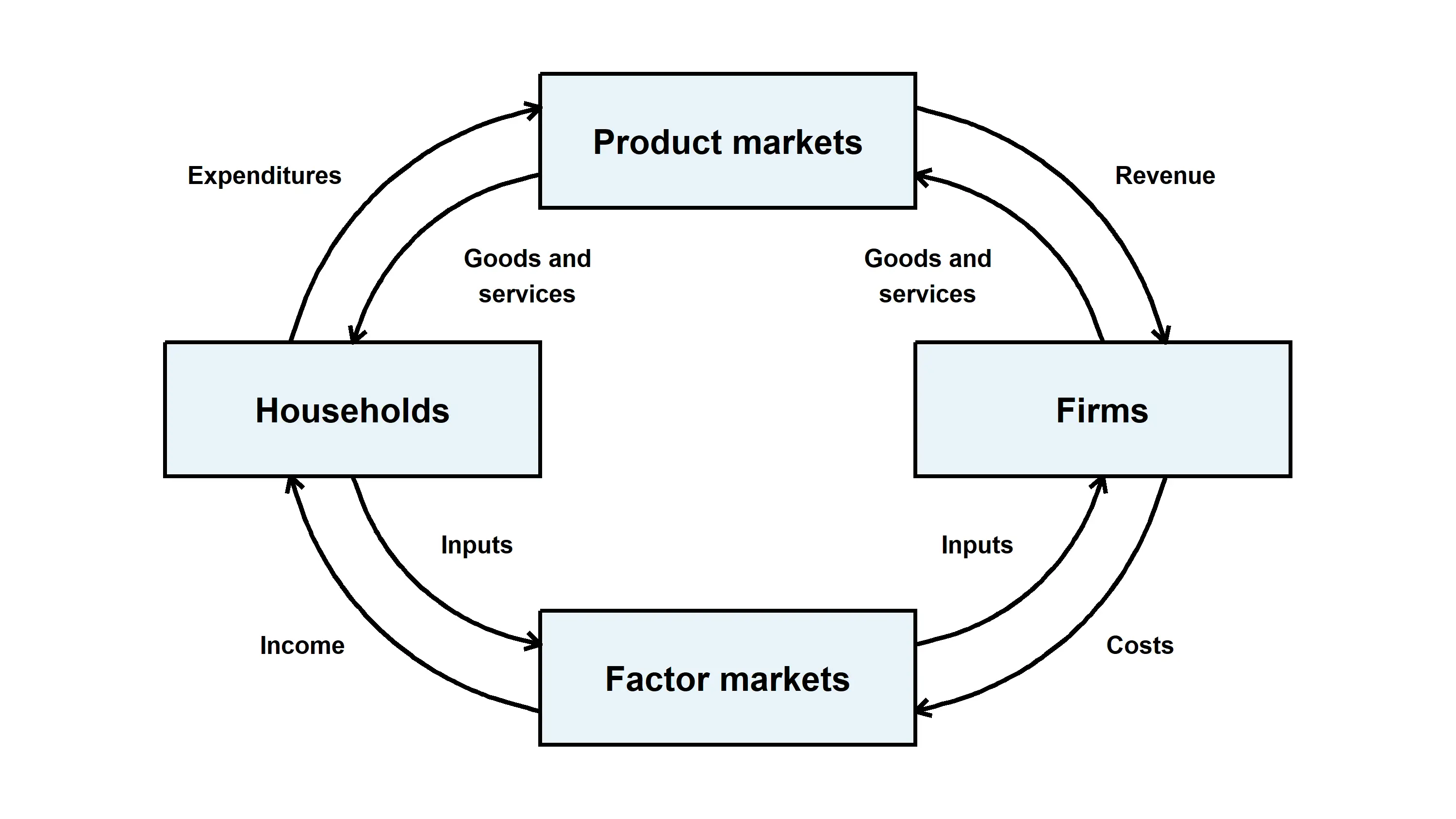
The rounded arrows in the charts represent transactions. The interior arrows represent movements of physical items, goods, services, and inputs. The main inputs we discuss are labor, capital, natural resources and entrepreneurship. The exterior arrows represent the flow of money, various payments for the physical items…
In the product market households buy goods and services, in total those are expenditures. The businesses provide those goods and services and for them the funds received are revenue. Then in the factor market, businesses pay for the use of factors of production. Those factor payments are all are costs. The households provide all of those factors and to them factor payments are income…
The table below outlines the specific terminology for different factor payments.
| Factor | Payment |
|---|---|
| Labor | Wages |
| Capital | Interest |
| Natural resources | Rents |
| Entrepreneurship | Profits |
Now that we have all of the terminology, we can revisit the fully labelled circular flow diagram.
Key takeaways
Before we move on, there are a few important connections that must be made.
The first is that every quadrant of the chart represents that exact same dollar amount of activity. Looking at individual households, markets or firms, the links are weaker. When added up factor payments represent all income and because we cannot save, that is equal to spending. Every purchase by a household becomes income for the firm, which is what revenue is. And every payment to a factor is a cost for the firm.
All spending by any participant becomes income for someone else. Similarly, all income for an economic actor enables spending. Every good or service produced must be sold, representing spending for the household and revenue for the firm.
This clarifies an important fact when it comes to national accounting of income, spending and production. They are all equal.
This is something that may seem to only be true because this is a very stripped down world we have considered. However, when adding in more realistic details the only thing that changes is that tracking and accounting becomes more difficult. There are more adjustments to be made and extra care that needs to be taken, but if measured correctly income, spending and production for a country are exactly equal.