



Business cycles
Over longer periods of time growth in most countries will be positive. This is economic growth, which will be discussed at length later on in the text.
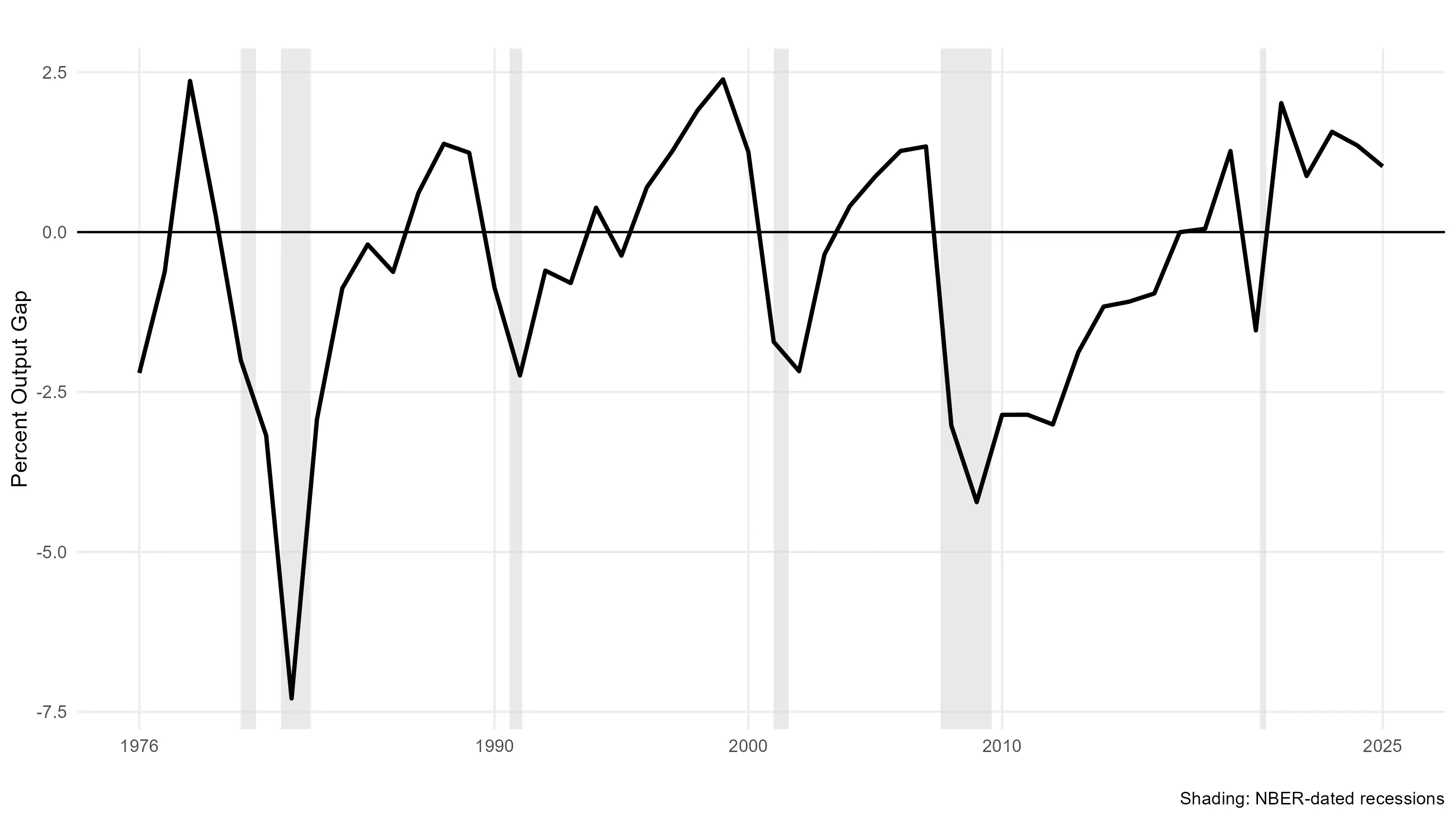
They can be most clearly seen by looking at the output gap, the percentage difference between real GDP and potential real GDP.
The bars represent recessions, negative economic events we will define shortly. Business cycles are what we call these fluctuations around long run growth.
Business cycles have four distinct phases, expansion, peak, contraction, and trough. These cycles reflect complex interactions between elements of the economy like consumer spending, business investment, employment and production. They are not regular and predictable in occurrence, nor in how long each phase lasts.
Expansion phase
In the expansion we expect the economy to show:
- Increasing GDP
- Falling unemployment rate
- Rising consumer spending
- Increasing business investment
During this phase economic activity in general is accelerating. Consumer confidence is rising, businesses are expanding and the stock market typically performs well.
Peak phase
The peak represents the height of economic activity. Signs of this include:
- Low unemployment levels
- Increasing inflation
This phase usually has a higher level of real GDP compared to periods before and after, but that can only be observed looking backwards with data.
Contraction phase (recessionary gap)
When economic activity experiences a significant decline that is the contraction phase, more commonly referred to as a recession. The preferred AP term later on will be recessionary gap.
We need to observe:
- A fall in real GDP
- Rising unemployment We may observe:
- Falling consumer spending
- Declining business investment
Inflation can rise or fall in a recessionary gap. There is unfortunately no clear movement of prices that occurs here.
In many other countries, for example, Canada and the United Kingdom, the definition of a recession is two consecutive quarters of negative growth in GDP. That is common in recessions in the United States, but it is not a requirement. In the United States a recession is determined by a board of economic experts at a non-profit foundation, the National Bureau of Economic Research (NBER).
Because of lags in data availability, the start and end months of recessions are almost always identified after they have started. COVID is a notable exception. The start was announced and dated to be in February of 2020 and is considered to have ended in April of 2020. Most recessions are longer and have less clarity about their start and end.
Trough phase
The trough represents the lowest point of economic activity. We expect:
- Lowest real GDP levels
- Highest unemployment rates
- Lower inflation or even deflation
This phase marks the bottom and the end of a recession. After this recovery from the recession begins in the form of a new expansion phase. The cycle begins again.
Costs and benefits of recessions
Recessions carry significant costs but also provide some benefits.
Costs can include:
- Reduction in household income due to job loss
- Long-term unemployment
- Increased poverty and reduced social mobility
- Company bankruptcies and reduced investment
- Psychological impacts such as increased economic anxiety and reduced consumer confidence
Benefits can include:
- Economic restructuring
- Inefficient businesses close
- Incentivizes productivity and efficiency
- Resource reallocation
- Redirects investment from unproductive sectors
- Encourages technological adoption and development
Not all recessions are equal and many of the more extreme outcomes only arise during a depression. There is no real definition of a depression other than it being a prolonged and deep recession.
Causes of business cycles
Business cycles are not predictable and result from complex interactions between different pieces of the economy. They may be caused by demand-side factors such as changes in consumer confidence or business confidence. They can also be caused by supply-side factors such as natural disasters, resource prices and structural economic transformations in response to new technologies.
Recessions in US history
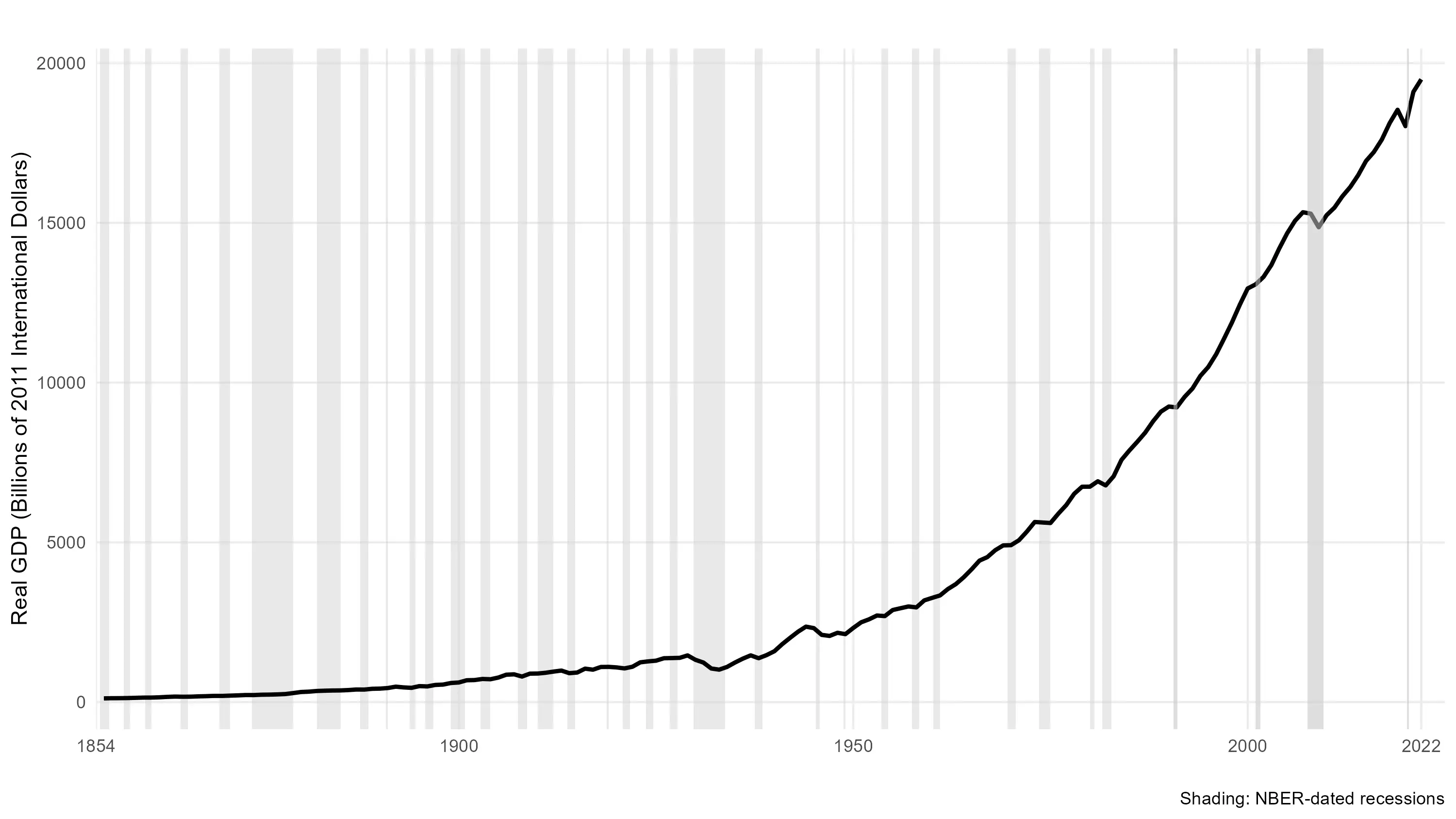
Since 1854, the United States has experienced 34 recessions as measured by a panel of experts, the Business Cycle Dating Committee of the National Bureau of Economic Research (NBER). Below is a chart of real GDP, with shaded bars representing each recession.
The deepest recession experienced in the US to date is the Great Depression. It was also the second longest, lasting 43 months from August 1929 until March 1933. Real GDP fell 30%, unemployment was as high as 25% and over 7000 banks failed, nearly 1/3 of the banking system at the time.
This is considered to be a global event, as many countries also experienced deep recessions around the same time, although most of them were less deep and shorter than in the United States. Still, it is estimated that world GDP fell by 15% and world trade was reduced by a third.
In contrast, the two most significant recent events were much shorter. The Great Recession lasted 18 months, from December 2007 to June of 2009. The COVID-19 Pandemic was the shortest recession to date, occurring in March and April of 2020.
Since the Great Depression generally recessions have become less frequent and shorter than they were before. However it is also true that in the 21st century business cycles have become more complex. In particular recessions have been more likely to occur in multiple countries simultaneously. This is because of increased global connections, rapid technological change and the increasing sophistication of financial systems.
The three events mentioned so far, the Great Depression, the Great Recession and the COVID-19 pandemic, are the three truly global economic downturns since 1900. Most recessions may affect neighbors or trade partners, but are not so widespread. A few other US events will be mentioned when they connect to new concepts.