


Achievable logoAchievable logo
AP Calculus AB
Sign in
Sign up
Purchase
Textbook
Practice exams
Support
How it works
Exam catalog
Mountain with a flag at the peak
Textbook
Introduction
1. Limits
1.1 Tables and graphs
1.2 Analytical limits
1.2.1 Direct substitution
1.2.2 Composite functions
1.3 Algebraic limits
1.4 Limits and infinity
1.5 Special limits
1.6 Continuity
2. Derivative basics
3. Advanced differentiation
4. Contextual uses
5. Analytical uses
6. Integration
7. Differential equations
8. Applications of integrals
Wrapping up
Achievable logoAchievable logo
1.2.1 Direct substitution
Achievable AP Calculus AB
1. Limits
1.2. Analytical limits
Our AP Calculus AB course is now in "early access" - get 50% off for a limited time.

Direct substitution

4 min read
Font
Discuss
Share
Feedback

What you’ll learn

  • Using direct substitution to find limits
  • Applying limit laws to simplify expressions

Evaluating limits analytically

While graphs and tables are excellent tools for visualizing behavior or double-checking your work, most limits can be evaluated analytically using algebra and calculus. For many functions, straightforward techniques such as direct substitution and the basic limit laws can be used to determine a limit.

Direct substitution

The simplest way to evaluate a limit is direct substitution. If plugging in x=a into f(x) gives a finite number, then that number is the limit.

Always try direct substitution first.

Example 1. Evaluate

x→−3lim​(x2+x)

(spoiler)

Substituting x=−3 into the expression directly,

x→−3lim​(x2+x)=(−3)2+(−3)=9−3=6

Example 2. Evaluate

x→5lim​x−1​x+1​

(spoiler)

Using direct substitution,

x→5lim​x−1​x+1​=5−1​5+1​=26​=3

Limit properties

Limits follow a set of rules, called limit laws, that allow complicated limits to be rewritten as simpler ones.

Let x→alim​f(x)=L and x→alim​g(x)=M. Then,

  1. Constant multiple: If c is a constant,

x→alim​[c×f(x)]=c×L

  1. Sum or difference:

x→alim​[f(x)±g(x)]=L±G

  1. Product:

x→alim​[f(x)×g(x)]=L×M

  1. Quotient:

x→alim​g(x)f(x)​=ML​ , M=0

  1. Power:

x→alim​[f(x)]n=Ln

Example 1. Given:

x→5lim​f(x)=2x→5lim​g(x)=4

Evaluate:

x→5lim​ [f(x)−3g(x)]2

(spoiler)

Applying limit laws,

x→5lim​ [f(x)−3g(x)]2=(x→5lim​f(x)−3⋅x→5lim​g(x))2=(2−3⋅4)2=100

Example 2. If

x→−2lim​f(x)x→−2lim​g(x)​=−3=6​

evaluate

x→−2lim​f(x)2g(x)−f(x)​​

(spoiler)

Applying limit laws,

x→−2lim​f(x)2g(x)−f(x)​​=(x→−2lim​f(x))2x→−2lim​g(x)−x→−2lim​f(x)​​=(−3)26−(−3)​​=99​​=31​

Using graphs

Limit laws can also be used after determining limit values from a graph.

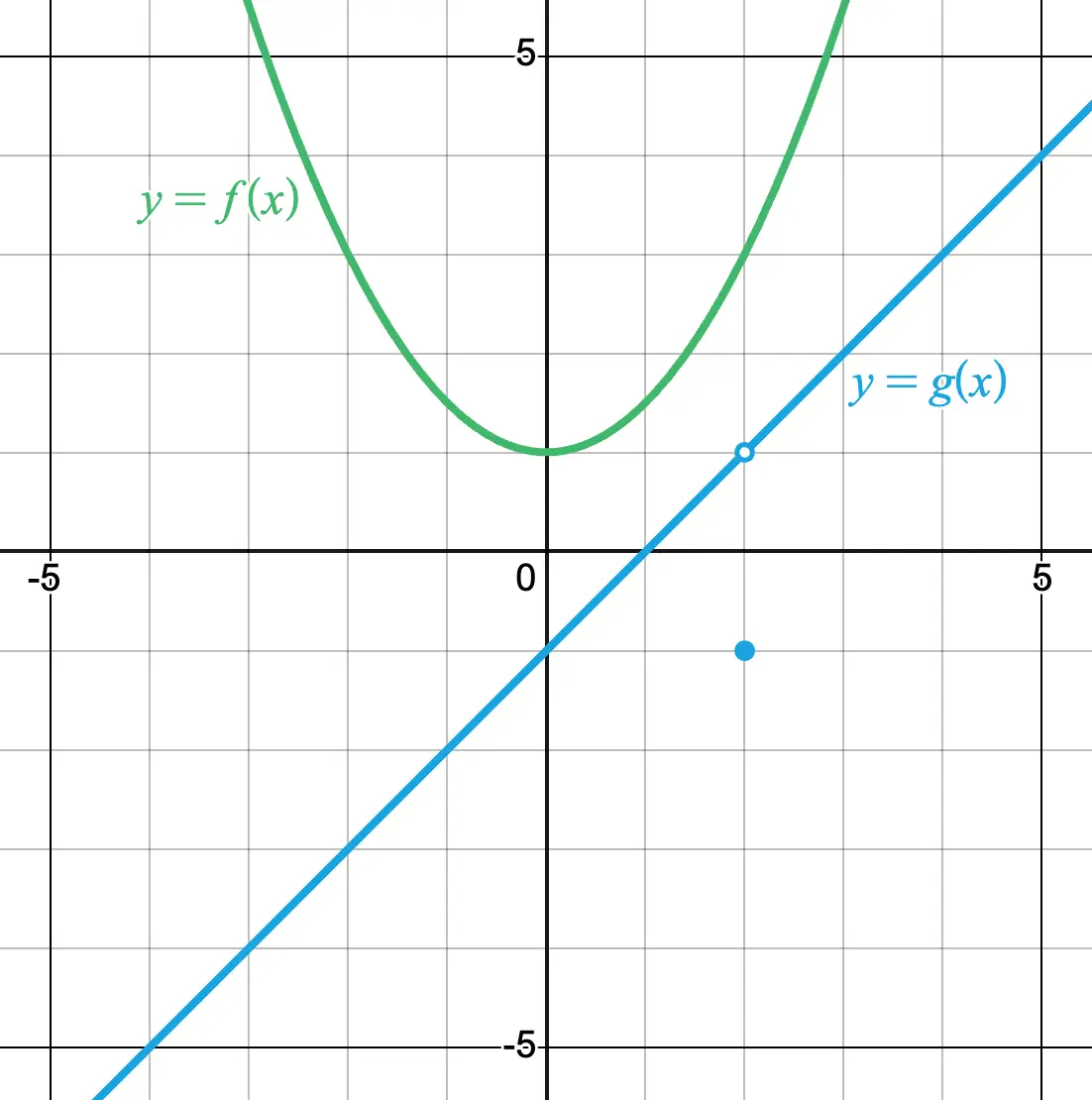
Using the following graphs of f(x) and g(x), find

x→2lim​g(x)f(x)+1​​

Applying limit laws
Applying limit laws
(spoiler)

From the graph,

  • x→2lim​f(x)=3

  • x→2lim​g(x)=1

So applying limit laws,

x→2lim​g(x)f(x)+1​​=x→2lim​g(x)x→2lim​f(x)+1​​=13+1​​=2

Direct substitution

  • Simplest method: plug x=a directly into f(x)
  • If result is a finite number, that is the limit
  • Always try direct substitution first

Limit laws

  • Allow complex limits to be broken into simpler parts
  • Require that individual limits L and M exist beforehand
  • Key rules (given limx→a​f(x)=L, limx→a​g(x)=M):
    • Constant multiple: lim[b⋅f(x)]=b⋅L
    • Sum/difference: lim[f(x)±g(x)]=L±M
    • Product: lim[f(x)⋅g(x)]=L⋅M
    • Quotient: limg(x)f(x)​=ML​, M=0
    • Power: lim[f(x)]n=Ln

Applying limit laws

  • Can be combined with direct substitution or graph-read values
  • Substitute known limit values after breaking expression into parts
  • Quotient law requires denominator limit =0

Sign up for free to take 7 quiz questions on this topic

All rights reserved ©2016 - 2026 Achievable, Inc.

Direct substitution

What you’ll learn

  • Using direct substitution to find limits
  • Applying limit laws to simplify expressions

Evaluating limits analytically

While graphs and tables are excellent tools for visualizing behavior or double-checking your work, most limits can be evaluated analytically using algebra and calculus. For many functions, straightforward techniques such as direct substitution and the basic limit laws can be used to determine a limit.

Direct substitution

The simplest way to evaluate a limit is direct substitution. If plugging in x=a into f(x) gives a finite number, then that number is the limit.

Always try direct substitution first.

Example 1. Evaluate

x→−3lim​(x2+x)

(spoiler)

Substituting x=−3 into the expression directly,

x→−3lim​(x2+x)=(−3)2+(−3)=9−3=6

Example 2. Evaluate

x→5lim​x−1​x+1​

(spoiler)

Using direct substitution,

x→5lim​x−1​x+1​=5−1​5+1​=26​=3

Limit properties

Limits follow a set of rules, called limit laws, that allow complicated limits to be rewritten as simpler ones.

Let x→alim​f(x)=L and x→alim​g(x)=M. Then,

  1. Constant multiple: If c is a constant,

x→alim​[c×f(x)]=c×L

  1. Sum or difference:

x→alim​[f(x)±g(x)]=L±G

  1. Product:

x→alim​[f(x)×g(x)]=L×M

  1. Quotient:

x→alim​g(x)f(x)​=ML​ , M=0

  1. Power:

x→alim​[f(x)]n=Ln

Example 1. Given:

x→5lim​f(x)=2x→5lim​g(x)=4

Evaluate:

x→5lim​ [f(x)−3g(x)]2

(spoiler)

Applying limit laws,

x→5lim​ [f(x)−3g(x)]2=(x→5lim​f(x)−3⋅x→5lim​g(x))2=(2−3⋅4)2=100

Example 2. If

x→−2lim​f(x)x→−2lim​g(x)​=−3=6​

evaluate

x→−2lim​f(x)2g(x)−f(x)​​

(spoiler)

Applying limit laws,

x→−2lim​f(x)2g(x)−f(x)​​=(x→−2lim​f(x))2x→−2lim​g(x)−x→−2lim​f(x)​​=(−3)26−(−3)​​=99​​=31​

Using graphs

Limit laws can also be used after determining limit values from a graph.

Using the following graphs of f(x) and g(x), find

x→2lim​g(x)f(x)+1​​

(spoiler)

From the graph,

  • x→2lim​f(x)=3

  • x→2lim​g(x)=1

So applying limit laws,

x→2lim​g(x)f(x)+1​​=x→2lim​g(x)x→2lim​f(x)+1​​=13+1​​=2

Key points

Direct substitution

  • Simplest method: plug x=a directly into f(x)
  • If result is a finite number, that is the limit
  • Always try direct substitution first

Limit laws

  • Allow complex limits to be broken into simpler parts
  • Require that individual limits L and M exist beforehand
  • Key rules (given limx→a​f(x)=L, limx→a​g(x)=M):
    • Constant multiple: lim[b⋅f(x)]=b⋅L
    • Sum/difference: lim[f(x)±g(x)]=L±M
    • Product: lim[f(x)⋅g(x)]=L⋅M
    • Quotient: limg(x)f(x)​=ML​, M=0
    • Power: lim[f(x)]n=Ln

Applying limit laws

  • Can be combined with direct substitution or graph-read values
  • Substitute known limit values after breaking expression into parts
  • Quotient law requires denominator limit =0

More from Analytical limits

  • Composite functions