



Additional problem types
Using tables
Problems that involve tabular data often appear on the AP exam.
A bathtub is being filled with water and the depth of the water is measured over a few minutes. Based on the table below:
Time (minutes) Depth (inches) a) Find the average rate of change over the time interval .
b) Estimate the instantaneous rate of change at .
Solutions
a) Average rate of change over
In AP Calculus, time is often the input/independent variable. Let water depth be the function of time defined by .
The average rate of change of the depth of the water over the interval is
The units are inches per minute because depth (numerator) is measured in inches and time (denominator) is measured in minutes.
So on average, the water depth increased by inches per minute between minutes 4 and 7.
b) Instantaneous rate of change at
The best estimate that can be made for the instantaneous rate of change uses the average rate of change over a small nearby interval.
Use the closest values around 3 minutes: and . The average rate of change over that interval is
This is the best estimate for how quickly the water level was changing at exactly 3 minutes.
Using graphs
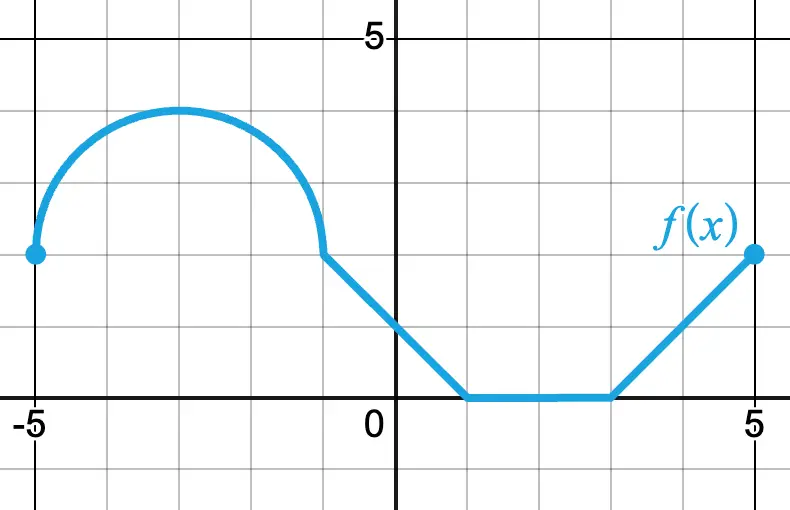
Shown below is the graph of function .
If is the function defined by
find the average rate of change of over the interval .
Solution
The average rate of change of over is
Since ,
and
Then the average rate of change of is
Finding from a limit
Most derivative problems ask you to find given a function . However, some problems involve identifying the original function and the point from a given limit.
The key is to recognize which limit definition is being used:
Examples
- Find a function and a number such that the following limit represents .
Solution
Since the limit notation specifies , match it to the 2nd definition
In the limit, the expression matches , which suggests that with .
Checking,
which matches the second term in the numerator of the limit expression.
Therefore, the limit represents the derivative of evaluated at .
- Find and a number such that the limit represents .
Solution
Since the limit notation specifies , then in the 1st limit definition
In the given limit, the expression matches , so .
Checking with ,
so
which matches the numerator.
Therefore, the limit represents the derivative of evaluated at .