



Related rates
Related rates problems involve quantities that change over time. In many real-world situations, several variables change together, and you can use related rates to calculate how the rate of change of one quantity affects another.
Step-by-step strategy
1. Define variables and draw a diagram if needed.
Write down given rates and target rates in mathematical terms.
For example, “the height is decreasing at a rate of inches per second” can be translated to
where is height and is time.
2. Find an equation that relates the given and target variables. There may be more than one equation involved in the problem.
If the relationship isn’t given directly, it’s often a geometric or trigonometric one, such as:
- a similarity proportion
- the Pythagorean theorem
- an area or volume formula
- a trigonometric function
3. Differentiate with respect to time using implicit differentiation.
- Treat any variable that changes over time as a function of .
- For example, if the distance between two objects is and increases over time, then it can be defined by . Use the chain rule when differentiating and multiply by .
4. Substitute known values and solve for the unknown rate.
Example 1: A classic problem
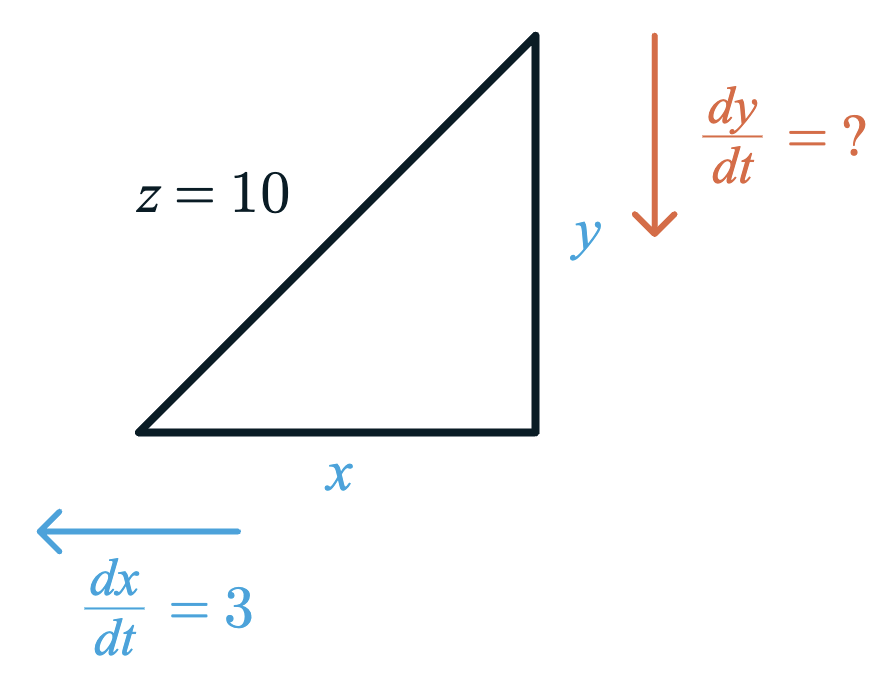
A -foot ladder is leaning against a wall. The bottom of the ladder slides away from the wall at a rate of feet per second. How fast is the top of the ladder sliding down the wall when the bottom is feet from the wall?
Solution
Step 1: Define variables and diagram
Given:
- ft and ft/s
Important: The rate of change is positive because increases as the ladder slides away from the wall.
Find:
- when ft
Step 2: Relate variables
To relate , , and , use the Pythagorean theorem for the right triangle.
Because the ladder length doesn’t change, can be replaced with :
Step 3: Differentiate with respect to time
Differentiate both sides with respect to :
Step 4: Substitute known values
Known:
-
ft and ft/s
-
To find , use the Pythagorean theorem
Now substitute into the differentiated equation:
Notice the negative sign: is decreasing, which matches the diagram (the top slides down).
So the top of the ladder is sliding down at .
Example 2: Using multiple equations
Sometimes more than one equation is involved.
Air is pumped into a balloon at a rate of ft per minute. At what rate is the surface area increasing (in ft per minute) when the volume is ft?
Solution
Step 1: Define variables and diagram
Given:
- ft/min
Important: The units tell you this is the rate of change of volume.
Find:
- (rate of change of surface area) when
Step 2: Relate variables
For a sphere, there are two relevant equations:
You could combine these into a single equation relating and , but you don’t have to. It’s fine to differentiate both equations and connect the rates afterward.
Step 3: Differentiate with respect to time
Differentiate both equations with respect to :
Notice that both equations contain . We can isolate in the volume equation and substitute it into the area equation to relate the two rates directly:
Step 4: Substitute known values
Known:
- ft/min
- Use the given volume to find :
Then substituting into ,
So the surface area of the balloon is increasing at a rate of
Example 3: Proportional relationships
In some problems, the relationship between quantities isn’t obvious at first. These often use similarity and proportional relationships.
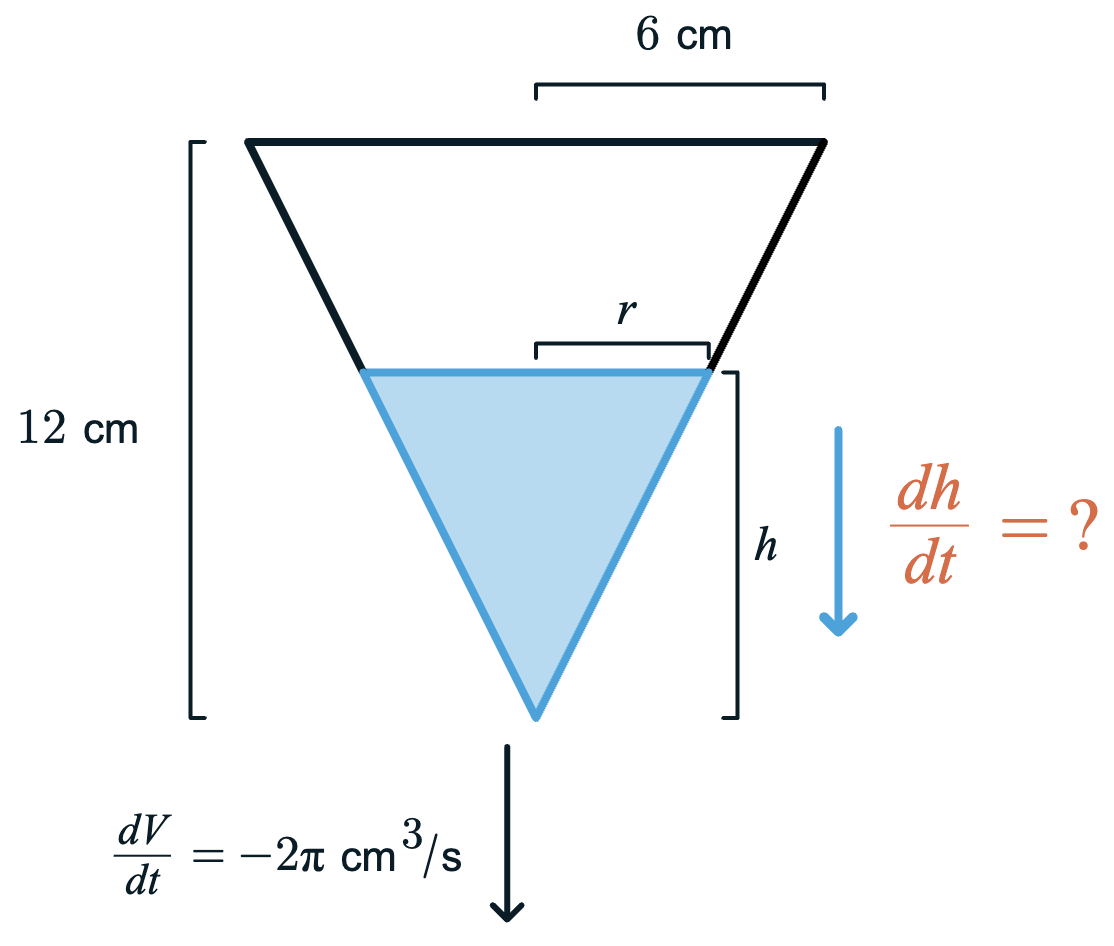
Water drains from a cone at cubic centimeters per second. The cone has a height of cm and a base radius of cm. How fast is the water level dropping when the height is cm?
Solution
Step 1: Define variables and diagram
Given:
- cm/s
- Negative because the volume of water is decreasing over time.
- The full cone has radius cm and height cm.
Find:
- when cm
Step 2: Relate variables
The volume of a cone is
Here, and refer to the radius and height of the water (the smaller cone). Both change as the water drains.
If we differentiate directly, we’d end up with both and due to the product rule. Since we aren’t given , it’s better to rewrite in terms of only.
To do this, note that the full cone and the smaller cone are similar triangles, so the ratio stays constant:
Substitute into the volume formula:
Now we have an equation that relates only the known variable and the target variable.
Step 3: Differentiate with respect to time
Step 4: Substitute known values
At cm and ,
The negative sign matches the situation: the water level is dropping at a rate of .
Example 4: Trigonometry
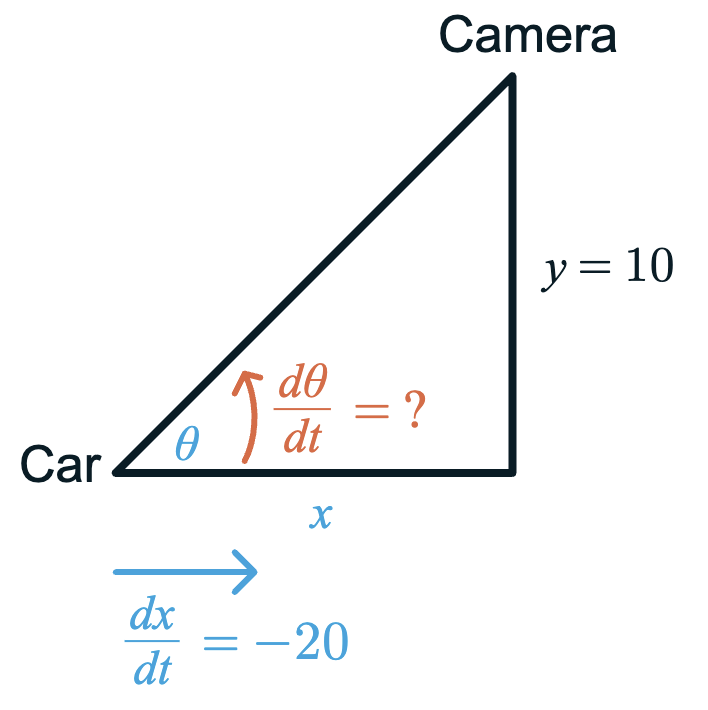
A camera is mounted on a -meter pole and is pointed at a car moving toward it. The car is traveling along a straight road at a speed of meters per second.
How fast is the angle of elevation from the car to the camera changing when the car is meters away from the pole?
Solution
Step 1: Define variables and diagram
Given:
- Height of pole: m
- Car’s motion: m/s
- Negative because the distance decreases as the car moves toward the pole.
Find:
- when meters.
Step 2: Relate variables
, , and are related by a trigonometric ratio:
Because the pole’s height is constant, can be replaced with :
Step 3: Differentiate with respect to time
Step 4: Substitute known values
You don’t need to compute directly. When m, the hypotenuse is m (by the Pythagorean theorem), so using the triangle in step 1,
Now substitute and and solve for :
The angle is increasing at a rate of , which matches the situation: as the car gets closer, the angle of elevation increases.
Alternatively, you could relate the variables using in step 2. Try solving it that way to confirm the answer.