Logarithmic functions
Logarithms and exponents describe the same relationship in two different forms. Any exponential equation can be rewritten as a logarithmic equation, and vice versa.
For example, consider the equation . This is equivalent to writing . In both forms, the value of that makes the statement true is .
A key reason logarithms matter is that they let you solve for variables in exponents. If the variable you want is in the exponent, you can’t isolate it using only basic algebraic operations - you typically need logarithms.
Just as exponent rules help you simplify exponential expressions, logarithm rules help you simplify logarithmic expressions.
Here is a quick diagram showing how the parts of an exponential expression match the parts of a logarithm.
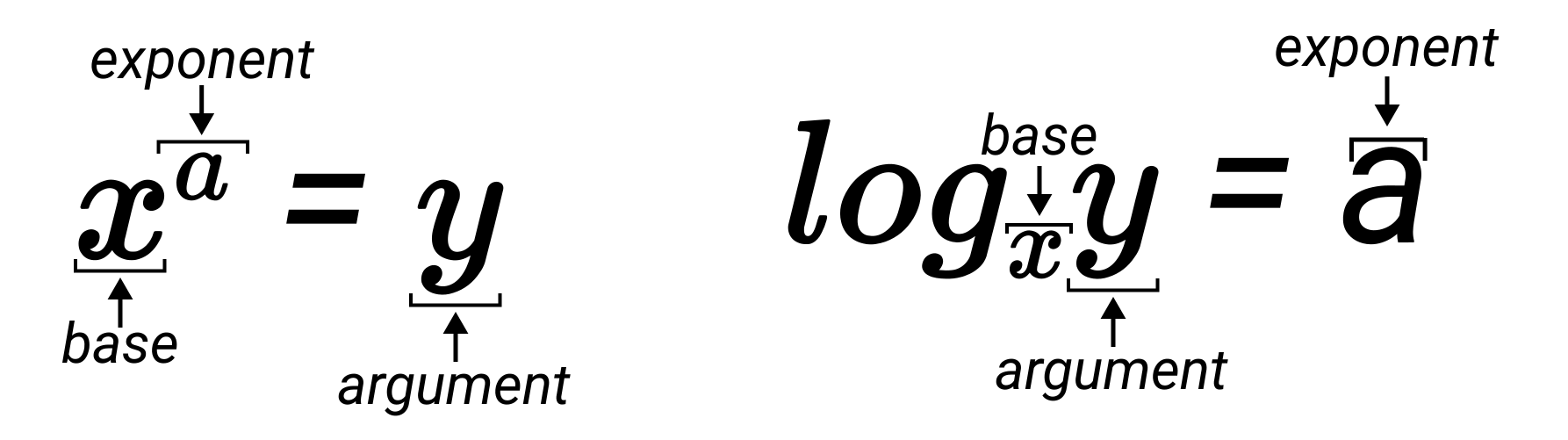
Below are a few examples of logarithms and their equivalent exponential forms. When the base is not written explicitly, the base is .
Logarithm rules and identities
These are some of the most useful logarithm rules to keep handy when simplifying expressions or solving equations involving logs.
Start the next example by using the final rule above (the change-of-base identity) to rewrite each denominator in base .
Example: The question below is from 2021 AMC 12B
What is the value of
A.
B.
C.
D.
E.
Answer: D.
Use the change-of-base identity to rewrite each denominator as a reciprocal in base :
Substituting these into the original expression flips the denominators and removes the complex fractions:
Now rewrite each logarithm so the arguments share common factors, which makes the product easier to expand and simplify:
Replace the simple logs with their values:
After distributing, all terms cancel except .
This next example is best handled by substitution.
Example: The question below is from 2022 AMC 12B
Suppose and are positive real numbers such that What is the greatest possible value of ?
A.
B.
C.
D.
E.
Answer: C.
Because , we can further simplify to .
Replacing with allows us to further simplify to .
This becomes a quadratic after distributing. If you let , the equation matches the form .
Among the two solutions to the quadratic, is greater.
Natural logarithms
Natural logarithms follow the same rules as other logarithms. The main difference is the base: natural logs use Euler’s number as the base.
You’ll usually see a natural logarithm written as instead of .
Try applying the usual logarithm rules to the next problem, which involves natural logarithms.
You will need the shoelace formula for the example below. It finds the area of a quadrilateral using only the coordinates of its vertices.
Example: The question below is from 2020 AMC 12A
The vertices of a quadrilateral lie on the graph of , and the -coordinates of these vertices are consecutive positive integers. The area of the quadrilateral is . What is the -coordinate of the leftmost vertex?
A.
B.
C.
D.
E.
Answer: D.
By using the shoelace formula, you will discover that everything simplifies to
After looking at the answer choices, it becomes clear that n must be for the fraction to be .
Graphical representation
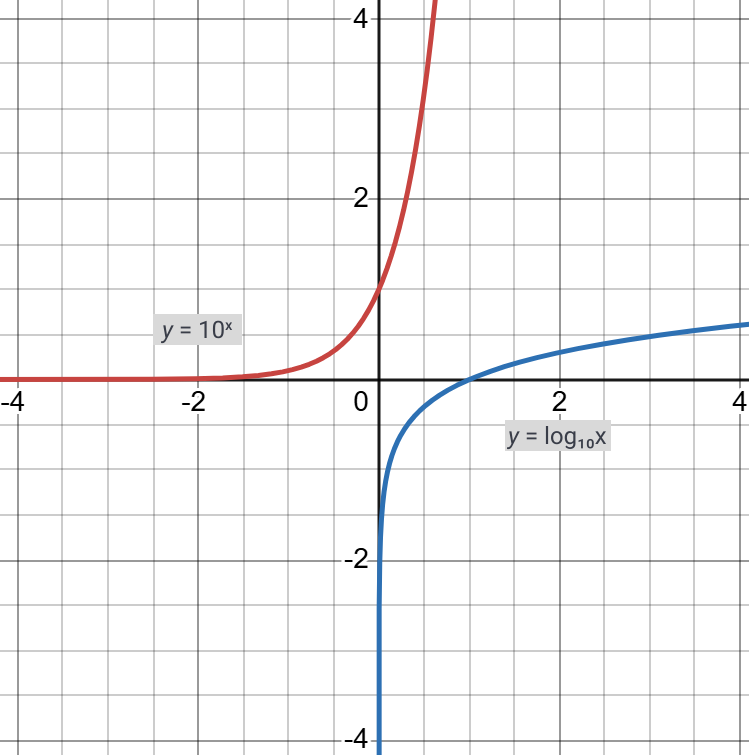
A logarithmic function has a distinctive graph.
- It crosses the -axis at because for any valid base .
- For bases greater than , the function increases, but it increases slowly and flattens out as grows.
Notice that the logarithmic function is reflected across by the function .