



Complex numbers
Real numbers are the numbers you can place on the number line. This includes integers, rational numbers, irrational numbers, and both positive and negative values.
Imaginary numbers come from taking the square root of a negative number. For example, is not a real number, but it can be written as , where .
A complex number is the sum of a real part and an imaginary part. In the standard form below, is the real part and is the coefficient of the imaginary part.
The square root of is , so must be . If you keep multiplying by another , the results cycle in a repeating pattern. Every fourth power returns to the same value.
| Product | |
|---|---|
This repeating pattern is essential when you simplify expressions involving large powers of .
Example: The question below is from 2018 AMC 12A
The solutions to the equations and where form the vertices of a parallelogram in the complex plane. The area of this parallelogram can be written in the form where and are positive integers and neither nor is divisible by the square of any prime number. What is
A.
B.
C.
D.
E.
Answer: A.
Complex number plane
The complex plane lets you plot complex numbers visually.
- The horizontal axis represents the real part .
- The vertical axis represents the imaginary part .
- Positive values of are above the horizontal axis.
- Negative values of are below the horizontal axis.
Here is an example.
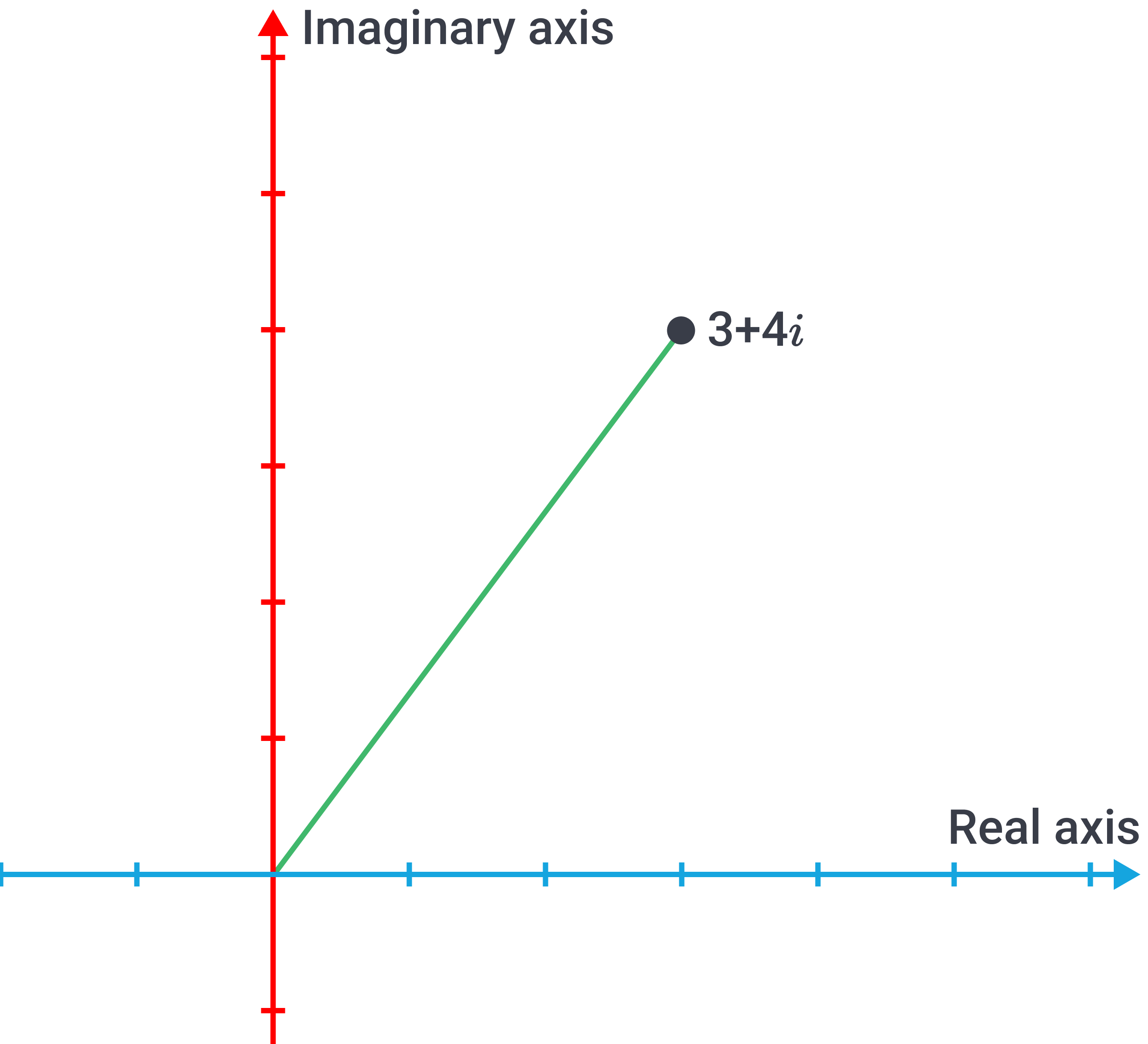
The magnitude of a complex number is the distance from the origin to the point representing the complex number. You can find this distance using the Pythagorean Theorem.
Therefore, the magnitude is .
Euler’s formula and identity
Some AMC 12 problems use Euler’s formula and Euler’s identity. These ideas connect exponents, trigonometry, and complex numbers in a single relationship. In particular, Euler’s formula tells you what happens when is raised to an imaginary exponent.
From this formula, you can derive Euler’s identity by substituting .
On the complex plane, values of the form lie on a circle (with measured in radians). That’s why the point corresponding to lands at on the real axis.
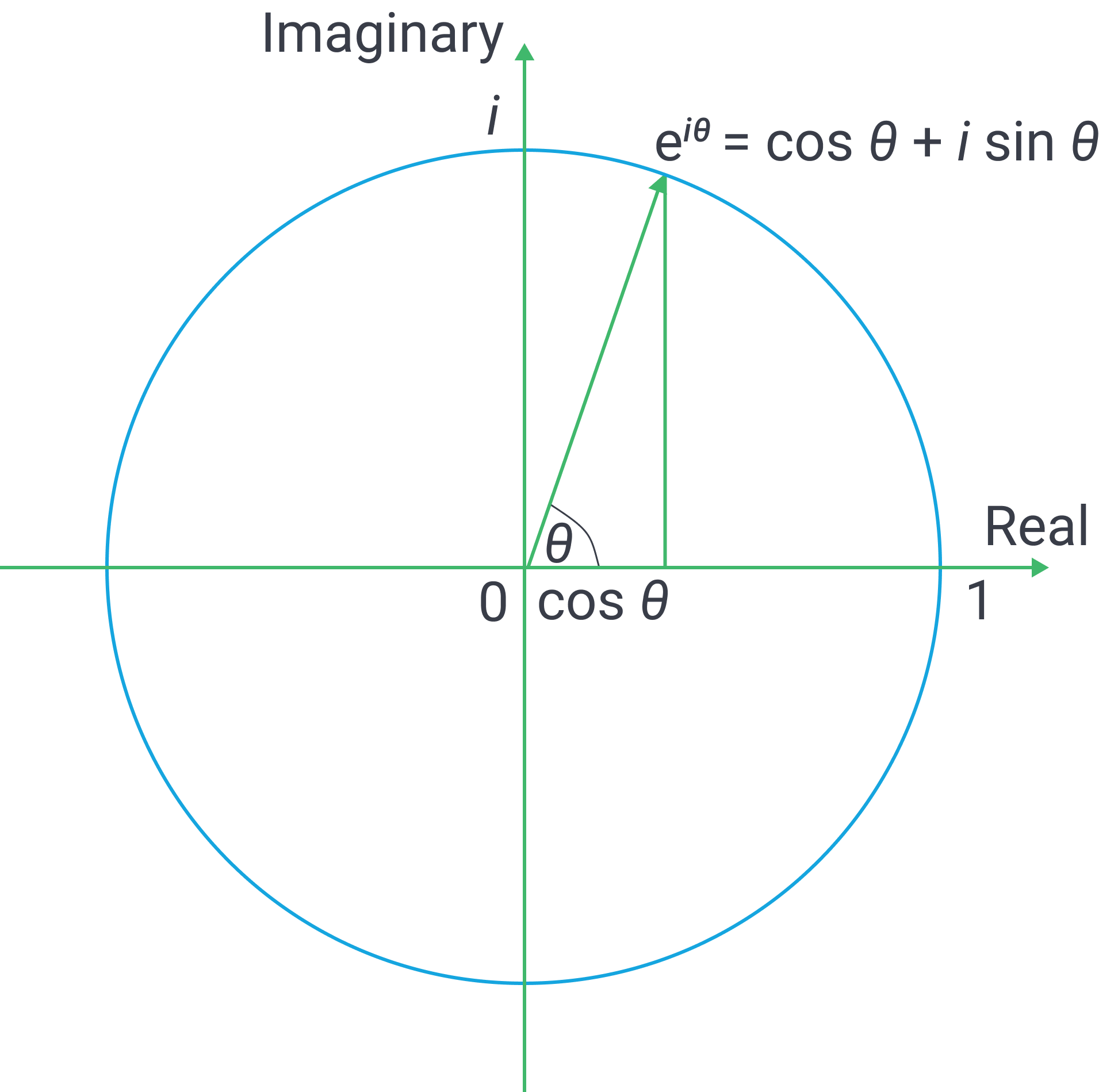
This next problem is a good example of how the complex-plane picture can simplify the reasoning. As you think about the points on the circle, ask:
- At which angles does the expression equal ?
- At which angles does it equal ?
- How many times does each happen?
Example: The question below is from 2017 AMC 12A
There are different complex numbers such that . For how many of these is a real number?
A.
B.
C.
D.
E.
Answer: D.