



Trigonometric functions
Trigonometry studies the relationships between angles and side lengths in right triangles. The three most common trigonometric functions are sine (sin), cosine (cos), and tangent (tan).
Each one is a ratio of two side lengths, measured relative to a chosen acute interior angle.
- Sine: opposite ÷ hypotenuse
- Cosine: adjacent ÷ hypotenuse
- Tangent: opposite ÷ adjacent
You can also think of tangent as a slope: it’s the slope of the line from the angle’s vertex up to the point on the hypotenuse.
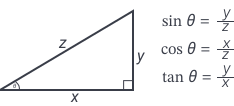
The interior angle (shown above as ) can be measured in degrees or radians. These are two different units for the same idea: how much the angle turns.
Radians often appear in terms of . A key conversion to remember is:
- radians = 180 degrees
Here’s a reference table of common degree-radian equivalents. Notice that each increase of 30 degrees adds another radians.
| Angle (°) | Radians |
|---|---|
| 0 | |
| 30 | |
| 60 | |
| 90 | |
| 120 | |
| 150 | |
| 180 | |
| 210 | |
| 240 | |
| 270 | |
| 300 | |
| 330 | |
| 360 |
Unit circle
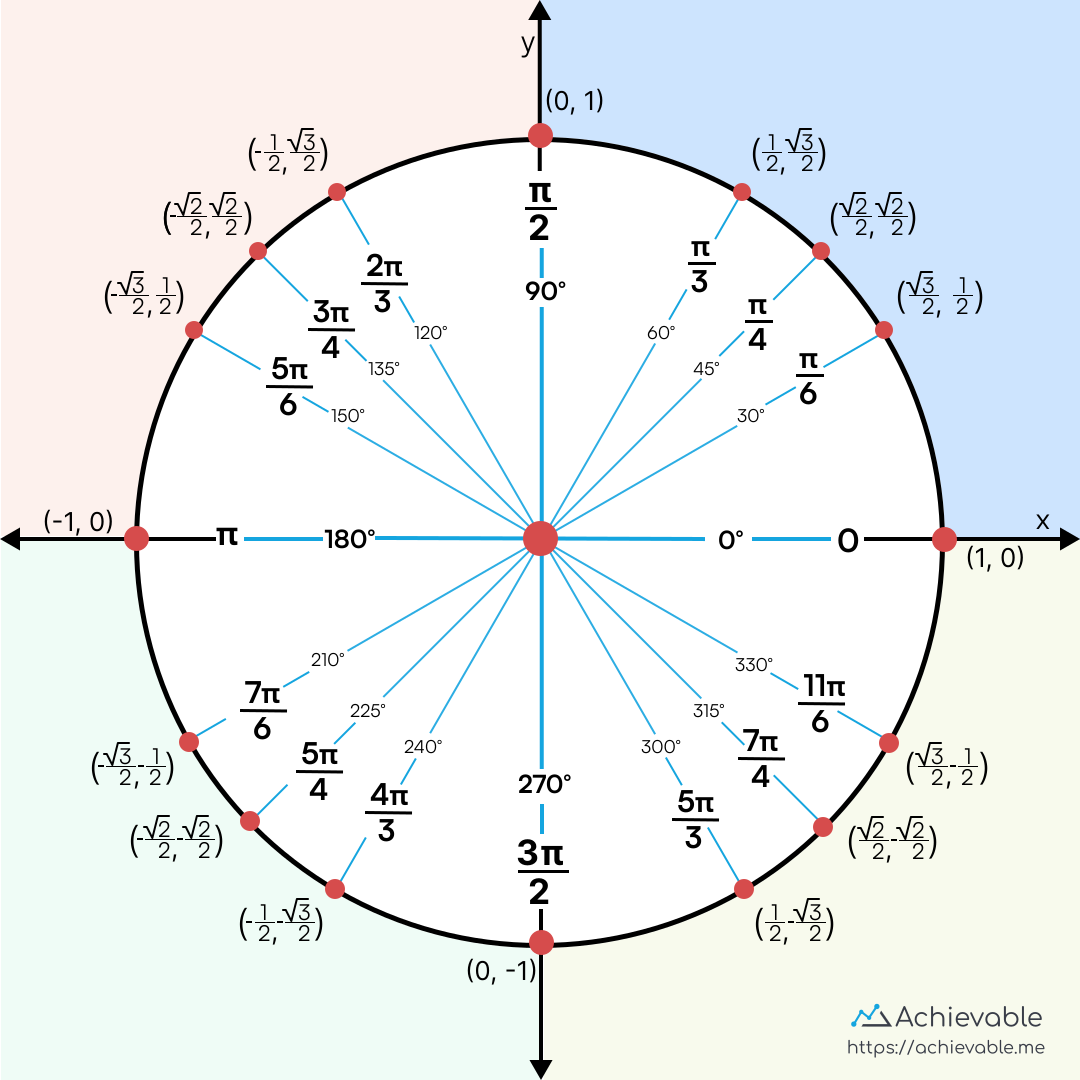
A common way to find and values is the unit circle, a circle of radius 1 centered at the origin.
As an angle rotates around the circle:
- is the horizontal coordinate (left/right distance).
- is the vertical coordinate (height).
- is the slope of the line from the origin to the point on the circle.
On the unit circle, the hypotenuse of the associated right triangle is always 1 (the radius). That’s why and match the triangle’s side lengths directly: each ratio is divided by a hypotenuse of 1.
You may also see three additional trig functions in AMC 12 problems: secant (sec), cosecant (csc), and cotangent (cot). These are reciprocals (or closely related ratios) of the three basic functions. They’re less common, but they do appear in harder questions.
Graphing trig functions
Trig functions can also be graphed. When you graph a trig function:
- The x-axis represents the angle (usually in radians).
- The y-axis represents the value of the trig function at that angle.
Two important graph features are:
- Period: the horizontal length of one full repeating cycle.
- Amplitude: the vertical distance from the midline to a peak (or to a trough).
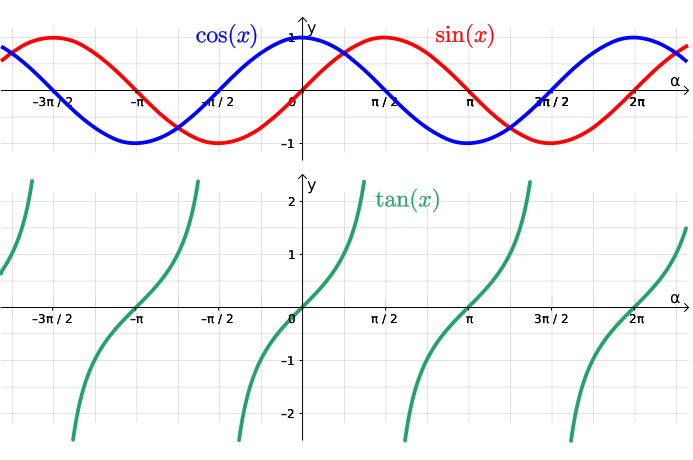
For the basic and graphs, the period is because radians is one full rotation around the unit circle.
Try using the unit circle above to compare the sine and cosine values at each radian measure, and check that they match the outputs on the graph below.
Example: The question below is from 2021 AMC 12B
How many values of in the interval satisfy
A.
B.
C.
D.
E.
Answer: D.
Start by rearranging the equation so each trig expression is on its own side:
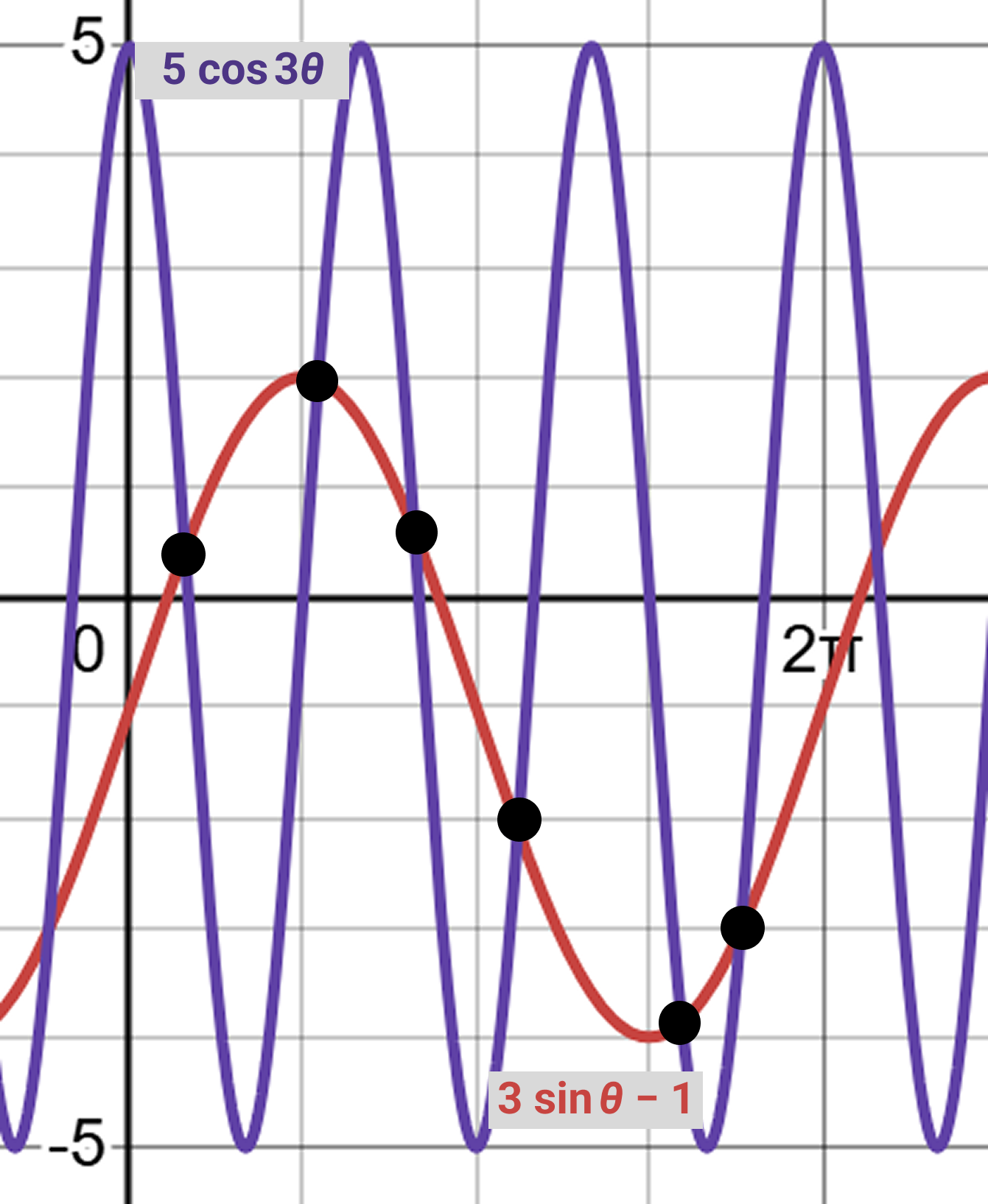
Now think of this as an intersection problem: the number of solutions is the number of times the graphs of and cross on the interval .
- is a sine graph with amplitude 3, shifted down by 1.
- is a cosine graph with amplitude 5, and the makes it complete 3 full cycles over to .
Over , the faster oscillating cosine curve intersects the shifted sine curve six times (twice per cosine cycle). The graph below shows the six intersection points.
Trigonometric identities
You don’t need to memorize every trigonometric identity for the AMC, but these three core identities are the most likely to be useful.