



Transformations and symmetry
Transforming graphs is a useful skill on many AMC geometry problems. Here, you’ll work with three common ideas:
- symmetry (even and odd functions)
- reflections
- rotations
Symmetry
A graph can have symmetry in a few different ways. For functions, the two most common are:
- y-axis symmetry, which corresponds to an even function
- origin symmetry, which corresponds to an odd function
A graph is symmetric about the origin if it looks the same after a rotation around the origin.
You won’t see a nontrivial function that’s symmetric across the x-axis, because x-axis symmetry would require both and to be on the graph. That gives two different outputs for the same input , which violates the definition of a function.
Here are the definitions you’ll use.
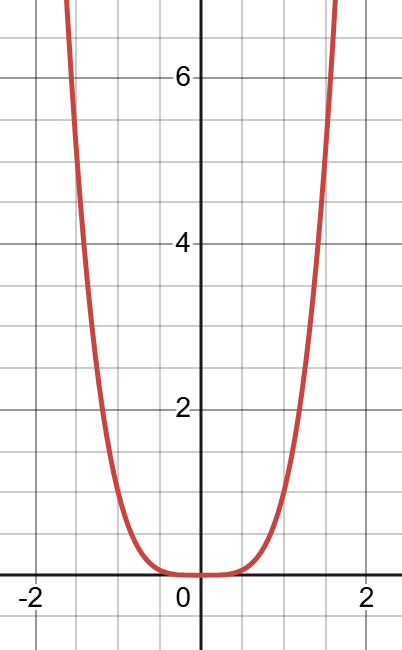
For an even function, you can think of the y-axis as a mirror: whatever appears on the left side appears identically on the right.
For example, the graph of is even. If you plug in inputs with the same magnitude but opposite signs (like and ), you get the same output. That’s exactly what means.
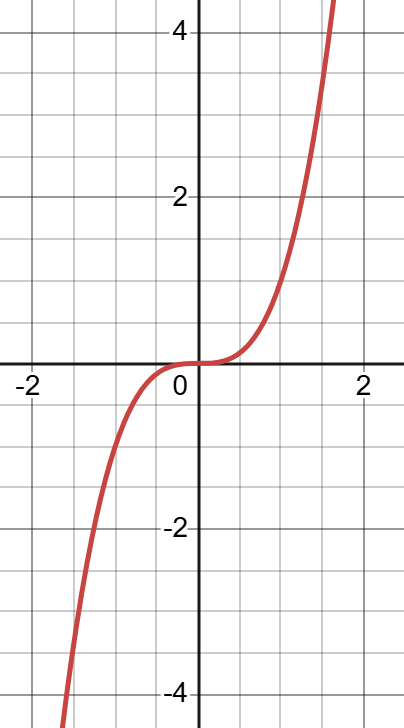
For an odd function, points come in pairs that are opposite across the origin: if is on the graph, then is also on the graph. That’s why odd symmetry matches a rotation about the origin.
All odd, continuous functions must pass through the origin. This isn’t the only requirement for odd symmetry, but it’s necessary: if the graph is unchanged by a rotation about the origin, then the origin must be on the graph.
For example, is odd.
Rotation
Picture graph paper on a table. If you place a pin at a point and spin the paper, you rotate the graph around that point. On the AMC, rotations are usually about the origin, so the “pin” is at .
To rotate a point, it helps to memorize what happens to coordinates.
-
A clockwise rotation about the origin sends to .
- You swap the coordinates, then multiply the new y-coordinate by .
-
A counterclockwise rotation about the origin sends to .
- You swap the coordinates, then multiply the new x-coordinate by .
| Rotation | Before rotation | After rotation |
|---|---|---|
| 90° clockwise | ||
| 90° counterclockwise | ||
| 180° |
Try this challenging AMC problem that uses both rotation and reflection.
- Any total rotation that’s a multiple of 360° ends back at the original position.
- Reflecting across both the -axis and the -axis (in either order) is equivalent to a 180° rotation.
Example: The question below is from 2020 AMC 10A
Let be the triangle in the coordinate plane with vertices and Consider the following five isometries (rigid transformations) of the plane: rotations of and counterclockwise around the origin, reflection across the -axis, and reflection across the -axis. How many of the sequences of three of these transformations (not necessarily distinct) will return to its original position? (For example, a rotation, followed by a reflection across the -axis, followed by a reflection across the -axis will return to its original position, but a rotation, followed by a reflection across the -axis, followed by another reflection across the -axis will not return to its original position.)
A.
B.
C.
D.
E.
Answer: A.