Achievable logoAchievable logo
AMC
Sign in
Sign up
Purchase
Textbook
Practice exams
Support
How it works
Exam catalog
Mountain with a flag at the peak
Textbook
Introduction
1. Algebra
2. Geometry
3. Number theory
4. Counting and probability
5. Intermediate topics (AMC 10/12)
5.1 Polynomials
5.2 Sequences and series
5.3 Transformations and symmetry
6. Advanced topics (AMC 12)
7. General approaches
8. Practical strategies
Wrapping up
Achievable logoAchievable logo
5.1 Polynomials
Achievable AMC
5. Intermediate topics (AMC 10/12)

Polynomials

6 min read
Font
Discuss
Share
Feedback

This chapter only applies to AMC 10/12 test takers.

Polynomials are built by adding terms. Each term is a coefficient multiplied by a variable raised to a nonnegative integer exponent. Many polynomials also include a constant term (a term with no variable). In the general form below, that constant is a0​.

When you set a polynomial equal to zero and solve for the variable, the equation can have more than one solution. Any solution is called a root (or zero) of the polynomial. Graphically, roots are the x-values where the graph crosses the x-axis - that is, where y=0.

A polynomial is defined like so.

an​xn+an−1​xn−1+⋅⋅⋅+a1​x+a0​

In this definition, the coefficients are the a values and the variable is x. The term a0​ is the constant because it is not multiplied by x. Polynomials must have whole-number exponents (no negatives, fractions, or variables in the exponent).

Here are some examples of polynomials:

3x4+5x3+7x2+4x+5

23+2x2+13x−2

(x+3)(x2−x+9)

Vieta’s formula for higher-degree polynomials

In the last chapter, we used Vieta’s formulas for quadratics. The same idea extends to higher-degree polynomials: certain combinations of the roots can be written directly in terms of the coefficients.

P(x)=an​xn+an−1​xn−1+⋅⋅⋅+a1​x+a0​

r1​+r2​+⋅⋅⋅+rn−1​+rn​=−an​an−1​​

r1​r2​⋅⋅⋅rn​=(−1)nan​a0​​

Here’s what these say in words:

  • The sum of all roots equals the negative of the coefficient of xn−1 divided by the coefficient of xn.
  • The product of all roots equals an​a0​​, with a sign of (−1)n (positive when n is even, negative when n is odd).

You’ll often see these used with cubic polynomials. For a cubic, the formulas simplify to:

P(x)=ax3+bx2+cx+d

r1​+r2​+r3​=−ab​

r1​r2​r3​=−ad​

Notice that the product of the roots is automatically negative here because a cubic has odd degree.

Example: The question below is from 2003 AMC 12B

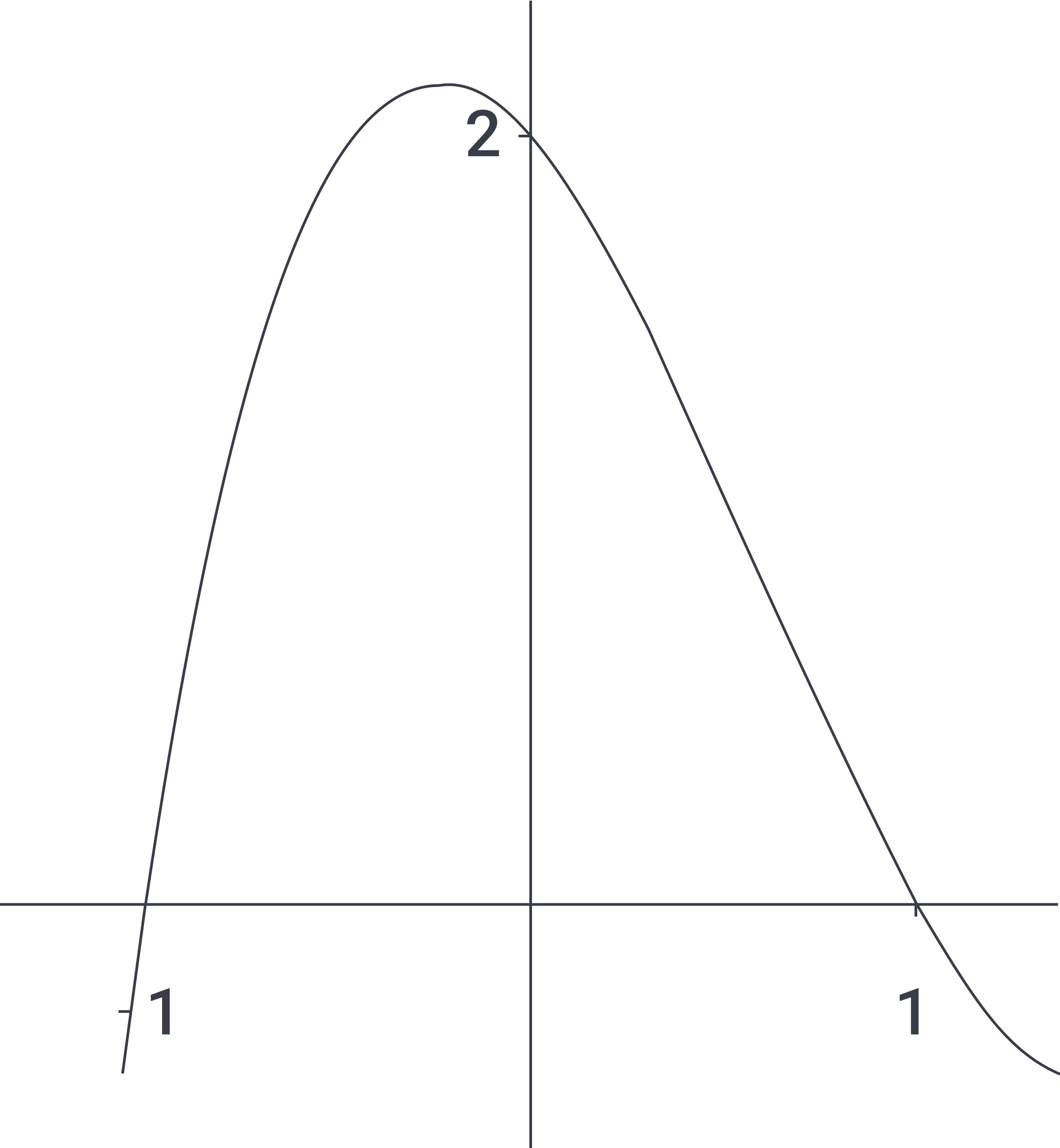
Part of the graph off(x)=ax3+bx2+cx+d is shown. What is b?

graph of f(x) = ax^3 + bx^2 + cx + d

Diagram not drawn to scale
A. −4
B. −2
C. 0
D. 2
E. 4

(spoiler)

Answer: B. −2

Example: The question below is from 2021 AMC 12A

All the roots of the polynomial z6−10z5+Az4+Bz3+Cz2+Dz+16 are positive integers, possibly repeated. What is the value of B?
A. −88
B. −80
C. −64
D. −41
E. −40

(spoiler)

Answer: A. −88

Newton sums

Newton Sums let you find sums of powers of the roots without solving for the roots directly. The idea is to use the coefficients to compute these sums step by step.

  • If you only need the sum of the roots (first power), Vieta’s formula is usually the quickest tool.
  • If you need sums like “sum of squares of the roots” or “sum of cubes of the roots,” Newton Sums are designed for that.

This method is recursive: you compute the first power sum, then use it to compute the second power sum, then the third, and so on.

To use the standard form below, the leading coefficient must be 1. If your polynomial starts with something like axn, divide the entire polynomial by a first.

f(x)=xn+a1​xn−1+a2​xn−2+⋅⋅⋅+an−1​x+an​

P1​+a1​=0

P2​+a1​P1​+2a2​=0

P3​+a1​P2​+a2​P1​+3a3​=0

P4​+a1​P3​+a2​P2​+a3​P1​+4a4​=0

Here, P1​ is the sum of the roots to the first power, P2​ is the sum of the squares of the roots, and so on. The coefficients a1​,a2​,…are the coefficients that come after the leading term.

Example: The question below is from 2019 AMC 12A

Let sk​ denote the sum of the kth powers of the roots of the polynomial x3−5x2+8x−13. In particular, s0​=3, s1​=5, and s2​=9. Let a, b, and c be real numbers such that sk+1​=ask​+bsk−1​+csk−2​ for k=2, 3, .... What is a+b+c?
A. −6
B. 0
C. 6
D. 10
E. 26

(spoiler)

Answer: D. 10

Rational expressions

Rational expressions are fractions where the numerator and denominator are both polynomials. They’re called “rational” because a fraction is a ratio.

For example, consider 3x−21x2−49​. Rational expressions often simplify by factoring and canceling common factors:

  • Factor the numerator: x2−49=(x+7)(x−7)
  • Factor the denominator: 3x−21=3(x−7)

So,

3x−21x2−49​=(3)(x−7)(x+7)(x−7)​

Now (x−7) cancels (as long as x=7), leaving the simplified expression 3x+7​.

Common themes

  • If a polynomial is symmetric about the y-axis, the sum of the roots is 0 and for every positive root there is a negative root of the same absolute value.
  • You still may need to divide rational expressions using long division if simplification is not enough.
  • Having an intuitive understanding of how polynomials behave graphically can help you to automatically eliminate answer choices.
  • Do not be afraid to plug in answer choices. More complex polynomial problems may just be solved more simply by testing out the answer choices.

Polynomials: Definitions and structure\

  • Built from terms: coefficient × variable^nonnegative integer exponent
  • General form: an​xn+an−1​xn−1+⋯+a1​x+a0​
  • Roots (zeros): solutions to P(x)=0; graphically, x-intercepts

Vieta’s formulas for higher-degree polynomials\

  • Sum of roots: −(an−1​/an​)
  • Product of roots: (−1)n(a0​/an​)
    • Sign depends on degree n (even: positive, odd: negative)
  • For cubics: r1​+r2​+r3​=−b/a, r1​r2​r3​=−d/a

Newton sums\

  • Compute sums of powers of roots recursively using coefficients
  • Standard form (leading coefficient 1):
    • P1​+a1​=0
    • P2​+a1​P1​+2a2​=0
    • P3​+a1​P2​+a2​P1​+3a3​=0
    • P4​+a1​P3​+a2​P2​+a3​P1​+4a4​=0
  • Pk​: sum of kth powers of roots

Rational expressions\

  • Fractions with polynomial numerator and denominator
  • Simplify by factoring and canceling common factors
  • May require polynomial long division if simplification is insufficient

Common themes\

  • Symmetry about y-axis: sum of roots =0; roots occur in ± pairs
  • Use graphical intuition to eliminate answer choices
  • Plug in answer choices or test values for complex problems
  • Long division may be needed for rational expressions that don’t simplify easily

Sign up for free to take 6 quiz questions on this topic

Previous
Next  | 5.2 Sequences and series
All rights reserved ©2016 - 2026 Achievable, Inc.

Polynomials

This chapter only applies to AMC 10/12 test takers.

Polynomials are built by adding terms. Each term is a coefficient multiplied by a variable raised to a nonnegative integer exponent. Many polynomials also include a constant term (a term with no variable). In the general form below, that constant is a0​.

When you set a polynomial equal to zero and solve for the variable, the equation can have more than one solution. Any solution is called a root (or zero) of the polynomial. Graphically, roots are the x-values where the graph crosses the x-axis - that is, where y=0.

A polynomial is defined like so.

an​xn+an−1​xn−1+⋅⋅⋅+a1​x+a0​

In this definition, the coefficients are the a values and the variable is x. The term a0​ is the constant because it is not multiplied by x. Polynomials must have whole-number exponents (no negatives, fractions, or variables in the exponent).

Here are some examples of polynomials:

3x4+5x3+7x2+4x+5

23+2x2+13x−2

(x+3)(x2−x+9)

Vieta’s formula for higher-degree polynomials

In the last chapter, we used Vieta’s formulas for quadratics. The same idea extends to higher-degree polynomials: certain combinations of the roots can be written directly in terms of the coefficients.

P(x)=an​xn+an−1​xn−1+⋅⋅⋅+a1​x+a0​

r1​+r2​+⋅⋅⋅+rn−1​+rn​=−an​an−1​​

r1​r2​⋅⋅⋅rn​=(−1)nan​a0​​

Here’s what these say in words:

  • The sum of all roots equals the negative of the coefficient of xn−1 divided by the coefficient of xn.
  • The product of all roots equals an​a0​​, with a sign of (−1)n (positive when n is even, negative when n is odd).

You’ll often see these used with cubic polynomials. For a cubic, the formulas simplify to:

P(x)=ax3+bx2+cx+d

r1​+r2​+r3​=−ab​

r1​r2​r3​=−ad​

Notice that the product of the roots is automatically negative here because a cubic has odd degree.

Example: The question below is from 2003 AMC 12B

Part of the graph off(x)=ax3+bx2+cx+d is shown. What is b?

graph of f(x) = ax^3 + bx^2 + cx + d

Diagram not drawn to scale
A. −4
B. −2
C. 0
D. 2
E. 4

(spoiler)

Answer: B. −2

Example: The question below is from 2021 AMC 12A

All the roots of the polynomial z6−10z5+Az4+Bz3+Cz2+Dz+16 are positive integers, possibly repeated. What is the value of B?
A. −88
B. −80
C. −64
D. −41
E. −40

(spoiler)

Answer: A. −88

Newton sums

Newton Sums let you find sums of powers of the roots without solving for the roots directly. The idea is to use the coefficients to compute these sums step by step.

  • If you only need the sum of the roots (first power), Vieta’s formula is usually the quickest tool.
  • If you need sums like “sum of squares of the roots” or “sum of cubes of the roots,” Newton Sums are designed for that.

This method is recursive: you compute the first power sum, then use it to compute the second power sum, then the third, and so on.

To use the standard form below, the leading coefficient must be 1. If your polynomial starts with something like axn, divide the entire polynomial by a first.

f(x)=xn+a1​xn−1+a2​xn−2+⋅⋅⋅+an−1​x+an​

P1​+a1​=0

P2​+a1​P1​+2a2​=0

P3​+a1​P2​+a2​P1​+3a3​=0

P4​+a1​P3​+a2​P2​+a3​P1​+4a4​=0

Here, P1​ is the sum of the roots to the first power, P2​ is the sum of the squares of the roots, and so on. The coefficients a1​,a2​,…are the coefficients that come after the leading term.

Example: The question below is from 2019 AMC 12A

Let sk​ denote the sum of the kth powers of the roots of the polynomial x3−5x2+8x−13. In particular, s0​=3, s1​=5, and s2​=9. Let a, b, and c be real numbers such that sk+1​=ask​+bsk−1​+csk−2​ for k=2, 3, .... What is a+b+c?
A. −6
B. 0
C. 6
D. 10
E. 26

(spoiler)

Answer: D. 10

Rational expressions

Rational expressions are fractions where the numerator and denominator are both polynomials. They’re called “rational” because a fraction is a ratio.

For example, consider 3x−21x2−49​. Rational expressions often simplify by factoring and canceling common factors:

  • Factor the numerator: x2−49=(x+7)(x−7)
  • Factor the denominator: 3x−21=3(x−7)

So,

3x−21x2−49​=(3)(x−7)(x+7)(x−7)​

Now (x−7) cancels (as long as x=7), leaving the simplified expression 3x+7​.

Common themes

  • If a polynomial is symmetric about the y-axis, the sum of the roots is 0 and for every positive root there is a negative root of the same absolute value.
  • You still may need to divide rational expressions using long division if simplification is not enough.
  • Having an intuitive understanding of how polynomials behave graphically can help you to automatically eliminate answer choices.
  • Do not be afraid to plug in answer choices. More complex polynomial problems may just be solved more simply by testing out the answer choices.
Key points

Polynomials: Definitions and structure\

  • Built from terms: coefficient × variable^nonnegative integer exponent
  • General form: an​xn+an−1​xn−1+⋯+a1​x+a0​
  • Roots (zeros): solutions to P(x)=0; graphically, x-intercepts

Vieta’s formulas for higher-degree polynomials\

  • Sum of roots: −(an−1​/an​)
  • Product of roots: (−1)n(a0​/an​)
    • Sign depends on degree n (even: positive, odd: negative)
  • For cubics: r1​+r2​+r3​=−b/a, r1​r2​r3​=−d/a

Newton sums\

  • Compute sums of powers of roots recursively using coefficients
  • Standard form (leading coefficient 1):
    • P1​+a1​=0
    • P2​+a1​P1​+2a2​=0
    • P3​+a1​P2​+a2​P1​+3a3​=0
    • P4​+a1​P3​+a2​P2​+a3​P1​+4a4​=0
  • Pk​: sum of kth powers of roots

Rational expressions\

  • Fractions with polynomial numerator and denominator
  • Simplify by factoring and canceling common factors
  • May require polynomial long division if simplification is insufficient

Common themes\

  • Symmetry about y-axis: sum of roots =0; roots occur in ± pairs
  • Use graphical intuition to eliminate answer choices
  • Plug in answer choices or test values for complex problems
  • Long division may be needed for rational expressions that don’t simplify easily

More from Intermediate topics (AMC 10/12)

  • Sequences and series
  • Transformations and symmetry