


Achievable logoAchievable logo
PTCE
Sign in
Sign up
Purchase
Textbook
Practice exams
Support
How it works
Resources
Exam catalog
Mountain with a flag at the peak
Textbook
Introduction
1. Medications
1.1 Generic names and brand names
1.2 Medical terminology
1.3 Classification of medications
1.4 Drug interactions and contraindications
1.4.1 Common and life-threatening drug interactions
1.4.2 Pharmacological drug-drug interactions
1.4.3 Pharmacokinetic drug-drug interactions
1.4.4 Other drug interactions
1.4.5 Additional information and drug contraindications
1.5 Medications by organ system
1.6 Drug strengths, dose, and dosage forms
1.7 Routes of administration and special handling of drugs
1.8 Medication side effects, adverse effects and allergies
1.9 Indications of medications and dietary supplements
1.10 Drug stability
1.11 Proper storage of medications
1.12 Vaccine types and schedules
2. Patient safety and quality assurance
3. Order entry and processing
4. Federal requirements
Wrapping up
Achievable logoAchievable logo
1.4.3 Pharmacokinetic drug-drug interactions
Achievable PTCE
1. Medications
1.4. Drug interactions and contraindications

Pharmacokinetic drug-drug interactions

6 min read
Font
Discuss
Share
Feedback

Pharmacokinetics is “what the body does to the drug.” It includes absorption, distribution, metabolism, excretion, and overall drug elimination.

A helpful way to organize pharmacokinetic interactions is the ADME framework:

  • “A” for absorption
  • “D” for distribution
  • “M” for metabolism
  • “E” for elimination

Drug absorption

Drug absorption depends on the route of administration and the drug’s properties.

In general, small, unionized, lipid-soluble drugs are absorbed more easily. Most drugs are absorbed in the small intestine because it has a large surface area.

Most drugs are absorbed by passive diffusion, meaning they move from an area of higher concentration to an area of lower concentration. Some drugs use other mechanisms, including active transport, facilitated passive diffusion, and pinocytosis.

Ionization matters because unionized drug molecules cross membranes more easily:

  • Weak acids are more unionized in an acidic environment, so they’re absorbed better in acidic conditions.
  • Weak bases are more unionized in an alkaline environment, so they’re absorbed better in alkaline conditions.

This same idea helps explain urinary drug excretion: alkalinizing the urine can accelerate the excretion of weak acids (like aspirin), and acidifying the urine can accelerate the excretion of weak bases.

Definitions
Bioavailability
The proportion of a dose that reaches the systemic circulation.
It increases as drug absorption increases.
First pass effect
Metabolism of an oral drug to inactive forms in the gut wall and liver before it reaches the systemic circulation.
The greater the first-pass effect, the lower the bioavailability.

Drug distribution

Drug distribution is not uniform throughout the body. Several factors determine how much drug reaches different tissues:

  • Solubility: Lipid-soluble drugs (for example, some anesthetics) can cross into lipid-rich tissues such as the brain.
  • Protein and tissue binding: Binding affects where the drug “stays.” For example, warfarin largely remains in the bloodstream because it binds strongly to plasma albumin.
  • Blood supply (perfusion): Well-perfused tissues reach higher drug concentrations faster than tissues with lower blood flow.
  • Tissue mass: The amount of tissue can influence how much drug is taken up overall.
  • Type of protein binding:
    • Acidic drugs tend to bind more to albumin.
    • Basic drugs tend to bind more to alpha-1 acid glycoprotein and lipoproteins.

Protein binding influences both distribution and duration of action because only the unbound fraction can readily leave the bloodstream and interact with targets.

Volume of distribution (Vd) describes how extensively a drug distributes in the body:

  • Drugs with a small Vd are largely confined to the blood.
  • Drugs with a large Vd distribute widely into tissues and body compartments.

Drug metabolism

Drug metabolism occurs primarily in the liver, but it can also occur in the kidneys, lungs, blood, and intestines.

Key points about metabolism:

  • Prodrugs are metabolized into active drugs.
  • Most drugs become inactive after metabolism.
  • Some drugs form toxic metabolites.
  • A major goal of metabolism is to make the drug (or its products) more water soluble (polar) so it can be eliminated more easily.

Types of metabolic reactions:

  • Phase 1 reactions (non-synthetic): Convert the drug to a more polar or more reactive/active form. Oxidation, reduction, deamination, hydrolysis.
  • Phase 2 reactions (synthetic): Make the drug more water soluble; the end product is inactive. Conjugation with glucuronic acid, glycine, sulfate, glutathione, etc.

Metabolism rates vary among patients:

  • Rapid metabolizers may not reach effective blood and tissue levels.
  • Slow metabolizers have a higher risk of adverse effects.

Factors that affect metabolism include genetics, age, coexisting liver or other diseases, and concomitant use of drugs that alter metabolism.

Cytochrome P450 (Cyt P450) enzymes (primarily on the smooth endoplasmic reticulum of the liver) carry out most oxidation reactions, and polymorphisms can change drug metabolism. Major enzymes include CYP3A4 and CYP2D6.

  • Inhibitors of Cyt P450 decrease enzyme activity.
  • Inducers of Cyt P450 increase enzyme activity.

Common inhibitors and inducers of Cyt P450 enzymes:

  • Inhibitors: Cimetidine, amiodarone, erythromycin, ciprofloxacin, omeprazole, fluconazole, grapefruit juice, ritonavir, isoniazid.

  • Inducers: Carbamazepine, phenytoin, rifampin, phenobarbital, chronic alcohol use, dexamethasone.

Pitfall: Inhibitors can raise the levels of drugs cleared by these enzymes (risk of toxicity); inducers can lower them (risk of treatment failure). The prescriber or pharmacist decides any dose change - the technician’s role is to recognize the combination and refer it to the pharmacist.

Drug excretion or elimination

Most drugs are excreted by the kidneys. Inhaled anesthetics are mainly excreted by the lungs, and some drugs are excreted in bile and feces.

Elimination is the removal of drug from the body, through metabolism and excretion (mainly by the kidneys). Drugs follow one of two elimination patterns: first-order or zero-order.

First-order elimination occurs when the rate of elimination is directly proportional to the remaining drug concentration. In other words, a constant fraction of the drug is eliminated per unit time.

  • These drugs have a constant half-life.
  • A plasma concentration vs. time graph shows an exponential decrease.
  • Drug concentration decreases by 50% with each half-life.
  • Most drugs follow first-order kinetics.
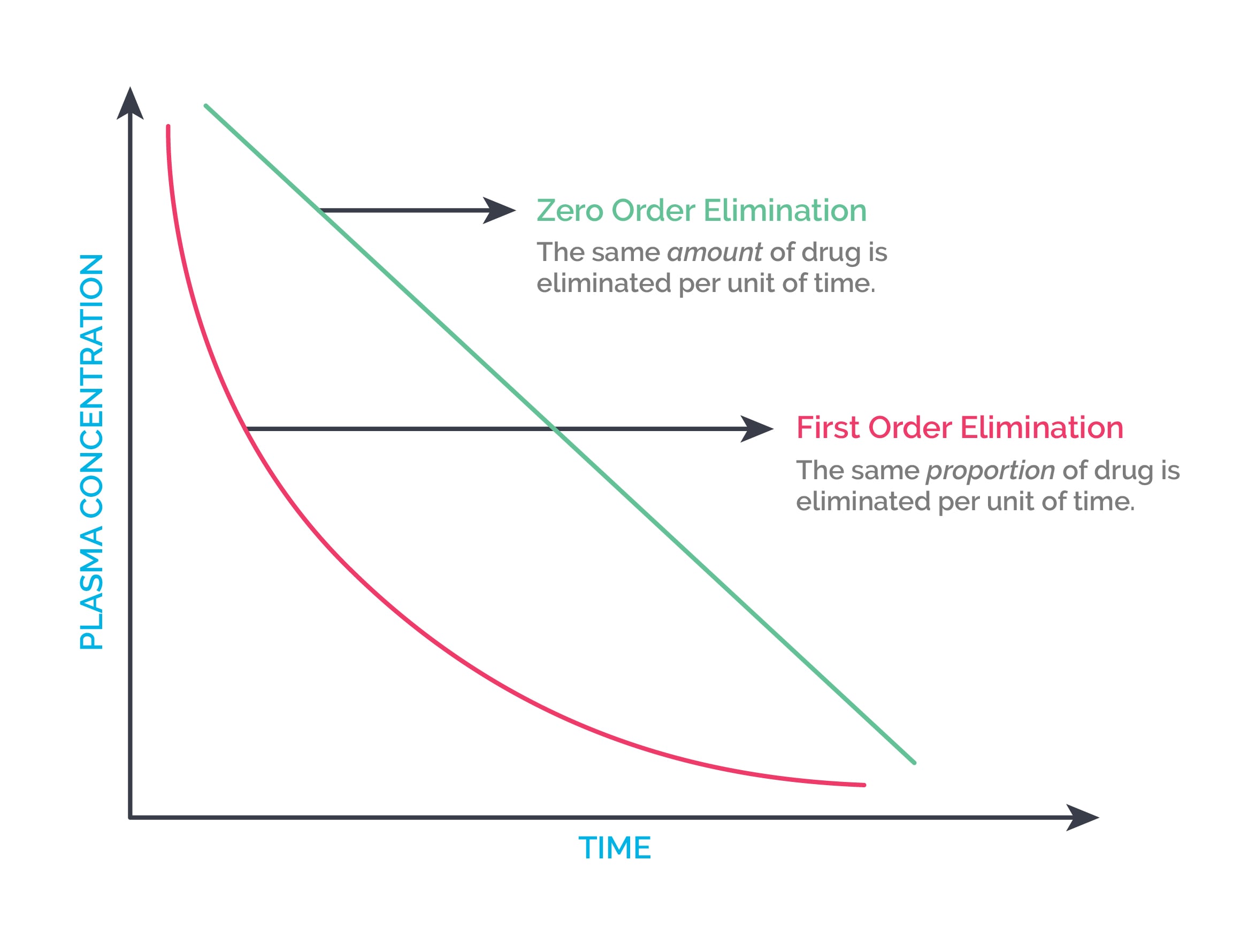
Diagram of pharmacokinetics time vs plasma concentration zero order elimination and first order elimination

Zero-order elimination occurs when a constant quantity of drug is eliminated per unit time.

  • This happens when elimination mechanisms become saturated.
  • A plasma concentration vs. time graph shows a linear decrease.
  • There is no constant half-life.

Ethanol, and aspirin and phenytoin at high doses, show zero-order elimination because their elimination pathways become saturated.

Examples and mechanism of pharmacokinetic drug-drug interactions

Example ADME level Mechanism
(Tetracyclines or quinolones) + multivalent cations (calcium, magnesium, or aluminum) Absorption Reduces absorption by the formation of complexes that cannot be absorbed
Itraconazole + antacids Absorption Itraconazole is a weak base that needs an acidic stomach to dissolve; raising the pH reduces its dissolution and absorption
Cyclosporine + St. John’s wort Absorption St. John’s wort increases the activity of P-glycoprotein* in the intestinal cells and decreases cyclosporine levels
Phenytoin + valproic acid Distribution Both drugs compete for binding sites on albumin
Rifampin + oral contraceptive pills Metabolism Rifampin induces Cyt P450, causing decreased estrogen levels and possible contraceptive failure
Warfarin + grapefruit juice Metabolism Grapefruit juice inhibits Cyt P450, causing increased warfarin levels, which may cause bleeding
Penicillin + probenecid Elimination Increased penicillin levels as probenecid competes with penicillin for transporters in the kidney

*P-glycoprotein is a membrane transporter that transports substances out of the cell. Certain drugs, supplements, and foods activate or inhibit P-glycoprotein, which can decrease or increase the levels of medications taken along with them.

Pharmacokinetics overview

  • “What the body does to the drug”
  • Organized via ADME: Absorption, Distribution, Metabolism, Elimination

Absorption

  • Small, unionized, lipid-soluble drugs absorb best; small intestine main site (large surface area)
  • Mainly passive diffusion (also active transport, facilitated diffusion, pinocytosis)
  • Weak acids absorb better in acidic environments; weak bases absorb better in alkaline environments
    • Same logic for excretion: alkalinize urine to speed weak acid excretion (aspirin); acidify urine for weak bases
  • Bioavailability: fraction of dose reaching systemic circulation; rises with absorption
  • First-pass effect: gut/liver metabolism before systemic circulation; greater effect = lower bioavailability

Distribution

  • Uneven; depends on solubility, protein/tissue binding, perfusion, tissue mass
  • Lipid-soluble drugs reach lipid-rich tissues (brain); highly protein-bound drugs (warfarin) stay in blood
  • Acidic drugs bind albumin; basic drugs bind alpha-1 acid glycoprotein/lipoproteins
  • Volume of distribution (Vd): small = confined to blood; large = widespread tissue distribution

Metabolism

  • Mainly liver (also kidneys, lungs, blood, intestines)
  • Prodrugs become active; most drugs inactivated; some form toxic metabolites
  • Goal: increase water solubility for elimination
  • Phase 1: oxidation, reduction, deamination, hydrolysis (more polar/reactive form)
  • Phase 2: conjugation (glucuronic acid, glycine, sulfate, glutathione) → inactive, water-soluble
  • Rapid metabolizers risk subtherapeutic levels; slow metabolizers risk toxicity
  • Cytochrome P450 (CYP3A4, CYP2D6): main oxidative enzymes
    • Inhibitors (cimetidine, erythromycin, grapefruit juice) raise drug levels/toxicity risk
    • Inducers (rifampin, phenytoin, carbamazepine) lower levels/treatment failure risk
    • Technician refers interactions to pharmacist, doesn’t adjust dose

Excretion/Elimination

  • Kidneys main route; lungs for inhaled anesthetics; some via bile/feces
  • First-order: constant fraction/time, constant half-life, exponential decline (most drugs)
  • Zero-order: constant amount/time (saturation), linear decline, no fixed half-life (ethanol, high-dose aspirin/phenytoin)

Drug-drug interaction examples (by ADME stage)

  • Absorption: complexation (tetracyclines+cations), pH effects (itraconazole+antacids), transporter induction (cyclosporine+St. John’s wort)
  • Distribution: albumin binding competition (phenytoin+valproic acid)
  • Metabolism: Cyt P450 induction/inhibition (rifampin+oral contraceptives; warfarin+grapefruit juice)
  • Elimination: renal transporter competition (penicillin+probenecid)
  • P-glycoprotein: efflux transporter; foods/drugs/supplements can induce or inhibit it, altering drug levels

Sign up for free to take 30 quiz questions on this topic

Previous
Next  | 1.4.4 Other drug interactions
All rights reserved ©2016 - 2026 Achievable, Inc.

Pharmacokinetic drug-drug interactions

Pharmacokinetics is “what the body does to the drug.” It includes absorption, distribution, metabolism, excretion, and overall drug elimination.

A helpful way to organize pharmacokinetic interactions is the ADME framework:

  • “A” for absorption
  • “D” for distribution
  • “M” for metabolism
  • “E” for elimination

Drug absorption

Drug absorption depends on the route of administration and the drug’s properties.

In general, small, unionized, lipid-soluble drugs are absorbed more easily. Most drugs are absorbed in the small intestine because it has a large surface area.

Most drugs are absorbed by passive diffusion, meaning they move from an area of higher concentration to an area of lower concentration. Some drugs use other mechanisms, including active transport, facilitated passive diffusion, and pinocytosis.

Ionization matters because unionized drug molecules cross membranes more easily:

  • Weak acids are more unionized in an acidic environment, so they’re absorbed better in acidic conditions.
  • Weak bases are more unionized in an alkaline environment, so they’re absorbed better in alkaline conditions.

This same idea helps explain urinary drug excretion: alkalinizing the urine can accelerate the excretion of weak acids (like aspirin), and acidifying the urine can accelerate the excretion of weak bases.

Definitions
Bioavailability
The proportion of a dose that reaches the systemic circulation.
It increases as drug absorption increases.
First pass effect
Metabolism of an oral drug to inactive forms in the gut wall and liver before it reaches the systemic circulation.
The greater the first-pass effect, the lower the bioavailability.

Drug distribution

Drug distribution is not uniform throughout the body. Several factors determine how much drug reaches different tissues:

  • Solubility: Lipid-soluble drugs (for example, some anesthetics) can cross into lipid-rich tissues such as the brain.
  • Protein and tissue binding: Binding affects where the drug “stays.” For example, warfarin largely remains in the bloodstream because it binds strongly to plasma albumin.
  • Blood supply (perfusion): Well-perfused tissues reach higher drug concentrations faster than tissues with lower blood flow.
  • Tissue mass: The amount of tissue can influence how much drug is taken up overall.
  • Type of protein binding:
    • Acidic drugs tend to bind more to albumin.
    • Basic drugs tend to bind more to alpha-1 acid glycoprotein and lipoproteins.

Protein binding influences both distribution and duration of action because only the unbound fraction can readily leave the bloodstream and interact with targets.

Volume of distribution (Vd) describes how extensively a drug distributes in the body:

  • Drugs with a small Vd are largely confined to the blood.
  • Drugs with a large Vd distribute widely into tissues and body compartments.

Drug metabolism

Drug metabolism occurs primarily in the liver, but it can also occur in the kidneys, lungs, blood, and intestines.

Key points about metabolism:

  • Prodrugs are metabolized into active drugs.
  • Most drugs become inactive after metabolism.
  • Some drugs form toxic metabolites.
  • A major goal of metabolism is to make the drug (or its products) more water soluble (polar) so it can be eliminated more easily.

Types of metabolic reactions:

  • Phase 1 reactions (non-synthetic): Convert the drug to a more polar or more reactive/active form. Oxidation, reduction, deamination, hydrolysis.
  • Phase 2 reactions (synthetic): Make the drug more water soluble; the end product is inactive. Conjugation with glucuronic acid, glycine, sulfate, glutathione, etc.

Metabolism rates vary among patients:

  • Rapid metabolizers may not reach effective blood and tissue levels.
  • Slow metabolizers have a higher risk of adverse effects.

Factors that affect metabolism include genetics, age, coexisting liver or other diseases, and concomitant use of drugs that alter metabolism.

Cytochrome P450 (Cyt P450) enzymes (primarily on the smooth endoplasmic reticulum of the liver) carry out most oxidation reactions, and polymorphisms can change drug metabolism. Major enzymes include CYP3A4 and CYP2D6.

  • Inhibitors of Cyt P450 decrease enzyme activity.
  • Inducers of Cyt P450 increase enzyme activity.

Common inhibitors and inducers of Cyt P450 enzymes:

  • Inhibitors: Cimetidine, amiodarone, erythromycin, ciprofloxacin, omeprazole, fluconazole, grapefruit juice, ritonavir, isoniazid.

  • Inducers: Carbamazepine, phenytoin, rifampin, phenobarbital, chronic alcohol use, dexamethasone.

Pitfall: Inhibitors can raise the levels of drugs cleared by these enzymes (risk of toxicity); inducers can lower them (risk of treatment failure). The prescriber or pharmacist decides any dose change - the technician’s role is to recognize the combination and refer it to the pharmacist.

Drug excretion or elimination

Most drugs are excreted by the kidneys. Inhaled anesthetics are mainly excreted by the lungs, and some drugs are excreted in bile and feces.

Elimination is the removal of drug from the body, through metabolism and excretion (mainly by the kidneys). Drugs follow one of two elimination patterns: first-order or zero-order.

First-order elimination occurs when the rate of elimination is directly proportional to the remaining drug concentration. In other words, a constant fraction of the drug is eliminated per unit time.

  • These drugs have a constant half-life.
  • A plasma concentration vs. time graph shows an exponential decrease.
  • Drug concentration decreases by 50% with each half-life.
  • Most drugs follow first-order kinetics.

Diagram of pharmacokinetics time vs plasma concentration zero order elimination and first order elimination

Zero-order elimination occurs when a constant quantity of drug is eliminated per unit time.

  • This happens when elimination mechanisms become saturated.
  • A plasma concentration vs. time graph shows a linear decrease.
  • There is no constant half-life.

Ethanol, and aspirin and phenytoin at high doses, show zero-order elimination because their elimination pathways become saturated.

Examples and mechanism of pharmacokinetic drug-drug interactions

Example ADME level Mechanism
(Tetracyclines or quinolones) + multivalent cations (calcium, magnesium, or aluminum) Absorption Reduces absorption by the formation of complexes that cannot be absorbed
Itraconazole + antacids Absorption Itraconazole is a weak base that needs an acidic stomach to dissolve; raising the pH reduces its dissolution and absorption
Cyclosporine + St. John’s wort Absorption St. John’s wort increases the activity of P-glycoprotein* in the intestinal cells and decreases cyclosporine levels
Phenytoin + valproic acid Distribution Both drugs compete for binding sites on albumin
Rifampin + oral contraceptive pills Metabolism Rifampin induces Cyt P450, causing decreased estrogen levels and possible contraceptive failure
Warfarin + grapefruit juice Metabolism Grapefruit juice inhibits Cyt P450, causing increased warfarin levels, which may cause bleeding
Penicillin + probenecid Elimination Increased penicillin levels as probenecid competes with penicillin for transporters in the kidney

*P-glycoprotein is a membrane transporter that transports substances out of the cell. Certain drugs, supplements, and foods activate or inhibit P-glycoprotein, which can decrease or increase the levels of medications taken along with them.

Key points

Pharmacokinetics overview

  • “What the body does to the drug”
  • Organized via ADME: Absorption, Distribution, Metabolism, Elimination

Absorption

  • Small, unionized, lipid-soluble drugs absorb best; small intestine main site (large surface area)
  • Mainly passive diffusion (also active transport, facilitated diffusion, pinocytosis)
  • Weak acids absorb better in acidic environments; weak bases absorb better in alkaline environments
    • Same logic for excretion: alkalinize urine to speed weak acid excretion (aspirin); acidify urine for weak bases
  • Bioavailability: fraction of dose reaching systemic circulation; rises with absorption
  • First-pass effect: gut/liver metabolism before systemic circulation; greater effect = lower bioavailability

Distribution

  • Uneven; depends on solubility, protein/tissue binding, perfusion, tissue mass
  • Lipid-soluble drugs reach lipid-rich tissues (brain); highly protein-bound drugs (warfarin) stay in blood
  • Acidic drugs bind albumin; basic drugs bind alpha-1 acid glycoprotein/lipoproteins
  • Volume of distribution (Vd): small = confined to blood; large = widespread tissue distribution

Metabolism

  • Mainly liver (also kidneys, lungs, blood, intestines)
  • Prodrugs become active; most drugs inactivated; some form toxic metabolites
  • Goal: increase water solubility for elimination
  • Phase 1: oxidation, reduction, deamination, hydrolysis (more polar/reactive form)
  • Phase 2: conjugation (glucuronic acid, glycine, sulfate, glutathione) → inactive, water-soluble
  • Rapid metabolizers risk subtherapeutic levels; slow metabolizers risk toxicity
  • Cytochrome P450 (CYP3A4, CYP2D6): main oxidative enzymes
    • Inhibitors (cimetidine, erythromycin, grapefruit juice) raise drug levels/toxicity risk
    • Inducers (rifampin, phenytoin, carbamazepine) lower levels/treatment failure risk
    • Technician refers interactions to pharmacist, doesn’t adjust dose

Excretion/Elimination

  • Kidneys main route; lungs for inhaled anesthetics; some via bile/feces
  • First-order: constant fraction/time, constant half-life, exponential decline (most drugs)
  • Zero-order: constant amount/time (saturation), linear decline, no fixed half-life (ethanol, high-dose aspirin/phenytoin)

Drug-drug interaction examples (by ADME stage)

  • Absorption: complexation (tetracyclines+cations), pH effects (itraconazole+antacids), transporter induction (cyclosporine+St. John’s wort)
  • Distribution: albumin binding competition (phenytoin+valproic acid)
  • Metabolism: Cyt P450 induction/inhibition (rifampin+oral contraceptives; warfarin+grapefruit juice)
  • Elimination: renal transporter competition (penicillin+probenecid)
  • P-glycoprotein: efflux transporter; foods/drugs/supplements can induce or inhibit it, altering drug levels

More from Drug interactions and contraindications

  • Common and life-threatening drug interactions
  • Pharmacological drug-drug interactions
  • Other drug interactions
  • Additional information and drug contraindications