



Interdisciplinary collaboration and referrals
Introduction
Nursing is a team sport. A single RN cannot meet every need of a client, but with the right collaboration, the client receives holistic care. Interdisciplinary practice is not about ceding responsibility; it’s about weaving together the skills of physicians, pharmacists, therapists, dietitians, case managers, and social workers so the client’s care is seamless.
On the NCLEX, collaboration questions test whether you know who to call, when to call them, and how to communicate effectively. Referrals are often the “hidden priority” in client scenarios, and missing them can mean fragmented care or unsafe discharge.
Learning objectives
By the end of this section, you should be able to:
- Explain the importance of interdisciplinary collaboration in delivering holistic, client-centered care
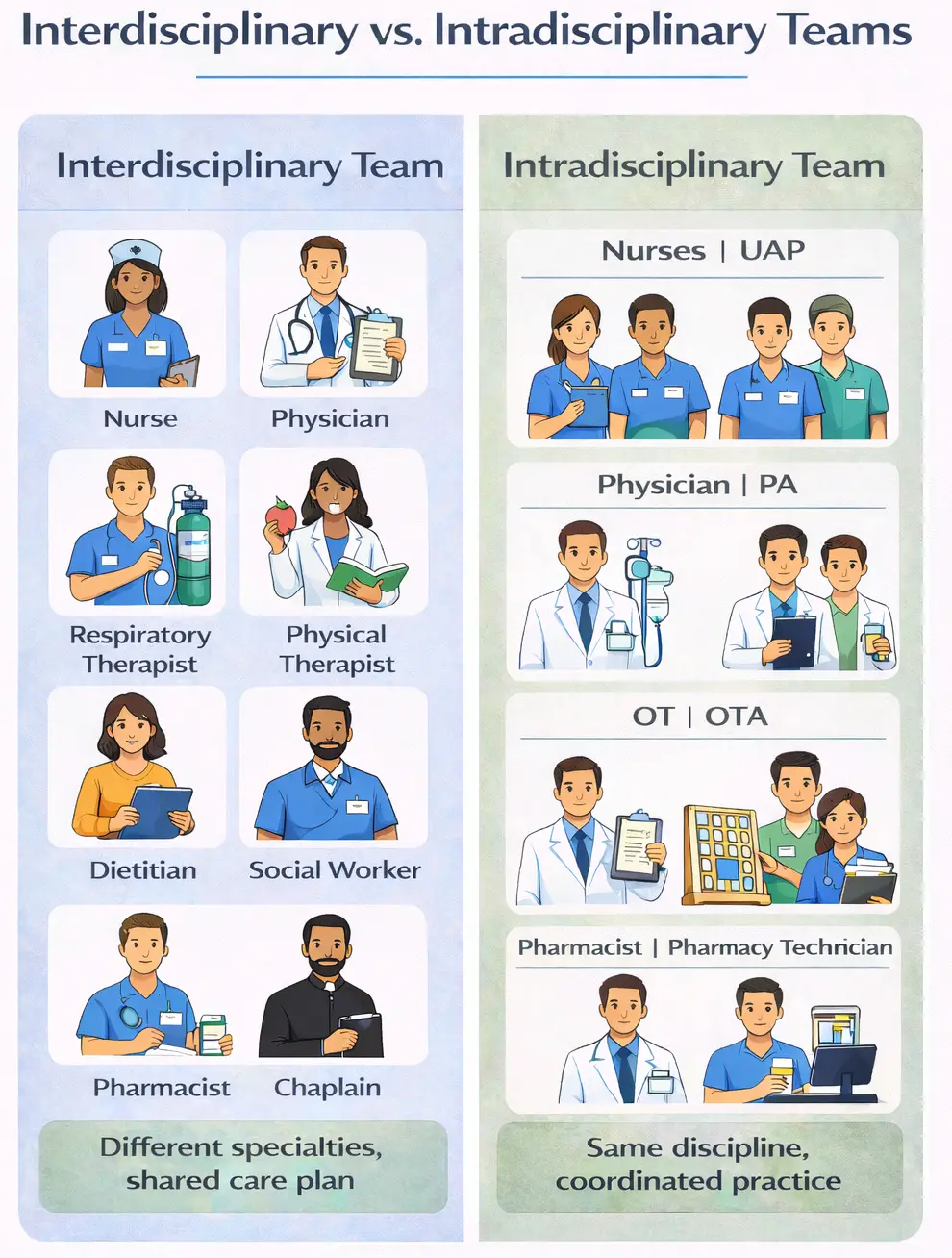
- Differentiate between interdisciplinary and intradisciplinary healthcare teams with practical examples
- Identify the roles and responsibilities of key healthcare professionals within the interdisciplinary team
- Recognize when and how to initiate appropriate referrals to improve continuity of care and client outcomes
- Apply SBAR communication to ensure clear, timely, and effective collaboration with other professionals
- Identify common NCLEX pitfalls related to poor collaboration, missed referrals, and unsafe delegation
- Demonstrate how effective teamwork supports safe discharge planning and prevents fragmented care
Interdisciplinary collaboration
Nurses link the moving parts: coordinating lab draws, adjusting medication with the physician, arranging physiotherapy sessions, and updating case managers.
A collaborative nurse knows who to involve and when, ensuring care plans stay structured.
- Physicians/NPs/PAs: diagnose, prescribe, and perform procedures
- Nurses: coordinate care, assess, advocate, and implement plans
- Respiratory therapists: manage oxygen therapy, ventilators, and ABGs
- Physical/Occupational therapists: restore mobility, function, and ADLs
- Speech-language pathologists: assess and manage swallowing (dysphagia) and communication disorders
- Dietitians: plan nutrition for diabetes, renal disease, and malnutrition
- Pharmacists: identify drug interactions, dose adjustments, and therapeutic monitoring
- Social workers/case managers: arrange discharge planning, community resources, and insurance
- Chaplains/pastoral care: provide spiritual support for clients and families
Core principle
- Respect expertise: Each discipline brings knowledge that nursing cannot replace.
- Client-centered focus: The client’s goals and values drive the team.
- Clear communication: Use SBAR (Situation, Background, Assessment, Recommendation) for concise, actionable messages.
- Timeliness: The right referral at the right time prevents complications and readmissions.
Referrals
Appropriate referrals improve continuity, reduce complications, and respect client dignity.
- Dietitian: malnutrition, difficulty swallowing, newly diagnosed diabetes.
- Physical therapy: stroke, hip fracture, post-op mobility issues.
- Occupational therapy: difficulty with ADLs after injury, neurological impairment.
- Speech-language pathology: dysphagia, communication disorders post-stroke.
- Social worker/case manager: discharge planning, abuse, homelessness, lack of support.
- Hospice/palliative care: end-of-life symptom management, quality of life.
The referral process: What NCLEX expects you to know
Students often know who to refer to, but not the actual process.
1. Identify the need
The nurse recognizes a gap in care:
- Dysphagia → Speech-language pathology
- Fall risk → Physical therapy
- Financial barriers → Social work
- Polypharmacy → Pharmacist
2. Communicate with the provider (if required)
Some facilities require an order for consults. The nurse may recommend the referral using SBAR.
3. Initiate the referral
Follow institutional policy for consult placement.
4. Document
Document:
- Why the referral was needed
- Who was notified
- The client’s response
- Follow-up plan
5. Follow through
The RN remains accountable for:
- Ensuring the consult occurred
- Integrating recommendations into the care plan
- Evaluating client response

- //////OPTIONAL. Caption: Nursing Referral Process
- Illustration type: Flowchart
- Illustration note: Illustrate the nursing referral process from identifying a client need, communicating with the provider when required, initiating the referral, documenting the referral, and following through by integrating recommendations and evaluating client outcomes.//////
Clinical vignette
It’s late afternoon on the stroke unit. You’re caring for Mr. H, who has left-sided weakness after a recent ischemic stroke. He’s frustrated and refusing meals.
Nursing action: Recognize that his poor intake may delay recovery. You notify the provider, recommend referrals to the dietitian for nutritional support and physical therapy for mobility assessment, and involve the case manager to begin discharge planning and ensure his home environment will support his new needs.
Rationale: Early interdisciplinary collaboration addresses nutrition, mobility, and discharge needs, promoting coordinated care and safer transitions.
SBAR in action
You are caring for a client with COPD whose oxygen needs are increasing. You call respiratory therapy:
- Situation: “Mr. L’s SpO₂ is 84% despite a 4L nasal cannula.”
- Background: “Admitted yesterday with COPD exacerbation, history of chronic hypoxemia.”
- Assessment: “He is using accessory muscles, HR 120, RR 32.”
- Recommendation: “Please assess for possible BiPAP initiation.”
SBAR keeps communication clear, concise, and actionable.
- //////OPTIONAL Caption: SBAR Communication Framework
- Illustration type: Process diagram
- Illustration note: Illustrate the SBAR communication framework by organizing information into Situation, Background, Assessment, and Recommendation using a clinical example to demonstrate effective interdisciplinary communication.//////