


Achievable logoAchievable logo
NCLEX
Sign in
Sign up
Purchase
Textbook
Practice exams
Support
How it works
Exam catalog
Mountain with a flag at the peak
Textbook
Introduction
1. Safe and effective care environment
1.1 Management of care
1.1.1 Delegation and supervision
1.1.2 Prioritization of care
1.1.3 Advocacy, client rights and informed consent
1.1.4 Interdisciplinary collaboration and referrals
1.1.5 Quality improvement and resource management
1.1.6 Ethical and legal practice
1.2 Safety and infection control
2. Health promotion and maintenance
3. Psychosocial Integrity
4. Physiological Integrity
Wrapping up
Achievable logoAchievable logo
1.1.5 Quality improvement and resource management
Achievable NCLEX
1. Safe and effective care environment
1.1. Management of care
Our NCLEX course is currently in development and is a work-in-progress.

Quality improvement and resource management

5 min read
Font
Discuss
Share
Feedback

Introduction

Nursing is rarely about caring for one client at a time; instead, it is about improving the system so that every client receives safer, more effective care tomorrow than they did today.

Quality improvement (QI) drives this forward by identifying problems, testing solutions, and measuring results. Resource management ensures that limited time, staff, and supplies are used wisely. Together, they position the nurse not only as a caregiver, but also as a steward of safe, effective healthcare systems.

Learning objectives

By the end of this section, you should be able to:

  • Define quality improvement (QI) and explain its role in enhancing client safety and healthcare systems
  • Differentiate between errors and near misses, and justify why both must be reported
  • Describe the nurse’s role in identifying problems, implementing changes, and evaluating outcomes in QI initiatives
  • Apply common QI tools (PDSA cycle, root cause analysis, benchmarking) to real clinical scenarios
  • Explain principles of resource management and how they support cost-effective, high-quality care
  • Identify strategies nurses use to promote efficiency without compromising safety
  • Recognize common NCLEX pitfalls related to QI, error reporting, and cost-focused decision-making
  • Demonstrate how frontline nursing actions contribute to system-level improvements in client care
Definitions
Quality improvement (QI)
A structured process for identifying problems, testing solutions, and improving client care at the system level
Near miss
An error that could have harmed a client but did not, either by chance or because it was intercepted in time
Cost-effective care
Providing the best outcomes at the lowest reasonable cost, without sacrificing safety or quality

Nursing role in QI

Nurses play a critical role in quality improvement initiatives:

  • Report errors and near misses: This is crucial for identifying system weaknesses and preventing future harm
  • Participate in audits, chart reviews, and root cause analyses: Nurses’ frontline experience is invaluable in these processes to understand why errors occur
  • Suggest changes based on frontline experiences: Their direct involvement with patient care provides unique insights for improvement
  • Implement new protocols and evaluate outcomes: Nurses are key in putting new procedures into practice and assessing their effectiveness

Common QI tools

Several tools are commonly used in quality improvement:

  • PDSA cycle (Plan → Do → Study → Act): This involves testing small changes on a limited scale before implementing them more broadly
  • Root cause analysis: A systematic process to dig beyond the symptoms and uncover the fundamental reasons why an error or problem occurred
  • Benchmarking: Comparing an organization’s performance against established standards or the performance of other institutions to identify areas for improvement

Clinical vignette

A unit notices multiple medication errors during shift changes. The QI team introduces a structured handoff tool (SBAR). Two months later, medication errors have decreased by 40%.

Nursing action: The nurse recognizes the safety issue and provides data, feedback, and real-world testing during implementation of the SBAR handoff process.

Reporting errors and near misses

Understanding the difference and importance of reporting both is vital:

  • Error: An event where medication was given to the wrong client
  • Near miss: An error caught before it reached the client (e.g., noticing the wrong medication before administration)
  • Both must be reported: Near misses are crucial because they reveal system vulnerabilities before actual harm occurs
  • Reports are confidential and nonpunitive: They are used for system learning and improvement, not for assigning blame

Resource management: Promoting cost-effective care

Healthcare resources are finite. The nurse must balance cost-effective care with quality and safety.

Strategies

  • Prevent duplicate testing: Reviewing client records before ordering new lab tests can avoid unnecessary procedures
  • Use supplies appropriately: This means avoiding hoarding or wasting materials
  • Prioritize staff assignments: Assigning staff based on client acuity ensures that care is delivered efficiently and effectively
  • Encourage preventive care: Promoting vaccinations and screenings can reduce long-term healthcare costs
  • Advocate for early discharge planning: This helps prevent costly readmissions by ensuring clients have the support they need after leaving the hospital

Clinical vignette

On the medical-surgical floor, a new pressure injury appears in three clients over two weeks. The nurse notices the pattern and suggests a system-wide intervention to the QI committee. The committee implements daily skin checks during rounds and teaches staff to identify early warning signs. This spares clients discomfort and saves the unit expense. Small actions ripple outward, improving safety and conserving resources.

Nursing action: The nurse recognizes the trend, reports it to the QI committee, and supports implementation of the new skin assessment protocol.

NGN tip:
If an option looks like it “saves money” but delays or compromises client safety, it’s wrong. Safety always outweighs cost in NCLEX questions.
alt_text
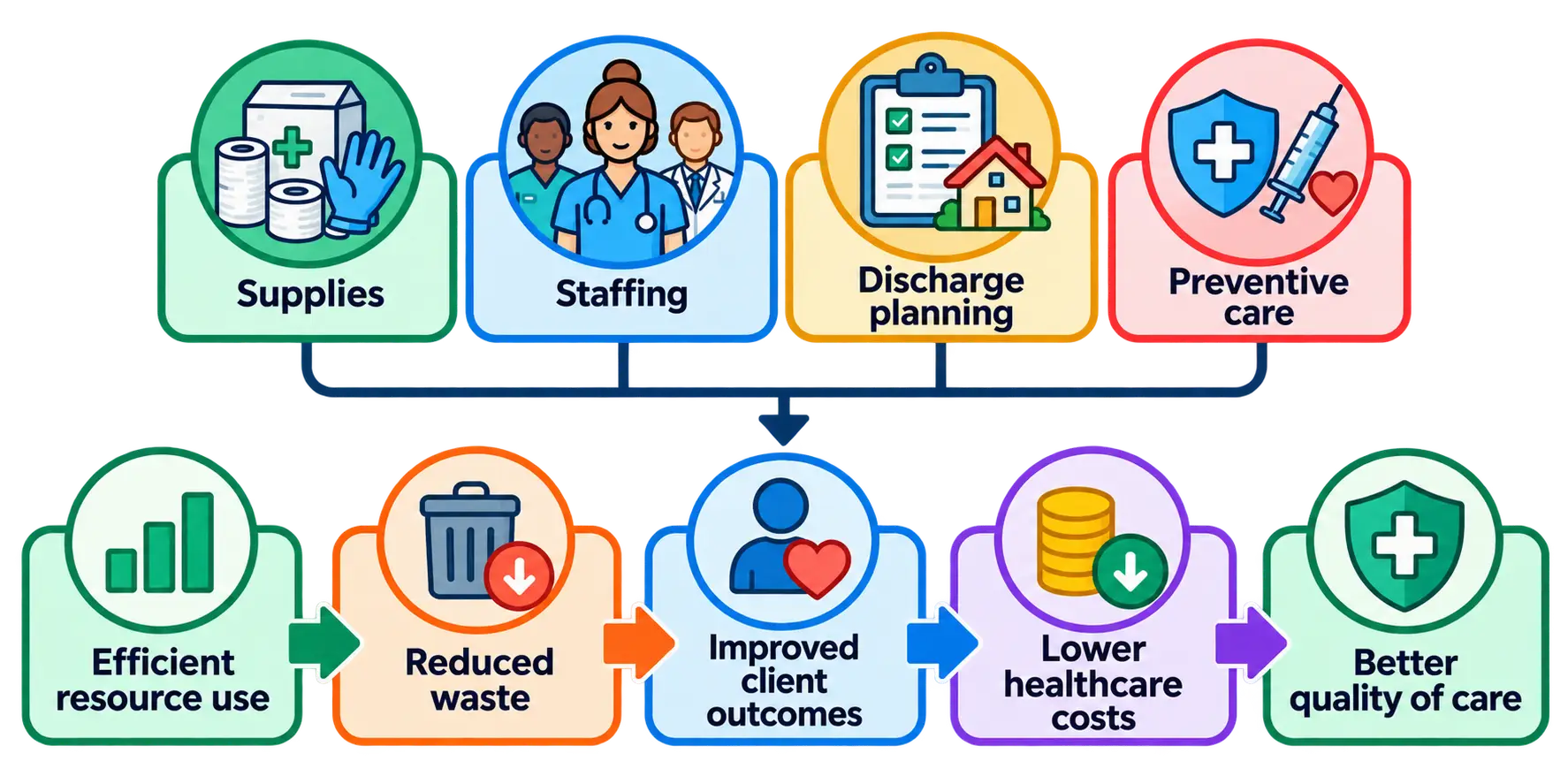
//////Caption: Resource Management Strategies
Illustration type: Flowchart infographic
Illustration note: Flowchart showing: Efficient resource use → Reduced waste → Improved client outcomes → Lower healthcare costs → Better quality of care. Include icons for supplies, staffing, discharge planning, and preventive care.///////

Safety and client education

  • Explain to clients why protocols change (e.g., new infection control procedures)
  • Teach staff that reporting errors improves safety rather than resulting in punishment
  • Empower clients to advocate for efficient, coordinated care (e.g., maintaining med lists)

Common pitfalls on the NCLEX

  • Confusing QI with research: QI focuses on process improvement, while research aims to generate new knowledge
  • Believing near misses don’t need reporting: They absolutely do, as they provide valuable insights into system weaknesses
  • Thinking resource management = cutting corners: It’s about smart allocation of resources without compromising safety or quality
  • Blaming individuals instead of systems: QI is nonpunitive. Reports focus on why the error occurred, not who is at fault
  • Prioritizing cost over safety: Efficiency is important, but never at the expense of timely, necessary care
  • QI is a continuous process, not a one-time project.
  • PDSA, root cause analysis, and benchmarking are standard tools.
  • Errors and near misses must be reported.
  • Resource management means using supplies and time efficiently without compromising safety.
  • Nurses are frontline drivers of QI initiatives.

Sign up for free to take 5 quiz questions on this topic

Previous
Next  | 1.1.6 Ethical and legal practice
All rights reserved ©2016 - 2026 Achievable, Inc.

Quality improvement and resource management

Introduction

Nursing is rarely about caring for one client at a time; instead, it is about improving the system so that every client receives safer, more effective care tomorrow than they did today.

Quality improvement (QI) drives this forward by identifying problems, testing solutions, and measuring results. Resource management ensures that limited time, staff, and supplies are used wisely. Together, they position the nurse not only as a caregiver, but also as a steward of safe, effective healthcare systems.

Learning objectives

By the end of this section, you should be able to:

  • Define quality improvement (QI) and explain its role in enhancing client safety and healthcare systems
  • Differentiate between errors and near misses, and justify why both must be reported
  • Describe the nurse’s role in identifying problems, implementing changes, and evaluating outcomes in QI initiatives
  • Apply common QI tools (PDSA cycle, root cause analysis, benchmarking) to real clinical scenarios
  • Explain principles of resource management and how they support cost-effective, high-quality care
  • Identify strategies nurses use to promote efficiency without compromising safety
  • Recognize common NCLEX pitfalls related to QI, error reporting, and cost-focused decision-making
  • Demonstrate how frontline nursing actions contribute to system-level improvements in client care
Definitions
Quality improvement (QI)
A structured process for identifying problems, testing solutions, and improving client care at the system level
Near miss
An error that could have harmed a client but did not, either by chance or because it was intercepted in time
Cost-effective care
Providing the best outcomes at the lowest reasonable cost, without sacrificing safety or quality

Nursing role in QI

Nurses play a critical role in quality improvement initiatives:

  • Report errors and near misses: This is crucial for identifying system weaknesses and preventing future harm
  • Participate in audits, chart reviews, and root cause analyses: Nurses’ frontline experience is invaluable in these processes to understand why errors occur
  • Suggest changes based on frontline experiences: Their direct involvement with patient care provides unique insights for improvement
  • Implement new protocols and evaluate outcomes: Nurses are key in putting new procedures into practice and assessing their effectiveness

Common QI tools

Several tools are commonly used in quality improvement:

  • PDSA cycle (Plan → Do → Study → Act): This involves testing small changes on a limited scale before implementing them more broadly
  • Root cause analysis: A systematic process to dig beyond the symptoms and uncover the fundamental reasons why an error or problem occurred
  • Benchmarking: Comparing an organization’s performance against established standards or the performance of other institutions to identify areas for improvement

Clinical vignette

A unit notices multiple medication errors during shift changes. The QI team introduces a structured handoff tool (SBAR). Two months later, medication errors have decreased by 40%.

Nursing action: The nurse recognizes the safety issue and provides data, feedback, and real-world testing during implementation of the SBAR handoff process.

Reporting errors and near misses

Understanding the difference and importance of reporting both is vital:

  • Error: An event where medication was given to the wrong client
  • Near miss: An error caught before it reached the client (e.g., noticing the wrong medication before administration)
  • Both must be reported: Near misses are crucial because they reveal system vulnerabilities before actual harm occurs
  • Reports are confidential and nonpunitive: They are used for system learning and improvement, not for assigning blame

Resource management: Promoting cost-effective care

Healthcare resources are finite. The nurse must balance cost-effective care with quality and safety.

Strategies

  • Prevent duplicate testing: Reviewing client records before ordering new lab tests can avoid unnecessary procedures
  • Use supplies appropriately: This means avoiding hoarding or wasting materials
  • Prioritize staff assignments: Assigning staff based on client acuity ensures that care is delivered efficiently and effectively
  • Encourage preventive care: Promoting vaccinations and screenings can reduce long-term healthcare costs
  • Advocate for early discharge planning: This helps prevent costly readmissions by ensuring clients have the support they need after leaving the hospital

Clinical vignette

On the medical-surgical floor, a new pressure injury appears in three clients over two weeks. The nurse notices the pattern and suggests a system-wide intervention to the QI committee. The committee implements daily skin checks during rounds and teaches staff to identify early warning signs. This spares clients discomfort and saves the unit expense. Small actions ripple outward, improving safety and conserving resources.

Nursing action: The nurse recognizes the trend, reports it to the QI committee, and supports implementation of the new skin assessment protocol.

NGN tip:
If an option looks like it “saves money” but delays or compromises client safety, it’s wrong. Safety always outweighs cost in NCLEX questions.
alt_text
//////Caption: Resource Management Strategies
Illustration type: Flowchart infographic
Illustration note: Flowchart showing: Efficient resource use → Reduced waste → Improved client outcomes → Lower healthcare costs → Better quality of care. Include icons for supplies, staffing, discharge planning, and preventive care.///////

Safety and client education

  • Explain to clients why protocols change (e.g., new infection control procedures)
  • Teach staff that reporting errors improves safety rather than resulting in punishment
  • Empower clients to advocate for efficient, coordinated care (e.g., maintaining med lists)

Common pitfalls on the NCLEX

  • Confusing QI with research: QI focuses on process improvement, while research aims to generate new knowledge
  • Believing near misses don’t need reporting: They absolutely do, as they provide valuable insights into system weaknesses
  • Thinking resource management = cutting corners: It’s about smart allocation of resources without compromising safety or quality
  • Blaming individuals instead of systems: QI is nonpunitive. Reports focus on why the error occurred, not who is at fault
  • Prioritizing cost over safety: Efficiency is important, but never at the expense of timely, necessary care
Key points
  • QI is a continuous process, not a one-time project.
  • PDSA, root cause analysis, and benchmarking are standard tools.
  • Errors and near misses must be reported.
  • Resource management means using supplies and time efficiently without compromising safety.
  • Nurses are frontline drivers of QI initiatives.

More from Management of care

  • Delegation and supervision
  • Prioritization of care
  • Advocacy, client rights and informed consent
  • Interdisciplinary collaboration and referrals
  • Ethical and legal practice