


Achievable logoAchievable logo
NCLEX
Sign in
Sign up
Purchase
Textbook
Practice exams
Support
How it works
Exam catalog
Mountain with a flag at the peak
Textbook
Introduction
1. Safe and effective care environment
1.1 Management of care
1.1.1 Delegation and supervision
1.1.2 Prioritization of care
1.1.3 Advocacy, client rights and informed consent
1.1.4 Interdisciplinary collaboration and referrals
1.1.5 Quality improvement and resource management
1.1.6 Ethical and legal practice
1.2 Safety and infection control
2. Health promotion and maintenance
3. Psychosocial Integrity
4. Physiological Integrity
Wrapping up
Achievable logoAchievable logo
1.1.2 Prioritization of care
Achievable NCLEX
1. Safe and effective care environment
1.1. Management of care
Our NCLEX course is currently in development and is a work-in-progress.

Prioritization of care

10 min read
Font
Discuss
Share
Feedback

Introduction

Every nurse learns quickly that you can’t be everywhere at once. Call lights flash, alarms sound, and clients call your name, often all at once. Prioritization is the art of answering the question: Who needs me right now, and who can wait five minutes?

On the NCLEX, prioritization questions are designed to test your clinical judgment under pressure. The scenarios look deceptively simple: four clients with different needs, but only one has a life-threatening problem. The frameworks below (ABC, Maslow, unstable vs stable, acute vs chronic, systemic vs local) are your compass. Without them, prioritization feels like guessing. With them, it becomes second nature.

Learning objectives

By the end of this section, you should be able to:

  • Explain the concept of prioritization and its importance in safe nursing practice and NCLEX-style decision-making
  • Apply the ABC (Airway, Breathing, Circulation) framework to identify clients requiring immediate intervention
  • Use Maslow’s hierarchy of needs to prioritize physiological needs over safety and psychosocial concerns
  • Differentiate between acute and chronic conditions when determining urgency of care
  • Identify unstable versus stable client presentations and prioritize care accordingly
  • Distinguish systemic problems from localized issues when making prioritization decisions
  • Analyze multi-client clinical scenarios to determine which patient should be seen first
  • Recognize common NCLEX pitfalls related to prioritization and avoid unsafe or emotionally driven choices

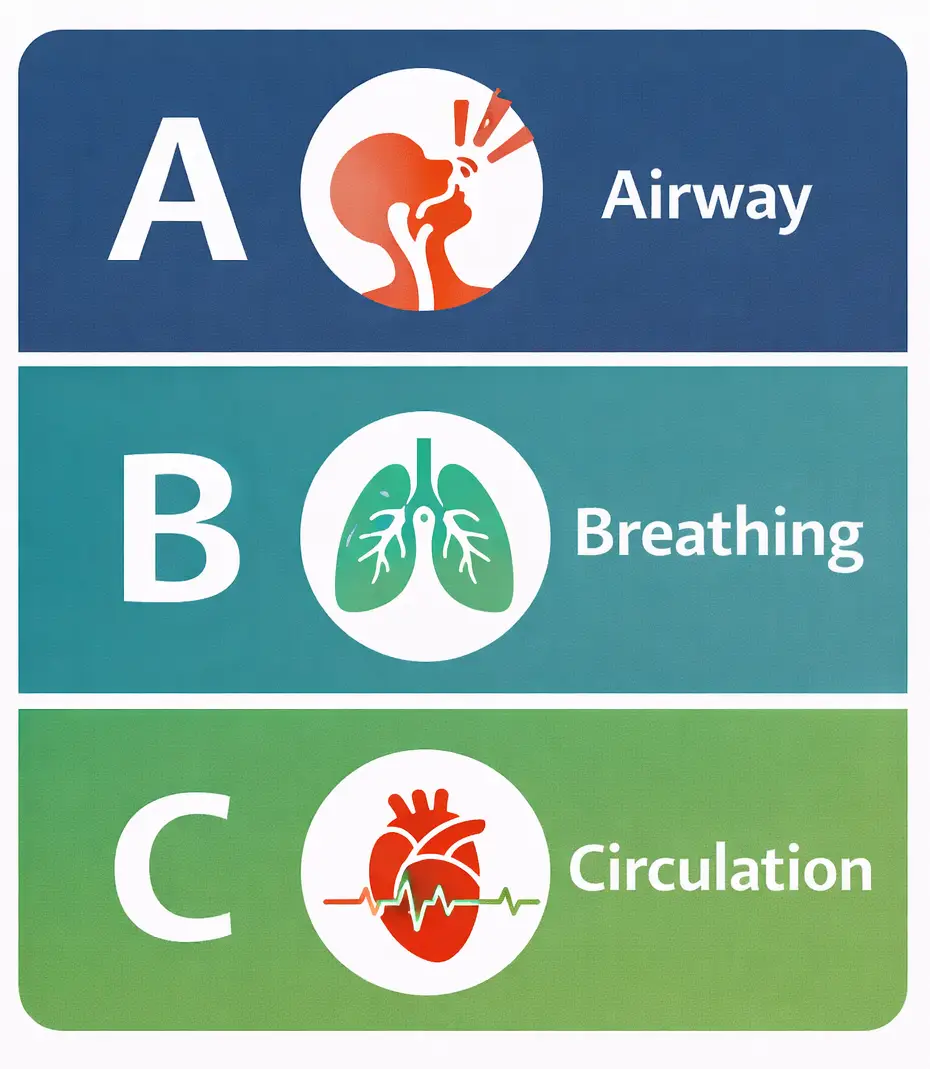
ABC (Airway, Breathing, Circulation)

Airways are always first. Without a clear airway, oxygen cannot reach the lungs. Common causes of airway obstruction include foreign bodies. Think of an object lodged in the trachea, or a large bolus of food entering the airway in a stroke client with impaired swallowing (dysphagia), rather than passing safely into the esophagus.

Breathing is next; a client with ventilatory failure is minutes from death. Common causes of breathing difficulties include respiratory exhaustion in an asthmatic client, presenting with a silent chest (no air movement heard on auscultation) and an overdose of opioids leading to significant respiratory depression.

Circulation follows; perfusion keeps the brain and organs alive. Common causes of circulatory compromise include a heart attack with significantly reduced cardiac output, massive hemorrhage with insufficient blood volume to maintain system-wide perfusion, and anaphylactic shock, with system-wide vasodilation lowering blood pressure and depriving organs of blood.

A diagram showing the priority of primary survey
Prioritization of care -ABC

The ABC sequence forms the foundation of the Primary Survey. The first thing every practitioner does for a client on presentation, and it is expected and non-negotiable in the prioritization of care for a client.

Definitions
Airway (A)
The Airway is the passage that extends from the mouth and nose down to the lungs, and its assessment focuses on ensuring it is clear and unobstructed. A patent airway is the first priority because a blockage prevents oxygen from reaching the lungs, which is critical for all subsequent steps.
Breathing (B)
This involves the movement of air into and out of the lungs, which is necessary to supply the blood with oxygen and remove carbon dioxide. This step confirms that air is actually moving and being exchanged effectively once the airway is open.
Circulation (C)
This is the process of the heart pumping oxygenated blood throughout the body to vital organs like the brain and heart. In an unresponsive client without a pulse, chest compressions are used to maintain this circulation artificially.
Call light
A signaling device placed within a client’s reach that allows them to alert nursing staff when assistance is needed. It is a primary safety tool, ensuring clients can quickly request help for needs such as pain, toileting, repositioning, or emergencies. Nurses must always confirm the call light is accessible before leaving the bedside.

Clinical vignette

A client with stridor and an oxygen saturation of 82% is admitted alongside a client with a femur fracture.

(spoiler)

Nursing action: Assess and manage the client with stridor first.

Rationale: Airway compromise takes priority over all other injuries because inadequate oxygenation is immediately life-threatening.

NGN tip:
If you see “airway obstruction,” “respiratory distress,” “low O₂ sat,” or “uncontrolled bleeding” those are almost always the first to be addressed.

Maslow’s hierarchy of needs

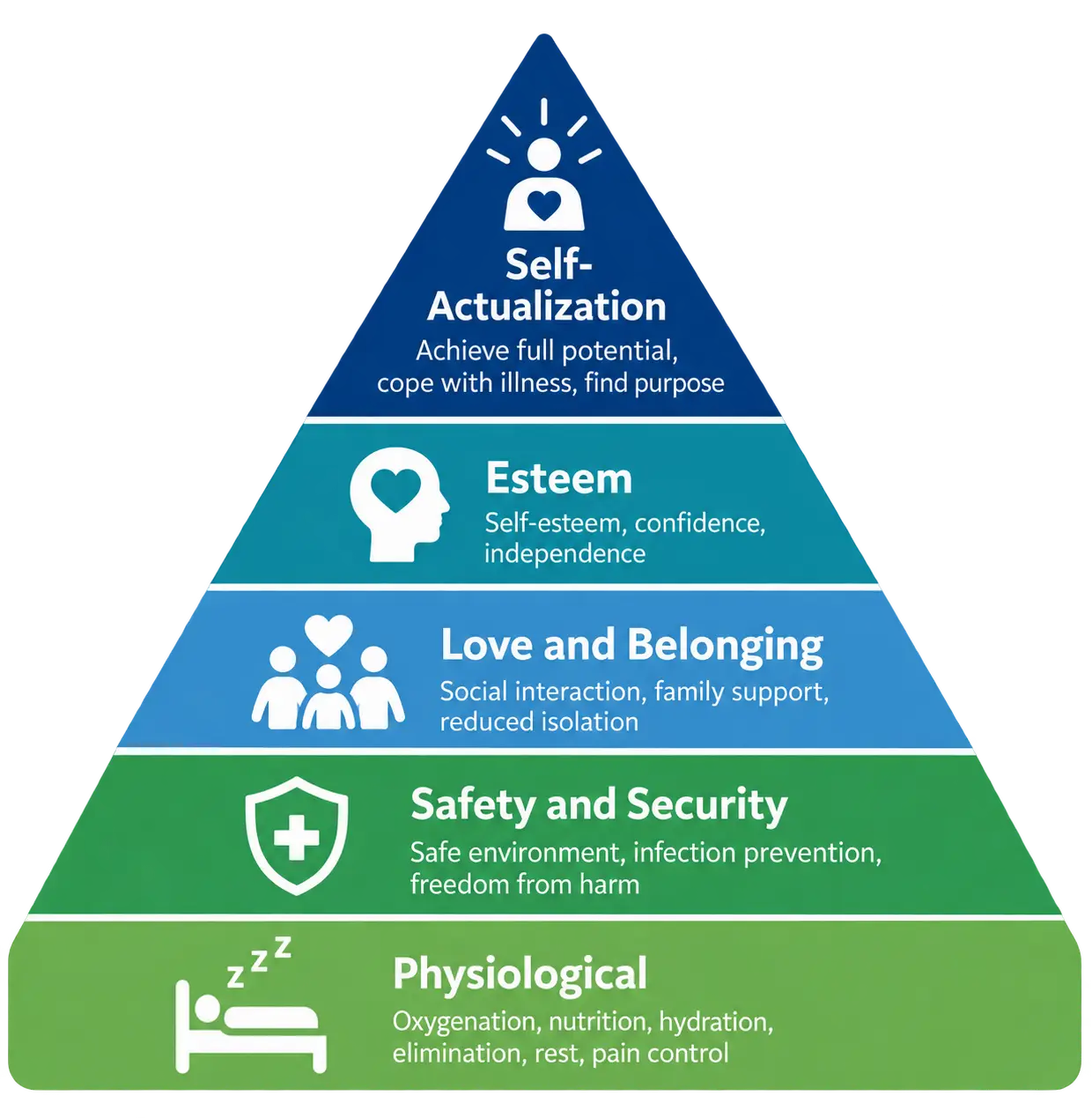
The order of need follows as such: physiological > safety > love/belonging > esteem > self-actualization

Physiological needs outrank safety, belonging, esteem, or self-actualization. In clinical practice, oxygenation and other physiological needs take priority over comfort or psychosocial concerns.

A diagram showing a nursing applied Maslow's Hierarchy
Maslow's Hierarchy of Clinical needs

From NEEDS to needs

Maslow’s pyramid describes how human needs stack from the most urgent to the most abstract. In prioritization, nurses must address lower-level needs before higher-level ones, because survival always outweighs comfort or growth.

Physiological needs

  • These are the foundations of survival: oxygen, food, water, elimination, temperature regulation, sleep, sex, and shelter. In nursing care, this means airway management, circulation, nutrition, and elimination take priority over all other concerns.

Safety and security

  • Once the basics are met, clients seek protection from harm: safe environments, stable health, freedom from abuse, and infection prevention. For nurses, this includes fall precautions, medication safety, infection control, and protection from violence.

Love and belonging

  • Human beings need connection: family, friendships, intimacy, and social interaction. In the hospital, this means supporting family visitation, therapeutic communication, and addressing isolation or withdrawal.

Esteem

  • Respect and self-worth fuel confidence and independence. Nurses promote esteem by involving clients in decision-making, respecting their autonomy, and celebrating small victories in rehabilitation or self-care.

Self-actualization

  • At the peak is growth. One realizes one’s potential, creativity, and purpose. In healthcare, this may be seen when clients adapt to chronic illness, find meaning in recovery, or pursue goals despite limitations.

Clinical vignette

A client requests pain medication while another client’s blood glucose is 45 mg/dL (normal is above 70 mg/dL).

(spoiler)

Nursing action: Assess and treat the client with hypoglycemia first.

Rationale: A client with hypoglycemia takes priority because physiological needs come before comfort needs, and untreated hypoglycemia can rapidly become life-threatening.

Acute vs chronic

A new, rapidly developing condition is almost always a higher priority than a long-standing chronic one. Attend first to what has just erupted; chest pain that began an hour ago outweighs stable arthritis that has lingered for years. Acute changes demand your attention now; chronic conditions can typically wait, though they should never be ignored.

Note: A chronic condition can become urgent if it suddenly worsens; an acute exacerbation of a chronic illness is treated as acute.

Clinical vignette

A client with stable arthritis pain and another with new-onset chest pain both request assistance.

(spoiler)

Nursing action: Assess the client with new-onset chest pain first.

Rationale: Acute conditions take priority over stable chronic conditions.

Unstable vs stable

Unstable clients are unpredictable, and unpredictable is dangerous. An unstable client teeters at the edge, while the stable one sits on firm ground. Instability (dropping blood pressure, rising pulse, sudden confusion) calls for the RN’s immediate presence. The stable case can safely be managed later or delegated down the chain. Stable clients can wait, even if uncomfortable.

Clinical vignette

A post-operative client’s blood pressure falls from 130/80 mmHg to 90/50 mmHg while another client requests discharge teaching.

(spoiler)

Nursing action: Assess the client with the falling blood pressure first.

Rationale: Sudden deterioration indicates instability requiring immediate nursing assessment.

NGN insight:
When multiple prioritization frameworks apply, choose the client who is unstable and has an airway, breathing, or circulation problem.

Systemic vs local

Systemic problems (like sepsis, shock or anaphylaxis) threaten the whole body. Localized issues (like an infected toe) are lower priority, unless they show signs of spreading or systemic involvement. Localized pain or infection may ache, but the systemic threat is the one that can kill if ignored.

Clinical vignette

A client with fever, chills, and hypotension is admitted alongside a client with localized cellulitis.

(spoiler)

Nursing action: Assess the client with fever, chills, and hypotension first.

Rationale: Systemic illness takes priority because it threatens multiple organ systems.

Clinical scenario: Multi-client prioritization

It’s 11:00 a.m. on the inpatient cardiac ward. Four of your assigned clients press their call lights within minutes of each other.

  • Mr. J, admitted last night with unstable angina, reports new chest pain rated 8/10. He is pale, clutching his sternum, and breathing rapidly.
  • Ms. R, recovering from a valve replacement, has a low-grade fever of 101°F and is awaiting her morning antibiotics.
  • Mr. K, stable after a pacemaker insertion, rings to request assistance to the bathroom. He says he feels steady but prefers not to walk alone.
  • Mrs. L, post-CABG day 5, is ready for discharge and is waiting for you to review her medication instructions.

You are the RN on duty. The call lights are all glowing.

A pictogram showing 4 patients scenarios piquing determinaiton of priority
Multi-client scenario

Question: Which client should the nurse see first?

(spoiler)

Answer: Mr. J with chest pain rated 8/10.

Rationale: Using the ABC framework, this presentation (chest pain, pallor, and rapid breathing in a client with known unstable angina) strongly suggests myocardial infarction, a life-threatening emergency requiring immediate assessment. Fever, toileting needs, and discharge teaching can wait until the immediate airway/breathing/circulation threat is stabilized. Mr. J’s presentation is acute, potentially unstable, and directly threatens circulation, making him the clear priority across every framework covered in this chapter.

Common pitfalls on the NCLEX

  • Choosing the loudest or most uncomfortable client instead of the most critical
  • Prioritizing psychosocial needs before physiologic ones
  • Assuming “chronic pain” means urgent. It usually doesn’t
  • Overlooking the unstable client with subtle vital sign changes
  • ABC first.
  • “Unstable trumps stable.”
  • Acute beats chronic.
  • Systemic over local.
  • When in doubt: oxygen and circulation win.

Sign up for free to take 6 quiz questions on this topic

Previous
Next  | 1.1.3 Advocacy, client rights and informed consent
All rights reserved ©2016 - 2026 Achievable, Inc.

Prioritization of care

Introduction

Every nurse learns quickly that you can’t be everywhere at once. Call lights flash, alarms sound, and clients call your name, often all at once. Prioritization is the art of answering the question: Who needs me right now, and who can wait five minutes?

On the NCLEX, prioritization questions are designed to test your clinical judgment under pressure. The scenarios look deceptively simple: four clients with different needs, but only one has a life-threatening problem. The frameworks below (ABC, Maslow, unstable vs stable, acute vs chronic, systemic vs local) are your compass. Without them, prioritization feels like guessing. With them, it becomes second nature.

Learning objectives

By the end of this section, you should be able to:

  • Explain the concept of prioritization and its importance in safe nursing practice and NCLEX-style decision-making
  • Apply the ABC (Airway, Breathing, Circulation) framework to identify clients requiring immediate intervention
  • Use Maslow’s hierarchy of needs to prioritize physiological needs over safety and psychosocial concerns
  • Differentiate between acute and chronic conditions when determining urgency of care
  • Identify unstable versus stable client presentations and prioritize care accordingly
  • Distinguish systemic problems from localized issues when making prioritization decisions
  • Analyze multi-client clinical scenarios to determine which patient should be seen first
  • Recognize common NCLEX pitfalls related to prioritization and avoid unsafe or emotionally driven choices

ABC (Airway, Breathing, Circulation)

Airways are always first. Without a clear airway, oxygen cannot reach the lungs. Common causes of airway obstruction include foreign bodies. Think of an object lodged in the trachea, or a large bolus of food entering the airway in a stroke client with impaired swallowing (dysphagia), rather than passing safely into the esophagus.

Breathing is next; a client with ventilatory failure is minutes from death. Common causes of breathing difficulties include respiratory exhaustion in an asthmatic client, presenting with a silent chest (no air movement heard on auscultation) and an overdose of opioids leading to significant respiratory depression.

Circulation follows; perfusion keeps the brain and organs alive. Common causes of circulatory compromise include a heart attack with significantly reduced cardiac output, massive hemorrhage with insufficient blood volume to maintain system-wide perfusion, and anaphylactic shock, with system-wide vasodilation lowering blood pressure and depriving organs of blood.

The ABC sequence forms the foundation of the Primary Survey. The first thing every practitioner does for a client on presentation, and it is expected and non-negotiable in the prioritization of care for a client.

Definitions
Airway (A)
The Airway is the passage that extends from the mouth and nose down to the lungs, and its assessment focuses on ensuring it is clear and unobstructed. A patent airway is the first priority because a blockage prevents oxygen from reaching the lungs, which is critical for all subsequent steps.
Breathing (B)
This involves the movement of air into and out of the lungs, which is necessary to supply the blood with oxygen and remove carbon dioxide. This step confirms that air is actually moving and being exchanged effectively once the airway is open.
Circulation (C)
This is the process of the heart pumping oxygenated blood throughout the body to vital organs like the brain and heart. In an unresponsive client without a pulse, chest compressions are used to maintain this circulation artificially.
Call light
A signaling device placed within a client’s reach that allows them to alert nursing staff when assistance is needed. It is a primary safety tool, ensuring clients can quickly request help for needs such as pain, toileting, repositioning, or emergencies. Nurses must always confirm the call light is accessible before leaving the bedside.

Clinical vignette

A client with stridor and an oxygen saturation of 82% is admitted alongside a client with a femur fracture.

(spoiler)

Nursing action: Assess and manage the client with stridor first.

Rationale: Airway compromise takes priority over all other injuries because inadequate oxygenation is immediately life-threatening.

NGN tip:
If you see “airway obstruction,” “respiratory distress,” “low O₂ sat,” or “uncontrolled bleeding” those are almost always the first to be addressed.

Maslow’s hierarchy of needs

The order of need follows as such: physiological > safety > love/belonging > esteem > self-actualization

Physiological needs outrank safety, belonging, esteem, or self-actualization. In clinical practice, oxygenation and other physiological needs take priority over comfort or psychosocial concerns.

From NEEDS to needs

Maslow’s pyramid describes how human needs stack from the most urgent to the most abstract. In prioritization, nurses must address lower-level needs before higher-level ones, because survival always outweighs comfort or growth.

Physiological needs

  • These are the foundations of survival: oxygen, food, water, elimination, temperature regulation, sleep, sex, and shelter. In nursing care, this means airway management, circulation, nutrition, and elimination take priority over all other concerns.

Safety and security

  • Once the basics are met, clients seek protection from harm: safe environments, stable health, freedom from abuse, and infection prevention. For nurses, this includes fall precautions, medication safety, infection control, and protection from violence.

Love and belonging

  • Human beings need connection: family, friendships, intimacy, and social interaction. In the hospital, this means supporting family visitation, therapeutic communication, and addressing isolation or withdrawal.

Esteem

  • Respect and self-worth fuel confidence and independence. Nurses promote esteem by involving clients in decision-making, respecting their autonomy, and celebrating small victories in rehabilitation or self-care.

Self-actualization

  • At the peak is growth. One realizes one’s potential, creativity, and purpose. In healthcare, this may be seen when clients adapt to chronic illness, find meaning in recovery, or pursue goals despite limitations.

Clinical vignette

A client requests pain medication while another client’s blood glucose is 45 mg/dL (normal is above 70 mg/dL).

(spoiler)

Nursing action: Assess and treat the client with hypoglycemia first.

Rationale: A client with hypoglycemia takes priority because physiological needs come before comfort needs, and untreated hypoglycemia can rapidly become life-threatening.

Acute vs chronic

A new, rapidly developing condition is almost always a higher priority than a long-standing chronic one. Attend first to what has just erupted; chest pain that began an hour ago outweighs stable arthritis that has lingered for years. Acute changes demand your attention now; chronic conditions can typically wait, though they should never be ignored.

Note: A chronic condition can become urgent if it suddenly worsens; an acute exacerbation of a chronic illness is treated as acute.

Clinical vignette

A client with stable arthritis pain and another with new-onset chest pain both request assistance.

(spoiler)

Nursing action: Assess the client with new-onset chest pain first.

Rationale: Acute conditions take priority over stable chronic conditions.

Unstable vs stable

Unstable clients are unpredictable, and unpredictable is dangerous. An unstable client teeters at the edge, while the stable one sits on firm ground. Instability (dropping blood pressure, rising pulse, sudden confusion) calls for the RN’s immediate presence. The stable case can safely be managed later or delegated down the chain. Stable clients can wait, even if uncomfortable.

Clinical vignette

A post-operative client’s blood pressure falls from 130/80 mmHg to 90/50 mmHg while another client requests discharge teaching.

(spoiler)

Nursing action: Assess the client with the falling blood pressure first.

Rationale: Sudden deterioration indicates instability requiring immediate nursing assessment.

NGN insight:
When multiple prioritization frameworks apply, choose the client who is unstable and has an airway, breathing, or circulation problem.

Systemic vs local

Systemic problems (like sepsis, shock or anaphylaxis) threaten the whole body. Localized issues (like an infected toe) are lower priority, unless they show signs of spreading or systemic involvement. Localized pain or infection may ache, but the systemic threat is the one that can kill if ignored.

Clinical vignette

A client with fever, chills, and hypotension is admitted alongside a client with localized cellulitis.

(spoiler)

Nursing action: Assess the client with fever, chills, and hypotension first.

Rationale: Systemic illness takes priority because it threatens multiple organ systems.

Clinical scenario: Multi-client prioritization

It’s 11:00 a.m. on the inpatient cardiac ward. Four of your assigned clients press their call lights within minutes of each other.

  • Mr. J, admitted last night with unstable angina, reports new chest pain rated 8/10. He is pale, clutching his sternum, and breathing rapidly.
  • Ms. R, recovering from a valve replacement, has a low-grade fever of 101°F and is awaiting her morning antibiotics.
  • Mr. K, stable after a pacemaker insertion, rings to request assistance to the bathroom. He says he feels steady but prefers not to walk alone.
  • Mrs. L, post-CABG day 5, is ready for discharge and is waiting for you to review her medication instructions.

You are the RN on duty. The call lights are all glowing.

Question: Which client should the nurse see first?

(spoiler)

Answer: Mr. J with chest pain rated 8/10.

Rationale: Using the ABC framework, this presentation (chest pain, pallor, and rapid breathing in a client with known unstable angina) strongly suggests myocardial infarction, a life-threatening emergency requiring immediate assessment. Fever, toileting needs, and discharge teaching can wait until the immediate airway/breathing/circulation threat is stabilized. Mr. J’s presentation is acute, potentially unstable, and directly threatens circulation, making him the clear priority across every framework covered in this chapter.

Common pitfalls on the NCLEX

  • Choosing the loudest or most uncomfortable client instead of the most critical
  • Prioritizing psychosocial needs before physiologic ones
  • Assuming “chronic pain” means urgent. It usually doesn’t
  • Overlooking the unstable client with subtle vital sign changes
Key points
  • ABC first.
  • “Unstable trumps stable.”
  • Acute beats chronic.
  • Systemic over local.
  • When in doubt: oxygen and circulation win.

More from Management of care

  • Delegation and supervision
  • Advocacy, client rights and informed consent
  • Interdisciplinary collaboration and referrals
  • Quality improvement and resource management
  • Ethical and legal practice