



Insurance Contracts
Essential Elements of an Insurance Contract
An insurance contract is built on utmost good faith from everyone involved. The applicant relies on the insurer’s promise to pay covered benefits. The insurer relies on the applicant to provide truthful, complete information on the application.
Insurance is also governed by contract law. For a contract to be valid and enforceable, these conditions must be met:
- There must be consideration by both parties.
- An offer must be made by one party and acceptance of that offer made by the other party.
- All parties to the contract must be legally capable of entering into a contract.
- The purpose of the contract must be legal.
Consideration
A valid contract requires an exchange of consideration (something of value).
- The insurer’s consideration is its promise to pay policy benefits if the insured suffers a covered loss (acceptance of the risk).
- The applicant’s consideration is the premium.
Premiums are often calculated on an annualized basis, even when the insured pays monthly, quarterly, or semiannually. Insurers also maintain statutory reserves to help meet future claim obligations.
The more often premium is paid, the more the insured pays over a year, because the insurer collects less money up front to invest and incurs more billing and processing expense. Paying less often, such as annually instead of monthly, lowers the total annual outlay.
Offer and Acceptance
For a contract to form, one party must make an offer and the other must accept it unconditionally.
- The applicant typically makes the offer by completing an application.
- The insurer may accept the application as written, or it may make a counteroffer (for example, by proposing a rated policy).
A contract exists only if both parties agree to the final terms. If they don’t, there is no contract.
Legal Capacity
Both parties must be legally capable of entering into a contract.
- An insurer has legal capacity if it is admitted or authorized in the state.
- An applicant generally has legal capacity unless he/she is a minor, mentally incompetent, intoxicated, or under the influence of narcotics.
Some individuals (such as enemy aliens or others restricted by law) may also lack capacity in certain jurisdictions.
Insurable interest rules also matter:
- For life insurance, insurable interest must exist at policy inception.
- For property and casualty insurance, it must exist at the time of loss.
Legal Purpose
A valid contract must have a legal purpose and must not violate public policy. For example, a life insurance policy purchased with the intent to have the insured killed is not a valid contract.
For an insurance contract to be valid, there must be an insurable interest between the applicant/owner and the insured.
Sections of Coverage
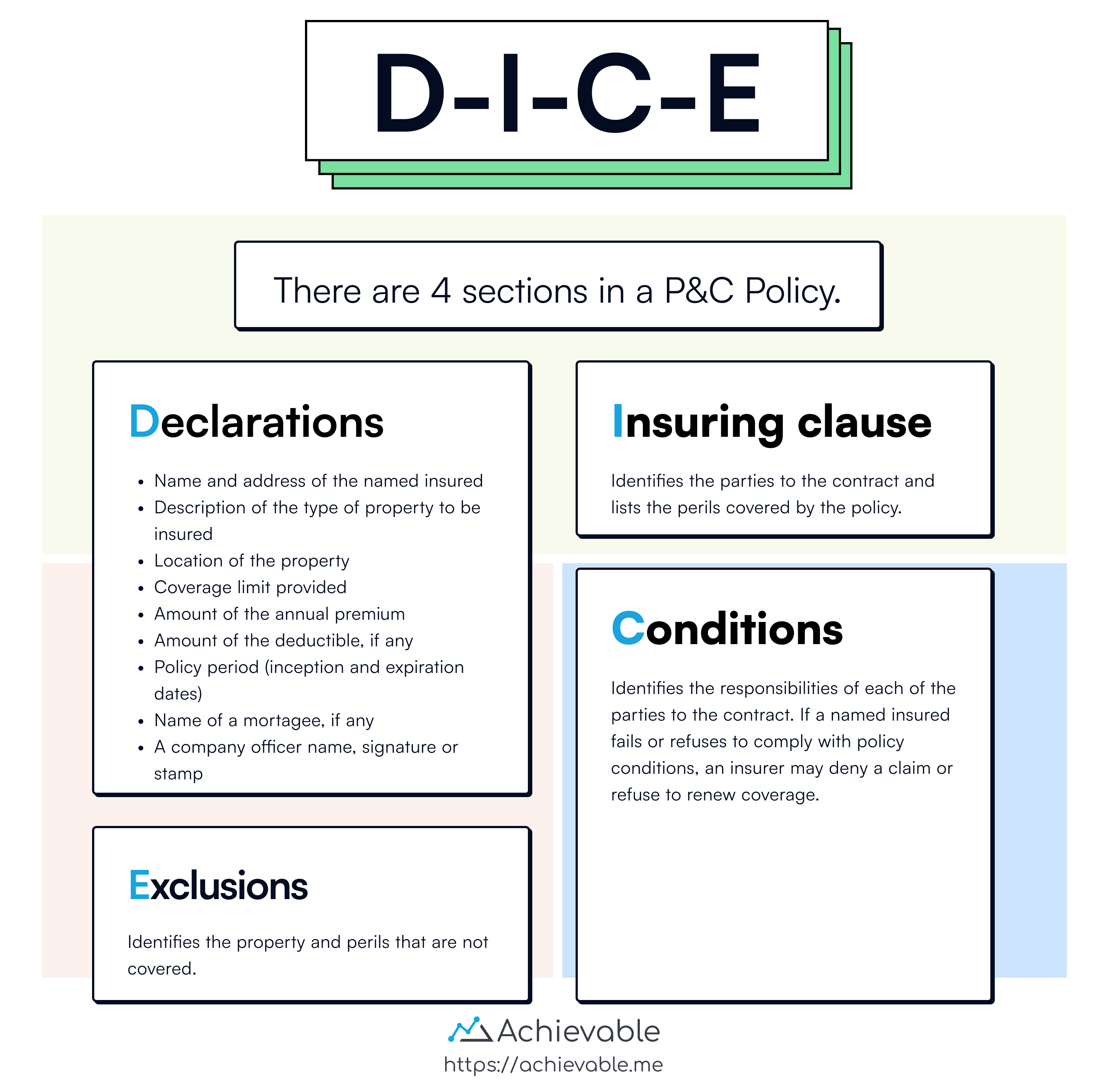
A property and casualty insurance policy is comprised of four basic sections of coverage including:
-
Declarations
-
Insuring agreement
-
Conditions
-
Exclusions
Declarations
The declarations page describes the property or exposures being insured. Much of this information comes directly from the application and includes, but is not limited to:
-
Name and address of the named insured
-
A description of the type of property to be insured
-
The location of the property
-
The coverage limit provided
-
The amount of the annual premium
-
Amount of the deductible, if any
-
The policy period (inception and expiration dates)
-
The name of a mortgagee, if any
-
A company officer name, signature or stamp
Insuring Clause
This section summarizes the coverage agreement between the named insured and the insurer. It identifies the parties to the contract and lists the perils covered by the policy.
Conditions
This section explains the responsibilities of each party to the contract. If a named insured fails or refuses to comply with policy conditions, the insurer may deny a claim or refuse to renew coverage.
Most policy conditions apply to the named insured. For example, after a loss the named insured must give the insurer prompt notice, protect the property from further damage and cooperate with the insurer’s investigation of the claim.
Exclusions
This section identifies property and perils that are not covered. Exclusions allow an insurer to protect itself from financial disaster by not providing coverage for catastrophic losses.
Insurance contracts are unique because the applicant generally must accept the policy as written, without an opportunity to modify or clarify the language. Over time, courts have applied the Doctrine of Adhesion to interpret ambiguous contract terms or conditions in favor of the insured, since the insured had no chance to alter the contract at the time of application.
Insurers work to make contract language clear and to avoid misunderstandings about policy terms. Even so, questions and conflicts still arise. When they do, they often involve warranties and representations.
A warranty is a statement or promise incorporated into the policy that must be true as stated or performed as promised. Under modern insurance law, a breach must generally be material to affect coverage.
Representations are statements made on the application that are substantially true to the best of the applicant’s knowledge.
If an applicant makes a statement on an application that the applicant knows is false, it is a misrepresentation and may constitute fraud. If the insurer can prove that a material misrepresentation was made intentionally, it may void the contract, and the applicant may be prosecuted for insurance fraud, which state law makes a crime.
Lesson Summary
An insurance contract is based on utmost good faith. The applicant relies on the insurer’s promise to pay, and the insurer relies on the truthfulness of the applicant’s statements.
To be valid under contract law, an insurance contract must include consideration, offer and acceptance, legal capacity, and a legal purpose. Consideration is the exchange of value: the insurer promises benefits for covered losses, and the applicant pays the premium.
Offer and acceptance require an unconditional agreement. The applicant makes an offer by submitting an application. The insurer may accept it as written or make a counteroffer. A contract forms only when both parties agree to the final terms.
Legal capacity means both parties must be able to enter into a contract. The contract’s purpose must also be legal and not against public policy. A valid insurance contract must establish an insurable interest between the applicant/owner and the insured.
-
Insurance contracts have unique features:
-
Applicants must accept policies as written without modification.
-
The Doctrine of Adhesion favors insured parties in case of ambiguous terms.
Insurers strive for clear contract language to prevent misunderstandings.
A property and casualty insurance policy consists of four parts:
- Declarations: Information about the insured property
- Insuring Clause: Summary of coverage and perils covered
- Conditions: Responsibilities of each party
- Exclusions: Identifies what is not covered
Warranties are promises that must be true as stated; representations are statements believed to be true to the best of the applicant’s knowledge.
Misrepresentations, if intentional and material, can void the contract and may constitute fraud.