
Short calls
This chapter covers the fundamentals of short call options contracts. To get comfortable with the language used when discussing options, watch this video:
When an investor goes short a call, they’re bearish on the underlying security’s market price. Selling a call creates an obligation: if the option is assigned (exercised), the writer must sell stock at the strike price.
- If the stock’s market price rises above the call’s strike price (often remembered as “call up”), the call is in the money and the holder may exercise. If that happens, the writer must fulfill the obligation.
- If the market price stays at or below the strike price, the call is out of the money and the holder won’t exercise. In that case, the writer keeps the premium as a gain.
Let’s work through a few examples to understand short calls more clearly.
Short 1 ABC Sep 75 call @ $6
This contract obligates the writer to sell ABC stock at $75 per share if assigned. The writer received $600 for selling the option ($6 premium × 100 shares). The contract expires on the third Friday in September.
The investor is betting ABC’s market price stays at or below $75 through expiration. If ABC rises above $75, the holder may exercise, which can create losses for the writer.
Math-based options questions are common on the exam. They usually ask for potential gains, losses, and breakeven values. Let’s go through each.
An investor goes short 1 ABC Sep 75 call @ $6. The market price rises to $100. What is the gain or loss?
Can you figure it out?
Answer = $1,900 loss
| Action | Result |
|---|---|
| Sell call | +$600 |
| Buy shares | -$10,000 |
| Assigned - sell shares | +$7,500 |
| Total | -$1,900 |
At a $100 market price, the call is in the money by $25 ($100 − $75). That’s bad for the call writer.
We can safely assume the investor is assigned, which requires selling 100 shares at $75. If the investor doesn’t already own the shares, they must buy 100 shares in the market at $100 and then sell them for $75.
- Loss from assignment: $25 × 100 = $2,500
- Premium received: +$600
- Net result: −$2,500 + $600 = −$1,900
The higher the underlying security’s market price rises, the more a call writer loses if assigned. If the market price rose to $125, $200, $250, and so on, the loss would keep increasing. Because there’s no ceiling on how high a stock price can go, the maximum loss for a short call is unlimited.
When an option is sold with no hedge (protection), it’s considered naked. A naked short call is especially risky because the writer may have to buy shares at a higher market price and then sell them at the lower strike price. Since the market has no ceiling, the potential loss is unlimited.
In future sections, you’ll learn how investors hedge short options. For now, here’s a quick list of positions that would cover a short call:
- Long shares
- Long call
- Rights or warrants
- Convertible securities
Notice the pattern: if the writer already owns the shares, or can obtain the shares through something convertible (preferred stock or bonds) or exercisable (rights or warrants), they can deliver shares without having to buy them at the higher market price.
Even though the maximum loss on a short naked call is unlimited, the writer doesn’t lose money immediately when the option goes in the money. The premium provides a cushion: the writer must lose more than the premium before the overall position becomes a net loss.
Let’s look at an example where the position breaks even.
An investor goes short 1 ABC Sep 75 call @ $6. The market price rises to $81. What is the gain or loss?
Answer = $0 (breakeven)
| Action | Result |
|---|---|
| Sell call | +$600 |
| Buy shares | -$8,100 |
| Assigned - sell shares | +$7,500 |
| Total | $0 |
At $81, the option is $6 in the money ($81 − $75). Assuming exercise (a safe assumption), the investor buys ABC shares at $81 and sells them at $75.
- Loss from assignment: $6 × 100 = $600
- Premium received: +$600
- Net result: $0
The breakeven for short call contracts can be found using this formula:
The breakeven formula for long calls is the same. The buyer and seller have opposite payoffs, but they break even at the same underlying price.
If ABC’s market price rises only slightly above $75, the investor can still have an overall profit because the premium may be larger than the assignment loss.
An investor goes short 1 ABC Sep 75 call @ $6. The market price rises to $79. What is the gain or loss?
Answer = $200 gain
| Action | Result |
|---|---|
| Sell call | +$600 |
| Buy shares | -$7,900 |
| Assigned - sell shares | +$7,500 |
| Total | +$200 |
At $79, the option is $4 in the money ($79 − $75). If assigned, the investor buys shares at $79 and sells them at $75.
- Loss from assignment: $4 × 100 = $400
- Premium received: +$600
- Net result: +$600 − $400 = +$200
Expiration is the best-case outcome for investors writing (going short) options. If the option expires out of the money, the writer keeps the premium and never has to fulfill the obligation.
An investor goes short 1 ABC Sep 75 call @ $6. The market price falls to $73. What is the gain or loss?
Answer = $600 gain
| Action | Result |
|---|---|
| Sell call | +$600 |
| Total | +$600 |
At $73, the option is $2 out of the money. When the market price is at or below $75, the holder won’t exercise. There’s no reason to buy stock for $75 when it’s available in the market for $73.
A quick way to check whether a call is likely to be exercised is the phrase “call up.” Calls are exercised only when the underlying security’s market price is above the strike price. That isn’t true here, so the option expires.
A short option position can only earn the premium - nothing more. If exercise occurs, losses start reducing that premium and can eventually turn into a net loss.
Writers can also exit their obligation before expiration by making a closing transaction.
An investor goes short 1 ABC Sep 75 call @ $6. After ABC’s market price rises to $79, the premium rises to $9, and the investor performs a closing purchase. What is the gain or loss?
Answer = $300 loss
| Action | Result |
|---|---|
| Sell call | +$600 |
| Close call | -$900 |
| Total | -$300 |
To find the profit or loss on a closing transaction, compare:
- the premium received when the option was sold, and
- the premium paid to buy it back.
Here, the investor sold the call for $6 and later bought it back for $9.
- Net loss per share: $9 − $6 = $3
- Net loss per contract: $3 × 100 = $300
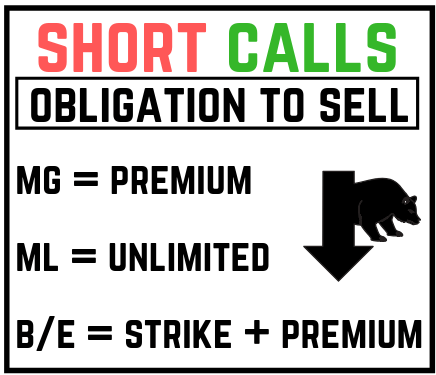
Here’s a visual summarizing the important aspects of short calls: