



Wrapping up
You’ve reached the end of the Achievable SIE material.
This final chapter doesn’t introduce new testable content. Instead, it covers what to expect on exam day and a few best practices to use as your test date approaches.
When am I ready for the exam?
There’s no single perfect answer, but Achievable’s exam readiness score is a strong indicator. At the top of your homepage, you’ll see a 0-100% score that reflects your likelihood of passing. In general, the closer your score is to 100%, the better your odds on test day.
Your readiness score is based on multiple factors, including:
- Program completion (for example, reading chapters)
- Practice quiz performance
- Practice exam performance (scores and number of attempts)
If you’ve used the system as intended, you’ve likely answered hundreds (or even thousands) of practice questions. That repetition matters: completing practice quizzes and assigned reviews is how you build the knowledge you’ll need on exam day.
One of the most important inputs to your readiness score is practice exam performance. Practice exams help you “put the big picture together” by pulling questions from across all chapters in a format similar to the real exam. The most reliable way to raise your readiness score is to take additional practice exams and improve your scores over time.
Before you take a practice exam, put your notes aside. Using outside resources (for example, the Achievable text or Google) will artificially inflate your score. On the actual exam, you won’t have access to study materials - only a notepad and a calculator.
After every practice exam, do a thorough review of each question and answer. Make sure you understand why you got a question right or wrong. Also, think beyond the question. A common pitfall is studying specific questions instead of learning the underlying content. While our questions are designed to resemble the real exam, no one knows which questions they’ll see on test day. FINRA closely guards its question bank, and test writers use unique wording.
If you’re memorizing answers without understanding the why, you’re likely to struggle when the scenario or wording changes.
A useful self-check is:
“If I was given another question, with a completely different scenario and wording, am I confident I would know the answer?”
If the answer is yes, keep moving forward. If the answer is no, go back to the reading materials and review that topic.
How many practice exams should I take?
There’s no universal number. Some people pass without taking a single practice exam, and others can take many and still fall short. It depends on how well you understand - and can apply - the material.
Generally speaking, we recommend taking at least 10 practice exams. Many students start in the 50s or 60s. The goal is to build knowledge from each exam through careful review and then apply what you learned on the next one.
A consistent passing score (70% or higher) over five or more exams usually indicates a solid grasp of the material. Higher is better.
Be sure to spend quality time reviewing each exam right after taking it. That’s where most of the improvement happens.
Another reason to take several practice finals is topic coverage. The SIE can test a very wide range of material - think thousands of subtopics. A full-length practice exam covers 75 questions, so each additional exam increases the breadth of what you’ve tested yourself on.
What score should I aim for on my practice exams?
A passing score (70% or above) is a good baseline. However, it’s smart to aim higher.
If you’ve averaged around 70% on your last several practice exams, you have a reasonable chance of passing. Still, the real exam often feels harder because of the testing environment and the pressure of taking the real thing. Anxiety can affect timing, focus, and accuracy.
We recommend aiming for a mid-high 70s average (or higher) on your last 2-3 practice finals. That gives you a buffer for nerves, unfamiliar wording, or a tougher-than-expected question mix.
Exam registration
1. Create and register an account on the FINRA website.
2. Enroll for the Securities Industry Essentials (SIE) Exam from the list of available exams.
3. Schedule your exam. You have the option to test either at a Prometric test center or online. If you choose to take your exam online, your exam will be proctored.
It is recommended to schedule your exam session as far in advance as possible to secure your desired exam date.
Additional exam information
The FINRA SIE exam costs $100 per attempt. The passing score is a 70% or higher.
There are waiting periods after failed attempts: 30 days after the first two failed attempts, and 180 days after the third and subsequent failures within a two-year period.
FINRA has filed a rule change that will shorten these waiting periods to 15 days after the first two failed attempts and 60 days after the third and subsequent failures. It is not yet in effect for candidates. FINRA will announce the implementation date in a future regulatory notice, and the waiting periods above apply until then.
Tips for testing day
As you approach test day, we recommend the following to make sure you perform at the highest possible level:
-
Review your email confirmation.
Give yourself time to review the appointment details either the night before your exam or the morning of it.
-
Bring your ID.
Regardless of how you are testing, bring one valid, government-issued identification document with a signature and picture, such as an unexpired driver’s license, passport, or military ID. Also, make sure the name on your ID exactly matches the name under which your exam is scheduled.
-
Arrive early.
If you are testing at a testing center, arriving early helps you avoid delays and reduces stress. If you are testing online, arriving early gives you time to set up and troubleshoot any technical issues.
Additional resources
As always, refer to the FINRA website for further information.
Check out the Achievable blog for more study tips and best practices.
Dump sheet
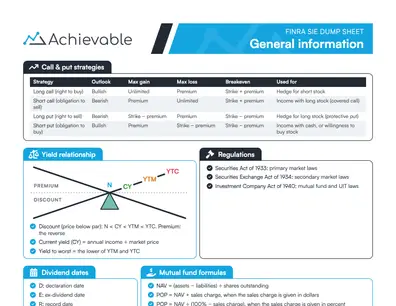
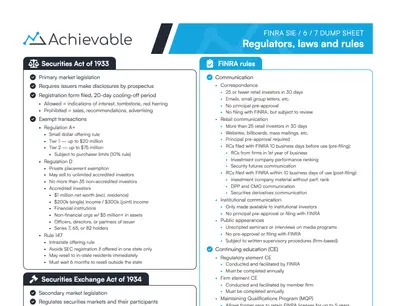
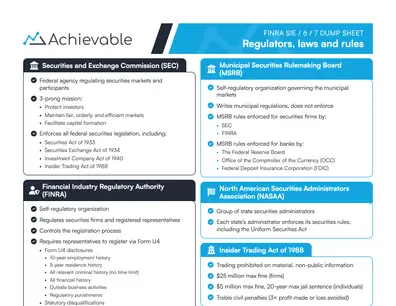
Many test takers use “dump sheets” as study supplements and as a guide for a “legal cheat sheet” on the exam. Dump sheets typically include visual guides and summarized notes of important test topics. As the name suggests, you memorize key items and then do a “data dump” onto your notepad at the beginning of the exam.
These are allowed in the test center as long as they are created after the test has started (and not during the initial tutorial). They aren’t necessary to succeed, but some test takers find them helpful.
You can certainly create your own, but here are Achievable’s SIE Exam dump sheets:
Download: SIE Exam Dump Sheet - General Formulas
Download: SIE Exam Dump Sheet - Regulators, Laws, and Rules front
Download: SIE Exam Dump Sheet - Regulators, Laws, and Rules back
Final thoughts
FINRA exams can be anxiety-inducing. The most reliable way to manage that is preparation that matches the real testing conditions: use the Achievable system as intended, take closed-book practice exams, and review your results carefully.
If you have any feedback, please let us know!
Wishing you the best,
The Achievable team