This browser is too old to run Achievable.

Update it, or open this page in a current version of Chrome, Safari, Firefox or Edge. On an iPhone or iPad, update iOS: every browser there runs on the version of Safari that comes with it.

Achievable logoAchievable logo
SIE
Sign in
Sign up
Purchase
Textbook
Practice exams
Support
How it works
Resources
Exam catalog
Mountain with a flag at the peak
Achievable logoAchievable logo
Resources

FINRA SIE resources

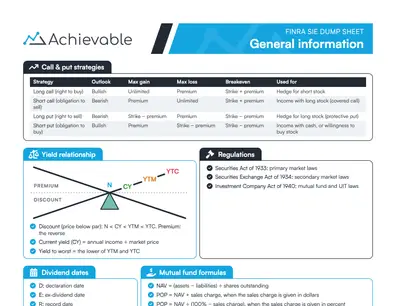
Dump sheet: General
Dump sheet: General
Quick reference sheet ("cheat sheet") for the SIE covering general information.
Download
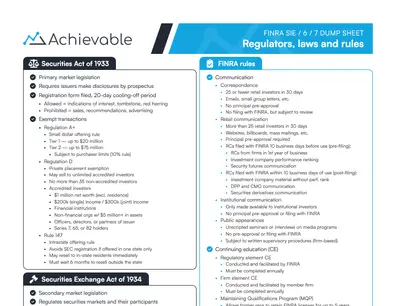
Dump sheet: Regulators, laws, rules (front)
Quick reference sheet ("cheat sheet") for the SIE covering regulators, laws and rules (front).
Download
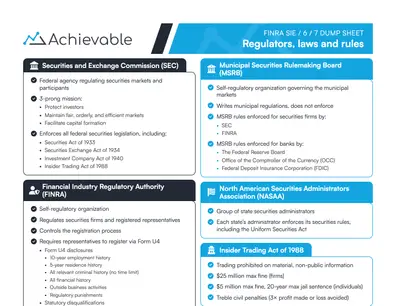
Dump sheet: Regulators, laws, rules (back)
Quick reference sheet ("cheat sheet") for the SIE covering regulators, laws and rules (back).
Download
SIE tutoring
Want one-on-one help with your studying? Check out Achievable's directory of FINRA SIE tutors.
Browse SIE tutors
Achievable's FINRA podcast
FINRA course author Brandon Rith and guests provide actionable tips and topic reviews to help you pass your FINRA exams.
Visit site
Achievable App
Study on the go! Learn how to use Achievable on your phone.
View
Support
Need some help or have some thoughts to share with us? We'd love to hear from you.
View
Know Yourself, Grow Your Wealth®
Build a better relationship with yourself and your money through this state-of-the-art education and empowerment experience.
Register now
Finance|able
Finance|able
Finance|able is an innovative finance training platform with intuitive, interactive courses that help you gain the skills you need to land the job and crush it when you hit the desk.
Visit site
Video library
What is common stock?
8:20
Common stock represents partial ownership in a company, profiting through capital appreciation or cash dividends, as seen with Netflix and McDonald's shares.
Rights and warrants question
7:57
A practice question asks which short-term security lets a company's shareholders buy stock below market price, working through warrants, call options, rights, and convertible preferred stock to find the answer.
Forward stock splits
2:01
Forward stock splits lower share price without losing value, shown through Apple's 2014 seven-for-one split and the stock split factor calculation.
Reverse stock splits
2:33
Reverse stock splits raise a low share price by shrinking share count, shown through a split-factor calculation turning 1000 $4 shares into 100 $40 shares. Because they alter par value, they need shareholder approval.
Systematic vs non-systematic risk
7:38
Works through a practice question contrasting market risk, which hits the whole market and can't be diversified away, with financial, business, and liquidity risk, which hit specific companies and can be.
Negotiable and redeemable
7:38
Negotiable securities like stocks and bonds trade between investors at market price with commissions, while redeemable ones like mutual funds trade directly with the issuer at net asset value with sales charges.
Cash dividends
Cash dividends
2:10
Cash dividends share company profits with shareholders, unlike growth companies that reinvest profits for capital appreciation instead. Larger, established firms past their growth phase, such as Ford, typically pay them.
Call protection
Call protection
3:33
Walks through a practice question on a callable bond with three call dates and premiums, showing that call protection is simply the earliest date the issuer can call, ignoring the other numbers given.
Bond volatility & stability
4:44
Bond price swings most with long maturities and low coupons, and stays stable with short maturities and high coupons, shown through a practice question comparing four bonds including a zero-coupon strip.
Current yield
Current yield
4:36
A practice question decodes a bond quote's coupon and price, then finds current yield by dividing annual interest by market price.
Long call basics
Long call basics
9:25
A long call quote is broken into its parts, showing how strike price, expiration and premium set the right to buy 100 shares. The call up put down rule splits that premium into intrinsic value and time value.
Short call basics
Short call basics
9:42
Selling a call obligates the seller to sell 100 shares at the strike price, while the premium splits into intrinsic and time value via the call up rule.
Long put basics
Long put basics
8:36
A long put quote shows the right to sell stock at a strike price, then its premium is split into intrinsic and time value using call up put down.
Short put basics
Short put basics
9:54
A short put quote is decoded piece by piece, showing why selling it obligates the seller to buy stock at the strike price. The 'call up, put down' rule splits the premium into intrinsic and time value.
Agency vs. principal
4:32
Agency trades connect buyers and sellers for a commission, while principal (dealer) trades fill orders from the firm's own inventory with a markup or markdown.
Options hedging strategies
18:06
Works through a long-stock-plus-long-put hedge, using a t-chart and the call up put down rule to find maximum gain, maximum loss, breakeven, and profit at given stock prices.
Covered calls
Covered calls
16:47
Works through a covered call example, buying stock at 60 and selling a 75 call, to find maximum gain, maximum loss, and breakeven using a T-chart. Shows why the position is a bull-neutral, partial-hedge strategy rather than a pure hedge.
Income strategies
Income strategies
10:40
Covered calls and covered puts sell an option against a stock position for premium income, yet the stock position can still lose significant money.
Hedging strategies
Hedging strategies
11:17
Hedging pairs long stock with a long put, or short stock with a long call, using the option as insurance at the cost of its premium.
Voting rights
Voting rights
11:40
Shareholder voting for the board, shown via a real proxy statement, contrasts statutory voting's per-seat cap with cumulative voting's pooled votes.
Total return
Total return
7:10
Total return divides dividends, interest, and capital appreciation by the original investment, worked through a question that filters out an irrelevant CPI figure.
Dividend dates
Dividend dates
12:33
Walks through the declaration, record, ex-dividend, and payable dates, showing how T+1 settlement makes the ex-dividend date match the record date.
Intrinsic value (calls)
10:34
A 70 call worth $5 when the market hits 75 shows the call up rule, and premium splits into intrinsic plus time value; good for longs, bad for short sellers.
Intrinsic value (puts)
9:53
Puts gain intrinsic value as market price falls below strike price (put down), distinct from premium; an example computes the resulting gain or loss.
Market makers - bid/ask
9:59
A market maker's inside quote has customers selling at the bid and buying at the ask, with size capping shares at that price. An example order shows when a request exceeds it.
Market orders
Market orders
8:21
Market orders guarantee execution at the next available price, not a set price, and always default to a day timeframe, never good-till-cancel.
Buy limit orders
Buy limit orders
8:35
Buy limit orders execute only at the specified price or lower, trading guaranteed price for uncertain execution, and run as day or GTC orders. A ticker-tape practice question shows how to spot the first price meeting that threshold.
Sell limit orders
Sell limit orders
9:53
Sell limit orders set a minimum acceptable price, guaranteeing that price but not execution if the market falls instead of rising.
Sell stop orders
Sell stop orders
6:36
A sell stop order triggers once price falls to the stop level, then fills as a market order at the next available price, not a guaranteed one.
Buy stop orders
Buy stop orders
9:06
Buy stop orders protect short stock positions, triggering a market order once price hits the stop price or above, with no guaranteed fill price.
Buy stop limit orders
9:39
Buy stop limit orders combine a stop trigger with a buy limit to cap losses on a short position, using SLOBS vs BLISS to track when the order triggers then executes.
Sell stop limit orders
8:07
Sell stop limit orders protect a long position, triggering at the stop price then executing only as a limit order at that price or better.
Short stock with long call options hedging strategy
14:43
A short stock and long call hedge is solved with a T-chart for max gain, max loss, and break-even, showing the call caps losses above the strike.
Minimum maintenance
Minimum maintenance
7:57
Works a margin account example where a stock rises from 80 to 90, finding equity, equity percentage, and the 25% minimum maintenance level for long accounts.
Combined equity
Combined equity
7:03
Equity in a margin account combines long market value minus debit plus credit minus short market value, with a worked example plugging in numbers to find the total.
Covered puts
Covered puts
13:29
A short stock position paired with a short put shows how breakeven, max gain, and max loss play out using a T-chart, revealing that max loss stays unlimited despite the strategy's name.
All rights reserved ©2016 - 2026 Achievable, Inc.