



Long straddles
When you can’t confidently predict whether the market will move up or down, but you do expect a big move (high volatility), a long straddle can be an appropriate strategy. This position can profit if the stock price rises or falls significantly.
These are the components of a long straddle:
Long call & long put*
*Must be the same strike price and expiration
For example:
Long 1 ABC Jan 60 call
Long 1 ABC Jan 60 put
A long call gives the right to buy the stock at the strike price, and a long put gives the right to sell the stock at the strike price. The long call is bullish (it benefits from rising prices), and the long put is bearish (it benefits from falling prices). By buying both, the investor is betting on volatility - a large move in either direction.
-
If the stock price rises above the strike price (“call up”), the call can be exercised. The investor buys shares at the strike price and can sell them at the higher market price. The position is profitable if the call’s gain exceeds the combined premiums paid for both options.
-
If the stock price falls below the strike price (“put down”), the put can be exercised. The investor buys shares at the lower market price and sells them at the higher strike price. The position is profitable if the put’s gain exceeds the combined premiums paid for both options.
A long straddle can look appealing because it can profit in either a bull or bear market. The trade-off is cost: you pay two premiums up front. That means the stock must move far enough for one option’s intrinsic value to exceed the total premiums. If the stock stays near the shared strike price, the investor can lose some or all of the combined premiums.
Let’s take a look at several scenarios to understand long straddles better:
An investor goes long 1 ABC Jan 60 call at $4 and long 1 ABC Jan 60 put at $5 when ABC’s market price is $60. What is the gain or loss if ABC’s market price rises to $100?
Can you figure it out?
Answer = $3,100 gain
| Action | Result |
|---|---|
| Buy call | -$400 |
| Buy put | -$500 |
| Exercise call - buy shares | -$6,000 |
| Sell shares | +$10,000 |
| Total | +$3,100 |
At $100, the call is in the money (it has intrinsic value), and the put is out of the money (no intrinsic value). The put expires worthless, and the call is exercised, allowing the investor to buy ABC at $60 and sell at $100.
- Intrinsic value on the call = $100 − $60 = $40 per share
- Total intrinsic value = $40 × 100 = $4,000
- Combined premiums paid = ($4 + $5) × 100 = $900
- Net gain = $4,000 − $900 = $3,100
Only one option finished in the money, but the call gained enough intrinsic value to more than offset the $900 paid in premiums.
The maximum gain for a long straddle is unlimited*. The further the market rises, the more intrinsic value the call option gains.
What happens if the market rises by a small amount?
An investor goes long 1 ABC Jan 60 call at $4 and long 1 ABC Jan 60 put at $5 when ABC’s market price is $60. What is the gain or loss if ABC’s market price rises to $69?
Answer = $0 (breakeven)
| Action | Result |
|---|---|
| Buy call | -$400 |
| Buy put | -$500 |
| Exercise call - buy shares | -$6,000 |
| Sell shares | +$6,900 |
| Total | $0 |
At $69, the call is in the money and the put is out of the money. The put expires worthless, and the call is exercised.
- Call intrinsic value = $69 − $60 = $9 per share
- Total intrinsic value = $9 × 100 = $900
- Combined premiums paid = $900
The $900 intrinsic value exactly offsets the $900 paid in premiums, so the position breaks even.
This is one of two breakevens for a straddle. On the upside, breakeven is always:
- Upside breakeven = strike price + combined premium
In this example: $60 + $9 = $69.
Let’s try another example:
What happens if the market rises by a small amount?
An investor goes long 1 ABC Jan 60 call at $4 and long 1 ABC Jan 60 put at $5 when ABC’s market price is $60. What is the gain or loss if ABC’s market price rises to $62?
Answer = $700 loss
| Action | Result |
|---|---|
| Buy call | -$400 |
| Buy put | -$500 |
| Exercise call - buy shares | -$6,000 |
| Sell shares | +$6,200 |
| Total | -$700 |
At $62, the call is in the money and the put is out of the money. The put expires worthless, and the call is exercised.
- Call intrinsic value = $62 − $60 = $2 per share
- Total intrinsic value = $2 × 100 = $200
- Combined premiums paid = $900
- Net result = $200 − $900 = −$700
This shows the main risk of a long straddle: if the stock doesn’t move enough, the intrinsic value gained won’t cover the combined premiums.
What happens if the market remains flat?
An investor goes long 1 ABC Jan 60 call at $4 and long 1 ABC Jan 60 put at $5 when ABC’s market price is $60. What is the gain or loss if ABC’s market price stays at $60?
Answer = $900 loss
| Action | Result |
|---|---|
| Buy call | -$400 |
| Buy put | -$500 |
| Total | -$900 |
At $60, both options are at the money, so both expire worthless (an option must have intrinsic value to be exercised). The investor loses the entire combined premium: $900.
This is the worst-case outcome for a long straddle, because neither option gains intrinsic value.
To find the maximum loss for any long straddle, you can use this formula:
What happens if the market falls a small amount?
An investor goes long 1 ABC Jan 60 call at $4 and long 1 ABC Jan 60 put at $5 when ABC’s market price is $60. What is the gain or loss if ABC’s market price falls to $57?
Answer = $600 loss
| Action | Result |
|---|---|
| Buy call | -$400 |
| Buy put | -$500 |
| Buy shares | -$5,700 |
| Exercise put - sell shares | +$6,000 |
| Total | -$600 |
At $57, the put is in the money and the call is out of the money. The call expires worthless, and the put is exercised after shares are purchased at the market price.
- Put intrinsic value = $60 − $57 = $3 per share
- Total intrinsic value = $3 × 100 = $300
- Combined premiums paid = $900
- Net result = $300 − $900 = −$600
Again, the stock moved, but not enough to cover the combined premiums.
What happens if the market falls a little further?
An investor goes long 1 ABC Jan 60 call at $4 and long 1 ABC Jan 60 put at $5 when ABC’s market price is $60. What is the gain or loss if ABC’s market price falls to $51?
Answer = $0 (breakeven)
| Action | Result |
|---|---|
| Buy call | -$400 |
| Buy put | -$500 |
| Buy shares | -$5,100 |
| Exercise put - sell shares | +$6,000 |
| Total | $0 |
At $51, the put is in the money and the call is out of the money. The call expires worthless, and the put is exercised.
- Put intrinsic value = $60 − $51 = $9 per share
- Total intrinsic value = $9 × 100 = $900
- Combined premiums paid = $900
The $900 intrinsic value offsets the $900 paid in premiums, so the position breaks even.
This is the downside breakeven. On the downside, breakeven is always:
- Downside breakeven = strike price − combined premium
In this example: $60 − $9 = $51.
Here’s the general formula for breakeven on straddles:
You’ll learn more about this in the next section, but the breakeven formula is the same for both long and short straddles.
Straddles are one of the only options strategies with multiple breakevens. To find both quickly:
- Add up the combined premiums.
- Add the combined premiums to the strike price (upside breakeven).
- Subtract the combined premiums from the strike price (downside breakeven).
In summary, the two breakevens for this long straddle are $51 and $69.
What happens if the market falls significantly?
An investor goes long 1 ABC Jan 60 call at $4 and long 1 ABC Jan 60 put at $5 when ABC’s market price is $60. What is the gain or loss if ABC’s market price falls to $25?
Answer = $2,600 gain
| Action | Result |
|---|---|
| Buy call | -$400 |
| Buy put | -$500 |
| Buy shares | -$2,500 |
| Exercise put - sell shares | +$6,000 |
| Total | +$2,600 |
At $25, the put is in the money and the call is out of the money. The call expires worthless, and the put is exercised.
- Put intrinsic value = $60 − $25 = $35 per share
- Total intrinsic value = $35 × 100 = $3,500
- Combined premiums paid = $900
- Net gain = $3,500 − $900 = $2,600
Only one option finished in the money, but the put gained enough intrinsic value to offset the $900 paid in premiums.
Let’s look at the options payoff chart to summarize the “big picture” of this long straddle. First, let’s re-establish the example:
Long 1 ABC Jan 60 call @ $4
Long 1 ABC Jan 60 put @ $5
Here’s the payoff chart:
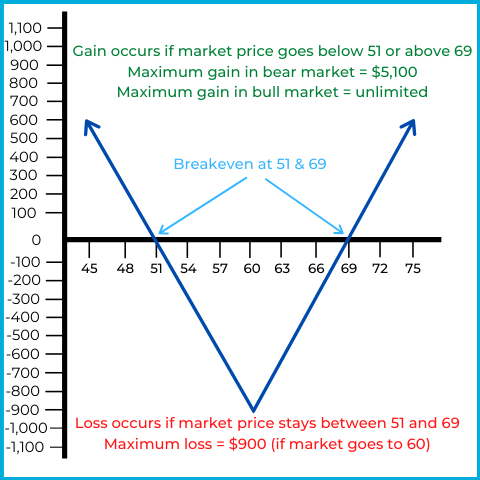
The horizontal axis represents the market price of ABC stock, while the vertical axis represents overall gain or loss.
As the long straddle payoff chart shows, the investor reaches their maximum loss of $900 at a market price of $60. At that price, both options expire worthless, so the combined premiums are the total loss.
- Above $60, the call gains intrinsic value.
- Below $60, the put gains intrinsic value.
At $69, the call has $9 of intrinsic value, which offsets the $9 combined premium. Any market price above $69 produces a profit, and the upside gain potential is unlimited.
At $51, the put has $9 of intrinsic value, which offsets the $9 combined premium. Any market price below $51 produces a profit, and the downside gain potential is up to $5,100 (which would occur if the stock fell to $0).
In our last few examples, let’s explore what happens if investors close out contracts at intrinsic value. As we’ve learned previously, closing out contracts involves trading the contracts instead of exercising or allowing them to expire.
An investor goes long 1 ABC Jan 60 call at $4 and long 1 ABC Jan 60 put at $5 when ABC’s market price is $60. ABC’s market falls to $45 and the investor closes the contracts at intrinsic value. What is the gain or loss?
Answer = $600 gain
| Action | Result |
|---|---|
| Buy call | -$400 |
| Buy put | -$500 |
| Close call | $0 |
| Close put | +$1,500 |
| Total | +$600 |
At $45, the put is in the money and the call is out of the money.
- The call has $0 intrinsic value, so it’s closed by selling it for $0 (closing sale).
- The put has $15 intrinsic value ($60 − $45), so it’s closed by selling it for $15 (closing sale).
The investor paid $9 in total premium and sells the position for $15 of intrinsic value, for a net gain of $6 per share:
- Net gain = ($15 − $9) × 100 = $600
As a reminder, closing a long option position means doing the opposite transaction of the opening trade. Since both options were purchased to open the straddle, both are sold to close.
Let’s examine one more scenario involving closing transactions for our last example:
An investor goes long 1 ABC Jan 60 call at $4 and long 1 ABC Jan 60 put at $5 when ABC’s market price is $60. ABC’s market rises to $66 and the investor closes the contracts at intrinsic value. What is the gain or loss?
Answer = $300 loss
| Action | Result |
|---|---|
| Buy call | -$400 |
| Buy put | -$500 |
| Close call | +$600 |
| Close put | $0 |
| Total | -$300 |
At $66, the call is in the money and the put is out of the money.
- The put has $0 intrinsic value, so it’s closed by selling it for $0 (closing sale).
- The call has $6 intrinsic value ($66 − $60), so it’s closed by selling it for $6 (closing sale).
The investor paid $9 in total premium and sells the position for $6 of intrinsic value, for a net loss of $3 per share:
- Net loss = ($9 − $6) × 100 = $300
As in the prior example, both options were purchased to open the straddle, so both are sold to close.
This video covers the important concepts related to long straddles:
For suitability, long straddles should only be recommended to aggressive option traders if volatility is expected. Although the maximum loss is limited to the premiums, losses can add up quickly due to the short-term nature of options. The investor realizes a loss if volatility does not materialize before expiration (9 months or less for standard options).