



Water quality
This chapter covers the following:
- Ground and surface water quality, basic water chemistry
- Biochemical oxygen demand (BOD)
- BOD exertion
- Kinetic temperature corrections
- Stream modeling - Streeter Phelps
- Oxygen saturation
- Dilution purification of wastewater streams
Basic water chemistry
Groundwater tends to run low in dissolved oxygen and turbidity but high in hardness and dissolved minerals; surface water sees more reaeration and organic loading, so it runs higher in BOD and turbidity with more variable DO. The next chapter, Water treatment and distribution, covers how these differences drive treatment design.
To compare ions on a common basis, convert to an equivalent concentration of ():
Example: phosphate concentration as CaCO₃
A sample contains of (molecular weight , contributing equivalents). Find the equivalent concentration as .
Answer: as
For , the equilibrium constant expression is:
Example: equilibrium constant
For the reaction , equilibrium concentrations are , , and . Find .
Answer:
Biochemical oxygen demand (BOD)
Biochemical oxygen demand (BOD) measures how much dissolved oxygen microorganisms need to biologically oxidize biodegradable organic matter under aerobic conditions. In practice, BOD is most commonly reported as the 5-day test at 20°C, written as .
Because BOD reflects the amount of biodegradable organic pollution present, it’s widely used in:
- wastewater treatment design
- regulatory compliance
- evaluating impacts on receiving waters
There are three BOD equations covering different setups. The basic equation applies when dilution water is unseeded. The seeded version applies when seed organisms are added to the dilution water. The BOD sub t equation applies when you need the BOD exerted at a time other than the standard five days.
The three equations below cover the setups you’ll see: the basic equation applies when the dilution water is unseeded, the seeded version applies when seed organisms are added to the dilution water, and applies when you need the BOD exerted at some incubation time other than the standard 5 days.
Basic BOD testing/sampling equation
Example: BOD5 dilution test
A sample is diluted to with unseeded water. DO is at time zero and after 5 days at 20°C. Find .
Answer:
When the dilution water is seeded
Where:
- = dissolved oxygen of diluted sample immediately after preparation (mg/L)
- = dissolved oxygen of diluted sample after 5-day incubation at 20°C (mg/L)
- = dissolved oxygen of seed control before incubation (mg/L)
- = dissolved oxygen of seed control after incubation (mg/L)
- = fraction of seeded dilution water volume in sample to volume of seeded dilution water in seed control
- = fraction of wastewater sample volume to total combined volume
is the BOD exerted after days of incubation, based on the difference between the blank and the sample, scaled by the dilution factor.
Where:
- = dissolved oxygen concentration in blank after days in incubation (mg/L)
- = dissolved oxygen concentration in sample after days in incubation (mg/L)
Dilution factor:
The dilution factor is just the reciprocal of P. Multiplying by the dilution factor gives the same result as dividing by P in the basic BOD equation above. The BOD sub t form simply substitutes the blank and sample dissolved oxygen readings for D sub 1 and D sub 2.
Notice that the dilution factor is just the reciprocal of (), so multiplying by the dilution factor gives the same result as dividing by in the basic BOD equation above - the form simply substitutes the blank/sample DO readings for .
BOD exertion
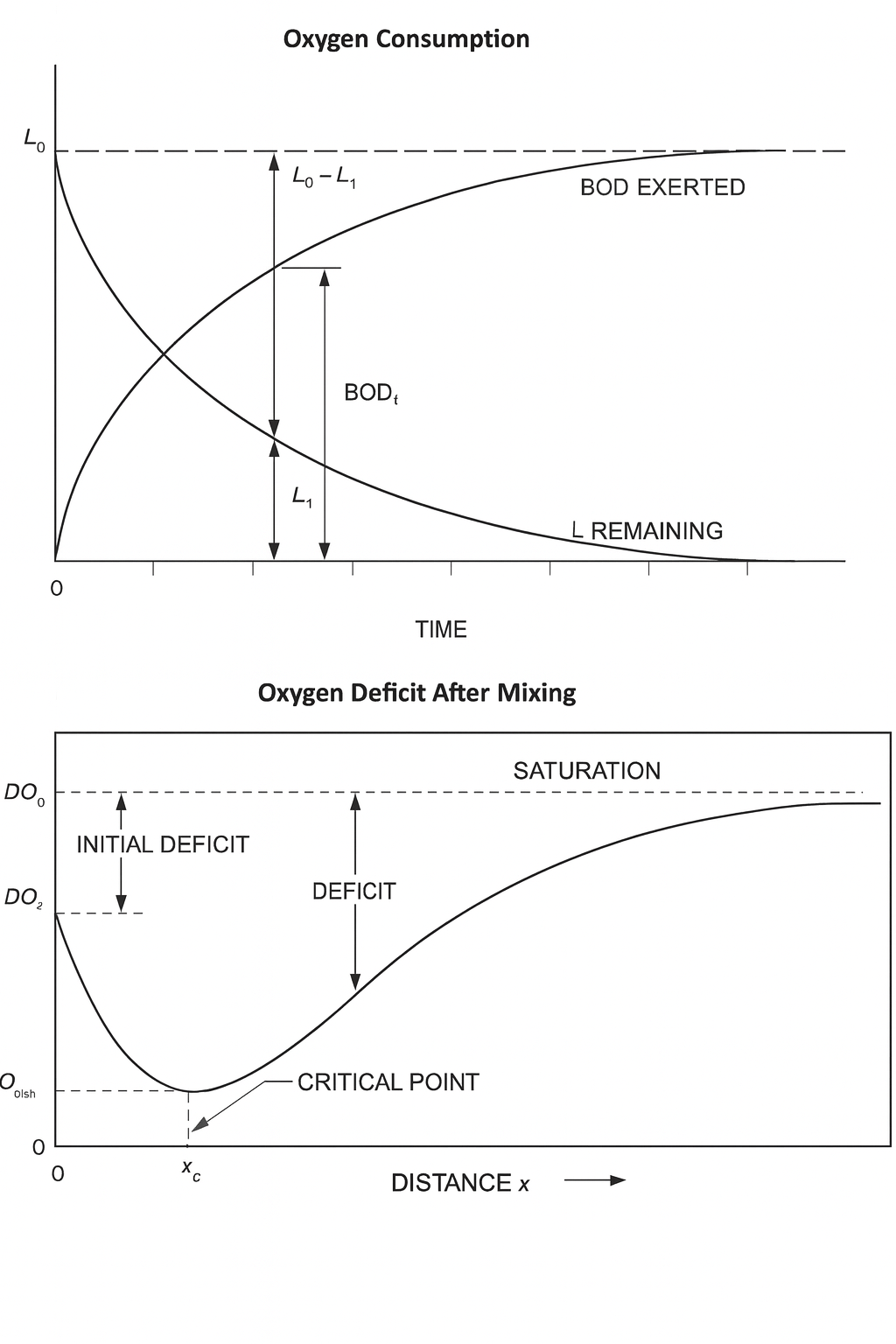
BOD exertion describes how oxygen demand is applied over time as microorganisms decompose organic matter. The demand isn’t used up instantly; it increases gradually as biochemical reactions proceed. Under ideal conditions, this behavior is modeled with first-order kinetics.
Where:
- = amount of BOD exerted at time (mg/L)
- = BOD decay rate constant, base (day⁻¹)
- = rate constant, base 10 (day⁻¹)
- = ultimate BOD (mg/L)
- = time (days)
Kinetic temperature corrections
Reaction rates in water quality processes depend strongly on temperature. To model conditions at temperatures other than the standard reference of 20°C, you adjust the rate constant using a temperature correction.
Where:
- = temperature of interest (°C)
- = BOD rate constant at the temperature of interest (day⁻¹)
- = BOD rate constant determined at 20°C (day⁻¹)
- = temperature coefficient
- BOD (): for to , or for to
- Reaeration ():
Stream modeling - Streeter-Phelps
The Streeter-Phelps model describes dissolved oxygen (DO) changes in a stream after an organic waste discharge. It combines two competing processes:
- oxygen depletion from BOD exertion (deoxygenation)
- oxygen replenishment from the atmosphere (reaeration)
The model predicts the DO deficit downstream, including the critical point where DO reaches its minimum before recovering toward saturation. The saturation concentration is covered in the next section.
The first equation calculates the dissolved oxygen deficit downstream at a given time. The second equation finds the critical time when dissolved oxygen is at its lowest point. The third equation relates dissolved oxygen to the saturation value minus the deficit.
Where:
- = dissolved oxygen deficit (mg/L)
- = dissolved oxygen concentration (mg/L)
- = initial dissolved oxygen deficit in mixing zone (mg/L)
- = saturated dissolved oxygen concentration (mg/L)
- = deoxygenation rate constant, base (day⁻¹)
- = reaeration rate constant, base (day⁻¹)
- = initial ultimate BOD in mixing zone (mg/L)
- = time (days)
- = time at which minimum dissolved oxygen occurs (days)
Example: Streeter-Phelps deficit
A river has deoxygenation rate and reaeration rate (both already base ), initial ultimate BOD , and initial deficit immediately after mixing. Find the dissolved oxygen deficit at days downstream.
Answer:
Oxygen saturation
Oxygen saturation is the maximum dissolved oxygen concentration water can hold when it’s in equilibrium with the atmosphere. It depends mainly on:
- temperature
- atmospheric pressure
- salinity
Saturation is a key reference value because it sets the upper limit for DO and helps define the oxygen deficit used in stream modeling. Henry’s law describes the underlying relationship:
Where:
- = Henry’s law constant (moles/L·atm)
- = partial pressure of oxygen (atm)
is the same used in this chapter’s deficit equation (); there’s no separate formula to learn.
Dilution purification of wastewater streams
Dilution and natural purification control what happens to wastewater after it enters a receiving water.
- Dilution lowers pollutant concentrations through mixing with cleaner water.
- Purification reduces pollutants through processes such as biodegradation, sedimentation, and reaeration.
Together, these processes determine a stream’s assimilative capacity and help guide discharge permit limits.
If untreated or partially treated sewage is instantly mixed upon discharge into a large water body, the resulting parameter levels (e.g., temperature, DO, BOD, suspended solids) can be estimated using a weighted average. If the mixed conditions meet water quality standards, pretreatment may not be required.
Consider a wastewater flow rate with ultimate BOD and dissolved oxygen mixing with a river with flow rate , ultimate BOD , and dissolved oxygen . Each parameter below follows the same weighted-average pattern; keep and in matching flow units.
The initial (immediately after mixing) ultimate BOD of the river-wastewater mix is:
Initial dissolved oxygen immediately after mixing is given by:
Temperature immediately after mixing is given by:
Initial oxygen deficit after mixing is given by:
Example: river-wastewater mixing
with enters a river at with . Find the DO immediately downstream (flows already share units).
Answer: