


Achievable logoAchievable logo
CMA Part 1
Sign in
Sign up
Purchase
Textbook
Practice exams
Support
How it works
Exam catalog
Mountain with a flag at the peak
Textbook
1. External financial reporting decisions
2. Planning, budgeting, and forecasting
2.1 Strategic planning
2.1.1 Analysis of external and internal factors affecting strategy
2.1.2 Long-term mission and goals
2.1.3 Alignment of tactics with long-term strategic goals
2.1.4 Strategic planning models and analytical techniques
2.1.5 Characteristics of successful strategic planning process
2.2 Budgeting concepts
2.3 Forecasting techniques
2.4 Budgeting methodologies
2.5 Annual profit plan and supporting schedules
2.6 Top-level planning and analysis
3. Performance management
4. Cost management
5. Internal control
6. Technology and analytics
Achievable logoAchievable logo
2.1.5 Characteristics of successful strategic planning process
Achievable CMA Part 1
2. Planning, budgeting, and forecasting
2.1. Strategic planning
Our CMA Part 1 course is currently in development and is a work-in-progress.

Characteristics of successful strategic planning process

3 min read
Font
Discuss
Share
Feedback

Learning outcome statements

The learning outcome statements relevant for this section are:

  1. identify the characteristics of successful strategic plans

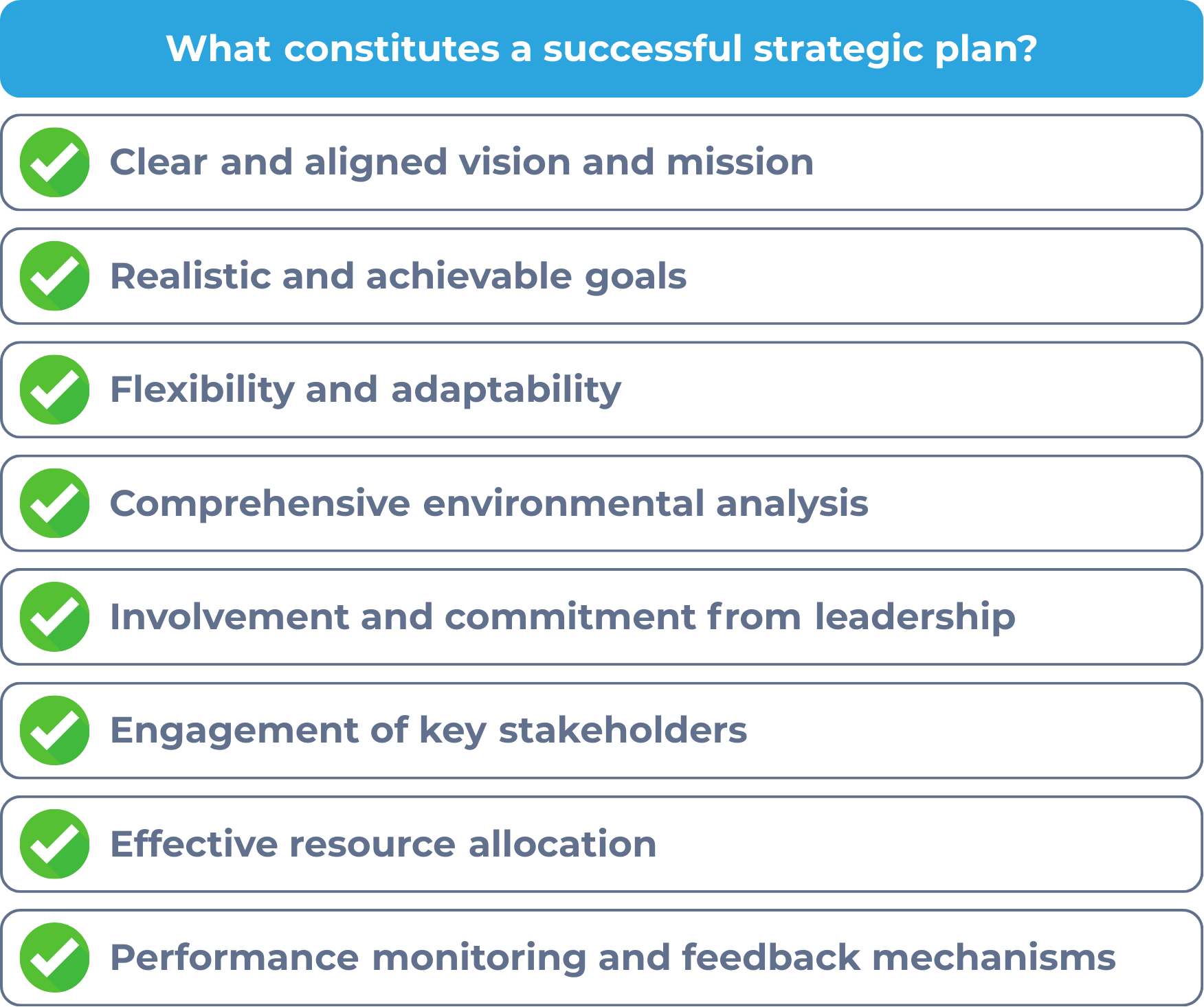
What constitutes a successful strategic plan?

A successful strategic plan not only defines an organization’s long-term goals but also provides a clear roadmap for achieving them. It requires a well-structured process that incorporates key characteristics to ensure that the plan is both practical and effective in guiding the organization toward its vision. There is no exhaustive list of the characteristics of a successful strategic planning process. However, we may consider the below factors:

What constitutes a succcessful strategic plan?

Clear and aligned vision and mission

A successful strategic plan starts with a well-defined vision and mission that articulates the organization’s purpose and aspirations. The mission explains why the organization exists, while the vision describes what it aims to become in the future. These foundational elements provide direction and ensure that all strategic actions are aligned with the organization’s ultimate goals.

Realistic and achievable goals

Strategic plans must set realistic and achievable goals that are grounded in the organization’s current capabilities and resources. Ambitious goals are important, but they must be practical and attainable within the given time frame. Goals should also be measurable so progress can be tracked.

Flexibility and adaptability

While strategic plans set a long-term direction, they must be flexible enough to adapt to changing environments. A successful plan anticipates that market conditions, technology, and competitive landscapes may evolve, and it builds in mechanisms for periodic review and adjustment.

Comprehensive environmental analysis

Successful strategic planning relies on a thorough analysis of both the internal and external environments. Tools such as the SWOT analysis, PEST analysis, and Porter’s Five Forces help organizations understand their strengths, weaknesses, opportunities, and threats. This insight is critical for setting informed, data-driven strategies.

Involvement and commitment from leadership

Leadership involvement is a critical component of successful strategic planning. The commitment and support of top management drive the strategic plan’s implementation and help align the entire organization with the strategy. Leaders must actively communicate the plan, inspire participation, and allocate resources to support its execution.

Engagement of key stakeholders

A successful strategic planning process involves input from a wide range of stakeholders, including employees, customers, suppliers, and investors. Engaging these stakeholders ensures that the plan addresses key concerns and capitalizes on the perspectives of those who are critical to the organization’s success.

Effective resource allocation

The strategic plan must be supported by appropriate allocation of resources, including finances, human capital, and technology. This ensures that the organization has the necessary tools to achieve its goals.

Performance monitoring and feedback mechanisms

A successful strategic plan includes mechanisms for tracking progress and measuring performance. Key Performance Indicators (KPIs) and regular performance reviews allow the organization to assess how well it is achieving its goals and make adjustments where needed. Feedback from employees, customers, and stakeholders also provides valuable insights that can inform future strategic adjustments.

Clear and aligned vision and mission

  • Well-defined vision and mission statements
  • Mission: organization’s purpose; Vision: future aspirations
  • Ensures strategic actions align with goals

Realistic and achievable goals

  • Goals grounded in current capabilities and resources
  • Ambitious but practical and attainable
  • Measurable for tracking progress

Flexibility and adaptability

  • Plan allows for adjustments to changing environments
  • Mechanisms for periodic review and updates

Comprehensive environmental analysis

  • Uses SWOT, PEST, Porter’s Five Forces
  • Analyzes internal strengths/weaknesses and external opportunities/threats
  • Informs data-driven strategies

Involvement and commitment from leadership

  • Top management actively supports and communicates the plan
  • Leadership allocates resources and inspires participation

Engagement of key stakeholders

  • Involves employees, customers, suppliers, investors
  • Incorporates diverse perspectives and addresses key concerns

Effective resource allocation

  • Aligns finances, human capital, and technology with strategic goals
  • Ensures necessary tools and support are available

Performance monitoring and feedback mechanisms

  • Uses KPIs and regular performance reviews
  • Collects feedback from employees, customers, stakeholders
  • Enables ongoing assessment and strategic adjustments

Sign up for free to take 5 quiz questions on this topic

Previous
Next  | 2.2.1 Operations and performance goals
All rights reserved ©2016 - 2026 Achievable, Inc.

Characteristics of successful strategic planning process

Learning outcome statements

The learning outcome statements relevant for this section are:

  1. identify the characteristics of successful strategic plans

What constitutes a successful strategic plan?

A successful strategic plan not only defines an organization’s long-term goals but also provides a clear roadmap for achieving them. It requires a well-structured process that incorporates key characteristics to ensure that the plan is both practical and effective in guiding the organization toward its vision. There is no exhaustive list of the characteristics of a successful strategic planning process. However, we may consider the below factors:

Clear and aligned vision and mission

A successful strategic plan starts with a well-defined vision and mission that articulates the organization’s purpose and aspirations. The mission explains why the organization exists, while the vision describes what it aims to become in the future. These foundational elements provide direction and ensure that all strategic actions are aligned with the organization’s ultimate goals.

Realistic and achievable goals

Strategic plans must set realistic and achievable goals that are grounded in the organization’s current capabilities and resources. Ambitious goals are important, but they must be practical and attainable within the given time frame. Goals should also be measurable so progress can be tracked.

Flexibility and adaptability

While strategic plans set a long-term direction, they must be flexible enough to adapt to changing environments. A successful plan anticipates that market conditions, technology, and competitive landscapes may evolve, and it builds in mechanisms for periodic review and adjustment.

Comprehensive environmental analysis

Successful strategic planning relies on a thorough analysis of both the internal and external environments. Tools such as the SWOT analysis, PEST analysis, and Porter’s Five Forces help organizations understand their strengths, weaknesses, opportunities, and threats. This insight is critical for setting informed, data-driven strategies.

Involvement and commitment from leadership

Leadership involvement is a critical component of successful strategic planning. The commitment and support of top management drive the strategic plan’s implementation and help align the entire organization with the strategy. Leaders must actively communicate the plan, inspire participation, and allocate resources to support its execution.

Engagement of key stakeholders

A successful strategic planning process involves input from a wide range of stakeholders, including employees, customers, suppliers, and investors. Engaging these stakeholders ensures that the plan addresses key concerns and capitalizes on the perspectives of those who are critical to the organization’s success.

Effective resource allocation

The strategic plan must be supported by appropriate allocation of resources, including finances, human capital, and technology. This ensures that the organization has the necessary tools to achieve its goals.

Performance monitoring and feedback mechanisms

A successful strategic plan includes mechanisms for tracking progress and measuring performance. Key Performance Indicators (KPIs) and regular performance reviews allow the organization to assess how well it is achieving its goals and make adjustments where needed. Feedback from employees, customers, and stakeholders also provides valuable insights that can inform future strategic adjustments.

Key points

Clear and aligned vision and mission

  • Well-defined vision and mission statements
  • Mission: organization’s purpose; Vision: future aspirations
  • Ensures strategic actions align with goals

Realistic and achievable goals

  • Goals grounded in current capabilities and resources
  • Ambitious but practical and attainable
  • Measurable for tracking progress

Flexibility and adaptability

  • Plan allows for adjustments to changing environments
  • Mechanisms for periodic review and updates

Comprehensive environmental analysis

  • Uses SWOT, PEST, Porter’s Five Forces
  • Analyzes internal strengths/weaknesses and external opportunities/threats
  • Informs data-driven strategies

Involvement and commitment from leadership

  • Top management actively supports and communicates the plan
  • Leadership allocates resources and inspires participation

Engagement of key stakeholders

  • Involves employees, customers, suppliers, investors
  • Incorporates diverse perspectives and addresses key concerns

Effective resource allocation

  • Aligns finances, human capital, and technology with strategic goals
  • Ensures necessary tools and support are available

Performance monitoring and feedback mechanisms

  • Uses KPIs and regular performance reviews
  • Collects feedback from employees, customers, stakeholders
  • Enables ongoing assessment and strategic adjustments

More from Strategic planning

  • Analysis of external and internal factors affecting strategy
  • Long-term mission and goals
  • Alignment of tactics with long-term strategic goals
  • Strategic planning models and analytical techniques