



Operations and performance goals
Learning outcome statements
The learning outcome statements relevant for this section are:
- describe the role that budgeting plays in the overall planning and performance evaluation process of an organization
- explain the interrelationships between economic conditions, industry situation, and an organization’s plans and budgets
- identify the role that budgeting plays in formulating short-term objectives and in planning and controlling operations to meet those objectives
- demonstrate an understanding of the role that budgets play in measuring performance against established goals
Budgeting is a fundamental tool in the overall planning and performance evaluation process of an organization. By providing a structured financial plan, budgets help set short-term objectives, guide operations, and evaluate performance against established goals. In this section, we will explore how budgets contribute to the organization’s overall strategy, how they interact with economic conditions and industry trends, and how they are used to measure and control performance.
The role of budgeting in planning and performance evaluation
Budgeting plays a pivotal role in the planning and performance evaluation processes of an organization. Through budgeting, organizations can translate their long-term strategic goals into actionable, short-term financial plans.
Key functions of budgeting include:
- Resource allocation: Budgets allow organizations to allocate resources effectively, ensuring that funds, labor, and materials are used in a way that supports the overall strategy.
- Coordination: Budgets help align various departments within the organization by setting financial targets that are consistent with the company’s strategic objectives.
- Communication: A budget serves as a communication tool, outlining the expectations of management to various stakeholders, from employees to investors.
- Performance evaluation: Once the budget is in place, it becomes the benchmark against which actual performance is measured. This helps management identify areas where operations are on track or where adjustments are needed.
The interrelationships between economic conditions, industry situation, and an organization’s plans and budgets
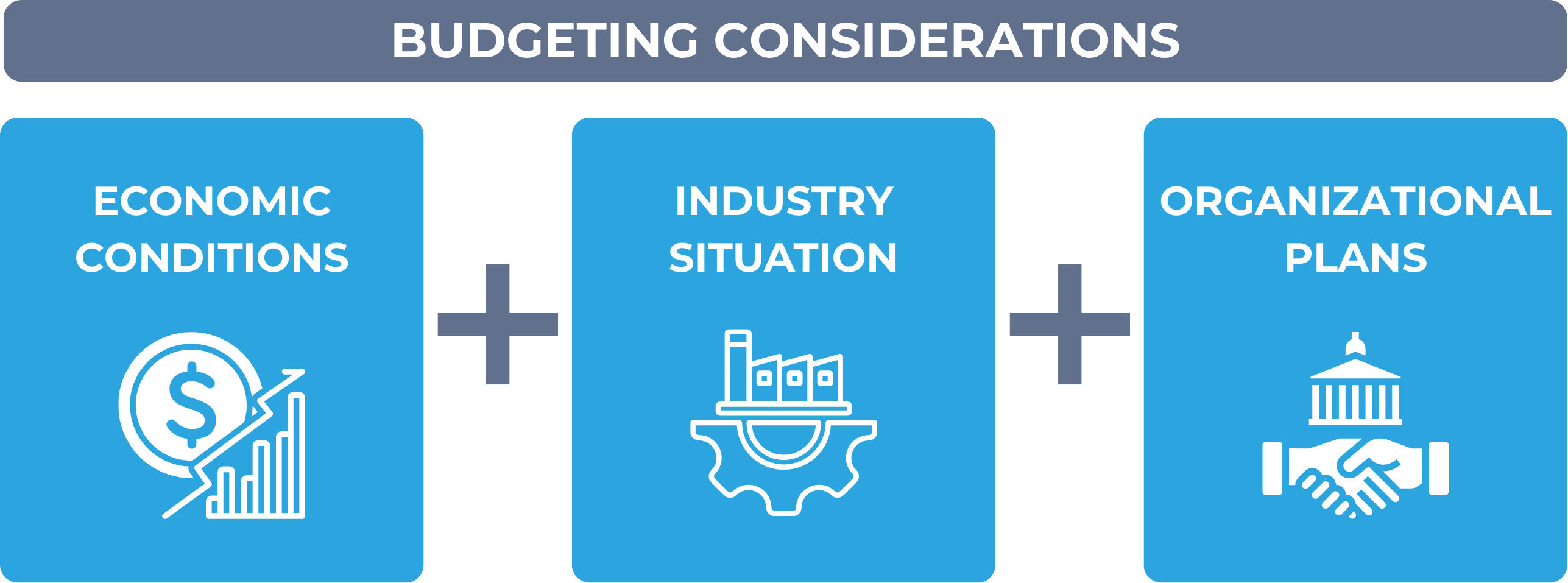
Budgets are not created in isolation; they must take into account external factors, including economic conditions and the industry environment. These factors influence an organization’s ability to achieve its goals and must be reflected in both short-term and long-term planning.
- Economic conditions: Factors such as inflation, interest rates, and overall economic growth can significantly impact an organization’s budgeting process. For example, rising inflation may lead to increased costs for raw materials, which must be factored into the budget to avoid cost overruns.
- Industry situation: The competitive landscape and industry trends also play a major role. For instance, if an industry is in a growth phase, a company may need to increase its budget for marketing and production to capture new market share. Conversely, if the industry is contracting, the company might prioritize cost-cutting measures in its budget.
- Organizational plans: The organization’s internal plans, such as expansion into new markets, product development, or cost-reduction initiatives, will interact with both economic conditions and the industry situation. Successful budgeting ensures that all these factors are considered to create a realistic and achievable financial plan.
By understanding these interrelationships, organizations can create budgets that are flexible enough to adapt to external changes while remaining aligned with their strategic goals. Tools introduced earlier in the strategic planning material - PEST analysis, scenario planning, and forecasting models - help link these external factors to the budgeting process, so budgets can be adjusted as economic and industry conditions shift.
Budgeting and short-term objectives
Budgeting is crucial in the process of formulating short-term objectives and planning operations to meet those goals. Short-term objectives typically span a period of one year or less and are often the stepping stones toward achieving long-term strategic goals.
- Formulating objectives: Budgets are used to set financial targets for revenue, expenses, production, and other key areas. These targets help the organization focus its efforts on specific, measurable objectives that support the overall strategy.
- Planning operations: The master budget, which integrates all departmental budgets, helps plan daily operations to ensure that resources are used efficiently. This includes production schedules, staffing, procurement of materials, and marketing efforts.
- Controlling operations: Budgets act as a control mechanism, comparing actual results to budgeted figures so management can catch areas that need corrective action, such as reducing costs or adjusting production levels. The next section covers this comparison - variance analysis - in more detail.
The role of budgets in measuring performance against established goals
Budgets are a key tool in the process of performance measurement. Once a budget is established, it serves as a benchmark against which actual performance can be evaluated. The performance evaluation process typically involves the following steps:
- Setting performance standards: The budget sets performance expectations for each department, including revenue targets, cost limits, and production goals.
- Measuring actual performance: At regular intervals, actual performance is measured and compared to the budgeted figures.
- Variance analysis: This process involves analyzing the differences between actual and budgeted performance. A favorable variance means the result was better than budgeted - for revenue, actual exceeded budget; for a cost, actual came in below budget. An unfavorable variance means the opposite direction. Favorable doesn’t automatically mean good performance, though: a favorable variance in one area (for example, buying cheaper materials) can cause unfavorable variances elsewhere (for example, more waste or lower quality), so each variance needs investigation before you draw conclusions about actual performance.
- Taking corrective action: If significant variances are identified, management can take corrective actions such as adjusting operations, revising the budget, or implementing cost-saving measures to get back on track.
Many organizations also use management by objectives (MBO) to align individual and departmental goals with the budget.
For example, if a company sets an objective to increase market share by 10%, the budget allocates resources to marketing, sales, and product development to support that goal, and actual results are tracked against the objective just like any other budgeted figure.
Conclusion
Budgeting ties an organization’s strategic goals to its day-to-day operations: it sets short-term objectives, allocates resources, and then serves as the benchmark for measuring and correcting performance. The next chapter, Characteristics of a successful budget process, looks at what makes the budgeting process itself effective.