


Achievable logoAchievable logo
CMA Part 1
Sign in
Sign up
Purchase
Textbook
Practice exams
Support
How it works
Exam catalog
Mountain with a flag at the peak
Textbook
1. External financial reporting decisions
2. Planning, budgeting, and forecasting
2.1 Strategic planning
2.2 Budgeting concepts
2.2.1 Operations and performance goals
2.2.2 Characteristics of a successful budget process
2.2.3 Resource allocation
2.2.4 Other budgeting concepts
2.3 Forecasting techniques
2.4 Budgeting methodologies
2.5 Annual profit plan and supporting schedules
2.6 Top-level planning and analysis
3. Performance management
4. Cost management
5. Internal control
6. Technology and analytics
Achievable logoAchievable logo
2.2.2 Characteristics of a successful budget process
Achievable CMA Part 1
2. Planning, budgeting, and forecasting
2.2. Budgeting concepts
Our CMA Part 1 course is currently in development and is a work-in-progress.

Characteristics of a successful budget process

8 min read
Font
Discuss
Share
Feedback

Learning outcome statements

The learning outcome statements relevant for this section are:

  1. identify the characteristics that define successful budgeting processes
  2. explain how the budgeting process facilitates communication among organizational units and enhances coordination of organizational activities
  3. describe the concept of a controllable cost as it relates to both budgeting and performance evaluation

The budget process is a critical element of an organization’s financial management and planning. A successful budgeting process ensures that resources are allocated efficiently, goals are aligned across departments, and performance is measured effectively. In this section, we will explore the key characteristics of a successful budget process, how it facilitates communication and coordination, and the concept of controllable costs in relation to budgeting and performance evaluation.

Overview of the budget development process

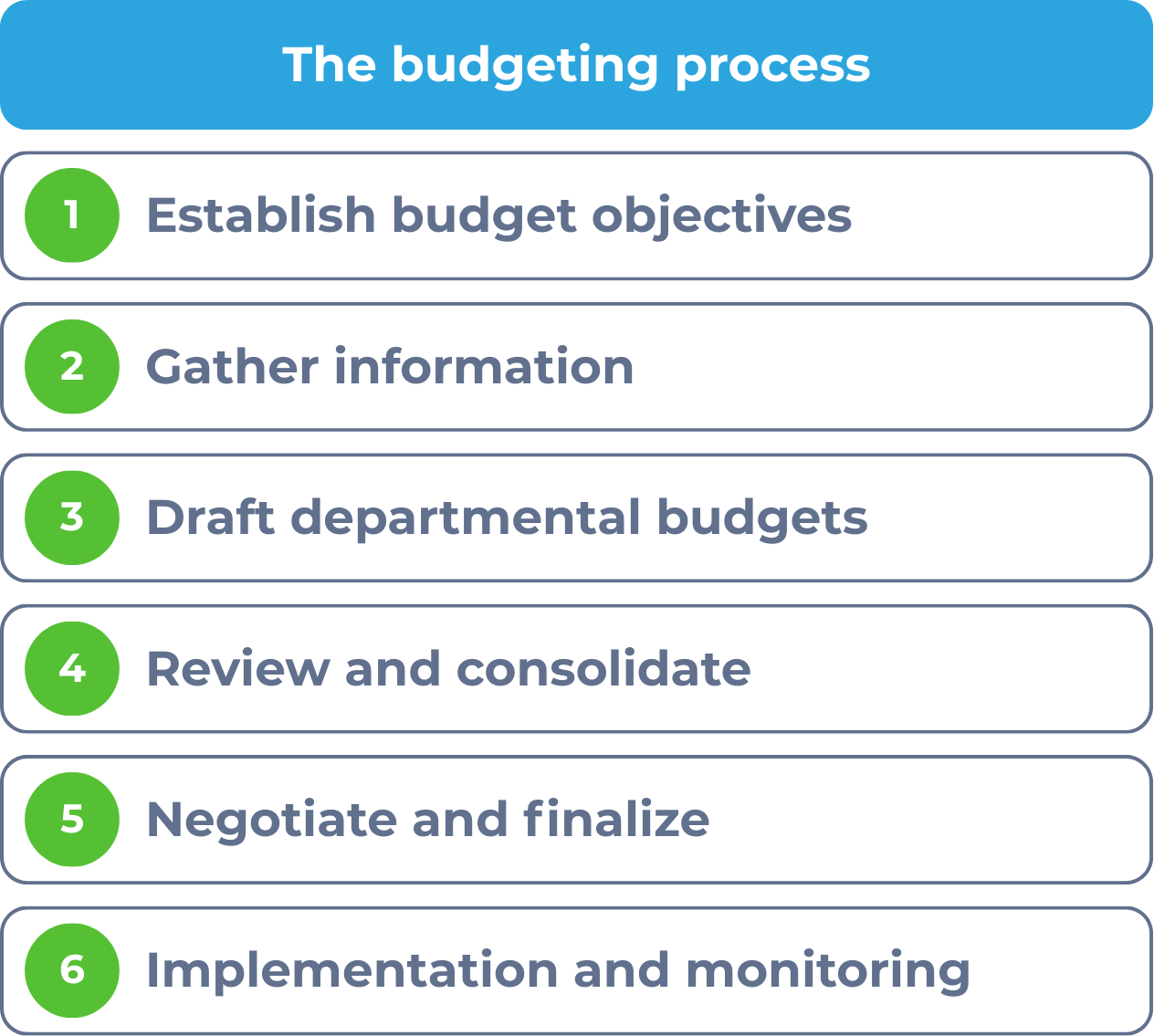
The budget development process is a step-by-step approach that organizations follow to create a comprehensive financial plan for the upcoming period, typically a fiscal year. Below are the key steps involved in developing a budget. Take note that these are general steps that are summarized to apply to organizations and some companies may have different ways of performing the budget development process.

Budgeting process
Budgeting process

A well-structured budget development process ensures that resources are aligned with the organization’s goals and provides a clear financial roadmap for the year ahead.

1. Establish budget objectives

The process begins with setting clear objectives, which are aligned with the organization’s long-term strategic goals. These objectives may include growth targets, cost reduction, or market expansion.

2. Gather information

Departments and units across the organization provide input on their expected revenue, expenses, and resource needs for the upcoming period. Historical financial data, market forecasts, and economic trends are also considered during this step.

3. Draft departmental budgets

Each department prepares its own budget based on the gathered information. These budgets outline the expected revenues and expenses related to specific operations, projects, or activities of the department.

4. Review and consolidate

Departmental budgets are reviewed by senior management to ensure that they align with overall company goals. The budgets are then consolidated into a master budget, which includes financial statements such as the income statement, cash flow statement, and balance sheet.

5. Negotiate and finalize

Budget discussions may occur between departments and senior management to resolve any inconsistencies or disagreements. Once finalized, the budget becomes the formal financial plan for the organization for the next fiscal year.

6. Implementation and monitoring

The approved budget is implemented across the organization, and performance is monitored regularly through variance analysis, which compares actual results to the budgeted figures.

Characteristics of a successful budgeting process

Several key characteristics define a successful budgeting process:

  • Alignment with strategic goals: The budget must reflect the organization’s long-term strategy and ensure that resources are allocated in a way that supports these objectives.

  • Inclusivity and collaboration: A successful budget process involves input from all relevant departments and units within the organization. This ensures that the budget reflects the needs and goals of the entire company, fostering collaboration and commitment.

  • Support and commitment from top management: For the budgeting process to be effective, it must have strong support and commitment from top management. Senior leaders set the tone for the organization, and their active involvement ensures that the budget process is taken seriously at all levels. Their commitment provides the necessary authority to allocate resources, resolve conflicts, and ensure alignment with the organization’s overall strategy. Without top management’s backing, the budgeting process may lack direction and fail to engage employees across the organization.

  • Flexibility: While a budget sets financial targets, it should also be flexible enough to adapt to changing market conditions, economic shifts, or internal priorities. This allows the organization to respond effectively to unexpected challenges or opportunities.

  • Realism and accuracy: A successful budget is based on realistic assumptions and accurate data. Overly optimistic or conservative budgets can lead to misallocation of resources.

  • Continuous monitoring and feedback: A strong budget process includes ongoing performance monitoring and regular feedback. Variance analysis helps managers identify where actual performance deviates from the budget, allowing for corrective actions as needed.

Communication and coordination through budgeting

The budgeting process serves as a key tool for facilitating communication and enhancing coordination within the organization. Here’s how:

  • Clear communication of expectations: The budget sets clear expectations for each department, specifying revenue targets, cost limits, and resource allocation. This ensures that all organizational units understand their roles and responsibilities in achieving overall company objectives.
  • Enhanced coordination: The process of consolidating departmental budgets into a master budget ensures that all departments work toward common goals. For example, the production department’s budget must align with the sales department’s revenue targets, ensuring that resources are available to meet demand.
  • Conflict resolution: During the budget review process, disagreements between departments may arise. These discussions help clarify priorities and resolve conflicts, ensuring that resources are allocated in the best interests of the organization.

By aligning the efforts of different departments, the budgeting process ensures that the organization functions as a cohesive unit, working together to achieve its strategic objectives.

Controllable costs in budgeting and performance evaluation

In the context of budgeting and performance evaluation, understanding the concept of controllable costs is crucial. Controllable costs are those costs that managers can influence or control within their areas of responsibility. These costs play a central role in both the budgeting process and performance evaluation, since they define the amount of control that departments have over the results of their own department.

Definitions
Departmental budgeting
This is the process of allocating a portion of the overall organizational budget to individual departments based on their expected revenues, expenses, and operational needs. Each department is responsible for preparing its budget, considering its specific goals and resource requirements.

Advantages of departmental budgeting

The following are some advantages of departmental budgeting:

  • Enhanced accountability: By assigning each department a separate budget, managers become directly responsible for controlling costs and achieving financial targets within their respective areas.
  • Improved resource allocation: Departmental budgets provide a more granular view of resource needs across the organization, ensuring that resources are distributed efficiently to support both departmental and organizational goals.
  • Better decision-making: Departmental budgeting encourages managers to focus on cost control and operational efficiency within their departments, fostering more informed decision-making at both the departmental and organizational levels.
  • Performance evaluation: With individual departmental budgets in place, management can better evaluate the performance of each department by comparing actual results to the budgeted figures.

Controllable vs. non-controllable costs

One of the aspects of departmental budgeting is the classification of costs as either controllable or non-controllable. This distinction is important for both performance monitoring and evaluation.

Definitions
Controllable costs
These are costs that a department manager has direct influence over. For example, a production manager can control labor costs, material usage, and maintenance expenses within the production department. These costs are a key focus in performance evaluations because they reflect the manager’s ability to operate efficiently within their budget.
Non-controllable costs
These are costs that a department manager cannot influence, such as corporate overhead, depreciation, or externally set utility rates. While these costs are part of the department’s overall budget, they should not be included in performance evaluations of individual managers, as they are outside their control.

Labeling costs as controllable or non-controllable within a departmental budget is critical for the following reasons:

  • Fair performance evaluation: By clearly distinguishing between controllable and non-controllable costs, organizations can assess a department’s contributions more fairly. Managers should only be held accountable for the costs they can control. This prevents managers from being penalized for factors beyond their influence, such as rising utility rates, specific corporate-level decisions or overhead allocations.
  • Accurate monitoring: Properly labeling costs ensures that the organization can monitor the right variables when assessing departmental efficiency. For instance, if labor costs exceed the budget, it is likely a controllable cost that requires action by the department manager. On the other hand, if non-controllable costs (e.g., depreciation) rise, the department is not held responsible for such changes.
  • Improved managerial focus: When costs are clearly identified as controllable or non-controllable, managers can focus their efforts on optimizing the areas they influence. This ensures that departments remain efficient and aligned with organizational objectives while minimizing wasted efforts on factors they cannot control.

Conclusion

A successful budgeting process is characterized by its alignment with strategic goals, inclusivity, support from top management, flexibility, and accuracy. It serves as a critical tool for communication and coordination, ensuring that all departments work toward common objectives. The concept of departmental budgeting enhances accountability and decision-making by assigning specific financial targets to individual departments. Furthermore, the proper labeling of costs as controllable or non-controllable plays a crucial role in both budgeting and performance evaluation, ensuring that departments are assessed fairly and accurately.

Budget Development Process

  • Stepwise approach: objectives → information gathering → departmental budgets → review/consolidation → negotiation/finalization → implementation/monitoring
  • Aligns resources with organizational goals
  • Uses variance analysis to monitor performance

Characteristics of a Successful Budgeting Process

  • Alignment with strategic goals
  • Inclusivity and collaboration across departments
  • Top management support and commitment
  • Flexibility to adapt to changes
  • Realistic, accurate data and assumptions
  • Continuous monitoring and feedback

Communication and Coordination through Budgeting

  • Sets clear expectations for departments (targets, limits, allocations)
  • Master budget consolidates departmental plans for unified goals
  • Facilitates conflict resolution and clarifies priorities

Controllable Costs in Budgeting and Performance Evaluation

  • Controllable costs: directly influenced by department managers (e.g., labor, materials)
  • Non-controllable costs: outside manager’s control (e.g., corporate overhead, depreciation)
  • Only controllable costs used for fair performance evaluation

Advantages of Departmental Budgeting

  • Enhanced accountability for managers
  • Improved resource allocation and operational efficiency
  • Better decision-making at departmental and organizational levels
  • Enables performance evaluation by comparing actual vs. budgeted results

Importance of Labeling Costs

  • Fair performance evaluation by distinguishing controllable vs. non-controllable costs
  • Accurate monitoring of departmental efficiency
  • Focuses managerial efforts on areas within their control

Sign up for free to take 5 quiz questions on this topic

Previous
Next  | 2.2.3 Resource allocation
All rights reserved ©2016 - 2026 Achievable, Inc.

Characteristics of a successful budget process

Learning outcome statements

The learning outcome statements relevant for this section are:

  1. identify the characteristics that define successful budgeting processes
  2. explain how the budgeting process facilitates communication among organizational units and enhances coordination of organizational activities
  3. describe the concept of a controllable cost as it relates to both budgeting and performance evaluation

The budget process is a critical element of an organization’s financial management and planning. A successful budgeting process ensures that resources are allocated efficiently, goals are aligned across departments, and performance is measured effectively. In this section, we will explore the key characteristics of a successful budget process, how it facilitates communication and coordination, and the concept of controllable costs in relation to budgeting and performance evaluation.

Overview of the budget development process

The budget development process is a step-by-step approach that organizations follow to create a comprehensive financial plan for the upcoming period, typically a fiscal year. Below are the key steps involved in developing a budget. Take note that these are general steps that are summarized to apply to organizations and some companies may have different ways of performing the budget development process.

A well-structured budget development process ensures that resources are aligned with the organization’s goals and provides a clear financial roadmap for the year ahead.

1. Establish budget objectives

The process begins with setting clear objectives, which are aligned with the organization’s long-term strategic goals. These objectives may include growth targets, cost reduction, or market expansion.

2. Gather information

Departments and units across the organization provide input on their expected revenue, expenses, and resource needs for the upcoming period. Historical financial data, market forecasts, and economic trends are also considered during this step.

3. Draft departmental budgets

Each department prepares its own budget based on the gathered information. These budgets outline the expected revenues and expenses related to specific operations, projects, or activities of the department.

4. Review and consolidate

Departmental budgets are reviewed by senior management to ensure that they align with overall company goals. The budgets are then consolidated into a master budget, which includes financial statements such as the income statement, cash flow statement, and balance sheet.

5. Negotiate and finalize

Budget discussions may occur between departments and senior management to resolve any inconsistencies or disagreements. Once finalized, the budget becomes the formal financial plan for the organization for the next fiscal year.

6. Implementation and monitoring

The approved budget is implemented across the organization, and performance is monitored regularly through variance analysis, which compares actual results to the budgeted figures.

Characteristics of a successful budgeting process

Several key characteristics define a successful budgeting process:

  • Alignment with strategic goals: The budget must reflect the organization’s long-term strategy and ensure that resources are allocated in a way that supports these objectives.

  • Inclusivity and collaboration: A successful budget process involves input from all relevant departments and units within the organization. This ensures that the budget reflects the needs and goals of the entire company, fostering collaboration and commitment.

  • Support and commitment from top management: For the budgeting process to be effective, it must have strong support and commitment from top management. Senior leaders set the tone for the organization, and their active involvement ensures that the budget process is taken seriously at all levels. Their commitment provides the necessary authority to allocate resources, resolve conflicts, and ensure alignment with the organization’s overall strategy. Without top management’s backing, the budgeting process may lack direction and fail to engage employees across the organization.

  • Flexibility: While a budget sets financial targets, it should also be flexible enough to adapt to changing market conditions, economic shifts, or internal priorities. This allows the organization to respond effectively to unexpected challenges or opportunities.

  • Realism and accuracy: A successful budget is based on realistic assumptions and accurate data. Overly optimistic or conservative budgets can lead to misallocation of resources.

  • Continuous monitoring and feedback: A strong budget process includes ongoing performance monitoring and regular feedback. Variance analysis helps managers identify where actual performance deviates from the budget, allowing for corrective actions as needed.

Communication and coordination through budgeting

The budgeting process serves as a key tool for facilitating communication and enhancing coordination within the organization. Here’s how:

  • Clear communication of expectations: The budget sets clear expectations for each department, specifying revenue targets, cost limits, and resource allocation. This ensures that all organizational units understand their roles and responsibilities in achieving overall company objectives.
  • Enhanced coordination: The process of consolidating departmental budgets into a master budget ensures that all departments work toward common goals. For example, the production department’s budget must align with the sales department’s revenue targets, ensuring that resources are available to meet demand.
  • Conflict resolution: During the budget review process, disagreements between departments may arise. These discussions help clarify priorities and resolve conflicts, ensuring that resources are allocated in the best interests of the organization.

By aligning the efforts of different departments, the budgeting process ensures that the organization functions as a cohesive unit, working together to achieve its strategic objectives.

Controllable costs in budgeting and performance evaluation

In the context of budgeting and performance evaluation, understanding the concept of controllable costs is crucial. Controllable costs are those costs that managers can influence or control within their areas of responsibility. These costs play a central role in both the budgeting process and performance evaluation, since they define the amount of control that departments have over the results of their own department.

Definitions
Departmental budgeting
This is the process of allocating a portion of the overall organizational budget to individual departments based on their expected revenues, expenses, and operational needs. Each department is responsible for preparing its budget, considering its specific goals and resource requirements.

Advantages of departmental budgeting

The following are some advantages of departmental budgeting:

  • Enhanced accountability: By assigning each department a separate budget, managers become directly responsible for controlling costs and achieving financial targets within their respective areas.
  • Improved resource allocation: Departmental budgets provide a more granular view of resource needs across the organization, ensuring that resources are distributed efficiently to support both departmental and organizational goals.
  • Better decision-making: Departmental budgeting encourages managers to focus on cost control and operational efficiency within their departments, fostering more informed decision-making at both the departmental and organizational levels.
  • Performance evaluation: With individual departmental budgets in place, management can better evaluate the performance of each department by comparing actual results to the budgeted figures.

Controllable vs. non-controllable costs

One of the aspects of departmental budgeting is the classification of costs as either controllable or non-controllable. This distinction is important for both performance monitoring and evaluation.

Definitions
Controllable costs
These are costs that a department manager has direct influence over. For example, a production manager can control labor costs, material usage, and maintenance expenses within the production department. These costs are a key focus in performance evaluations because they reflect the manager’s ability to operate efficiently within their budget.
Non-controllable costs
These are costs that a department manager cannot influence, such as corporate overhead, depreciation, or externally set utility rates. While these costs are part of the department’s overall budget, they should not be included in performance evaluations of individual managers, as they are outside their control.

Labeling costs as controllable or non-controllable within a departmental budget is critical for the following reasons:

  • Fair performance evaluation: By clearly distinguishing between controllable and non-controllable costs, organizations can assess a department’s contributions more fairly. Managers should only be held accountable for the costs they can control. This prevents managers from being penalized for factors beyond their influence, such as rising utility rates, specific corporate-level decisions or overhead allocations.
  • Accurate monitoring: Properly labeling costs ensures that the organization can monitor the right variables when assessing departmental efficiency. For instance, if labor costs exceed the budget, it is likely a controllable cost that requires action by the department manager. On the other hand, if non-controllable costs (e.g., depreciation) rise, the department is not held responsible for such changes.
  • Improved managerial focus: When costs are clearly identified as controllable or non-controllable, managers can focus their efforts on optimizing the areas they influence. This ensures that departments remain efficient and aligned with organizational objectives while minimizing wasted efforts on factors they cannot control.

Conclusion

A successful budgeting process is characterized by its alignment with strategic goals, inclusivity, support from top management, flexibility, and accuracy. It serves as a critical tool for communication and coordination, ensuring that all departments work toward common objectives. The concept of departmental budgeting enhances accountability and decision-making by assigning specific financial targets to individual departments. Furthermore, the proper labeling of costs as controllable or non-controllable plays a crucial role in both budgeting and performance evaluation, ensuring that departments are assessed fairly and accurately.

Key points

Budget Development Process

  • Stepwise approach: objectives → information gathering → departmental budgets → review/consolidation → negotiation/finalization → implementation/monitoring
  • Aligns resources with organizational goals
  • Uses variance analysis to monitor performance

Characteristics of a Successful Budgeting Process

  • Alignment with strategic goals
  • Inclusivity and collaboration across departments
  • Top management support and commitment
  • Flexibility to adapt to changes
  • Realistic, accurate data and assumptions
  • Continuous monitoring and feedback

Communication and Coordination through Budgeting

  • Sets clear expectations for departments (targets, limits, allocations)
  • Master budget consolidates departmental plans for unified goals
  • Facilitates conflict resolution and clarifies priorities

Controllable Costs in Budgeting and Performance Evaluation

  • Controllable costs: directly influenced by department managers (e.g., labor, materials)
  • Non-controllable costs: outside manager’s control (e.g., corporate overhead, depreciation)
  • Only controllable costs used for fair performance evaluation

Advantages of Departmental Budgeting

  • Enhanced accountability for managers
  • Improved resource allocation and operational efficiency
  • Better decision-making at departmental and organizational levels
  • Enables performance evaluation by comparing actual vs. budgeted results

Importance of Labeling Costs

  • Fair performance evaluation by distinguishing controllable vs. non-controllable costs
  • Accurate monitoring of departmental efficiency
  • Focuses managerial efforts on areas within their control

More from Budgeting concepts

  • Operations and performance goals
  • Resource allocation