


Achievable logoAchievable logo
CMA Part 1
Sign in
Sign up
Purchase
Textbook
Practice exams
Support
How it works
Exam catalog
Mountain with a flag at the peak
Textbook
1. External financial reporting decisions
2. Planning, budgeting, and forecasting
2.1 Strategic planning
2.1.1 Analysis of external and internal factors affecting strategy
2.1.2 Long-term mission and goals
2.1.3 Alignment of tactics with long-term strategic goals
2.1.4 Strategic planning models and analytical techniques
2.1.5 Characteristics of successful strategic planning process
2.2 Budgeting concepts
2.3 Forecasting techniques
2.4 Budgeting methodologies
2.5 Annual profit plan and supporting schedules
2.6 Top-level planning and analysis
3. Performance management
4. Cost management
5. Internal control
6. Technology and analytics
Achievable logoAchievable logo
2.1.2 Long-term mission and goals
Achievable CMA Part 1
2. Planning, budgeting, and forecasting
2.1. Strategic planning
Our CMA Part 1 course is currently in development and is a work-in-progress.

Long-term mission and goals

5 min read
Font
Discuss
Share
Feedback

Learning outcome statements

The learning outcome statements relevant for this section are:

  1. demonstrate an understanding of how an organization’s mission leads to the formulation of long-term business objectives, such as business diversification, the addition or deletion of product lines, or the penetration of new markets

An organization’s mission serves as the foundation for its strategic direction, guiding the development of long-term objectives that define its growth, evolution, and competitive positioning in the marketplace. These long-term goals often encompass initiatives such as business diversification, product line adjustments, or market expansion.

Understanding the organization’s mission

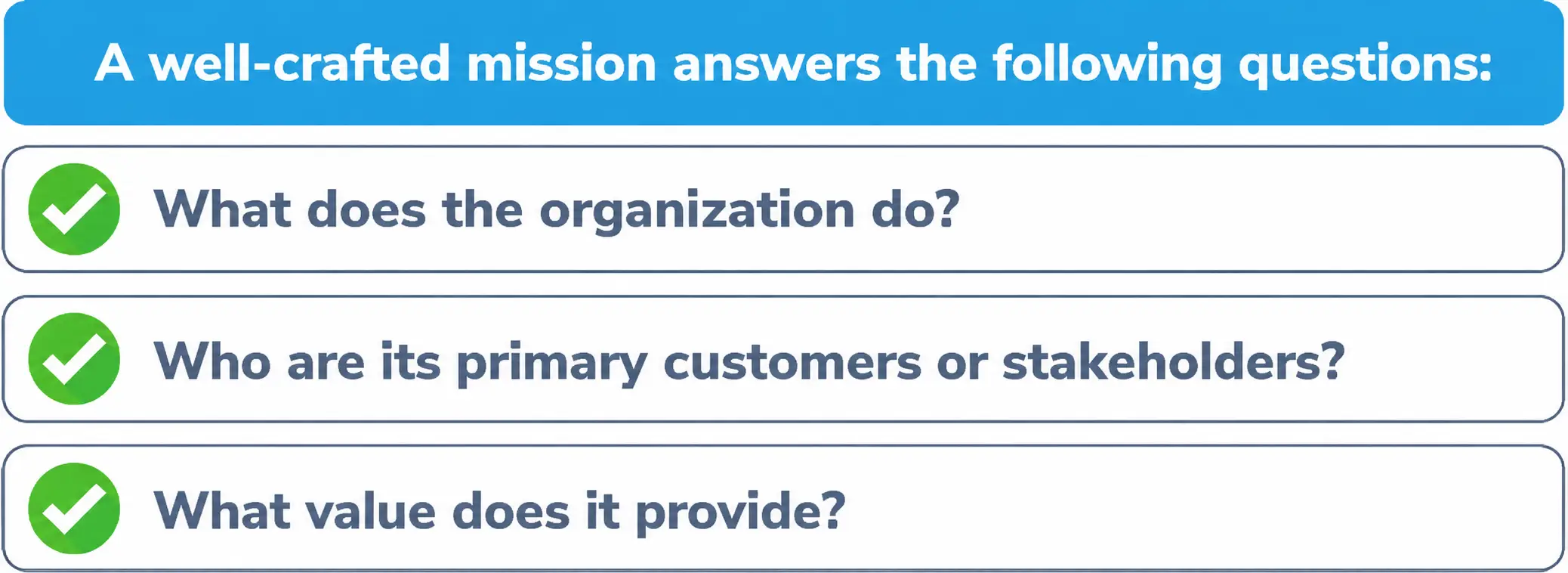
The mission of an organization defines its purpose: what it exists to do, the value it delivers, and the key markets it serves.

Of three questions a well-crafted mission statement should answer about purpose, customers, and value.
Well-Crafted Mission Questions

The mission is the starting point for all strategic decisions, ensuring that all goals, whether short-term or long-term, align with this central guiding principle. The mission statement should be specific enough to direct decision-making but broad enough to allow flexibility as the market and business environment change.

From mission to long-term business objectives

The transition from an organization’s mission to its long-term objectives is a critical process in strategic planning. These long-term objectives typically span several years and reflect the organization’s ambitions for growth, competitiveness, and sustainability.

The company’s mission should directly translate to its long-term business objectives. Key areas where long-term objectives are formulated through its mission include the following:

Business diversification

Diversification involves expanding the organization’s operations into new products, services, or markets. This strategy may be pursued to reduce risk, leverage existing capabilities in new areas, or capitalize on emerging market trends. An example of this is when a technology company diversifies from software development into hardware manufacturing to offer an integrated product suite.

Product line adjustments

Long-term goals may include decisions to add or delete product lines based on market demand, profitability, or strategic fit with the company’s core mission. Adding new products can help meet changing customer needs, capture new market segments, or keep pace with technological advancements while discontinuing underperforming or non-core products allows the organization to focus on areas of growth and profitability.

Market penetration and expansion

Penetrating new markets or expanding in existing ones is another key long-term objective. This can involve entering new geographic regions, targeting different customer demographics, or enhancing market share through increased marketing efforts. An example of this is when a retail chain opens new stores in emerging economies to expand its global footprint.

Strategic alignment of long-term goals

To ensure that long-term goals are effectively aligned with the mission, organizations must undertake a careful analysis of both external and internal factors (as discussed in the previous section). This alignment ensures that:

  • The organization remains focused on delivering its core value proposition.
  • New initiatives support and enhance the mission rather than distract from it.
  • Resources are allocated efficiently to initiatives that further long-term strategic success.

Strategic plans must be regularly monitored to ensure that they are progressing toward the set objectives. This requires the use of effective control systems that help track performance, detect issues early, and make timely adjustments if necessary. These control systems enable the organization to redirect efforts if progress deviates from the planned trajectory.

Strategic plan monitoring requires three types of controls:

  • Preliminary controls: These are proactive measures put in place before the implementation of a strategic plan to ensure that everything is in line to achieve the objectives. This can include resource allocation, personnel readiness, and operational capability assessments.
  • Screening controls (Concurrent Controls): These controls monitor activities and progress during the implementation phase. By continuously measuring performance, screening controls help managers identify problems in real time and make adjustments as needed.
  • Post-action controls: These are retrospective controls that evaluate the results after the completion of a plan. The purpose is to assess whether the strategic goals were met, analyze the causes of success or failure, and apply lessons learned to future planning cycles.

Conclusion

An organization’s mission is the compass that directs its long-term goals and objectives. By staying true to the mission, businesses can strategically decide where to expand, what products to offer or discontinue, and which markets to penetrate. Monitoring progress through effective control systems ensures that the strategic plan remains on track and can be adjusted when necessary. Long-term planning grounded in the organization’s mission helps ensure that growth initiatives are both purposeful and sustainable.

Organization’s Mission

  • Defines purpose, value delivered, key markets served
  • Foundation for all strategic decisions
  • Must be specific for direction, broad for flexibility

From Mission to Long-Term Business Objectives

  • Mission directly informs long-term objectives

  • Objectives reflect growth, competitiveness, sustainability

    • Business Diversification

      • Expanding into new products, services, or markets
      • Reduces risk, leverages capabilities, capitalizes on trends
    • Product Line Adjustments

      • Adding or deleting product lines based on demand, profitability, or fit
      • Focus on growth areas, discontinue underperformers
    • Market Penetration and Expansion

      • Entering new regions, targeting new demographics, increasing market share
      • Expands global or market footprint

Strategic Alignment of Long-Term Goals

  • Align goals with mission for focus and value delivery
  • Ensure initiatives support mission, avoid distractions
  • Efficient resource allocation to mission-driven objectives

Strategic Plan Monitoring and Controls

  • Use control systems to track progress and make adjustments
    • Preliminary controls: Proactive measures before implementation (resource allocation, readiness)
    • Screening controls: Monitor activities during implementation, real-time adjustments
    • Post-action controls: Evaluate results after completion, analyze success/failure, apply lessons learned

Sign up for free to take 6 quiz questions on this topic

Previous
Next  | 2.1.3 Alignment of tactics with long-term strategic goals
All rights reserved ©2016 - 2026 Achievable, Inc.

Long-term mission and goals

Learning outcome statements

The learning outcome statements relevant for this section are:

  1. demonstrate an understanding of how an organization’s mission leads to the formulation of long-term business objectives, such as business diversification, the addition or deletion of product lines, or the penetration of new markets

An organization’s mission serves as the foundation for its strategic direction, guiding the development of long-term objectives that define its growth, evolution, and competitive positioning in the marketplace. These long-term goals often encompass initiatives such as business diversification, product line adjustments, or market expansion.

Understanding the organization’s mission

The mission of an organization defines its purpose: what it exists to do, the value it delivers, and the key markets it serves.


The mission is the starting point for all strategic decisions, ensuring that all goals, whether short-term or long-term, align with this central guiding principle. The mission statement should be specific enough to direct decision-making but broad enough to allow flexibility as the market and business environment change.

From mission to long-term business objectives

The transition from an organization’s mission to its long-term objectives is a critical process in strategic planning. These long-term objectives typically span several years and reflect the organization’s ambitions for growth, competitiveness, and sustainability.

The company’s mission should directly translate to its long-term business objectives. Key areas where long-term objectives are formulated through its mission include the following:

Business diversification

Diversification involves expanding the organization’s operations into new products, services, or markets. This strategy may be pursued to reduce risk, leverage existing capabilities in new areas, or capitalize on emerging market trends. An example of this is when a technology company diversifies from software development into hardware manufacturing to offer an integrated product suite.

Product line adjustments

Long-term goals may include decisions to add or delete product lines based on market demand, profitability, or strategic fit with the company’s core mission. Adding new products can help meet changing customer needs, capture new market segments, or keep pace with technological advancements while discontinuing underperforming or non-core products allows the organization to focus on areas of growth and profitability.

Market penetration and expansion

Penetrating new markets or expanding in existing ones is another key long-term objective. This can involve entering new geographic regions, targeting different customer demographics, or enhancing market share through increased marketing efforts. An example of this is when a retail chain opens new stores in emerging economies to expand its global footprint.

Strategic alignment of long-term goals

To ensure that long-term goals are effectively aligned with the mission, organizations must undertake a careful analysis of both external and internal factors (as discussed in the previous section). This alignment ensures that:

  • The organization remains focused on delivering its core value proposition.
  • New initiatives support and enhance the mission rather than distract from it.
  • Resources are allocated efficiently to initiatives that further long-term strategic success.

Strategic plans must be regularly monitored to ensure that they are progressing toward the set objectives. This requires the use of effective control systems that help track performance, detect issues early, and make timely adjustments if necessary. These control systems enable the organization to redirect efforts if progress deviates from the planned trajectory.

Strategic plan monitoring requires three types of controls:

  • Preliminary controls: These are proactive measures put in place before the implementation of a strategic plan to ensure that everything is in line to achieve the objectives. This can include resource allocation, personnel readiness, and operational capability assessments.
  • Screening controls (Concurrent Controls): These controls monitor activities and progress during the implementation phase. By continuously measuring performance, screening controls help managers identify problems in real time and make adjustments as needed.
  • Post-action controls: These are retrospective controls that evaluate the results after the completion of a plan. The purpose is to assess whether the strategic goals were met, analyze the causes of success or failure, and apply lessons learned to future planning cycles.

Conclusion

An organization’s mission is the compass that directs its long-term goals and objectives. By staying true to the mission, businesses can strategically decide where to expand, what products to offer or discontinue, and which markets to penetrate. Monitoring progress through effective control systems ensures that the strategic plan remains on track and can be adjusted when necessary. Long-term planning grounded in the organization’s mission helps ensure that growth initiatives are both purposeful and sustainable.

Key points

Organization’s Mission

  • Defines purpose, value delivered, key markets served
  • Foundation for all strategic decisions
  • Must be specific for direction, broad for flexibility

From Mission to Long-Term Business Objectives

  • Mission directly informs long-term objectives

  • Objectives reflect growth, competitiveness, sustainability

    • Business Diversification

      • Expanding into new products, services, or markets
      • Reduces risk, leverages capabilities, capitalizes on trends
    • Product Line Adjustments

      • Adding or deleting product lines based on demand, profitability, or fit
      • Focus on growth areas, discontinue underperformers
    • Market Penetration and Expansion

      • Entering new regions, targeting new demographics, increasing market share
      • Expands global or market footprint

Strategic Alignment of Long-Term Goals

  • Align goals with mission for focus and value delivery
  • Ensure initiatives support mission, avoid distractions
  • Efficient resource allocation to mission-driven objectives

Strategic Plan Monitoring and Controls

  • Use control systems to track progress and make adjustments
    • Preliminary controls: Proactive measures before implementation (resource allocation, readiness)
    • Screening controls: Monitor activities during implementation, real-time adjustments
    • Post-action controls: Evaluate results after completion, analyze success/failure, apply lessons learned

More from Strategic planning

  • Analysis of external and internal factors affecting strategy
  • Alignment of tactics with long-term strategic goals
  • Strategic planning models and analytical techniques
  • Characteristics of successful strategic planning process