



Achievable logoAchievable logo
CMA Part 1
Sign in
Sign up
Purchase
Textbook
Practice exams
Support
How it works
Exam catalog
Mountain with a flag at the peak
Textbook
1. External financial reporting decisions
2. Planning, budgeting, and forecasting
2.1 Strategic planning
2.1.1 Analysis of external and internal factors affecting strategy
2.1.2 Long-term mission and goals
2.1.3 Alignment of tactics with long-term strategic goals
2.1.4 Strategic planning models and analytical techniques
2.1.5 Characteristics of successful strategic planning process
2.2 Budgeting concepts
2.3 Forecasting techniques
2.4 Budgeting methodologies
2.5 Annual profit plan and supporting schedules
2.6 Top-level planning and analysis
3. Performance management
4. Cost management
5. Internal control
6. Technology and analytics
Achievable logoAchievable logo
2.1.1 Analysis of external and internal factors affecting strategy
Achievable CMA Part 1
2. Planning, budgeting, and forecasting
2.1. Strategic planning
Our CMA Part 1 course is currently in development and is a work-in-progress.

Analysis of external and internal factors affecting strategy

7 min read
Font
Discuss
Share
Feedback

Learning outcome statements

The learning outcome statements relevant for this section are:

  1. discuss how strategic planning determines the path an organization chooses for attaining its long-term goals, vision, and mission, and distinguish between vision and mission
  2. identify the time frame appropriate for a strategic plan
  3. identify the external factors that should be analyzed during the strategic planning process and understand how this analysis leads to recognition of organizational opportunities, limitations, and threats
  4. identify the internal factors that should be analyzed during the strategic planning process and explain how this analysis leads to recognition of organizational strengths, weaknesses, and competitive advantages

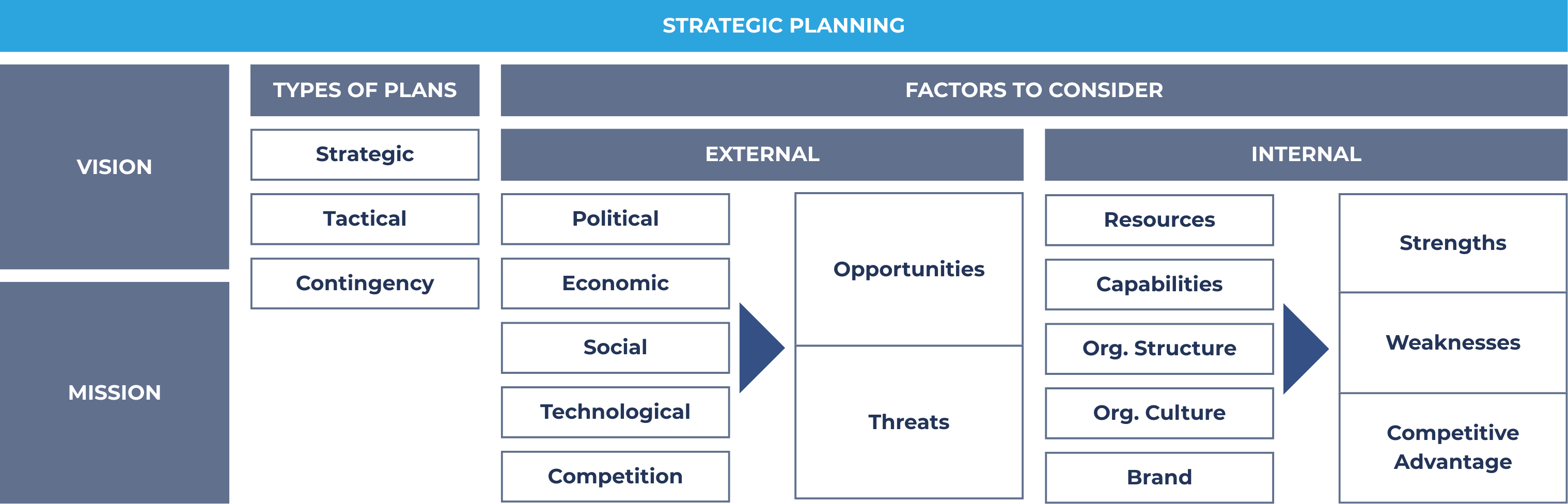
Strategic planning is the foundation upon which an organization builds its path toward achieving long-term goals, aligning its vision and mission, and positioning itself in a competitive market. To develop a comprehensive strategic plan, organizations must evaluate both external and internal factors that impact their strategic decisions.

Strategic planning overview

The role of strategic planning in attaining long-term goals

Strategic planning determines the course of action an organization follows to reach its long-term objectives. It provides a roadmap that connects the organization’s mission, its core purpose. and its vision, its aspirational future state. Understanding the distinction between the two is key to creating a strategy that aligns with both.

Definitions
Vision
A long-term aspirational goal that reflects the organization’s desired future. It focuses on what the organization wants to become.
Mission
The present purpose of the organization. It defines why the organization exists, the value it provides, and the key markets or audiences it serves.

The strategic plan bridges the gap between where the organization is today and where it aims to be, ensuring that all activities contribute to the realization of the vision and mission.

Types of plans

Strategic planning is part of a broader set of organizational plans that include different levels and time frames. Understanding the distinctions between these types of plans helps ensure the proper alignment of activities at all levels of the organization.

Strategic plans

Strategic plans are focused on the long-term goals of the organization, usually over a 3-5 year horizon (but can be longer). These are designed to align with the company’s vision and mission and concerned with overall direction, major initiatives, and the allocation of resources at the highest level.

Shorter-term strategic plans (1 to 2 years) might be necessary in fast-moving industries where technology or customer preferences evolve rapidly, whereas longer-term strategic plans (5 to 10 years) are more appropriate for industries with slow-moving trends or long-term investments, such as infrastructure or energy.

Tactical plans

These are shorter-term plans (usually 1-3 years) that translate strategic plans into specific, actionable objectives for individual departments or units of the organization. These plans break down the broad goals of strategic plans into manageable pieces, addressing how different areas of the organization will contribute.

Operational plans

Operational plans are very short-term plans, usually covering day-to-day or month-to-month activities with a focus on the internal operations of the organization, including production processes, personnel management, and budgeting. Operational plans are highly specific and detail-oriented, ensuring that the tactical plans are implemented effectively.

Contingency plans

Aside from the above there are other plans that organizations use to respond to different situations such as contingency plans. These plans are developed to address unexpected events or emergencies that could disrupt the normal course of operations. Contingency plans are designed to ensure business continuity and resilience by outlining how the organization will respond to crises such as natural disasters, economic downturns, or operational failures.

These various types of plans work together, with strategic plans setting the overall direction, tactical plans translating that direction into actionable steps, operational plans ensuring efficient execution, and contingency plans providing backup strategies in case of unforeseen events.

External factors in strategic planning

An effective strategic plan requires an in-depth analysis of external factors that influence the organization’s ability to achieve its goals. These factors are typically beyond the organization’s control but must be monitored and responded to.

Some common external factors include:

  • Political and legal environment: Laws, regulations, and government policies that impact business operations.
  • Economic factors: Market trends, inflation rates, interest rates, and general economic conditions that influence customer spending and business investments.
  • Social and cultural trends: Changes in consumer behavior, societal values, and cultural shifts that can affect demand for products or services.
  • Technological advancements: Innovations and new technologies that can disrupt industries or offer new opportunities.
  • Environmental factors: Ecological and environmental considerations that may affect operations or customer preferences, particularly in industries related to natural resources.
  • Competitive landscape: Market competition, including the number of competitors, their strategies, and the potential for new entrants.

This analysis, often referred to as a PESTEL analysis (Political, Economic, Social, Technological, Environmental, Legal), helps organizations recognize:

  • Opportunities: External conditions that could benefit the organization or create new markets.
  • Threats and limitations: External risks or challenges, such as new competitors or regulatory changes and factors that could restrict the organization’s ability to grow.
The PESTEL framework of analysis

More planning tools and techniques will be discussed in succeeding chapters.

Internal factors in strategic planning

Internal factors also play a critical role in shaping the strategic plan. These are aspects of the organization that it has control over and can modify to support its strategy.

Key internal factors to analyze include:

  • Resources: The availability of financial, human, and physical resources necessary to implement strategies. This includes the organization’s financial strength, workforce skills, and technological capabilities.
  • Capabilities: The unique processes, skills, and expertise the organization possesses that provide a competitive edge. This can include specialized knowledge, innovative product development, or efficient supply chain management.
  • Organizational structure and culture: The way the organization is structured, including its leadership, decision-making processes, and corporate culture. A supportive culture that embraces innovation and collaboration can be a significant asset.
  • Brand and reputation: The public perception of the organization and its products or services. A strong brand can drive customer loyalty and give the organization a competitive advantage.

By analyzing these internal factors, organizations can identify:

  • Strengths: Internal capabilities that give the organization a competitive advantage.
  • Weaknesses: Areas where the organization is lacking or underperforming, which may limit its ability to achieve strategic goals.
  • Competitive advantages: Unique strengths that allow the organization to outperform its competitors, such as proprietary technology, a strong brand, or a highly skilled workforce.

More planning tools and techniques will be discussed in succeeding chapters.

Conclusion

The analysis of both external and internal factors is critical in developing a strategic plan that is realistic, actionable, and aligned with the organization’s long-term goals. While external factors help identify opportunities and threats, internal analysis highlights strengths and weaknesses, allowing an organization to leverage its advantages and address its vulnerabilities. Additionally, the integration of different types of plans (strategic, tactical, operational, and contingency) ensures that the organization operates effectively at all levels, with a clear direction for both short-term and long-term goals.

Role of strategic planning

  • Aligns mission (core purpose) and vision (aspirational future)
  • Provides roadmap for achieving long-term goals
  • Distinguishes between mission (present purpose) and vision (future state)

Types of plans

  • Strategic plans: long-term (3-5+ years), set overall direction
    • Shorter-term (1-2 years) for fast-changing industries
    • Longer-term (5-10 years) for slow-changing industries
  • Tactical plans: mid-term (1-3 years), departmental objectives
  • Operational plans: short-term (day-to-day/monthly), internal operations
  • Contingency plans: responses to unexpected events, ensure continuity

External factors in strategic planning

  • Analyzed using PESTEL framework:
    • Political/legal, economic, social/cultural, technological, environmental, competitive
  • Identify:
    • Opportunities (external benefits/new markets)
    • Threats/limitations (risks, challenges, restrictions)

Internal factors in strategic planning

  • Key areas:
    • Resources (financial, human, physical)
    • Capabilities (unique skills/processes)
    • Structure/culture (leadership, decision-making, values)
    • Brand/reputation (public perception, loyalty)
  • Identify:
    • Strengths (competitive advantages)
    • Weaknesses (limitations, underperformance)
    • Competitive advantages (unique strengths over competitors)

Conclusion

  • Both external and internal analysis are essential for effective strategic planning
  • Integration of all plan types ensures alignment and operational effectiveness across timeframes

Sign up for free to take 10 quiz questions on this topic

Previous
Next  | 2.1.2 Long-term mission and goals
All rights reserved ©2016 - 2026 Achievable, Inc.

Analysis of external and internal factors affecting strategy

Learning outcome statements

The learning outcome statements relevant for this section are:

  1. discuss how strategic planning determines the path an organization chooses for attaining its long-term goals, vision, and mission, and distinguish between vision and mission
  2. identify the time frame appropriate for a strategic plan
  3. identify the external factors that should be analyzed during the strategic planning process and understand how this analysis leads to recognition of organizational opportunities, limitations, and threats
  4. identify the internal factors that should be analyzed during the strategic planning process and explain how this analysis leads to recognition of organizational strengths, weaknesses, and competitive advantages

Strategic planning is the foundation upon which an organization builds its path toward achieving long-term goals, aligning its vision and mission, and positioning itself in a competitive market. To develop a comprehensive strategic plan, organizations must evaluate both external and internal factors that impact their strategic decisions.

The role of strategic planning in attaining long-term goals

Strategic planning determines the course of action an organization follows to reach its long-term objectives. It provides a roadmap that connects the organization’s mission, its core purpose. and its vision, its aspirational future state. Understanding the distinction between the two is key to creating a strategy that aligns with both.

Definitions
Vision
A long-term aspirational goal that reflects the organization’s desired future. It focuses on what the organization wants to become.
Mission
The present purpose of the organization. It defines why the organization exists, the value it provides, and the key markets or audiences it serves.

The strategic plan bridges the gap between where the organization is today and where it aims to be, ensuring that all activities contribute to the realization of the vision and mission.

Types of plans

Strategic planning is part of a broader set of organizational plans that include different levels and time frames. Understanding the distinctions between these types of plans helps ensure the proper alignment of activities at all levels of the organization.

Strategic plans

Strategic plans are focused on the long-term goals of the organization, usually over a 3-5 year horizon (but can be longer). These are designed to align with the company’s vision and mission and concerned with overall direction, major initiatives, and the allocation of resources at the highest level.

Shorter-term strategic plans (1 to 2 years) might be necessary in fast-moving industries where technology or customer preferences evolve rapidly, whereas longer-term strategic plans (5 to 10 years) are more appropriate for industries with slow-moving trends or long-term investments, such as infrastructure or energy.

Tactical plans

These are shorter-term plans (usually 1-3 years) that translate strategic plans into specific, actionable objectives for individual departments or units of the organization. These plans break down the broad goals of strategic plans into manageable pieces, addressing how different areas of the organization will contribute.

Operational plans

Operational plans are very short-term plans, usually covering day-to-day or month-to-month activities with a focus on the internal operations of the organization, including production processes, personnel management, and budgeting. Operational plans are highly specific and detail-oriented, ensuring that the tactical plans are implemented effectively.

Contingency plans

Aside from the above there are other plans that organizations use to respond to different situations such as contingency plans. These plans are developed to address unexpected events or emergencies that could disrupt the normal course of operations. Contingency plans are designed to ensure business continuity and resilience by outlining how the organization will respond to crises such as natural disasters, economic downturns, or operational failures.

These various types of plans work together, with strategic plans setting the overall direction, tactical plans translating that direction into actionable steps, operational plans ensuring efficient execution, and contingency plans providing backup strategies in case of unforeseen events.

External factors in strategic planning

An effective strategic plan requires an in-depth analysis of external factors that influence the organization’s ability to achieve its goals. These factors are typically beyond the organization’s control but must be monitored and responded to.

Some common external factors include:

  • Political and legal environment: Laws, regulations, and government policies that impact business operations.
  • Economic factors: Market trends, inflation rates, interest rates, and general economic conditions that influence customer spending and business investments.
  • Social and cultural trends: Changes in consumer behavior, societal values, and cultural shifts that can affect demand for products or services.
  • Technological advancements: Innovations and new technologies that can disrupt industries or offer new opportunities.
  • Environmental factors: Ecological and environmental considerations that may affect operations or customer preferences, particularly in industries related to natural resources.
  • Competitive landscape: Market competition, including the number of competitors, their strategies, and the potential for new entrants.

This analysis, often referred to as a PESTEL analysis (Political, Economic, Social, Technological, Environmental, Legal), helps organizations recognize:

  • Opportunities: External conditions that could benefit the organization or create new markets.
  • Threats and limitations: External risks or challenges, such as new competitors or regulatory changes and factors that could restrict the organization’s ability to grow.

More planning tools and techniques will be discussed in succeeding chapters.

Internal factors in strategic planning

Internal factors also play a critical role in shaping the strategic plan. These are aspects of the organization that it has control over and can modify to support its strategy.

Key internal factors to analyze include:

  • Resources: The availability of financial, human, and physical resources necessary to implement strategies. This includes the organization’s financial strength, workforce skills, and technological capabilities.
  • Capabilities: The unique processes, skills, and expertise the organization possesses that provide a competitive edge. This can include specialized knowledge, innovative product development, or efficient supply chain management.
  • Organizational structure and culture: The way the organization is structured, including its leadership, decision-making processes, and corporate culture. A supportive culture that embraces innovation and collaboration can be a significant asset.
  • Brand and reputation: The public perception of the organization and its products or services. A strong brand can drive customer loyalty and give the organization a competitive advantage.

By analyzing these internal factors, organizations can identify:

  • Strengths: Internal capabilities that give the organization a competitive advantage.
  • Weaknesses: Areas where the organization is lacking or underperforming, which may limit its ability to achieve strategic goals.
  • Competitive advantages: Unique strengths that allow the organization to outperform its competitors, such as proprietary technology, a strong brand, or a highly skilled workforce.

More planning tools and techniques will be discussed in succeeding chapters.

Conclusion

The analysis of both external and internal factors is critical in developing a strategic plan that is realistic, actionable, and aligned with the organization’s long-term goals. While external factors help identify opportunities and threats, internal analysis highlights strengths and weaknesses, allowing an organization to leverage its advantages and address its vulnerabilities. Additionally, the integration of different types of plans (strategic, tactical, operational, and contingency) ensures that the organization operates effectively at all levels, with a clear direction for both short-term and long-term goals.

Key points

Role of strategic planning

  • Aligns mission (core purpose) and vision (aspirational future)
  • Provides roadmap for achieving long-term goals
  • Distinguishes between mission (present purpose) and vision (future state)

Types of plans

  • Strategic plans: long-term (3-5+ years), set overall direction
    • Shorter-term (1-2 years) for fast-changing industries
    • Longer-term (5-10 years) for slow-changing industries
  • Tactical plans: mid-term (1-3 years), departmental objectives
  • Operational plans: short-term (day-to-day/monthly), internal operations
  • Contingency plans: responses to unexpected events, ensure continuity

External factors in strategic planning

  • Analyzed using PESTEL framework:
    • Political/legal, economic, social/cultural, technological, environmental, competitive
  • Identify:
    • Opportunities (external benefits/new markets)
    • Threats/limitations (risks, challenges, restrictions)

Internal factors in strategic planning

  • Key areas:
    • Resources (financial, human, physical)
    • Capabilities (unique skills/processes)
    • Structure/culture (leadership, decision-making, values)
    • Brand/reputation (public perception, loyalty)
  • Identify:
    • Strengths (competitive advantages)
    • Weaknesses (limitations, underperformance)
    • Competitive advantages (unique strengths over competitors)

Conclusion

  • Both external and internal analysis are essential for effective strategic planning
  • Integration of all plan types ensures alignment and operational effectiveness across timeframes

More from Strategic planning

  • Long-term mission and goals
  • Alignment of tactics with long-term strategic goals
  • Strategic planning models and analytical techniques
  • Characteristics of successful strategic planning process