


Achievable logoAchievable logo
CMA Part 1
Sign in
Sign up
Purchase
Textbook
Practice exams
Support
How it works
Exam catalog
Mountain with a flag at the peak
Textbook
1. External financial reporting decisions
2. Planning, budgeting, and forecasting
2.1 Strategic planning
2.2 Budgeting concepts
2.3 Forecasting techniques
2.4 Budgeting methodologies
2.4.1 Learning outcomes
2.4.2 Annual business plans (master budgets)
2.4.3 Project budgeting
2.4.4 Activity-based budgeting
2.4.5 Zero-based budgeting
2.4.6 Continuous (rolling) budgets
2.4.7 Flexible budgeting
2.5 Annual profit plan and supporting schedules
2.6 Top-level planning and analysis
3. Performance management
4. Cost management
5. Internal control
6. Technology and analytics
Achievable logoAchievable logo
2.4.2 Annual business plans (master budgets)
Achievable CMA Part 1
2. Planning, budgeting, and forecasting
2.4. Budgeting methodologies
Our CMA Part 1 course is currently in development and is a work-in-progress.

Annual business plans (master budgets)

6 min read
Font
Discuss
Share
Feedback

Definition, purpose, and time frame

Definitions
Master budget
(also known as the annual business plan or the comprehensive budget)
A consolidated financial plan that covers all key aspects of an organization’s operations over a set time frame, typically one fiscal year.

This budget is a comprehensive projection that includes estimates for revenue, expenses, cash flows, and balance sheet items. The master budget functions as a central financial roadmap, providing management with clear targets and expectations to guide decision-making and performance evaluation. The preparation of this budget is normally the culmination of the budget process.

Its purpose is to align all departments with the company’s strategic objectives by assigning resources in line with projected revenues, expenses, and production needs. By consolidating individual budgets from each department, the master budget provides a complete picture of expected financial outcomes, ensuring that each department’s targets support the company’s overall business objectives.

Components and interrelationships

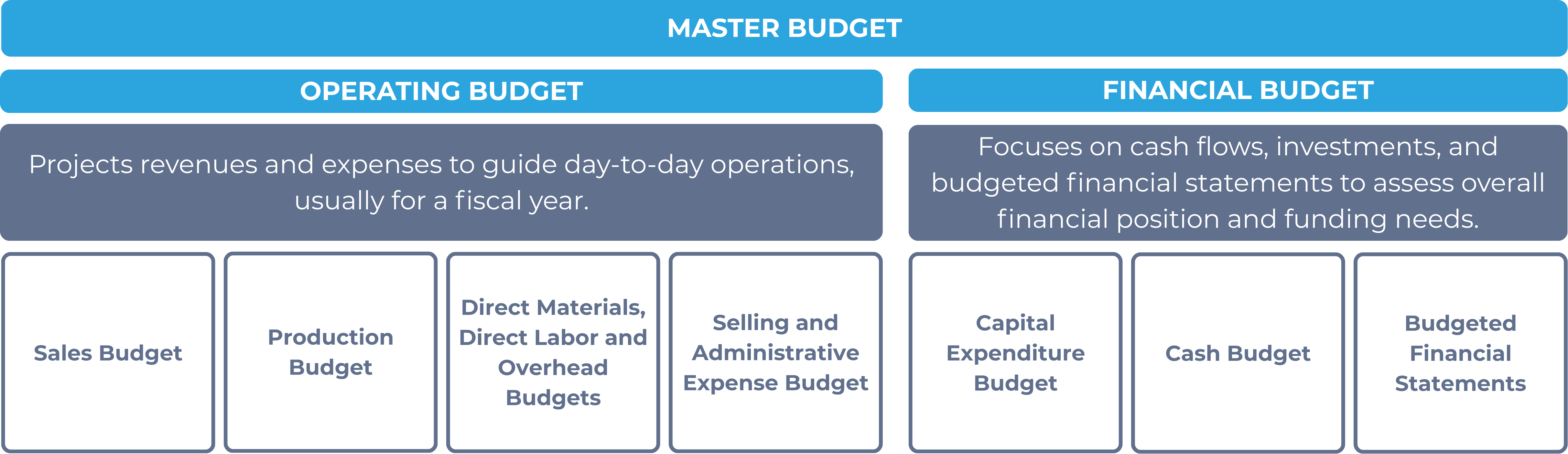
The master budget consists of two main sections: the operating budget and the financial budget, each with several subcomponents that interact closely:

Master budget components

Operating budget

A comprehensive plan detailing the projected revenue and expenses needed to achieve a company’s operational goals over a specific period, often a fiscal year. It is typically composed of:

  1. Sales budget: Sets revenue targets based on projected sales volumes and prices, laying the groundwork for subsequent budgets.
  2. Production budget: Based on sales projections, the production budget determines the volume of goods or services needed to meet sales demand.
  3. Direct materials, direct labor, and overhead budgets: Each derived from production needs, these budgets forecast costs associated with producing the required units.
  4. Selling and administrative budget: Projects costs associated with marketing, selling, and administrative functions necessary to support projected sales and production levels.

Financial budget

The financial budget is the part of the master budget that focuses on the company’s overall financial position and resource planning. It translates operating and capital plans into projections of cash needs, investment requirements, and expected financial results. By linking together the cash budget, capital expenditures, and budgeted financial statements, the financial budget ensures that the organization can meet its obligations, fund strategic initiatives, and evaluate the impact of its plans on profitability and liquidity. It is composed of:

  1. Capital expenditures budget: Plans for long-term investments in equipment or facilities required to support production goals.
  2. Cash budget: Projects cash inflows and outflows, ensuring that sufficient liquidity is available to cover operating and capital needs.
  3. Budgeted financial statements: The pro-forma income statement, balance sheet, and statement of cash flows offer a complete picture of expected financial outcomes, linking all budget components together.

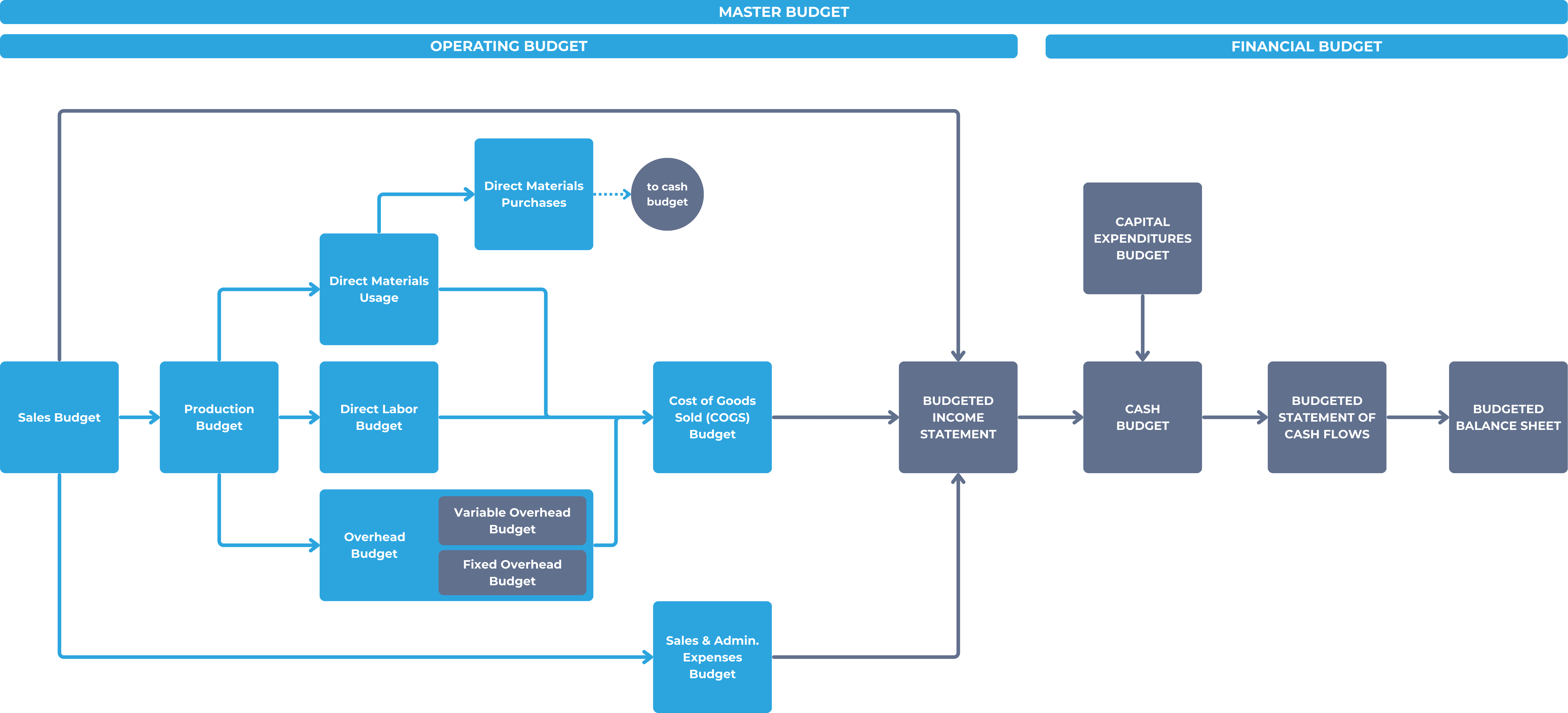
These components are interdependent; for example, sales estimates drive production schedules, which then affect direct materials, labor, and overhead budgets. The production costs influence cash outflows in the cash budget and determine the cost of goods sold in the income statement. With all of these budgets combined, you can see that the master budget is composed of interrelated smaller budgets and reports that help different levels of management and operations.

Developing the master budget

Creating the master budget typically begins with the sales forecast, which drives the entire budgeting process. Once sales projections are set, the production budget ensures that sufficient inventory or service levels are maintained to meet demand.

Budgets for materials, labor, and overhead are then developed, followed by selling, administrative, and capital expenditure budgets. At the final stage, departments work together to compile budgeted financial statements, which are financial statements based on budget inputs from all departments. These statements provide an anticipated view of the company’s financial condition at the end of the budget period.

Master budget development process

It’s essential to note that the master budget is a static budget. Unlike a flexible budget, which adjusts to actual activity levels, a static budget remains unchanged after being established, regardless of fluctuations in activity or sales. This characteristic makes the master budget ideal for annual planning but less adaptable to unexpected changes. To provide a more complete picture of how budgets help with planning and performance management, flexible budgets are used in conjunction with the master budget. Flexible budgets are discussed in the succeeding sections.

The preparation of the master budget and all its components are discussed in detail in the section about the " annual profit plan".

Benefits and limitations

Benefits

  • Alignment with strategic goals: The master budget brings all departments in line with the company’s strategic objectives by setting shared financial targets.
  • Performance measurement tool: It provides a benchmark against which actual performance is measured, helping management evaluate departmental efficiency and make corrective adjustments.
  • Resource allocation: By detailing specific resource needs, the master budget ensures that departments are allocated funds based on priority and relevance to business objectives.

Limitations

  • Lack of flexibility: As a static budget, the master budget may not adapt to changes in market conditions or operational needs, unlike a flexible budget, which allows adjustments based on actual activity levels.
  • Complex and time-consuming: Developing a master budget requires significant coordination across departments and relies on accurate data projections. The preparation of this budget is time-intensive.
  • Potential budget slack: Departments might overestimate expenses or underestimate revenues to create easier targets, which can reduce the budget’s effectiveness.

Application in business situations

The master budget is particularly useful for organizations with predictable production cycles and relatively stable demand patterns. For instance, a manufacturing company can use the master budget to set annual production targets, manage inventory levels, and ensure adequate cash flow for operations and capital investments. However, in highly dynamic industries or uncertain economic environments, a master budget may need to be supplemented with rolling forecasts or flexible budgets that provide periodic updates.

For example, if an economic shift or sudden demand fluctuation occurs, management might adjust sales projections and inventory requirements, which could affect the production and cash budgets. As a comprehensive plan, the master budget serves as a foundational tool but may require flexibility in volatile environments.

Definition, purpose, and time frame

  • Master budget = consolidated annual financial plan
  • Covers all operations: revenue, expenses, cash flows, balance sheet
  • Aligns departments with strategic objectives via resource allocation

Components and interrelationships

  • Two main sections:
    • Operating budget: sales, production, direct materials/labor/overhead, selling & admin
    • Financial budget: capital expenditures, cash budget, budgeted financial statements
  • Components are interdependent; sales drive production, which drives costs and cash flows

Developing the Master Budget

  • Starts with sales forecast; drives production and other budgets
  • Sequential development: materials, labor, overhead, selling/admin, capital expenditures
  • Ends with budgeted financial statements (pro-forma)
  • Master budget is static (does not adjust for actual activity levels)
    • Flexible budgets used for adaptability

Benefits and limitations

  • Benefits:
    • Aligns departments with strategic goals
    • Provides performance benchmarks
    • Facilitates resource allocation
  • Limitations:
    • Static—lacks flexibility for changing conditions
    • Complex and time-consuming to prepare
    • Risk of budget slack (over/underestimating targets)

Application in business situations

  • Best for predictable, stable environments (e.g., manufacturing)
  • Used for setting production, inventory, and cash flow targets
  • May require rolling forecasts or flexible budgets in dynamic industries

Sign up for free to take 10 quiz questions on this topic

Previous
Next  | 2.4.3 Project budgeting
All rights reserved ©2016 - 2026 Achievable, Inc.

Annual business plans (master budgets)

Definition, purpose, and time frame

Definitions
Master budget
(also known as the annual business plan or the comprehensive budget)
A consolidated financial plan that covers all key aspects of an organization’s operations over a set time frame, typically one fiscal year.

This budget is a comprehensive projection that includes estimates for revenue, expenses, cash flows, and balance sheet items. The master budget functions as a central financial roadmap, providing management with clear targets and expectations to guide decision-making and performance evaluation. The preparation of this budget is normally the culmination of the budget process.

Its purpose is to align all departments with the company’s strategic objectives by assigning resources in line with projected revenues, expenses, and production needs. By consolidating individual budgets from each department, the master budget provides a complete picture of expected financial outcomes, ensuring that each department’s targets support the company’s overall business objectives.

Components and interrelationships

The master budget consists of two main sections: the operating budget and the financial budget, each with several subcomponents that interact closely:

Operating budget

A comprehensive plan detailing the projected revenue and expenses needed to achieve a company’s operational goals over a specific period, often a fiscal year. It is typically composed of:

  1. Sales budget: Sets revenue targets based on projected sales volumes and prices, laying the groundwork for subsequent budgets.
  2. Production budget: Based on sales projections, the production budget determines the volume of goods or services needed to meet sales demand.
  3. Direct materials, direct labor, and overhead budgets: Each derived from production needs, these budgets forecast costs associated with producing the required units.
  4. Selling and administrative budget: Projects costs associated with marketing, selling, and administrative functions necessary to support projected sales and production levels.

Financial budget

The financial budget is the part of the master budget that focuses on the company’s overall financial position and resource planning. It translates operating and capital plans into projections of cash needs, investment requirements, and expected financial results. By linking together the cash budget, capital expenditures, and budgeted financial statements, the financial budget ensures that the organization can meet its obligations, fund strategic initiatives, and evaluate the impact of its plans on profitability and liquidity. It is composed of:

  1. Capital expenditures budget: Plans for long-term investments in equipment or facilities required to support production goals.
  2. Cash budget: Projects cash inflows and outflows, ensuring that sufficient liquidity is available to cover operating and capital needs.
  3. Budgeted financial statements: The pro-forma income statement, balance sheet, and statement of cash flows offer a complete picture of expected financial outcomes, linking all budget components together.

These components are interdependent; for example, sales estimates drive production schedules, which then affect direct materials, labor, and overhead budgets. The production costs influence cash outflows in the cash budget and determine the cost of goods sold in the income statement. With all of these budgets combined, you can see that the master budget is composed of interrelated smaller budgets and reports that help different levels of management and operations.

Developing the master budget

Creating the master budget typically begins with the sales forecast, which drives the entire budgeting process. Once sales projections are set, the production budget ensures that sufficient inventory or service levels are maintained to meet demand.

Budgets for materials, labor, and overhead are then developed, followed by selling, administrative, and capital expenditure budgets. At the final stage, departments work together to compile budgeted financial statements, which are financial statements based on budget inputs from all departments. These statements provide an anticipated view of the company’s financial condition at the end of the budget period.

It’s essential to note that the master budget is a static budget. Unlike a flexible budget, which adjusts to actual activity levels, a static budget remains unchanged after being established, regardless of fluctuations in activity or sales. This characteristic makes the master budget ideal for annual planning but less adaptable to unexpected changes. To provide a more complete picture of how budgets help with planning and performance management, flexible budgets are used in conjunction with the master budget. Flexible budgets are discussed in the succeeding sections.

The preparation of the master budget and all its components are discussed in detail in the section about the " annual profit plan".

Benefits and limitations

Benefits

  • Alignment with strategic goals: The master budget brings all departments in line with the company’s strategic objectives by setting shared financial targets.
  • Performance measurement tool: It provides a benchmark against which actual performance is measured, helping management evaluate departmental efficiency and make corrective adjustments.
  • Resource allocation: By detailing specific resource needs, the master budget ensures that departments are allocated funds based on priority and relevance to business objectives.

Limitations

  • Lack of flexibility: As a static budget, the master budget may not adapt to changes in market conditions or operational needs, unlike a flexible budget, which allows adjustments based on actual activity levels.
  • Complex and time-consuming: Developing a master budget requires significant coordination across departments and relies on accurate data projections. The preparation of this budget is time-intensive.
  • Potential budget slack: Departments might overestimate expenses or underestimate revenues to create easier targets, which can reduce the budget’s effectiveness.

Application in business situations

The master budget is particularly useful for organizations with predictable production cycles and relatively stable demand patterns. For instance, a manufacturing company can use the master budget to set annual production targets, manage inventory levels, and ensure adequate cash flow for operations and capital investments. However, in highly dynamic industries or uncertain economic environments, a master budget may need to be supplemented with rolling forecasts or flexible budgets that provide periodic updates.

For example, if an economic shift or sudden demand fluctuation occurs, management might adjust sales projections and inventory requirements, which could affect the production and cash budgets. As a comprehensive plan, the master budget serves as a foundational tool but may require flexibility in volatile environments.

Key points

Definition, purpose, and time frame

  • Master budget = consolidated annual financial plan
  • Covers all operations: revenue, expenses, cash flows, balance sheet
  • Aligns departments with strategic objectives via resource allocation

Components and interrelationships

  • Two main sections:
    • Operating budget: sales, production, direct materials/labor/overhead, selling & admin
    • Financial budget: capital expenditures, cash budget, budgeted financial statements
  • Components are interdependent; sales drive production, which drives costs and cash flows

Developing the Master Budget

  • Starts with sales forecast; drives production and other budgets
  • Sequential development: materials, labor, overhead, selling/admin, capital expenditures
  • Ends with budgeted financial statements (pro-forma)
  • Master budget is static (does not adjust for actual activity levels)
    • Flexible budgets used for adaptability

Benefits and limitations

  • Benefits:
    • Aligns departments with strategic goals
    • Provides performance benchmarks
    • Facilitates resource allocation
  • Limitations:
    • Static—lacks flexibility for changing conditions
    • Complex and time-consuming to prepare
    • Risk of budget slack (over/underestimating targets)

Application in business situations

  • Best for predictable, stable environments (e.g., manufacturing)
  • Used for setting production, inventory, and cash flow targets
  • May require rolling forecasts or flexible budgets in dynamic industries

More from Budgeting methodologies

  • Learning outcomes
  • Project budgeting
  • Activity-based budgeting
  • Zero-based budgeting
  • Continuous (rolling) budgets