


This browser is too old to run Achievable.

Update it, or open this page in a current version of Chrome, Safari, Firefox or Edge. On an iPhone or iPad, update iOS: every browser there runs on the version of Safari that comes with it.

Achievable logoAchievable logo
CMA Part 1
Sign in
Sign up
Purchase
Textbook
Practice exams
Support
How it works
Resources
Exam catalog
Mountain with a flag at the peak
Textbook
Introduction
1. External financial reporting decisions
1.1 Financial statements
1.1.1 Learning outcomes
1.1.2 Introduction to external financial reporting
1.1.3 Statement of financial position
1.1.4 Statement of comprehensive income
1.1.5 Statement of changes in equity
1.1.6 Statement of cash flows
1.1.7 Cash flow preparation
1.1.8 Notes to the financial statements
1.1.9 Consolidated financial statements
1.1.10 Integrated reporting
1.2 Financial transactions
2. Planning, budgeting, and forecasting
3. Performance management
4. Cost management
5. Internal control
6. Technology and analytics
Wrapping up
Achievable logoAchievable logo
1.1.3 Statement of financial position
Achievable CMA Part 1
1. External financial reporting decisions
1.1. Financial statements
Our CMA Part 1 course is currently in development and is a work-in-progress.

Statement of financial position

7 min read
Font
Discuss
Share
Feedback

The balance sheet is the first financial statement you need to learn. It shows the structure of the resources of the entity (assets) and how they have been financed (liabilities and equity). Under IFRS, this statement is usually called the statement of financial position, while US GAAP commonly calls it the balance sheet; the CMA exam tests the US GAAP definitions, drawn from the FASB Conceptual Framework, used throughout this chapter.

The balance sheet should always adhere to the accounting equation:

Assets=Liabilities+Equity

Meaning that all of the entity’s total assets are either financed through liability or through equity. For example, borrowing $10,000 from a bank raises cash (an asset) and notes payable (a liability) by $10,000; buying equipment for cash swaps one asset for another, so total assets stay the same. The main elements of the balance sheet are assets, liability and equity. They’re discussed in more detail below.

Assets

Assets are simply defined as a present right of an entity to an economic benefit.

This definition gives an asset two distinct characteristics:

  1. It is a present right and
  2. The right is to an economic benefit.

Assets can also be classified as current or non-current:

Current assets

These are cash or other resources that are expected to be realized in cash or sold or consumed during the normal operating cycle of the business, or one year, whichever is longer. Note that if a company has no clearly defined operating cycle, the one-year rule governs.

Examples of current assets are:

  • Cash and cash equivalents
  • Marketable securities classified as current assets
  • Accounts receivables
  • Notes receivables
  • Inventory
  • Prepaid expenses.

Non-current assets

These are resources not expected to be realized in cash, sold, or consumed within the normal operating cycle of the business, or one year, whichever is longer. Non-current assets include long-term investments, tangible assets, and intangible assets.

Examples of long-term investments and advances (financial assets) are:

  • Long-term investments or advances.

Examples of tangible non-current assets are:

  • Property, plant and equipment

Examples of intangible non-current assets are:

  • Goodwill
  • Patents
  • Trademarks.

Watch out: Classification depends on when the asset is expected to be realized, not on the account’s name. A receivable or an investment can still be non-current if it isn’t expected to convert to cash within the operating cycle or one year, whichever is longer - for example, a note receivable due in three years belongs with non-current assets even though “receivable” often gets grouped with current items.

Liabilities

A liability is a present obligation of an entity to transfer an economic benefit. This definition gives a liability two essential characteristics:

  1. It is a present obligation
  2. The obligation requires an entity to transfer or otherwise provide economic benefits to others.

Similar to assets, liabilities can be classified as current or non-current:

Current liabilities

These are obligations that are expected to be paid off within the normal operating cycle or one year, whichever is longer.

Examples of current liabilities are:

  • Accounts payable
  • Current portion of notes payable
  • Accrued liabilities.

Non-current liabilities

These are obligations that are expected to be paid off after the company’s normal operating cycle or one year, whichever is longer.

Examples of non-current liabilities are:

  • Bonds
  • Non-current portion of lease liabilities
  • Deferred tax liabilities.

Equity

The terms equity or net assets represent the residual interest in the assets of an entity that remains after deducting its liabilities.

In terms of its technical definition, equity can be derived directly from the accounting equation:

Equity=Assets−Liabilities

In terms of its breakdown in the balance sheet, the equity or net assets section of the balance sheet can generally be split into two:

  1. Those arising from transactions with owners:
    • Share capital and additional paid-in capital, less treasury stock.
  2. Those arising from other movements:
    • Retained earnings (cumulative net income less dividends) and
    • All other (accumulated OCI).

Retained earnings ties the balance sheet to the income statement and the statement of changes in equity: it grows with net income and shrinks with dividends declared, both covered in the next chapter.

Treasury stock is shares repurchased by the company from shareholders. It is a contra-equity account - meaning it is deducted from total equity - and is excluded from contributed capital (share capital and additional paid-in capital).

Example: computing total equity

A company reports the following balances:

  • Share capital: $200,000
  • Additional paid-in capital (APIC): $50,000
  • Retained earnings: $80,000
  • Treasury stock: $30,000

Treasury stock is subtracted, not added, since it’s a contra-equity account:

Total equity=Share capital+APIC+Retained earnings−Treasury stock

Total equity=$200,000+$50,000+$80,000−$30,000=$300,000

Answer: Contributed capital - share capital plus APIC - is $250,000, which does not include treasury stock or retained earnings.

Purpose and limitations of the balance sheet

Purpose of the balance sheet

The primary users of the balance sheet are existing and potential investors, lenders, and other creditors, who rely on it to decide whether to provide capital to the entity.

Through the details included in the balance sheet, a company can use these as input or basis to assess the company’s:

  • Liquidity
  • Financial flexibility
  • Net resources available
  • Capability of generating future net cash flows
  • Exposures to risk and
  • Ability to meet long-term financial obligations.

However, the balance sheet does not provide this information directly and the user needs to have sufficient knowledge on how to use the inputs (assets, liabilities, equity items) and interpret the results to come up with sound decisions.

Limitations of the balance sheet

The following are some of the limitations of the balance sheet:

  • The information provided by the balance sheet does not show directly the value of the business. Instead, users should be able to make their own estimates based on the inputs available
  • Preparation of the financial statements may involve the use of estimates and judgments
  • There are non-monetary “assets” that are not being recognized in the balance sheet such as an organized and skilled workforce and internally generated brands.
  • Different assets are measured on different bases - some at historical cost and some at fair value - so the balance sheet doesn’t present a single, consistent measure of value. Historical cost figures, in particular, don’t reflect current market values.

Format and example

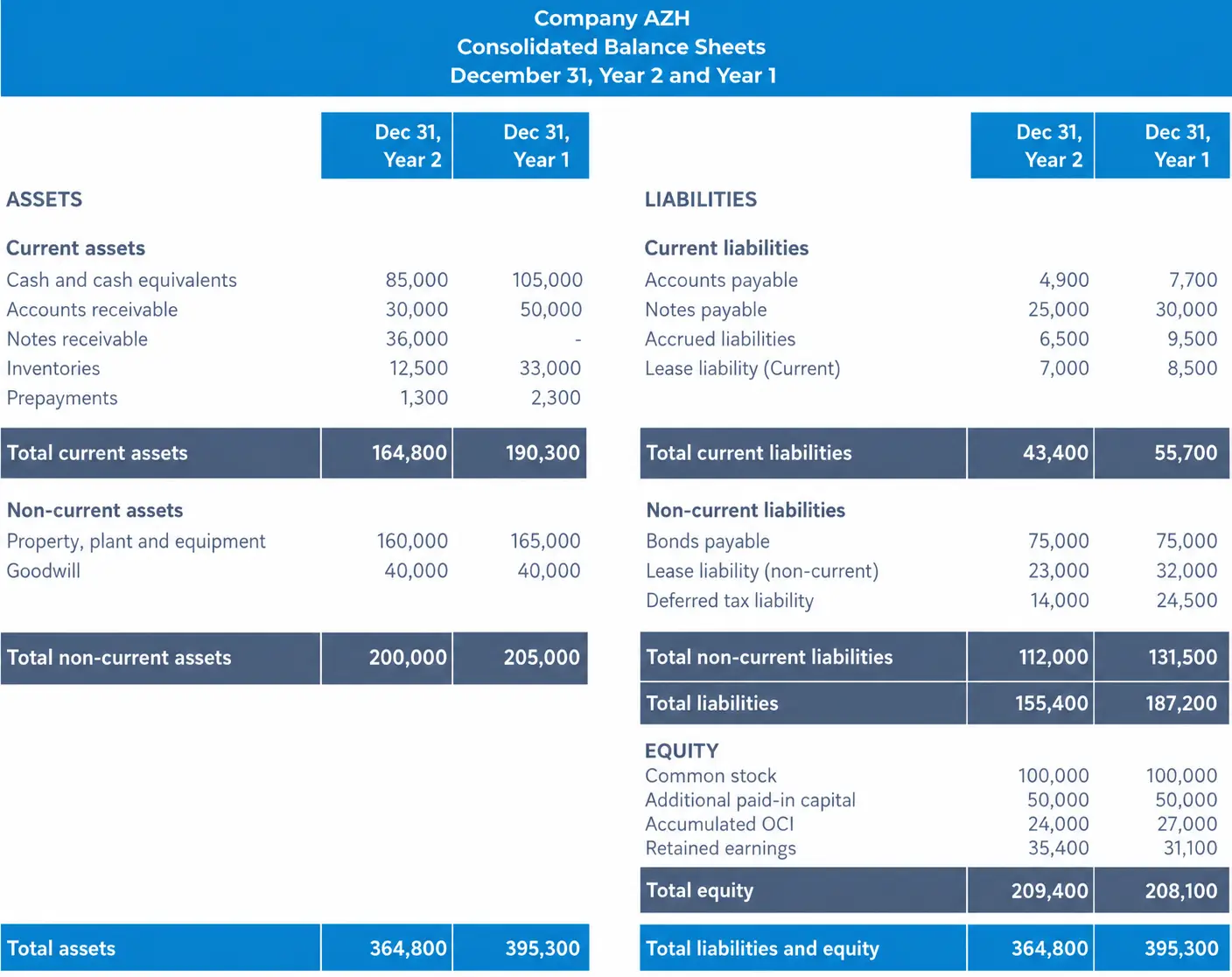
The following is an example of the balance sheet in report format - assets listed above liabilities and equity, rather than side by side as in account format. Notice how the accounting equation holds true wherein the total assets is equal to the total liabilities and shareholders’ equity.

Sample balance sheet in report format listing assets, then liabilities and equity, for two comparative years.
Proforma Balance Sheet
Achievable

Balance Sheet Basics

  • IFRS calls it “statement of financial position”; US GAAP calls it “balance sheet” (CMA exam uses US GAAP/FASB definitions)
  • Core accounting equation: Assets=Liabilities+Equity
  • Transactions either change both sides equally (e.g., borrowing cash) or swap within assets (e.g., buying equipment with cash)

Assets

  • Defined as a present right to an economic benefit
  • Current assets: cash/resources realized, sold, or consumed within normal operating cycle or one year (whichever longer) — e.g., cash, receivables, inventory, prepaid expenses
  • Non-current assets: not expected to convert within that period — includes long-term investments, PP&E (tangible), and goodwill/patents/trademarks (intangible)
  • Classification depends on expected timing of realization, not account name (e.g., a 3-year note receivable is non-current)

Liabilities

  • Defined as a present obligation to transfer an economic benefit
  • Current liabilities: due within operating cycle or one year — e.g., accounts payable, current portion of notes payable, accrued liabilities
  • Non-current liabilities: due beyond that period — e.g., bonds, long-term lease liabilities, deferred tax liabilities

Equity

  • Residual interest: Equity=Assets−Liabilities
  • Two sources: (1) owner transactions (share capital, APIC, less treasury stock) and (2) other movements (retained earnings, accumulated OCI)
  • Retained earnings = cumulative net income minus dividends; links balance sheet to income statement
  • Treasury stock = repurchased shares; contra-equity account (subtracted from total equity, excluded from contributed capital)
  • Total equity formula: Share capital+APIC+Retained earnings−Treasury stock

Purpose and Limitations

  • Used by investors/creditors to assess liquidity, financial flexibility, risk exposure, and ability to meet obligations — but requires interpretation, not a direct value readout
  • Limitations: doesn’t show business value directly, relies on estimates/judgment, excludes non-monetary assets (e.g., workforce skill, internal brands), and mixes measurement bases (historical cost vs. fair value)

Format

  • Can be presented in report format (assets above liabilities/equity) or account format (side by side)
  • Total assets must always equal total liabilities plus equity

Sign up for free to take 19 quiz questions on this topic

Previous
Next  | 1.1.4.1 Comprehensive income
All rights reserved ©2016 - 2026 Achievable, Inc.

Statement of financial position

The balance sheet is the first financial statement you need to learn. It shows the structure of the resources of the entity (assets) and how they have been financed (liabilities and equity). Under IFRS, this statement is usually called the statement of financial position, while US GAAP commonly calls it the balance sheet; the CMA exam tests the US GAAP definitions, drawn from the FASB Conceptual Framework, used throughout this chapter.

The balance sheet should always adhere to the accounting equation:

Assets=Liabilities+Equity

Meaning that all of the entity’s total assets are either financed through liability or through equity. For example, borrowing $10,000 from a bank raises cash (an asset) and notes payable (a liability) by $10,000; buying equipment for cash swaps one asset for another, so total assets stay the same. The main elements of the balance sheet are assets, liability and equity. They’re discussed in more detail below.

Assets

Assets are simply defined as a present right of an entity to an economic benefit.

This definition gives an asset two distinct characteristics:

  1. It is a present right and
  2. The right is to an economic benefit.

Assets can also be classified as current or non-current:

Current assets

These are cash or other resources that are expected to be realized in cash or sold or consumed during the normal operating cycle of the business, or one year, whichever is longer. Note that if a company has no clearly defined operating cycle, the one-year rule governs.

Examples of current assets are:

  • Cash and cash equivalents
  • Marketable securities classified as current assets
  • Accounts receivables
  • Notes receivables
  • Inventory
  • Prepaid expenses.

Non-current assets

These are resources not expected to be realized in cash, sold, or consumed within the normal operating cycle of the business, or one year, whichever is longer. Non-current assets include long-term investments, tangible assets, and intangible assets.

Examples of long-term investments and advances (financial assets) are:

  • Long-term investments or advances.

Examples of tangible non-current assets are:

  • Property, plant and equipment

Examples of intangible non-current assets are:

  • Goodwill
  • Patents
  • Trademarks.

Watch out: Classification depends on when the asset is expected to be realized, not on the account’s name. A receivable or an investment can still be non-current if it isn’t expected to convert to cash within the operating cycle or one year, whichever is longer - for example, a note receivable due in three years belongs with non-current assets even though “receivable” often gets grouped with current items.

Liabilities

A liability is a present obligation of an entity to transfer an economic benefit. This definition gives a liability two essential characteristics:

  1. It is a present obligation
  2. The obligation requires an entity to transfer or otherwise provide economic benefits to others.

Similar to assets, liabilities can be classified as current or non-current:

Current liabilities

These are obligations that are expected to be paid off within the normal operating cycle or one year, whichever is longer.

Examples of current liabilities are:

  • Accounts payable
  • Current portion of notes payable
  • Accrued liabilities.

Non-current liabilities

These are obligations that are expected to be paid off after the company’s normal operating cycle or one year, whichever is longer.

Examples of non-current liabilities are:

  • Bonds
  • Non-current portion of lease liabilities
  • Deferred tax liabilities.

Equity

The terms equity or net assets represent the residual interest in the assets of an entity that remains after deducting its liabilities.

In terms of its technical definition, equity can be derived directly from the accounting equation:

Equity=Assets−Liabilities

In terms of its breakdown in the balance sheet, the equity or net assets section of the balance sheet can generally be split into two:

  1. Those arising from transactions with owners:
    • Share capital and additional paid-in capital, less treasury stock.
  2. Those arising from other movements:
    • Retained earnings (cumulative net income less dividends) and
    • All other (accumulated OCI).

Retained earnings ties the balance sheet to the income statement and the statement of changes in equity: it grows with net income and shrinks with dividends declared, both covered in the next chapter.

Treasury stock is shares repurchased by the company from shareholders. It is a contra-equity account - meaning it is deducted from total equity - and is excluded from contributed capital (share capital and additional paid-in capital).

Example: computing total equity

A company reports the following balances:

  • Share capital: $200,000
  • Additional paid-in capital (APIC): $50,000
  • Retained earnings: $80,000
  • Treasury stock: $30,000

Treasury stock is subtracted, not added, since it’s a contra-equity account:

Total equity=Share capital+APIC+Retained earnings−Treasury stock

Total equity=$200,000+$50,000+$80,000−$30,000=$300,000

Answer: Contributed capital - share capital plus APIC - is $250,000, which does not include treasury stock or retained earnings.

Purpose and limitations of the balance sheet

Purpose of the balance sheet

The primary users of the balance sheet are existing and potential investors, lenders, and other creditors, who rely on it to decide whether to provide capital to the entity.

Through the details included in the balance sheet, a company can use these as input or basis to assess the company’s:

  • Liquidity
  • Financial flexibility
  • Net resources available
  • Capability of generating future net cash flows
  • Exposures to risk and
  • Ability to meet long-term financial obligations.

However, the balance sheet does not provide this information directly and the user needs to have sufficient knowledge on how to use the inputs (assets, liabilities, equity items) and interpret the results to come up with sound decisions.

Limitations of the balance sheet

The following are some of the limitations of the balance sheet:

  • The information provided by the balance sheet does not show directly the value of the business. Instead, users should be able to make their own estimates based on the inputs available
  • Preparation of the financial statements may involve the use of estimates and judgments
  • There are non-monetary “assets” that are not being recognized in the balance sheet such as an organized and skilled workforce and internally generated brands.
  • Different assets are measured on different bases - some at historical cost and some at fair value - so the balance sheet doesn’t present a single, consistent measure of value. Historical cost figures, in particular, don’t reflect current market values.

Format and example

The following is an example of the balance sheet in report format - assets listed above liabilities and equity, rather than side by side as in account format. Notice how the accounting equation holds true wherein the total assets is equal to the total liabilities and shareholders’ equity.

Key points

Balance Sheet Basics

  • IFRS calls it “statement of financial position”; US GAAP calls it “balance sheet” (CMA exam uses US GAAP/FASB definitions)
  • Core accounting equation: Assets=Liabilities+Equity
  • Transactions either change both sides equally (e.g., borrowing cash) or swap within assets (e.g., buying equipment with cash)

Assets

  • Defined as a present right to an economic benefit
  • Current assets: cash/resources realized, sold, or consumed within normal operating cycle or one year (whichever longer) — e.g., cash, receivables, inventory, prepaid expenses
  • Non-current assets: not expected to convert within that period — includes long-term investments, PP&E (tangible), and goodwill/patents/trademarks (intangible)
  • Classification depends on expected timing of realization, not account name (e.g., a 3-year note receivable is non-current)

Liabilities

  • Defined as a present obligation to transfer an economic benefit
  • Current liabilities: due within operating cycle or one year — e.g., accounts payable, current portion of notes payable, accrued liabilities
  • Non-current liabilities: due beyond that period — e.g., bonds, long-term lease liabilities, deferred tax liabilities

Equity

  • Residual interest: Equity=Assets−Liabilities
  • Two sources: (1) owner transactions (share capital, APIC, less treasury stock) and (2) other movements (retained earnings, accumulated OCI)
  • Retained earnings = cumulative net income minus dividends; links balance sheet to income statement
  • Treasury stock = repurchased shares; contra-equity account (subtracted from total equity, excluded from contributed capital)
  • Total equity formula: Share capital+APIC+Retained earnings−Treasury stock

Purpose and Limitations

  • Used by investors/creditors to assess liquidity, financial flexibility, risk exposure, and ability to meet obligations — but requires interpretation, not a direct value readout
  • Limitations: doesn’t show business value directly, relies on estimates/judgment, excludes non-monetary assets (e.g., workforce skill, internal brands), and mixes measurement bases (historical cost vs. fair value)

Format

  • Can be presented in report format (assets above liabilities/equity) or account format (side by side)
  • Total assets must always equal total liabilities plus equity

More from Financial statements

  • Learning outcomes
  • Introduction to external financial reporting
  • Statement of changes in equity
  • Statement of cash flows
  • Notes to the financial statements