


Achievable logoAchievable logo
CMA Part 1
Sign in
Sign up
Purchase
Textbook
Practice exams
Support
How it works
Exam catalog
Mountain with a flag at the peak
Textbook
1. External financial reporting decisions
2. Planning, budgeting, and forecasting
3. Performance management
4. Cost management
5. Internal control
6. Technology and analytics
Achievable logoAchievable logo
1.1.4.1 Comprehensive income
Achievable CMA Part 1
1. External financial reporting decisions
1.1. Financial statements
1.1.4. Statement of comprehensive income
Our CMA Part 1 course is currently in development and is a work-in-progress.

Comprehensive income

10 min read
Font
Discuss
Share
Feedback

This topic is discussed combining the provisions of Accounting Standards Codification on presentation of the income statement in ASC 225 and FASB’s Statements of Financial Accounting Concepts as amended December 2021.

Comprehensive income

The term comprehensive income is defined as the changes in net assets (equity) of a company coming from transactions and events other than those related to the owners.

Transactions with owners are not considered as part of comprehensive income. These transactions with owners include the elements discussed in the balance sheet:

  1. investments from owners
  2. distributions to owners

Other transactions resulting in a change in assets or liabilities are normally classified as comprehensive income.

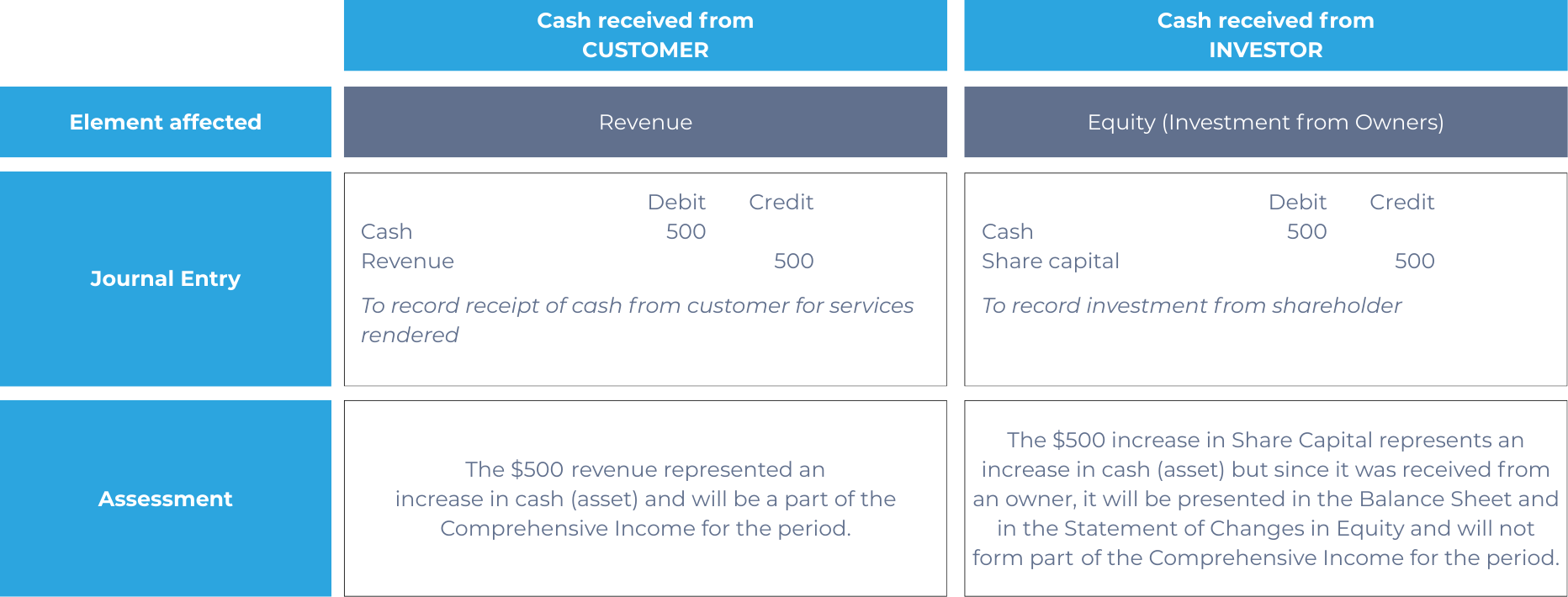
To simply illustrate this, let’s take a company that received $500. The treatment of this depends which party the cash was received from:

Revenue versus equity journal entry

The comprehensive income of an entity is composed of two subtotals:

  1. Net income
  2. Other comprehensive income (OCI)

Net income is composed of four elements: revenues, expenses, gains, and losses. OCI does not have these elements - instead, it consists of transactions specifically identified by US GAAP. Common OCI items include unrealized gains and losses on available-for-sale (AFS) debt securities, foreign currency translation adjustments, and certain pension and postretirement benefit adjustments. The next chapter, Discontinued operations and other comprehensive income (OCI), covers these items in detail.

US GAAP vs. IFRS: The comprehensive income presentation rules in this chapter follow US GAAP. IFRS permits additional OCI items - such as revaluation surplus on property, plant, and equipment - that are not recognized under US GAAP. Part 1 of the CMA exam tests US GAAP rules.

Before we discuss how the two components of total comprehensive income are different from each other, let us first show you how comprehensive income is presented as a financial statement.

Presentation of comprehensive income

A company has two options to report comprehensive income and its components:

Option 1: Single continuous financial statement

This option requires the company to present comprehensive income using one continuous financial statement called the statement of comprehensive income that is separated into two general sections:

  1. net income section; and
  2. other comprehensive income section

Each section should be further broken down into line items that provide information of the source or nature of each item.

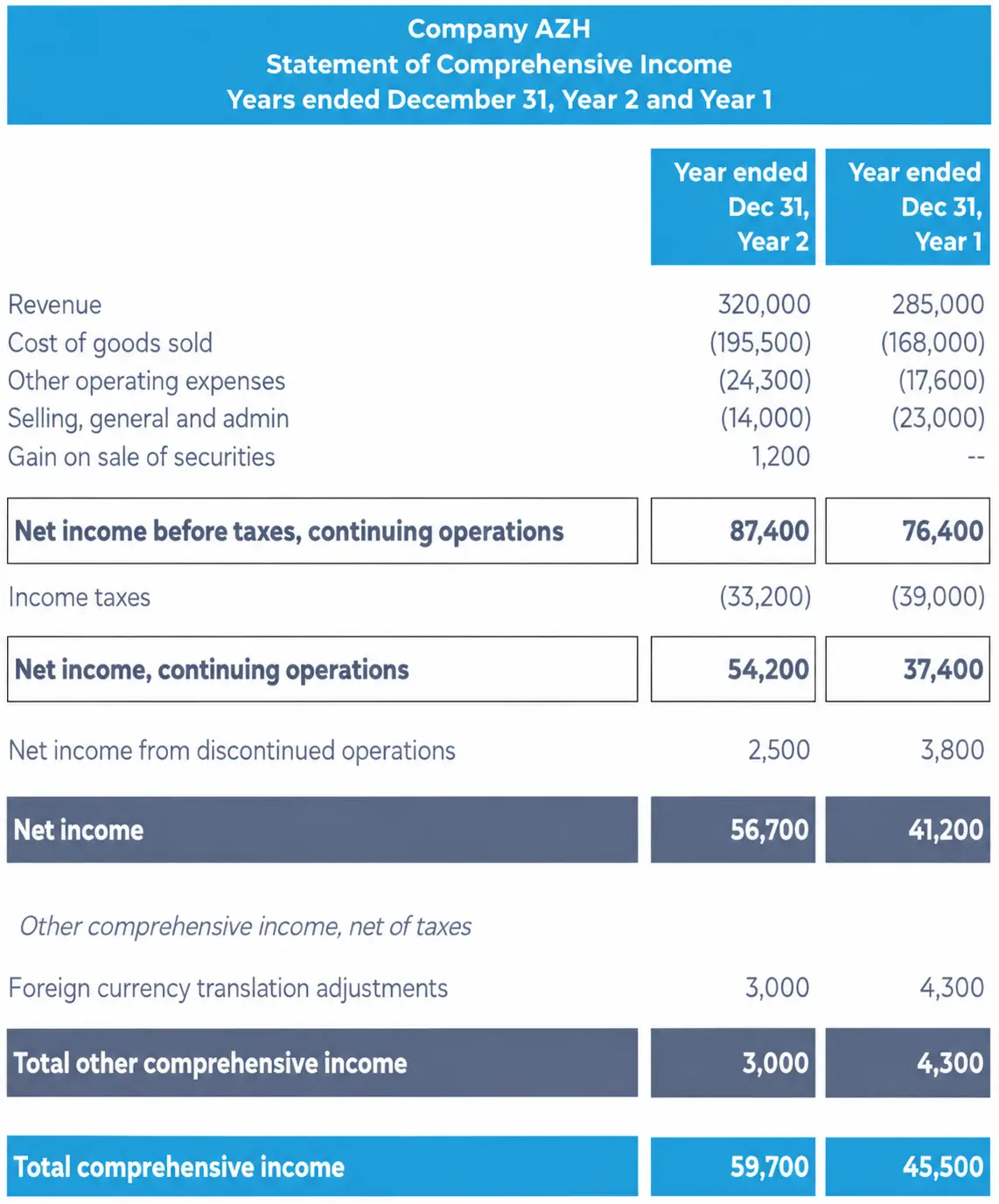
A sample continuous statement of comprehensive income is presented below:

Statement of comprehensive income showing revenue, expenses, net income, and other comprehensive income for two years.
Statement of Comprehensive Income

Option 2: Two separate but consecutive financial statements

This option requires the company to present the comprehensive income using two separate financial statements:

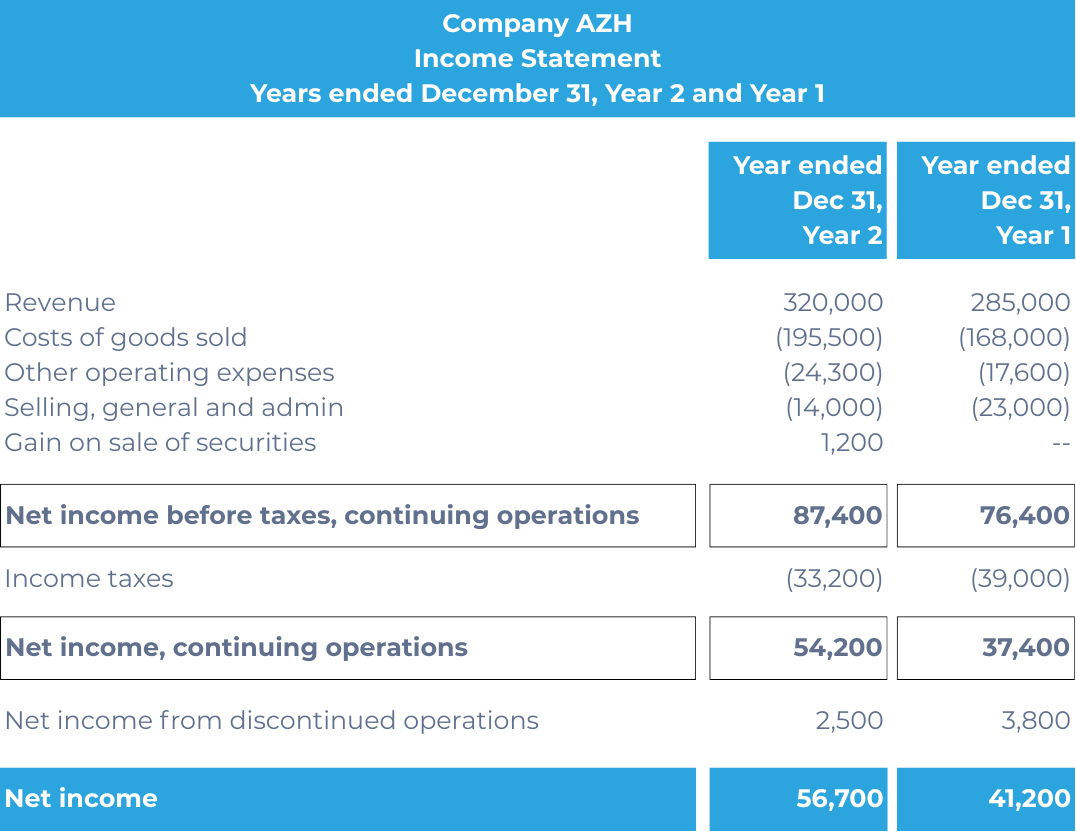
  1. Income statement - this separate financial statement gives details of the revenues, expenses, gains and losses of the company that are added together to form a singular net income for the period.
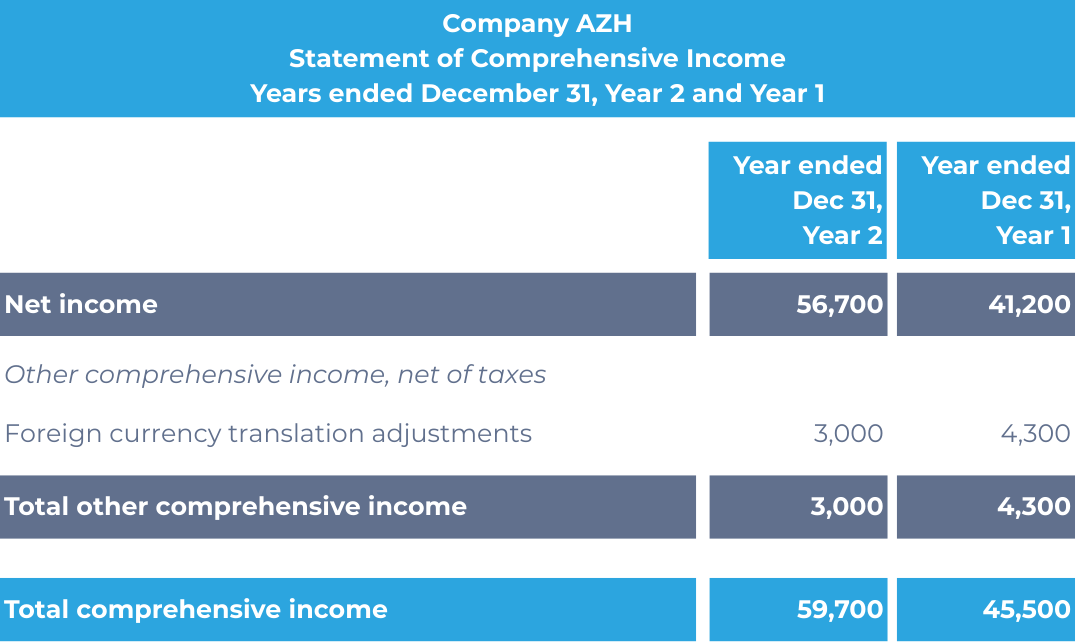
  2. Statement of comprehensive income - this financial statement starts with the amount of the net income from the income statement. Then the components of OCI are added together to form a singular comprehensive income for the period.

It should be noted that if a company has no items of OCI in any period presented, the statement of comprehensive income is not required and it is enough to present the income statement.

A sample of the two consecutive financial statements are presented below:

Proforma separate income statement
Proforma separate comprehensive income statement

The net income

The net income provides details about how the net assets (also called: equity) of a company has changed as a result of transactions or events other than those related to the owners (investments and distributions). These changes are represented by the elements:

  1. revenue
  2. expenses
  3. gains
  4. losses

The amounts in the income statement should be read and analyzed with the period in mind since the elements of the income statement are presented for “a period of time”.

For example, the net income can be presented for a 12-month period (this means that the revenues presented are the ones earned for the 12-month period covered by the statement) or quarterly basis (this means the revenues presented are only for a specified three-month period). Understanding this will help users of the financial statements better compare results to other companies or to previous periods.

Generally the elements of the income statement are recorded using the accrual method which means that:

  • Revenues and income are recorded when they are earned regardless of when cash was received; and
  • Expenses and losses are recorded when they are incurred regardless of when cash was paid.

Further details about revenue and expense recognition are explained below for each element.

1. Revenues

These are inflows or other enhancements of assets of an entity or settlements of its liabilities (or a combination of both) from delivering or producing goods, rendering services, or carrying out other activities. These include routine transactions as well as “other activities” - such as permitting others to use the entity’s resources - that result in interest, rent, royalties, and fees.

According to the GAAP revenue recognition principles, revenues are earned and recognized in the period when the performance obligation is satisfied.

2. Expenses

These are outflows or other using up of assets of an entity or incurrences of its liabilities (or a combination of both) from delivering or producing goods, rendering services, or carrying out other activities. These include routine transactions as well as “other activities” - such as the entity using the resources of others - that result in interest, rent, royalties, and fees paid.

The expense recognition principle, or the matching principle, states that recognition of expenses is related to net changes in assets and the earning of revenues. Expenses should be recognized when the work or product contributes to revenue.

Sidenote
About gains and losses

Although the revenues and expenses are considered as the primary sources of net income, there are other sources that may not normally be considered as falling under the definition of the two because they vary in stability, risk and predictability. This is where the other two elements come in.

3. Gains

These are increases in equity (net assets) from transactions and other events and circumstances affecting an entity except those that result from revenues or investments by owners.

4. Losses

These are decreases in equity (net assets) from transactions and other events and circumstances affecting an entity except those that result from expenses or distributions to owners.

Distinguishing between revenue, expenses, gains, or losses

The primary purpose of distinguishing revenues from gains, and expenses from losses is to make the information in the statement of comprehensive income as useful as possible.

In particular, the users should know the differences between items resulting from routine transactions (revenues and expenses) and from other events (gains and losses) to assess the amount, timing and uncertainty of potential future cash flows.

Although these classifications are ultimately covered by the standards (or codifications), they always consider the objective of financial reporting discussed in the Concept statements.

While revenues and expenses typically result from delivering or producing goods, rendering services or carrying out other activities, gains and losses typically result from one of the following three circumstances:

  1. Nonreciprocal transactions or events such as natural catastrophes - Nonreciprocal transactions or events are generally distinguishable from revenues and expenses.

  2. Exchange transactions - Distinctions between revenues and gains and expenses and losses from exchange transactions of an entity depend to a significant extent on the nature of the entity and the activity with which an item is associated. An identical item can be used by entities differently. As a result, the proceeds from the sale of an asset may be revenue for one entity and may be a factor in determining gain or loss for another. For example, the proceeds from the sale of a machine displayed as inventory would be considered revenue, and the cost of that machine would be considered an expense. However, the proceeds from the sale of a machine used by an entity in a productive capacity would not be considered revenue - the entity would report a gain or a loss upon disposition of that machine.

  3. Holding gains and losses - Holding gains and losses can be a result of a contractual change in value of an asset or a liability from a passage of time, as is the case of interest, or a change in the value of the asset or liability. Those value changes would be distinguished between those that are classified as revenues and expenses or those that are classified as gains and losses.

Example: Gain or loss on equipment disposal

A company sells a piece of equipment for $18,000. The equipment originally cost $25,000 and has accumulated depreciation of $10,000, giving a net book value of $15,000.

  • Net book value: $25,000 − $10,000 = $15,000
  • Sale proceeds: $18,000
  • Gain on disposal: $18,000 − $15,000 = $3,000

Because the equipment was used in a productive capacity (not held for sale as inventory), the $3,000 is reported as a gain on the income statement, not as revenue.

Additionally, current updates or adjustments of estimates of prior periods are often referred to in practice as gains and losses. These are not gains and losses; they are adjustments to previously recognized revenues, expenses, gains, or losses that should be reported as initially recognized.

Comprehensive Income

  • Defined as changes in net assets from non-owner transactions/events
  • Excludes investments from owners and distributions to owners
  • Comprised of:
    • Net income
    • Other comprehensive income (OCI)

Presentation of Comprehensive Income

  • Two reporting options:
    • Single continuous Statement of Comprehensive Income (net income + OCI sections)
    • Two consecutive statements: Income Statement, then Statement of Comprehensive Income (starting with net income, then OCI)
  • If no OCI items, only Income Statement is required

Net Income

  • Reflects changes in equity from non-owner transactions/events
  • Composed of:
    • Revenues
    • Expenses
    • Gains
    • Losses
  • Reported for a specific period (e.g., annual, quarterly)
  • Uses accrual accounting:
    • Revenues/income recognized when earned
    • Expenses/losses recognized when incurred

Revenues

  • Inflows/enhancements of assets or settlements of liabilities from delivering goods, services, or other activities
  • Recognized when performance obligation is satisfied (GAAP)

Expenses

  • Outflows/using up of assets or incurrence of liabilities from delivering goods, services, or other activities
  • Recognized when contributing to revenue (matching principle)

Gains

  • Increases in equity from transactions/events not classified as revenues or owner investments

Losses

  • Decreases in equity from transactions/events not classified as expenses or owner distributions

Distinguishing Revenues/Expenses vs. Gains/Losses

  • Revenues/expenses: routine transactions (goods/services)
  • Gains/losses: nonreciprocal events, certain exchange transactions, holding gains/losses
    • Example: Sale of inventory = revenue; sale of used equipment = gain/loss
  • Purpose: Provide useful info on cash flow timing, amount, uncertainty
  • Adjustments to prior period estimates are not gains/losses, but corrections to previously recognized amounts

Sign up for free to take 12 quiz questions on this topic

Previous
Next  | 1.1.4.2 Discontinued operations and other comprehensive income (OCI)
All rights reserved ©2016 - 2026 Achievable, Inc.

Comprehensive income

This topic is discussed combining the provisions of Accounting Standards Codification on presentation of the income statement in ASC 225 and FASB’s Statements of Financial Accounting Concepts as amended December 2021.

Comprehensive income

The term comprehensive income is defined as the changes in net assets (equity) of a company coming from transactions and events other than those related to the owners.

Transactions with owners are not considered as part of comprehensive income. These transactions with owners include the elements discussed in the balance sheet:

  1. investments from owners
  2. distributions to owners

Other transactions resulting in a change in assets or liabilities are normally classified as comprehensive income.

To simply illustrate this, let’s take a company that received $500. The treatment of this depends which party the cash was received from:

The comprehensive income of an entity is composed of two subtotals:

  1. Net income
  2. Other comprehensive income (OCI)

Net income is composed of four elements: revenues, expenses, gains, and losses. OCI does not have these elements - instead, it consists of transactions specifically identified by US GAAP. Common OCI items include unrealized gains and losses on available-for-sale (AFS) debt securities, foreign currency translation adjustments, and certain pension and postretirement benefit adjustments. The next chapter, Discontinued operations and other comprehensive income (OCI), covers these items in detail.

US GAAP vs. IFRS: The comprehensive income presentation rules in this chapter follow US GAAP. IFRS permits additional OCI items - such as revaluation surplus on property, plant, and equipment - that are not recognized under US GAAP. Part 1 of the CMA exam tests US GAAP rules.

Before we discuss how the two components of total comprehensive income are different from each other, let us first show you how comprehensive income is presented as a financial statement.

Presentation of comprehensive income

A company has two options to report comprehensive income and its components:

Option 1: Single continuous financial statement

This option requires the company to present comprehensive income using one continuous financial statement called the statement of comprehensive income that is separated into two general sections:

  1. net income section; and
  2. other comprehensive income section

Each section should be further broken down into line items that provide information of the source or nature of each item.

A sample continuous statement of comprehensive income is presented below:

Option 2: Two separate but consecutive financial statements

This option requires the company to present the comprehensive income using two separate financial statements:

  1. Income statement - this separate financial statement gives details of the revenues, expenses, gains and losses of the company that are added together to form a singular net income for the period.
  2. Statement of comprehensive income - this financial statement starts with the amount of the net income from the income statement. Then the components of OCI are added together to form a singular comprehensive income for the period.

It should be noted that if a company has no items of OCI in any period presented, the statement of comprehensive income is not required and it is enough to present the income statement.

A sample of the two consecutive financial statements are presented below:

The net income

The net income provides details about how the net assets (also called: equity) of a company has changed as a result of transactions or events other than those related to the owners (investments and distributions). These changes are represented by the elements:

  1. revenue
  2. expenses
  3. gains
  4. losses

The amounts in the income statement should be read and analyzed with the period in mind since the elements of the income statement are presented for “a period of time”.

For example, the net income can be presented for a 12-month period (this means that the revenues presented are the ones earned for the 12-month period covered by the statement) or quarterly basis (this means the revenues presented are only for a specified three-month period). Understanding this will help users of the financial statements better compare results to other companies or to previous periods.

Generally the elements of the income statement are recorded using the accrual method which means that:

  • Revenues and income are recorded when they are earned regardless of when cash was received; and
  • Expenses and losses are recorded when they are incurred regardless of when cash was paid.

Further details about revenue and expense recognition are explained below for each element.

1. Revenues

These are inflows or other enhancements of assets of an entity or settlements of its liabilities (or a combination of both) from delivering or producing goods, rendering services, or carrying out other activities. These include routine transactions as well as “other activities” - such as permitting others to use the entity’s resources - that result in interest, rent, royalties, and fees.

According to the GAAP revenue recognition principles, revenues are earned and recognized in the period when the performance obligation is satisfied.

2. Expenses

These are outflows or other using up of assets of an entity or incurrences of its liabilities (or a combination of both) from delivering or producing goods, rendering services, or carrying out other activities. These include routine transactions as well as “other activities” - such as the entity using the resources of others - that result in interest, rent, royalties, and fees paid.

The expense recognition principle, or the matching principle, states that recognition of expenses is related to net changes in assets and the earning of revenues. Expenses should be recognized when the work or product contributes to revenue.

Sidenote
About gains and losses

Although the revenues and expenses are considered as the primary sources of net income, there are other sources that may not normally be considered as falling under the definition of the two because they vary in stability, risk and predictability. This is where the other two elements come in.

3. Gains

These are increases in equity (net assets) from transactions and other events and circumstances affecting an entity except those that result from revenues or investments by owners.

4. Losses

These are decreases in equity (net assets) from transactions and other events and circumstances affecting an entity except those that result from expenses or distributions to owners.

Distinguishing between revenue, expenses, gains, or losses

The primary purpose of distinguishing revenues from gains, and expenses from losses is to make the information in the statement of comprehensive income as useful as possible.

In particular, the users should know the differences between items resulting from routine transactions (revenues and expenses) and from other events (gains and losses) to assess the amount, timing and uncertainty of potential future cash flows.

Although these classifications are ultimately covered by the standards (or codifications), they always consider the objective of financial reporting discussed in the Concept statements.

While revenues and expenses typically result from delivering or producing goods, rendering services or carrying out other activities, gains and losses typically result from one of the following three circumstances:

  1. Nonreciprocal transactions or events such as natural catastrophes - Nonreciprocal transactions or events are generally distinguishable from revenues and expenses.

  2. Exchange transactions - Distinctions between revenues and gains and expenses and losses from exchange transactions of an entity depend to a significant extent on the nature of the entity and the activity with which an item is associated. An identical item can be used by entities differently. As a result, the proceeds from the sale of an asset may be revenue for one entity and may be a factor in determining gain or loss for another. For example, the proceeds from the sale of a machine displayed as inventory would be considered revenue, and the cost of that machine would be considered an expense. However, the proceeds from the sale of a machine used by an entity in a productive capacity would not be considered revenue - the entity would report a gain or a loss upon disposition of that machine.

  3. Holding gains and losses - Holding gains and losses can be a result of a contractual change in value of an asset or a liability from a passage of time, as is the case of interest, or a change in the value of the asset or liability. Those value changes would be distinguished between those that are classified as revenues and expenses or those that are classified as gains and losses.

Example: Gain or loss on equipment disposal

A company sells a piece of equipment for $18,000. The equipment originally cost $25,000 and has accumulated depreciation of $10,000, giving a net book value of $15,000.

  • Net book value: $25,000 − $10,000 = $15,000
  • Sale proceeds: $18,000
  • Gain on disposal: $18,000 − $15,000 = $3,000

Because the equipment was used in a productive capacity (not held for sale as inventory), the $3,000 is reported as a gain on the income statement, not as revenue.

Additionally, current updates or adjustments of estimates of prior periods are often referred to in practice as gains and losses. These are not gains and losses; they are adjustments to previously recognized revenues, expenses, gains, or losses that should be reported as initially recognized.

Key points

Comprehensive Income

  • Defined as changes in net assets from non-owner transactions/events
  • Excludes investments from owners and distributions to owners
  • Comprised of:
    • Net income
    • Other comprehensive income (OCI)

Presentation of Comprehensive Income

  • Two reporting options:
    • Single continuous Statement of Comprehensive Income (net income + OCI sections)
    • Two consecutive statements: Income Statement, then Statement of Comprehensive Income (starting with net income, then OCI)
  • If no OCI items, only Income Statement is required

Net Income

  • Reflects changes in equity from non-owner transactions/events
  • Composed of:
    • Revenues
    • Expenses
    • Gains
    • Losses
  • Reported for a specific period (e.g., annual, quarterly)
  • Uses accrual accounting:
    • Revenues/income recognized when earned
    • Expenses/losses recognized when incurred

Revenues

  • Inflows/enhancements of assets or settlements of liabilities from delivering goods, services, or other activities
  • Recognized when performance obligation is satisfied (GAAP)

Expenses

  • Outflows/using up of assets or incurrence of liabilities from delivering goods, services, or other activities
  • Recognized when contributing to revenue (matching principle)

Gains

  • Increases in equity from transactions/events not classified as revenues or owner investments

Losses

  • Decreases in equity from transactions/events not classified as expenses or owner distributions

Distinguishing Revenues/Expenses vs. Gains/Losses

  • Revenues/expenses: routine transactions (goods/services)
  • Gains/losses: nonreciprocal events, certain exchange transactions, holding gains/losses
    • Example: Sale of inventory = revenue; sale of used equipment = gain/loss
  • Purpose: Provide useful info on cash flow timing, amount, uncertainty
  • Adjustments to prior period estimates are not gains/losses, but corrections to previously recognized amounts

More from Statement of comprehensive income

  • Discontinued operations and other comprehensive income (OCI)