



Statement of financial position
The balance sheet is the first financial statement you need to learn. It shows the structure of the resources of the entity (assets) and how they have been financed (liabilities and equity).
The balance sheet should always adhere to the accounting equation:
Meaning that all of the entity’s total assets are either financed through liability or through equity. The main elements of the balance sheet are assets, liability and equity. They’re discussed in more detail below.
In addition, within equity we can find the other elements identified in the Conceptual Framework:
- Contributions from investors; and
- Distributions to investors.
Assets
Assets are simply defined as a present right of an entity to an economic benefit.
This definition gives an asset two distinct characteristics:
- It is a present right; and
- The right is to an economic benefit.
Assets can also be classified as current or non-current:
Current assets
These are cash or other resources that are expected to be realized in cash or sold or consumed during the normal operating cycle of the business, or one year, whichever is longer. Note that if a company has no clearly defined operating cycle, the one-year rule governs.
Examples of current assets are:
- Cash and cash equivalents
- Marketable securities classified as current assets
- Accounts receivables
- Notes receivables
- Inventory
- Prepaid expenses.
Non-current assets
These are resources not expected to be realized in cash, sold, or consumed within the normal operating cycle of the business, or one year, whichever is longer. Non-current assets can be tangible or intangible.
Examples of tangible non-current assets are:
- Long-term investments or advances
- Property, plant and equipment
Examples of intangible non-current assets are:
- Goodwill
- Patents
- Trademarks.
Liabilities
A liability is a present obligation of an entity to transfer an economic benefit. This definition gives a liability two essential characteristics:
- It is a present obligation
- The obligation requires an entity to transfer or otherwise provide economic benefits to others.
Similar to assets, liabilities can be classified as current or non-current:
Current liabilities
These are obligations that are expected to be paid off within the normal operating cycle or one year, whichever is longer.
Examples of current liabilities are:
- Accounts payable
- Current portion of notes payable
- Accrued liabilities.
Non-current liabilities
These are obligations that are expected to be paid off after the company’s normal operating cycle or one year, whichever is longer.
Examples of non-current liabilities are:
- Bonds
- Non-current portion of lease liabilities
- Deferred tax liabilities.
Equity
The terms equity or net assets represent the residual interest in the assets of an entity that remains after deducting its liabilities. Equity also includes the elements: investments by owners and distributions to owners.
In terms of its technical definition, equity can be derived directly from the accounting equation:
In terms of its breakdown in the balance sheet, the equity or net assets section of the balance sheet can generally be split into two:
- Those arising from transactions with owners:
- Investment from owners (Share Capital and Additional Paid-in Capital); and
- Distributions to owners (Dividend Distributions).
- Those arising from other movements:
- From operations (Net Income and Retained Earnings); and
- All other (Accumulated OCI).
Treasury stock is shares repurchased by the company from shareholders. It is a contra-equity account - meaning it is deducted from total equity - and is excluded from contributed capital (Share Capital and Additional Paid-in Capital).
Purpose and limitations of the balance sheet
Purpose of the balance sheet
Through the details included in the balance sheet, a company can use these as input or basis to assess the Company’s:
- Liquidity
- Financial flexibility
- Net resources available
- Capability of generating future net cash flows
- Exposures to risk; and
- Ability to meet long-term financial obligations.
However, the balance sheet does not provide this information directly and the user needs to have sufficient knowledge on how to use the inputs (assets, liabilities, equity items) and interpret the results to come up with sound decisions.
Limitations of the balance sheet
The following are some of the limitations of the balance sheet:
- The information provided by the balance sheet does not show directly the value of the business. Instead, users should be able to make their own estimates based on the inputs available
- Preparation of the financial statements may involve the use of estimates and judgments
- There are non-monetary “assets” that are not being recognized in the balance sheet such as an organized and skilled workforce and internally generated brands.
- Different assets are measured on different bases - some at historical cost and some at fair value - so the balance sheet doesn’t present a single, consistent measure of value. Historical cost figures, in particular, don’t reflect current market values.
Format and example
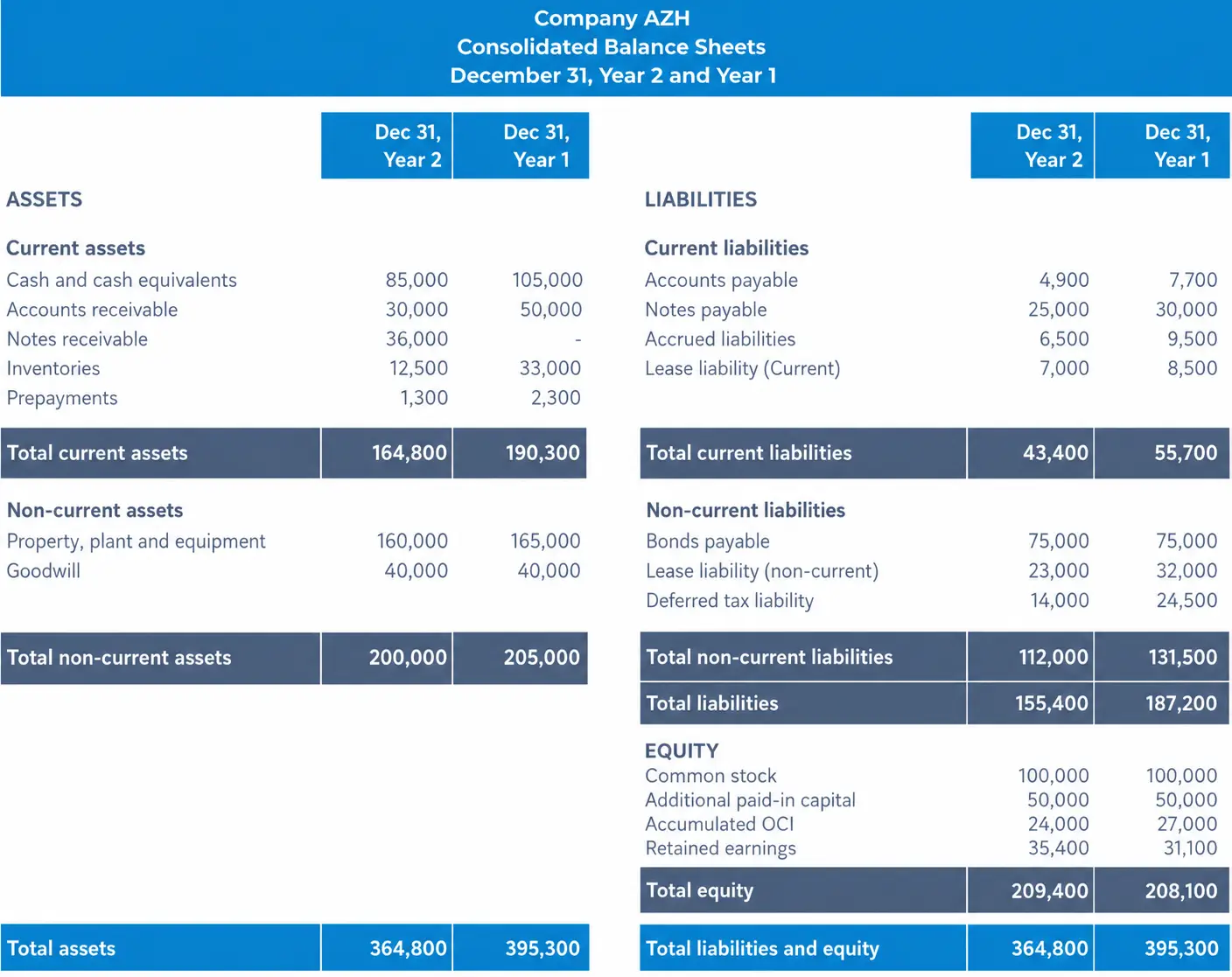
The following is an example of the balance sheet in report format. Notice how the accounting equation holds true wherein the total assets is equal to the total liabilities and shareholders’ equity.