



Introduction to external financial reporting
Prerequisite knowledge
Candidates are assumed to have prior knowledge in five areas: preparation of financial statements, business economics, time value of money, statistics, and probability. These topics are not covered here in detail.
There will also be references to the Accounting Standard Codifications (ASCs) and the Conceptual Framework for Financial Reporting chapters all throughout the review material. Candidates are not expected to memorize the exact references but only for further research in case candidates want to research more about the topics presented.
Users of the financial statements
The users of the financial statements can be generally divided into:
- the primary users
- other users
The primary users of general purpose financial reporting
The objective of general purpose financial reporting is to provide information about the reporting entity to the following users in making decisions about providing resources to the entity:
- Existing and potential investors
- Existing and potential lenders and other creditors
The users above are considered as the primary users of the financial information.
Below is a summary of the primary need of each user:
| Primary user | Primary need |
|---|---|
| Existing and potential investors | Expected returns from equity/debt instruments (dividends, interest, fair value changes), informed by the entity’s projected net cash inflows |
| Existing and potential lenders and other creditors | Expected principal and interest payments, informed by the timing and uncertainty of the entity’s future net cash inflows |
In order to assess the future net cash inflows of the reporting entity, the primary users need information about the following:
- Resources of the entity (i.e. assets)
- Claims against the entity (i.e. liabilities); and
- How efficiently and effectively the entity’s management and governing board have discharged their responsibilities to use the entity’s resources (i.e. other financial information such as the income statement, cash flows and relevant notes)
Despite the identified uses, the general purpose financial reports have the following limitations:
- The reports cannot provide all information that existing primary users need. Normally, these users need to consider other pertinent information such as the general economic conditions and expectations, the political climate and events surrounding the reporting entity and also outlooks on the industry as a whole.
- The reports are not designed to provide the value of the reporting entity but they may be used to help the users compute an estimate of the reporting entity’s value.
Other users of general purpose financial reporting
Other than the primary users identified above, the general purpose financial reports also are useful to the following set of other users:
- The management of a reporting entity - since this group of users are internal to the reporting entity, internal information is also available to the management that is not normally available to investors and creditors.
- Other parties - such as regulators and members of the public other than investors, lenders, and other creditors, financial analysts and rating agencies. Although the general purpose reports are not prepared with these users in mind, these other users may also find the reports useful for various specific purposes.
Types of financial statements
The following is an overview of the core set of financial statements:
Each of these financial statements are discussed in the succeeding sections.
Elements of financial statements
The Conceptual Framework identified ten (10) elements of financial statements which are considered as the building blocks with which financial statements are constructed. Presented below are the elements with the corresponding financial statement where they can be found:
| Element | Balance sheet | Statement of comprehensive income | Statement of changes in equity | Statement of cash flows | |
| Income statement | Other comprehensive income | ||||
| Assets | X | - | - | - | - |
| Liabilities | X | - | - | - | - |
| Equity | X | - | - | - | - |
| Investments by owners | X | - | - | X | - |
| Distributions to owners | X | - | - | X | - |
| Other comprehensive income | X | - | X | - | - |
| Revenues | - | X | - | - | - |
| Expenses | - | X | - | - | - |
| Gains | - | X | - | - | - |
| Losses | - | X | - | - | - |
The statement of cash flows are not constructed using any of the elements because the cash flows are classified by its nature: operating, investing and financing. More discussion about this topic is found in the succeeding section about the statement of cash flows.
In the statement of changes in equity, only the total amount of comprehensive income during the period is included and a breakdown is normally not presented per element (revenue, expense, gains and losses).
Each element is further discussed in the subsequent chapters on the financial statements.
Lastly, the notes to financial statements are not elements, though they serve important functions that are distinct from elements, including amplifying or complementing information about items in financial statements.
The relationship of the financial statements
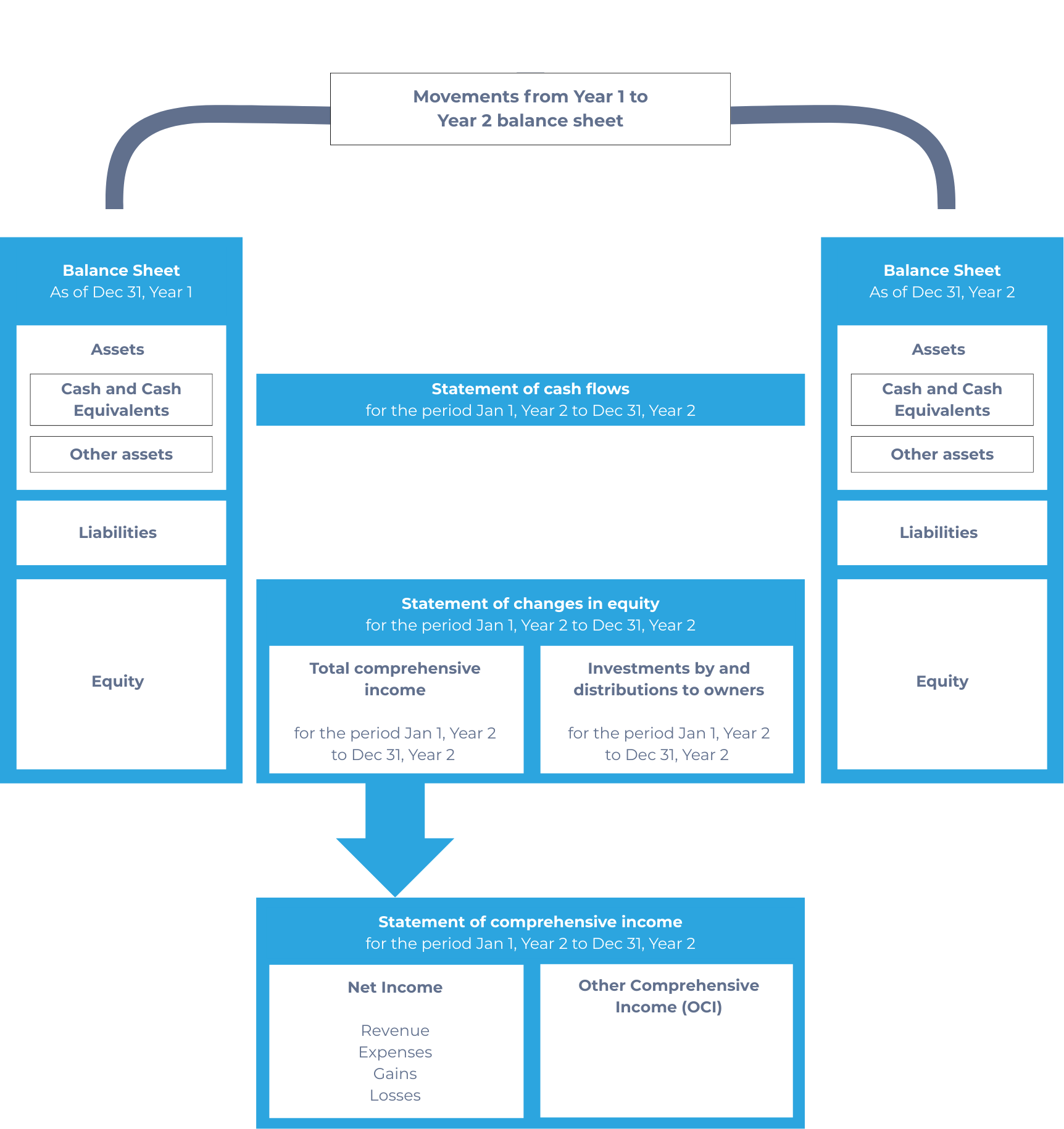
Before going into the details of each financial statement, it is important to understand how they are all interrelated. The figure below shows the relationships of each financial statement:
In the above illustration, two balance sheets are presented for the years ended: December 31, Year 1 and December 31, Year 2. This shows the nature of the balance sheet being a snapshot of the assets, liabilities and equity of the entity as at a specific date (i.e. December 31).
The other financial statements serve as “bridges” between two balance sheets that explain the movements of certain elements (i.e. equity) and balances (i.e. cash and cash equivalents) between the balance sheets as of December 31, Year 1 and December 31, Year 2.
The statement of cash flows explains the movement in cash from Year 1 to Year 2
The statement of changes in equity explains the movement of the equity element between two balance sheets from Year 1 to Year 2. It normally has two components:
-
The total comprehensive income during the period which is composed of: (a) net income (revenue, expenses, gains, losses); and (b) other comprehensive income (OCI)
-
The transactions with owners which are composed of: (a) investments by owners; and (b) distributions to owners during the period.
To make the bridge concept concrete: suppose equity on the Year 1 balance sheet is $500. During the year the entity earns net income of $80, records OCI of $10, and pays dividends of $20. The statement of changes in equity captures all three movements, and the Year 2 balance sheet reports equity of $570 ($500 + $80 + $10 − $20).