


This browser is too old to run Achievable.

Update it, or open this page in a current version of Chrome, Safari, Firefox or Edge. On an iPhone or iPad, update iOS: every browser there runs on the version of Safari that comes with it.

Achievable logoAchievable logo
CMA Part 1
Sign in
Sign up
Purchase
Textbook
Practice exams
Support
How it works
Resources
Exam catalog
Mountain with a flag at the peak
Textbook
Introduction
1. External financial reporting decisions
1.1 Financial statements
1.1.1 Learning outcomes
1.1.2 Introduction to external financial reporting
1.1.3 Statement of financial position
1.1.4 Statement of comprehensive income
1.1.5 Statement of changes in equity
1.1.6 Statement of cash flows
1.1.7 Cash flow preparation
1.1.8 Notes to the financial statements
1.1.9 Consolidated financial statements
1.1.10 Integrated reporting
1.2 Financial transactions
2. Planning, budgeting, and forecasting
3. Performance management
4. Cost management
5. Internal control
6. Technology and analytics
Wrapping up
Achievable logoAchievable logo
1.1.2 Introduction to external financial reporting
Achievable CMA Part 1
1. External financial reporting decisions
1.1. Financial statements
Our CMA Part 1 course is currently in development and is a work-in-progress.

Introduction to external financial reporting

9 min read
Font
Discuss
Share
Feedback

Prerequisite knowledge

Candidates are assumed to have prior knowledge in five areas: preparation of financial statements, business economics, time value of money, statistics, and probability. These topics are not covered here in detail.

There will also be references to the FASB Accounting Standards Codification (ASC) and the FASB Conceptual Framework for Financial Reporting chapters throughout the review material. References to the FASB ASC and Conceptual Framework are for further reading only; you do not need to memorize them.

Users of the financial statements

The users of the financial statements can be generally divided into:

  1. the primary users
  2. other users

The primary users of general purpose financial reporting

The objective of general purpose financial reporting is to provide information about the reporting entity to the following users in making decisions about providing resources to the entity:

  • Existing and potential investors
  • Existing and potential lenders and other creditors

The users above are considered as the primary users of the financial information.

Below is a summary of the primary need of each user:

Primary user Primary need
Existing and potential investors Expected returns from equity/debt instruments (dividends, interest, fair value changes), informed by the entity’s projected net cash inflows
Existing and potential lenders and other creditors Expected principal and interest payments, informed by the timing and uncertainty of the entity’s future net cash inflows

In order to assess the future net cash inflows of the reporting entity, the primary users need information about the following:

  • Resources of the entity (i.e., assets)
  • Claims against the entity (i.e., liabilities)
  • How efficiently and effectively the entity’s management and governing board have discharged their responsibilities to use the entity’s resources (i.e., other financial information such as the income statement, cash flows, and relevant notes)

Despite the identified uses, the general purpose financial reports have the following limitations:

  • The reports cannot provide all information that existing primary users need. Normally, these users need to consider other pertinent information such as the general economic conditions and expectations, the political climate and events surrounding the reporting entity and also outlooks on the industry as a whole.
  • The reports are not designed to provide the value of the reporting entity but they may be used to help the users compute an estimate of the reporting entity’s value.

Other users of general purpose financial reporting

Other than the primary users identified above, the general purpose financial reports also are useful to the following set of other users:

  • The management of a reporting entity - since this group of users are internal to the reporting entity, internal information is also available to the management that is not normally available to investors and creditors.
  • Other parties - such as regulators and members of the public other than investors, lenders, and other creditors, financial analysts and rating agencies. Although the general purpose reports are not prepared with these users in mind, these other users may also find the reports useful for various specific purposes.

Types of financial statements

The following is an overview of the core set of financial statements:

Definitions
Balance sheet
Shows a snapshot of an entity’s assets, liabilities, and equity as at a specific date. Also known as the statement of financial position (the IFRS caption; “balance sheet” is the conventional U.S. GAAP term tested on the CMA exam).
Income statement
Shows an entity’s revenues, expenses, gains, and losses for a given reporting period. Also known as the statement of profit or loss (the IFRS caption; “income statement” is the conventional U.S. GAAP term).
Statement of comprehensive income
A statement that combines the income statement and other comprehensive income items.
Statement of cash flows
Shows the movement in the entity’s cash and cash equivalents classified into operating, investing, and financing activities.
Statement of changes in equity
Shows the details of the movements of each equity item in the balance sheet from the ending of the previous period. These movements generally include net income, other comprehensive income, and transactions with owners during the period.
Notes to the financial statements
Provides additional information necessary for understanding the financial statements. These include accounting policies, significant estimates used, and other information.

Each of these financial statements is discussed in the succeeding sections.

Elements of financial statements

The FASB Conceptual Framework (Concepts Statement No. 8, Chapter 4) identifies ten (10) elements of financial statements, which are considered the building blocks from which financial statements are constructed. (The IFRS Conceptual Framework defines a different, five-element set - assets, liabilities, equity, income, and expenses - so don’t mix the two frameworks.) Presented below are the elements with the corresponding financial statement where they can be found:

Element Balance sheet Statement of comprehensive income Statement of changes in equity Statement of cash flows
Income statement Other comprehensive income
Assets X - - - -
Liabilities X - - - -
Equity X - - - -
Investments by owners X - - X -
Distributions to owners X - - X -
Comprehensive income X X X X -
Revenues - X - - -
Expenses - X - - -
Gains - X - - -
Losses - X - - -

Note on other comprehensive income (OCI): OCI appears in two places. Current-period OCI flows through the other comprehensive income section of the statement of comprehensive income. The cumulative balance of OCI is carried on the balance sheet as accumulated other comprehensive income (AOCI), an equity component. OCI is a component of the comprehensive income element (net income + OCI), not a separate element.

The statement of cash flows is not constructed from the elements because cash flows are classified by their nature: operating, investing, and financing. More discussion about this topic is found in the succeeding section about the statement of cash flows.

In the statement of changes in equity, only the total amount of comprehensive income during the period is included and a breakdown is normally not presented per element (revenue, expense, gains, and losses).

Each element is further discussed in the subsequent chapters on the financial statements.

Lastly, the notes to financial statements are not elements, though they serve important functions that are distinct from elements, including amplifying or complementing information about items in financial statements.

The relationship of the financial statements

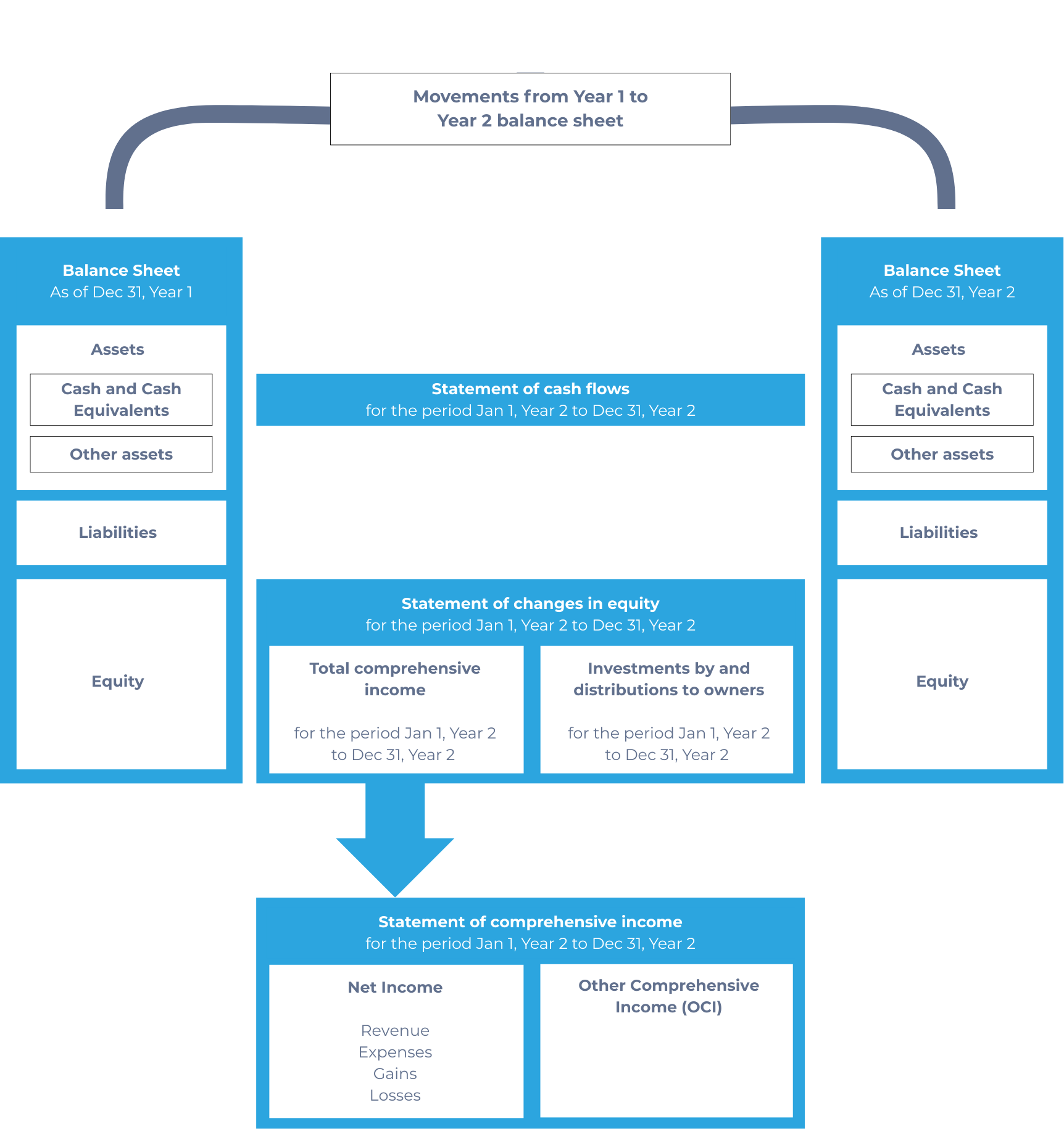
Before going into the details of each financial statement, it is important to understand how they are all interrelated. The figure below shows the relationships of each financial statement:

Relationship of financial statements
Achievable

In the above illustration, two balance sheets are presented, as of December 31, Year 1 and as of December 31, Year 2. This shows the nature of the balance sheet being a snapshot of the assets, liabilities, and equity of the entity as at a specific date (i.e., December 31).

The other financial statements serve as “bridges” between two balance sheets that explain the movements of certain elements (i.e., equity) and balances (i.e., cash and cash equivalents) between the balance sheets as of December 31, Year 1 and December 31, Year 2.

The statement of cash flows explains the movement in cash from Year 1 to Year 2.

The statement of changes in equity explains the movement of the equity element between two balance sheets from Year 1 to Year 2. It normally has two components:

  1. The total comprehensive income during the period which is composed of: (a) net income (revenue, expenses, gains, losses); and (b) other comprehensive income (OCI)

  2. The transactions with owners which are composed of: (a) investments by owners; and (b) distributions to owners during the period.

To make the bridge concept concrete: suppose equity on the Year 1 balance sheet is $500. During the year the entity earns net income of $80, records OCI of $10, and pays dividends of $20. The statement of changes in equity captures all three movements, and the Year 2 balance sheet reports equity of $570 ($500 + $80 + $10 − $20).

Key concept: point in time vs. period of time

It is important to notice that the balance sheet is captioned “as of December 31” while all other financial statements are captioned “for the period from January 1 to December 31”.

This is consistent with the nature of the amounts you will see in the financial statements being:

  • A snapshot as of a single point in time for the balance sheet (e.g., the cash balance in Year 2 balance sheet means it is the exact cash existing as at the day December 31, Year 2); versus
  • An amount pertaining to a period for all other financial statements (e.g., the revenue amount in the income statement means it is the total amount earned for the period January 1 to December 31 in Year 2).

Prerequisite knowledge

  • Assumes prior mastery of: financial statement prep, business economics, time value of money, statistics, probability
  • FASB ASC and Conceptual Framework references are for context only — not tested from memory

Users of financial statements

  • Primary users: existing/potential investors (want expected returns) and lenders/creditors (want expected principal/interest payments) — both need info on entity’s future net cash inflows
  • To assess cash inflows, primary users need: assets, liabilities, and info on management’s stewardship (income, cash flow, notes)
  • Limitations: reports don’t include all relevant info (economic/political climate, industry outlook) and don’t directly state entity value
  • Other users: internal management (has extra internal info) and external parties (regulators, analysts, rating agencies, public) — reports not designed for them but still useful

Core financial statements

  • Balance sheet (statement of financial position): snapshot of assets, liabilities, equity at a point in time
  • Income statement (statement of profit or loss): revenues, expenses, gains, losses over a period
  • Statement of comprehensive income: combines income statement + other comprehensive income (OCI)
  • Statement of cash flows: cash movement by operating, investing, financing activities
  • Statement of changes in equity: tracks equity movements (net income, OCI, owner transactions) between periods
  • Notes to financial statements: supplemental disclosures (policies, estimates, other info) — not an “element”

Elements of financial statements

  • FASB Conceptual Framework defines 10 elements (building blocks); IFRS framework differs (only 5: assets, liabilities, equity, income, expenses) — don’t conflate
  • Balance sheet elements: assets, liabilities, equity, investments by owners, distributions to owners, comprehensive income
  • Income statement elements: revenues, expenses, gains, losses (flow into comprehensive income)
  • OCI: appears as current-period flow in statement of comprehensive income; cumulative balance (AOCI) sits in equity on balance sheet — OCI is part of comprehensive income, not its own element
  • Statement of cash flows isn’t built from elements — organized by nature (operating/investing/financing) instead
  • Statement of changes in equity shows only total comprehensive income, not broken into revenue/expense/gain/loss detail

Relationship between financial statements

  • Balance sheet = snapshot “as of” a date; all other statements cover “for the period” between two balance sheet dates
  • Other statements act as “bridges” explaining changes in balance sheet items across two periods
  • Statement of cash flows bridges the cash balance between two balance sheets
  • Statement of changes in equity bridges equity balance via: (1) comprehensive income (net income + OCI) and (2) owner transactions (investments and distributions)
  • Example bridge: EquityYear1​ + Net income + OCI − Distributions = EquityYear2​ (e.g., $500 + $80 + $10 − $20 = $570)

Sign up for free to take 12 quiz questions on this topic

Previous
Next  | 1.1.3 Statement of financial position
All rights reserved ©2016 - 2026 Achievable, Inc.

Introduction to external financial reporting

Prerequisite knowledge

Candidates are assumed to have prior knowledge in five areas: preparation of financial statements, business economics, time value of money, statistics, and probability. These topics are not covered here in detail.

There will also be references to the FASB Accounting Standards Codification (ASC) and the FASB Conceptual Framework for Financial Reporting chapters throughout the review material. References to the FASB ASC and Conceptual Framework are for further reading only; you do not need to memorize them.

Users of the financial statements

The users of the financial statements can be generally divided into:

  1. the primary users
  2. other users

The primary users of general purpose financial reporting

The objective of general purpose financial reporting is to provide information about the reporting entity to the following users in making decisions about providing resources to the entity:

  • Existing and potential investors
  • Existing and potential lenders and other creditors

The users above are considered as the primary users of the financial information.

Below is a summary of the primary need of each user:

Primary user Primary need
Existing and potential investors Expected returns from equity/debt instruments (dividends, interest, fair value changes), informed by the entity’s projected net cash inflows
Existing and potential lenders and other creditors Expected principal and interest payments, informed by the timing and uncertainty of the entity’s future net cash inflows

In order to assess the future net cash inflows of the reporting entity, the primary users need information about the following:

  • Resources of the entity (i.e., assets)
  • Claims against the entity (i.e., liabilities)
  • How efficiently and effectively the entity’s management and governing board have discharged their responsibilities to use the entity’s resources (i.e., other financial information such as the income statement, cash flows, and relevant notes)

Despite the identified uses, the general purpose financial reports have the following limitations:

  • The reports cannot provide all information that existing primary users need. Normally, these users need to consider other pertinent information such as the general economic conditions and expectations, the political climate and events surrounding the reporting entity and also outlooks on the industry as a whole.
  • The reports are not designed to provide the value of the reporting entity but they may be used to help the users compute an estimate of the reporting entity’s value.

Other users of general purpose financial reporting

Other than the primary users identified above, the general purpose financial reports also are useful to the following set of other users:

  • The management of a reporting entity - since this group of users are internal to the reporting entity, internal information is also available to the management that is not normally available to investors and creditors.
  • Other parties - such as regulators and members of the public other than investors, lenders, and other creditors, financial analysts and rating agencies. Although the general purpose reports are not prepared with these users in mind, these other users may also find the reports useful for various specific purposes.

Types of financial statements

The following is an overview of the core set of financial statements:

Definitions
Balance sheet
Shows a snapshot of an entity’s assets, liabilities, and equity as at a specific date. Also known as the statement of financial position (the IFRS caption; “balance sheet” is the conventional U.S. GAAP term tested on the CMA exam).
Income statement
Shows an entity’s revenues, expenses, gains, and losses for a given reporting period. Also known as the statement of profit or loss (the IFRS caption; “income statement” is the conventional U.S. GAAP term).
Statement of comprehensive income
A statement that combines the income statement and other comprehensive income items.
Statement of cash flows
Shows the movement in the entity’s cash and cash equivalents classified into operating, investing, and financing activities.
Statement of changes in equity
Shows the details of the movements of each equity item in the balance sheet from the ending of the previous period. These movements generally include net income, other comprehensive income, and transactions with owners during the period.
Notes to the financial statements
Provides additional information necessary for understanding the financial statements. These include accounting policies, significant estimates used, and other information.

Each of these financial statements is discussed in the succeeding sections.

Elements of financial statements

The FASB Conceptual Framework (Concepts Statement No. 8, Chapter 4) identifies ten (10) elements of financial statements, which are considered the building blocks from which financial statements are constructed. (The IFRS Conceptual Framework defines a different, five-element set - assets, liabilities, equity, income, and expenses - so don’t mix the two frameworks.) Presented below are the elements with the corresponding financial statement where they can be found:

Element Balance sheet Statement of comprehensive income Statement of changes in equity Statement of cash flows
Income statement Other comprehensive income
Assets X - - - -
Liabilities X - - - -
Equity X - - - -
Investments by owners X - - X -
Distributions to owners X - - X -
Comprehensive income X X X X -
Revenues - X - - -
Expenses - X - - -
Gains - X - - -
Losses - X - - -

Note on other comprehensive income (OCI): OCI appears in two places. Current-period OCI flows through the other comprehensive income section of the statement of comprehensive income. The cumulative balance of OCI is carried on the balance sheet as accumulated other comprehensive income (AOCI), an equity component. OCI is a component of the comprehensive income element (net income + OCI), not a separate element.

The statement of cash flows is not constructed from the elements because cash flows are classified by their nature: operating, investing, and financing. More discussion about this topic is found in the succeeding section about the statement of cash flows.

In the statement of changes in equity, only the total amount of comprehensive income during the period is included and a breakdown is normally not presented per element (revenue, expense, gains, and losses).

Each element is further discussed in the subsequent chapters on the financial statements.

Lastly, the notes to financial statements are not elements, though they serve important functions that are distinct from elements, including amplifying or complementing information about items in financial statements.

The relationship of the financial statements

Before going into the details of each financial statement, it is important to understand how they are all interrelated. The figure below shows the relationships of each financial statement:

In the above illustration, two balance sheets are presented, as of December 31, Year 1 and as of December 31, Year 2. This shows the nature of the balance sheet being a snapshot of the assets, liabilities, and equity of the entity as at a specific date (i.e., December 31).

The other financial statements serve as “bridges” between two balance sheets that explain the movements of certain elements (i.e., equity) and balances (i.e., cash and cash equivalents) between the balance sheets as of December 31, Year 1 and December 31, Year 2.

The statement of cash flows explains the movement in cash from Year 1 to Year 2.

The statement of changes in equity explains the movement of the equity element between two balance sheets from Year 1 to Year 2. It normally has two components:

  1. The total comprehensive income during the period which is composed of: (a) net income (revenue, expenses, gains, losses); and (b) other comprehensive income (OCI)

  2. The transactions with owners which are composed of: (a) investments by owners; and (b) distributions to owners during the period.

To make the bridge concept concrete: suppose equity on the Year 1 balance sheet is $500. During the year the entity earns net income of $80, records OCI of $10, and pays dividends of $20. The statement of changes in equity captures all three movements, and the Year 2 balance sheet reports equity of $570 ($500 + $80 + $10 − $20).

Key concept: point in time vs. period of time

It is important to notice that the balance sheet is captioned “as of December 31” while all other financial statements are captioned “for the period from January 1 to December 31”.

This is consistent with the nature of the amounts you will see in the financial statements being:

  • A snapshot as of a single point in time for the balance sheet (e.g., the cash balance in Year 2 balance sheet means it is the exact cash existing as at the day December 31, Year 2); versus
  • An amount pertaining to a period for all other financial statements (e.g., the revenue amount in the income statement means it is the total amount earned for the period January 1 to December 31 in Year 2).
Key points

Prerequisite knowledge

  • Assumes prior mastery of: financial statement prep, business economics, time value of money, statistics, probability
  • FASB ASC and Conceptual Framework references are for context only — not tested from memory

Users of financial statements

  • Primary users: existing/potential investors (want expected returns) and lenders/creditors (want expected principal/interest payments) — both need info on entity’s future net cash inflows
  • To assess cash inflows, primary users need: assets, liabilities, and info on management’s stewardship (income, cash flow, notes)
  • Limitations: reports don’t include all relevant info (economic/political climate, industry outlook) and don’t directly state entity value
  • Other users: internal management (has extra internal info) and external parties (regulators, analysts, rating agencies, public) — reports not designed for them but still useful

Core financial statements

  • Balance sheet (statement of financial position): snapshot of assets, liabilities, equity at a point in time
  • Income statement (statement of profit or loss): revenues, expenses, gains, losses over a period
  • Statement of comprehensive income: combines income statement + other comprehensive income (OCI)
  • Statement of cash flows: cash movement by operating, investing, financing activities
  • Statement of changes in equity: tracks equity movements (net income, OCI, owner transactions) between periods
  • Notes to financial statements: supplemental disclosures (policies, estimates, other info) — not an “element”

Elements of financial statements

  • FASB Conceptual Framework defines 10 elements (building blocks); IFRS framework differs (only 5: assets, liabilities, equity, income, expenses) — don’t conflate
  • Balance sheet elements: assets, liabilities, equity, investments by owners, distributions to owners, comprehensive income
  • Income statement elements: revenues, expenses, gains, losses (flow into comprehensive income)
  • OCI: appears as current-period flow in statement of comprehensive income; cumulative balance (AOCI) sits in equity on balance sheet — OCI is part of comprehensive income, not its own element
  • Statement of cash flows isn’t built from elements — organized by nature (operating/investing/financing) instead
  • Statement of changes in equity shows only total comprehensive income, not broken into revenue/expense/gain/loss detail

Relationship between financial statements

  • Balance sheet = snapshot “as of” a date; all other statements cover “for the period” between two balance sheet dates
  • Other statements act as “bridges” explaining changes in balance sheet items across two periods
  • Statement of cash flows bridges the cash balance between two balance sheets
  • Statement of changes in equity bridges equity balance via: (1) comprehensive income (net income + OCI) and (2) owner transactions (investments and distributions)
  • Example bridge: EquityYear1​ + Net income + OCI − Distributions = EquityYear2​ (e.g., $500 + $80 + $10 − $20 = $570)

More from Financial statements

  • Learning outcomes
  • Statement of financial position
  • Statement of changes in equity
  • Statement of cash flows
  • Notes to the financial statements