


Achievable logoAchievable logo
CMA Part 1
Sign in
Sign up
Purchase
Textbook
Practice exams
Support
How it works
Exam catalog
Mountain with a flag at the peak
Textbook
1. External financial reporting decisions
2. Planning, budgeting, and forecasting
3. Performance management
4. Cost management
5. Internal control
6. Technology and analytics
Achievable logoAchievable logo
1.1.7.1 Indirect method for operating activities
Achievable CMA Part 1
1. External financial reporting decisions
1.1. Financial statements
1.1.7. Cash flow preparation
Our CMA Part 1 course is currently in development and is a work-in-progress.

Indirect method for operating activities

9 min read
Font
Discuss
Share
Feedback

The statement of cash flows can be prepared and presented in either of two ways that differ only in the preparation of the operating activities section. The financing and investing activities are the same in either format.

  • The indirect method prepares the operating activities section by adjusting the net income by removing the impacts of investing and financing activities and converting the net income into a cash basis by adjusting it with the changes in working capital (current assets and current liabilities) and non-cash items.
  • The direct method prepares the operating activities section by breaking it down into the major classes of gross cash receipts and payments. This is the format that Codification encourages.

The IMA Learning Outcome Statements specify that examinees are expected to know how to prepare the indirect method of cash flows only. Understanding the direct method clarifies how the indirect method differs.

Indirect method for operating activities

The indirect method of cash flow presentation for operating activities does not present gross cash receipts and payments but instead transforms the net income into the cash flows from operating activities through a series of adjustments. This method shows the total cash flows from operating activities but does not directly present the sources of the cash flows (i.e., cash receipts from customers, etc.), unlike the direct method. Theoretically, the direct method and indirect method cash flows should arrive at the same amount of cash flows from operating activities.

Steps in preparing indirect method cash flows

The CMA Exam Part 1 requires candidates to know how the statement of cash flows is prepared using the indirect method.

The indirect method starts with the net income. The following adjustments are normally made to the net income to arrive at the cash flows from operating activities:

  1. Adjustment 1: Remove non-cash income and expenses because these are items included in the net income but do not have cash impact.
  2. Adjustment 2: Eliminate gains or losses that pertain to financing and investing activities. The cash impact of these items are included in the financing and investing activities.
  3. Adjustment 3: Include the working capital adjustments. These are similar in nature to the balance sheet inputs in the direct method cash flows. They show the impact of the balance sheet items to the accrual-based amounts recorded in the net income to finally show the cash impact.

It will help to think that the goal of the indirect method exercise is to transform the net income, which is prepared using the accrual basis of accounting, into cash basis accounting.

Watch out for two common indirect-method traps:

  • Gains on disposal of an asset are subtracted from net income (losses are added back) because the full sale proceeds belong in investing activities, not operating.
  • Unrealized gains and losses on available-for-sale debt securities are recorded in other comprehensive income (OCI), not net income. Since they never affected net income, they are not reconciling items in the indirect method.

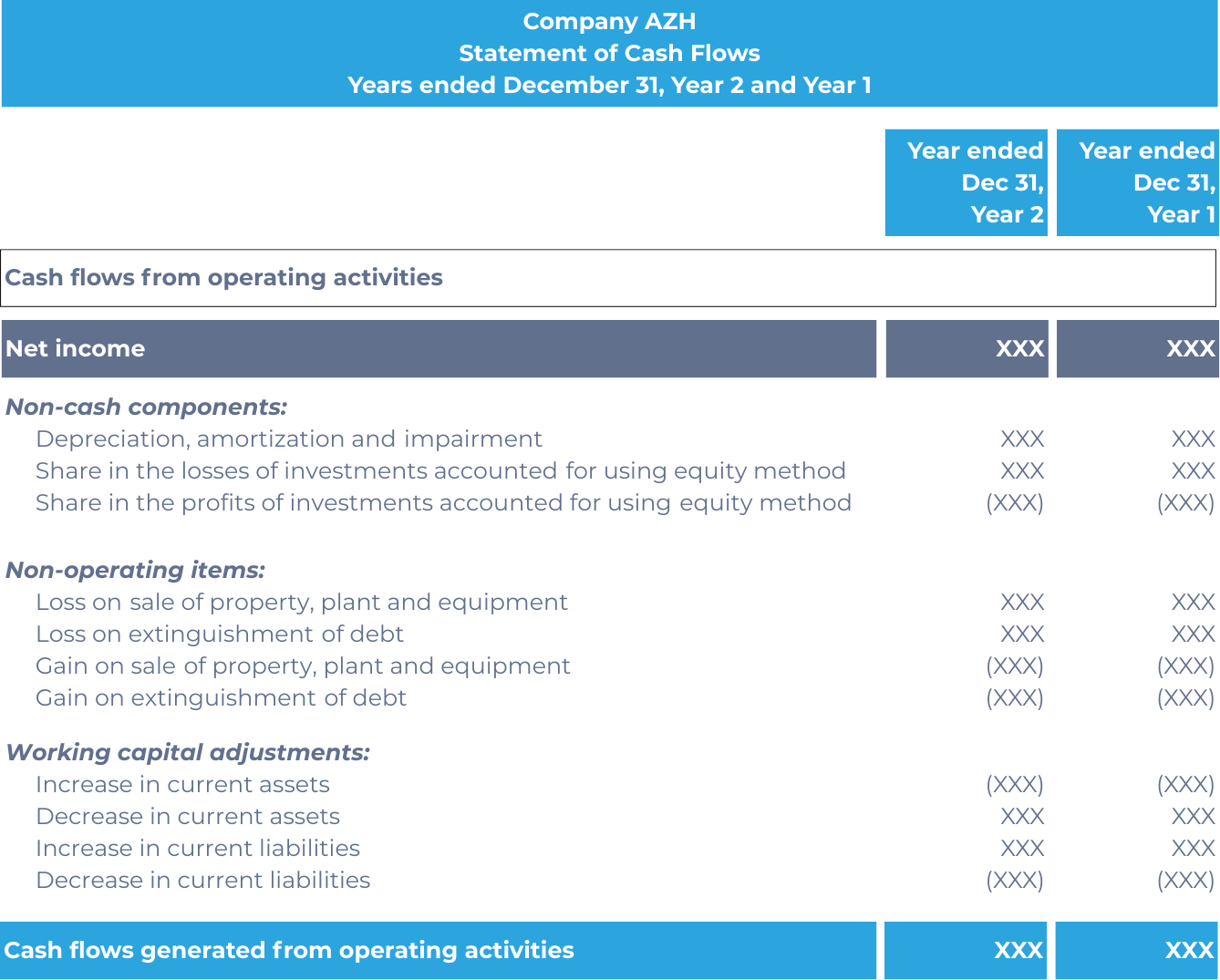
The following template will help in preparing cash flows from operating activities using the indirect method.

Net income XX Pick-up the amount of net income from the statement of profit or loss
Adjustment 1:
Non-cash items:
Add:
Expenses
XX Various expenses such as depreciation, impairment and share in losses of associates do not have cash impact but they were deducted to arrive at the net income.

Therefore to arrive at the cash-basis net income, we have to add them back to remove their impact.
Deduct:
Income
(XX) Various income such as share in income of associates do not have cash impact but they were added to arrive at the net income.

Therefore to arrive at the cash-basis net income, we have to subtract them to remove their impact.
Adjustment 2:
Non-operating items
Add:
Losses
XX Non-operating losses such as loss on disposal of PPE or loss on extinguishment of debt are part of investing and financing cash flows, respectively.

They were deducted from the net income, therefore we need to add them back to remove their impact.
Deduct
Gains
(XX) Non-operating gains such as gains on sale of PPE or gains on extinguishment of debt are part of investing and financing cash flows, respectively.

They were added to the net income, therefore we need to deduct them to remove their impact.
Adjustment 3:
Working capital adjustments
Deduct:
Increases in current assets
(XX) An increase in current assets (like accounts receivable) means that a portion of revenues (recorded using accrual basis) remained in the balance sheet and therefore have not been received.

This increase represents the non-cash component of the net income and therefore has to be deducted.

Another easier way of thinking about it is through a double entry. An increase in current assets is represented by a debit and therefore to balance the entry, the cash impact is a credit.

A credit in cash is an outflow.
Add:
Decreases in current assets
XX A decrease in current assets means that receivables from previous periods have been collected in the current period.

These amounts were recognized as revenue (and included in net income) in a prior period, but the cash is collected this period. Because net income does not reflect this current-period cash inflow, the decrease in the current asset is added back to convert net income to cash flow.

Another easier way of thinking about it is through a double entry. A decrease in current assets is represented by a credit and therefore to balance the entry, the cash impact is a debit.

A debit in cash is an inflow.
Add:
Increases in current liabilities
XX An increase in current liabilities means that a portion of expenses (recorded using accrual basis) remained in the balance sheet and therefore have not been paid.

This increase represents the non-cash component of the net income and therefore has to be added because under cash-basis, the expenses were overstated.

Another easier way of thinking about it is through a double entry. An increase in current liabilities is represented by a credit and therefore to balance the entry, the cash impact is a debit.

A debit in cash is an inflow.
Deduct:
Decreases in current liabilities
(XX) A decrease in current liability means that liabilities from previous periods have been paid in the current period. Using the accrual basis of accounting, these have been expensed in the previous year but for cash-basis of accounting, these expenses are recorded when paid in the current year.

The decrease in net income represents the amount of understatement of expenses using the cash-basis of accounting.

Another easier way of thinking about it is through a double entry. A decrease in current liabilities is represented by a debit and therefore to balance the entry, the cash impact is a credit.

A credit in cash is an outflow.
Cash flows generated from (used in) operating activities XX or (XX) Sum total of all above items can be positive or negative.

Disclosure considerations

When the indirect method is used, the following items shall be disclosed separately in the notes because they do not appear directly in the statement of cash flows:

  • Interest paid in cash (net of amounts capitalized)
  • Income taxes paid in cash during the period

Such disclosures already appear in the statement of cash flows under the direct method.

In addition, it is always required to present a reconciliation between the net income and the cash flows from operating activities regardless of the method used (direct or indirect).

In the case of the direct method, it will be presented separately in the notes.

As in the case of the indirect method, entities have the option to:

  • Present the reconciliation directly in the statement of cash flows
  • Present the reconciliation in a separate schedule (typically within the notes to the financial statements), while showing a single line cash flows from operating activities in the statement of cash flows

Example of indirect method cash flows for operating activities

For example, suppose net income is $150,000. Depreciation expense of $20,000 is added back under Adjustment 1 because it reduced net income without using cash. A $5,000 gain on the sale of equipment is subtracted under Adjustment 2 because the full sale proceeds belong in investing activities. Accounts receivable increased by $8,000, which is deducted under Adjustment 3 because that amount of revenue has not yet been collected in cash. Cash flows from operating activities equal $150,000 + $20,000 − $5,000 − $8,000 = $157,000.

Indirect method cash flow for operating activities

Statement of Cash Flows: Direct vs. Indirect Method

  • Two formats: indirect method (adjusts net income), direct method (lists gross cash receipts/payments)
  • Financing and investing sections same in both methods
  • Indirect method required for CMA exam; direct method encouraged by Codification

Indirect Method for Operating Activities

  • Starts with net income (accrual basis)
  • Adjusts for:
    • Non-cash items (e.g., depreciation, impairment)
    • Non-operating gains/losses (e.g., sale of PPE)
    • Changes in working capital (current assets/liabilities)
  • Goal: convert net income to cash basis

Steps in Preparing Indirect Method Cash Flows

  • Net income: base figure from income statement
  • Adjustment 1: Non-cash items
    • Add back non-cash expenses (e.g., depreciation)
    • Subtract non-cash income (e.g., equity income)
  • Adjustment 2: Non-operating items
    • Add back losses from investing/financing activities
    • Subtract gains from investing/financing activities
  • Adjustment 3: Working capital adjustments
    • Deduct increases in current assets
    • Add decreases in current assets
    • Add increases in current liabilities
    • Deduct decreases in current liabilities

Disclosure Considerations

  • Indirect method requires separate disclosure of:
    • Interest paid in cash
    • Income taxes paid in cash
  • Reconciliation of net income to cash flows from operating activities required for both methods
    • Can be presented in statement or notes

Key Formula (Indirect Method Template)

  • Net income
    • Non-cash expenses – Non-cash income
    • Losses on investing/financing – Gains on investing/financing – Increases in current assets
    • Decreases in current assets
    • Increases in current liabilities – Decreases in current liabilities = Cash flows from operating activities

Sign up for free to take 16 quiz questions on this topic

Previous
Next  | 1.1.7.2 Direct method for operating activities
All rights reserved ©2016 - 2026 Achievable, Inc.

Indirect method for operating activities

The statement of cash flows can be prepared and presented in either of two ways that differ only in the preparation of the operating activities section. The financing and investing activities are the same in either format.

  • The indirect method prepares the operating activities section by adjusting the net income by removing the impacts of investing and financing activities and converting the net income into a cash basis by adjusting it with the changes in working capital (current assets and current liabilities) and non-cash items.
  • The direct method prepares the operating activities section by breaking it down into the major classes of gross cash receipts and payments. This is the format that Codification encourages.

The IMA Learning Outcome Statements specify that examinees are expected to know how to prepare the indirect method of cash flows only. Understanding the direct method clarifies how the indirect method differs.

Indirect method for operating activities

The indirect method of cash flow presentation for operating activities does not present gross cash receipts and payments but instead transforms the net income into the cash flows from operating activities through a series of adjustments. This method shows the total cash flows from operating activities but does not directly present the sources of the cash flows (i.e., cash receipts from customers, etc.), unlike the direct method. Theoretically, the direct method and indirect method cash flows should arrive at the same amount of cash flows from operating activities.

Steps in preparing indirect method cash flows

The CMA Exam Part 1 requires candidates to know how the statement of cash flows is prepared using the indirect method.

The indirect method starts with the net income. The following adjustments are normally made to the net income to arrive at the cash flows from operating activities:

  1. Adjustment 1: Remove non-cash income and expenses because these are items included in the net income but do not have cash impact.
  2. Adjustment 2: Eliminate gains or losses that pertain to financing and investing activities. The cash impact of these items are included in the financing and investing activities.
  3. Adjustment 3: Include the working capital adjustments. These are similar in nature to the balance sheet inputs in the direct method cash flows. They show the impact of the balance sheet items to the accrual-based amounts recorded in the net income to finally show the cash impact.

It will help to think that the goal of the indirect method exercise is to transform the net income, which is prepared using the accrual basis of accounting, into cash basis accounting.

Watch out for two common indirect-method traps:

  • Gains on disposal of an asset are subtracted from net income (losses are added back) because the full sale proceeds belong in investing activities, not operating.
  • Unrealized gains and losses on available-for-sale debt securities are recorded in other comprehensive income (OCI), not net income. Since they never affected net income, they are not reconciling items in the indirect method.

The following template will help in preparing cash flows from operating activities using the indirect method.

Net income XX Pick-up the amount of net income from the statement of profit or loss
Adjustment 1:
Non-cash items:
Add:
Expenses
XX Various expenses such as depreciation, impairment and share in losses of associates do not have cash impact but they were deducted to arrive at the net income.

Therefore to arrive at the cash-basis net income, we have to add them back to remove their impact.
Deduct:
Income
(XX) Various income such as share in income of associates do not have cash impact but they were added to arrive at the net income.

Therefore to arrive at the cash-basis net income, we have to subtract them to remove their impact.
Adjustment 2:
Non-operating items
Add:
Losses
XX Non-operating losses such as loss on disposal of PPE or loss on extinguishment of debt are part of investing and financing cash flows, respectively.

They were deducted from the net income, therefore we need to add them back to remove their impact.
Deduct
Gains
(XX) Non-operating gains such as gains on sale of PPE or gains on extinguishment of debt are part of investing and financing cash flows, respectively.

They were added to the net income, therefore we need to deduct them to remove their impact.
Adjustment 3:
Working capital adjustments
Deduct:
Increases in current assets
(XX) An increase in current assets (like accounts receivable) means that a portion of revenues (recorded using accrual basis) remained in the balance sheet and therefore have not been received.

This increase represents the non-cash component of the net income and therefore has to be deducted.

Another easier way of thinking about it is through a double entry. An increase in current assets is represented by a debit and therefore to balance the entry, the cash impact is a credit.

A credit in cash is an outflow.
Add:
Decreases in current assets
XX A decrease in current assets means that receivables from previous periods have been collected in the current period.

These amounts were recognized as revenue (and included in net income) in a prior period, but the cash is collected this period. Because net income does not reflect this current-period cash inflow, the decrease in the current asset is added back to convert net income to cash flow.

Another easier way of thinking about it is through a double entry. A decrease in current assets is represented by a credit and therefore to balance the entry, the cash impact is a debit.

A debit in cash is an inflow.
Add:
Increases in current liabilities
XX An increase in current liabilities means that a portion of expenses (recorded using accrual basis) remained in the balance sheet and therefore have not been paid.

This increase represents the non-cash component of the net income and therefore has to be added because under cash-basis, the expenses were overstated.

Another easier way of thinking about it is through a double entry. An increase in current liabilities is represented by a credit and therefore to balance the entry, the cash impact is a debit.

A debit in cash is an inflow.
Deduct:
Decreases in current liabilities
(XX) A decrease in current liability means that liabilities from previous periods have been paid in the current period. Using the accrual basis of accounting, these have been expensed in the previous year but for cash-basis of accounting, these expenses are recorded when paid in the current year.

The decrease in net income represents the amount of understatement of expenses using the cash-basis of accounting.

Another easier way of thinking about it is through a double entry. A decrease in current liabilities is represented by a debit and therefore to balance the entry, the cash impact is a credit.

A credit in cash is an outflow.
Cash flows generated from (used in) operating activities XX or (XX) Sum total of all above items can be positive or negative.

Disclosure considerations

When the indirect method is used, the following items shall be disclosed separately in the notes because they do not appear directly in the statement of cash flows:

  • Interest paid in cash (net of amounts capitalized)
  • Income taxes paid in cash during the period

Such disclosures already appear in the statement of cash flows under the direct method.

In addition, it is always required to present a reconciliation between the net income and the cash flows from operating activities regardless of the method used (direct or indirect).

In the case of the direct method, it will be presented separately in the notes.

As in the case of the indirect method, entities have the option to:

  • Present the reconciliation directly in the statement of cash flows
  • Present the reconciliation in a separate schedule (typically within the notes to the financial statements), while showing a single line cash flows from operating activities in the statement of cash flows

Example of indirect method cash flows for operating activities

For example, suppose net income is $150,000. Depreciation expense of $20,000 is added back under Adjustment 1 because it reduced net income without using cash. A $5,000 gain on the sale of equipment is subtracted under Adjustment 2 because the full sale proceeds belong in investing activities. Accounts receivable increased by $8,000, which is deducted under Adjustment 3 because that amount of revenue has not yet been collected in cash. Cash flows from operating activities equal $150,000 + $20,000 − $5,000 − $8,000 = $157,000.

Key points

Statement of Cash Flows: Direct vs. Indirect Method

  • Two formats: indirect method (adjusts net income), direct method (lists gross cash receipts/payments)
  • Financing and investing sections same in both methods
  • Indirect method required for CMA exam; direct method encouraged by Codification

Indirect Method for Operating Activities

  • Starts with net income (accrual basis)
  • Adjusts for:
    • Non-cash items (e.g., depreciation, impairment)
    • Non-operating gains/losses (e.g., sale of PPE)
    • Changes in working capital (current assets/liabilities)
  • Goal: convert net income to cash basis

Steps in Preparing Indirect Method Cash Flows

  • Net income: base figure from income statement
  • Adjustment 1: Non-cash items
    • Add back non-cash expenses (e.g., depreciation)
    • Subtract non-cash income (e.g., equity income)
  • Adjustment 2: Non-operating items
    • Add back losses from investing/financing activities
    • Subtract gains from investing/financing activities
  • Adjustment 3: Working capital adjustments
    • Deduct increases in current assets
    • Add decreases in current assets
    • Add increases in current liabilities
    • Deduct decreases in current liabilities

Disclosure Considerations

  • Indirect method requires separate disclosure of:
    • Interest paid in cash
    • Income taxes paid in cash
  • Reconciliation of net income to cash flows from operating activities required for both methods
    • Can be presented in statement or notes

Key Formula (Indirect Method Template)

  • Net income
    • Non-cash expenses – Non-cash income
    • Losses on investing/financing – Gains on investing/financing – Increases in current assets
    • Decreases in current assets
    • Increases in current liabilities – Decreases in current liabilities = Cash flows from operating activities

More from Cash flow preparation

  • Direct method for operating activities
  • Investing and financing activities
  • Net change in cash and cash equivalents