


Achievable logoAchievable logo
CMA Part 1
Sign in
Sign up
Purchase
Textbook
Practice exams
Support
How it works
Exam catalog
Mountain with a flag at the peak
Textbook
1. External financial reporting decisions
2. Planning, budgeting, and forecasting
3. Performance management
4. Cost management
5. Internal control
6. Technology and analytics
Achievable logoAchievable logo
1.1.7.2 Direct method for operating activities
Achievable CMA Part 1
1. External financial reporting decisions
1.1. Financial statements
1.1.7. Cash flow preparation
Our CMA Part 1 course is currently in development and is a work-in-progress.

Direct method for operating activities

6 min read
Font
Discuss
Share
Feedback

The direct method presents cash flows more straightforwardly than the indirect method: it reports gross cash receipts and gross cash payments directly, instead of reconciling from net income (the approach used by the indirect method, covered in the next chapter).

Sidenote
Direct method cash flows in the CMA exam

Although the direct method is the preferred method in theory as mentioned in ASC 230, it is not part of the learning outcome statements for the CMA examination. Hence, here we will present only a summary of a pro forma direct method cash flow statement for operating activities and an overview of how certain amounts are computed.

We encourage students to check other resources if they are interested in learning about the specifics of how to prepare direct method cash flows.

This method breaks down the operating activity section of the statement of cash flows into the following items as a minimum:

  • Receipts of cash from customers, including lessees, licensees, and the like
  • Receipts of cash in the form of interests and dividends, except those that are donor restricted for long-term purposes
  • Other operating cash receipts or payments, if any
  • Cash payments to employees and other suppliers of goods or services
  • Cash payments for interest
  • Cash payments for taxes

Entities are encouraged to provide a further breakdown of the gross receipts or payments that are considered meaningful and feasible.

Steps in preparing direct method cash flows

The most accurate way of preparing a direct method of cash flows is to track the actual cash movements so they can be easily grouped into cash receipts and disbursements per nature. However, this proves to be too cumbersome in practice.

Sidenote
Direct method cash flows in practice

In practice, the Codification also mentions that presentation of the operating cash flows using the direct method does not require a separate cash-based accounting system. The major classes of cash receipts and payments can be indirectly derived by using the income statement as a starting point and then adjusting them for movements in the related balance sheet accounts. Hence, in practice, each line in the direct method cash flows can also be derived through the indirect method. This is the reason why this method is not very common in practice.

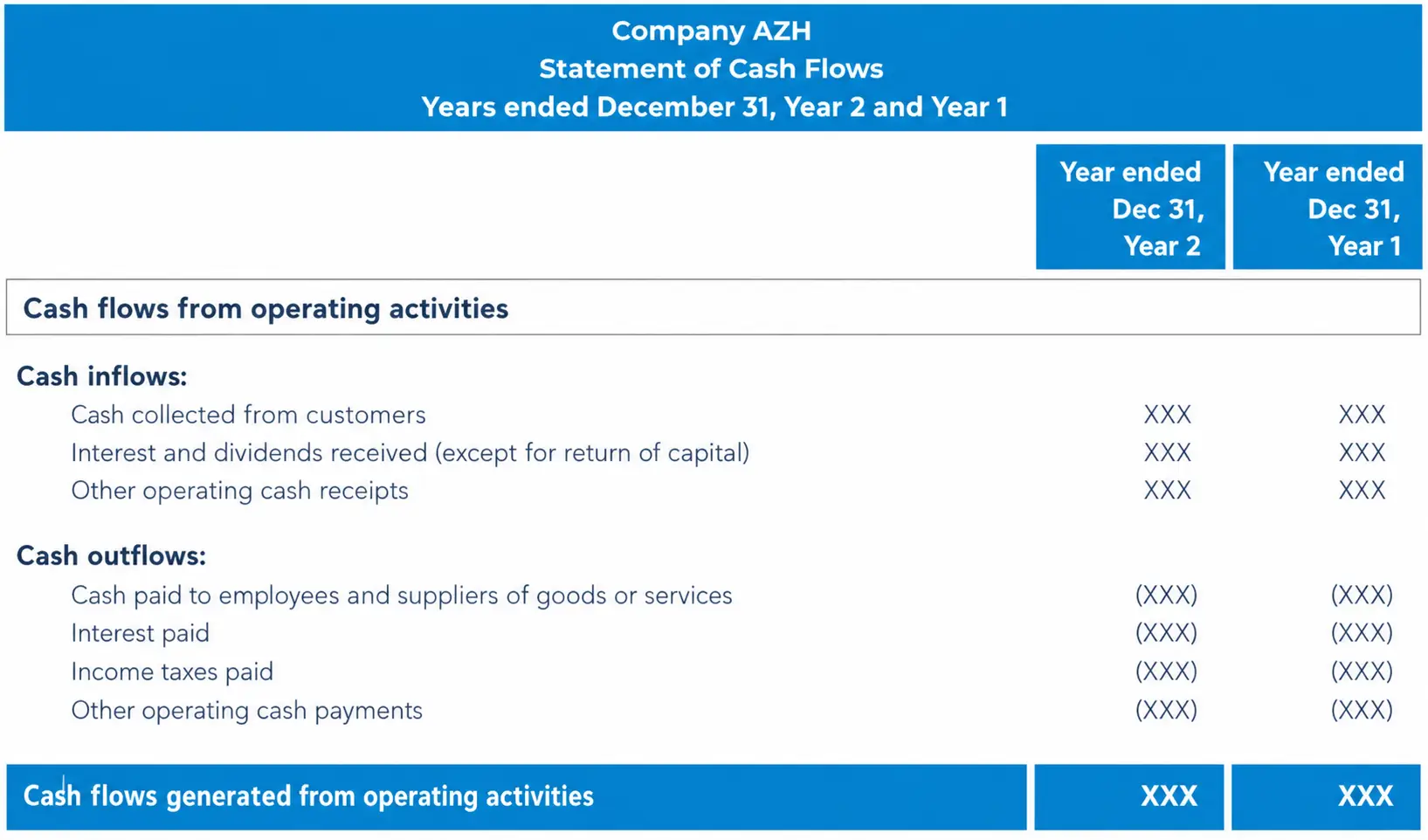
The following table shows the minimum line items of the direct method cash flows:

Cash flow statement section showing the direct method calculation of operating cash inflows and outflows.
Direct Method Operating Cash Flow

In case it is asked in the exam, all the above can be analyzed using the T-accounts.

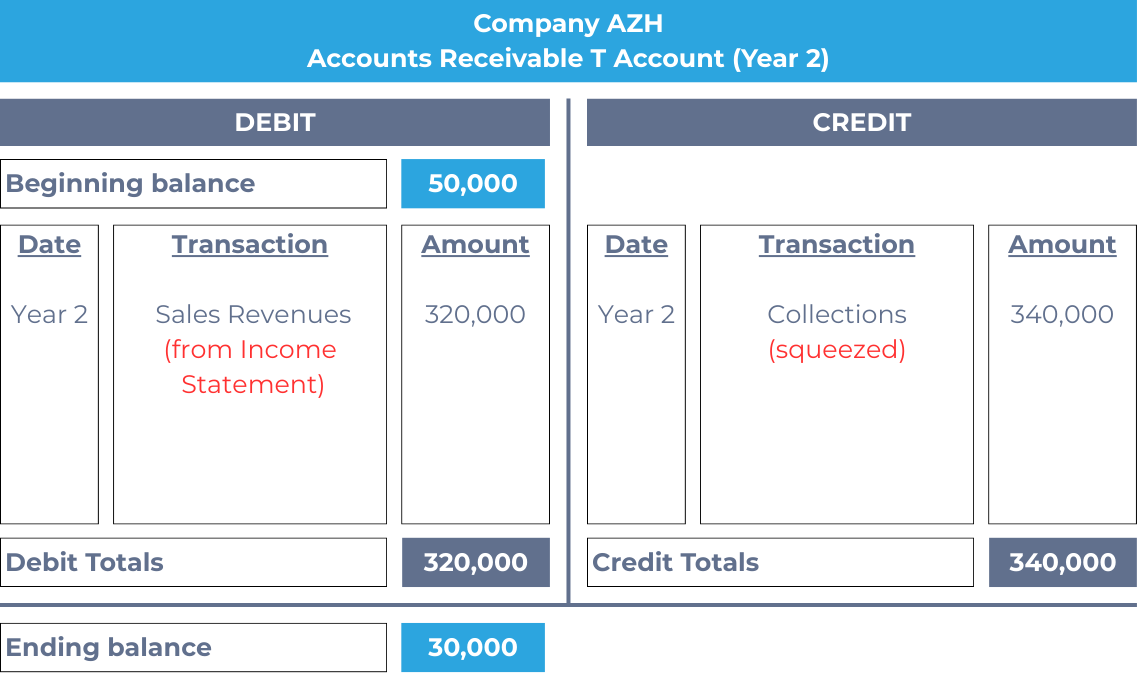
One example of the cash receipts from customers follows below. The cash collection line is indirectly determined through the T-Accounts as follows:

Accounts receivable T-account

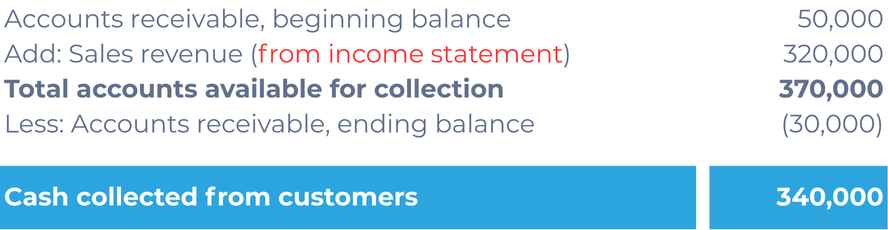
From the above template, we can understand that the beginning balance of accounts receivable plus the revenues during the period is equal to total receivables available for collection. When we remove the ending balance of accounts receivable from this, we are left with the cash collections that we can include in the statement of cash flows. This process can be represented by the formula:

Formula for sales collections for direct method cash flows

For example, if beginning accounts receivable is $100, sales during the period are $900, and ending accounts receivable is $150, then cash collected from customers is $100+$900−$150=$850

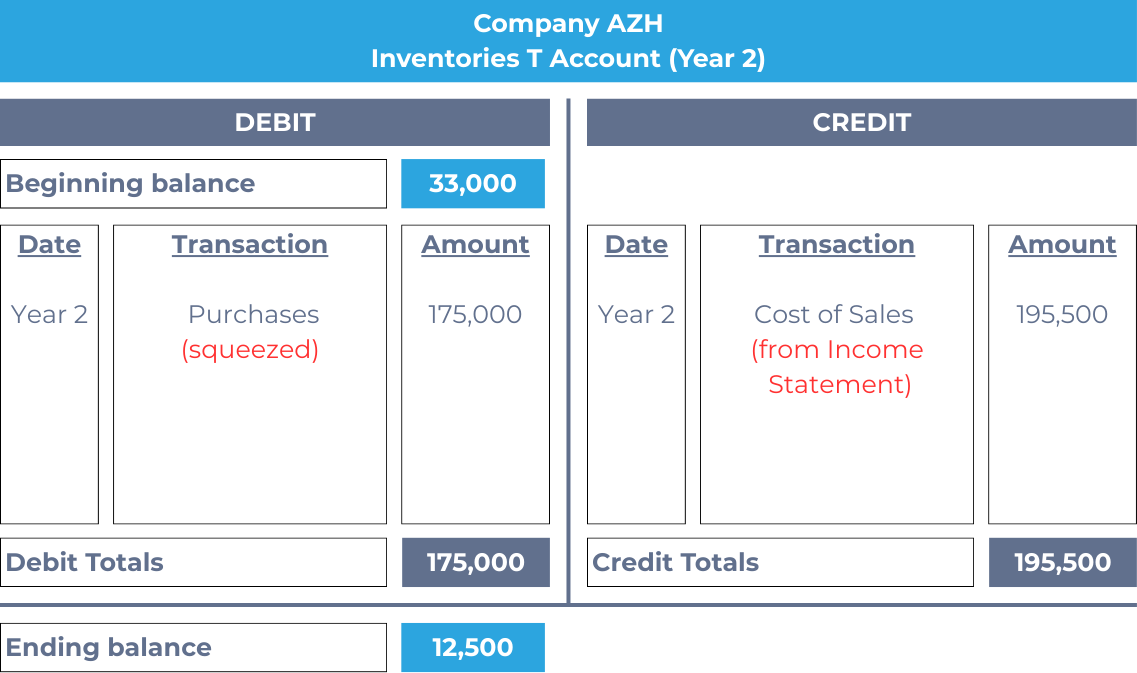
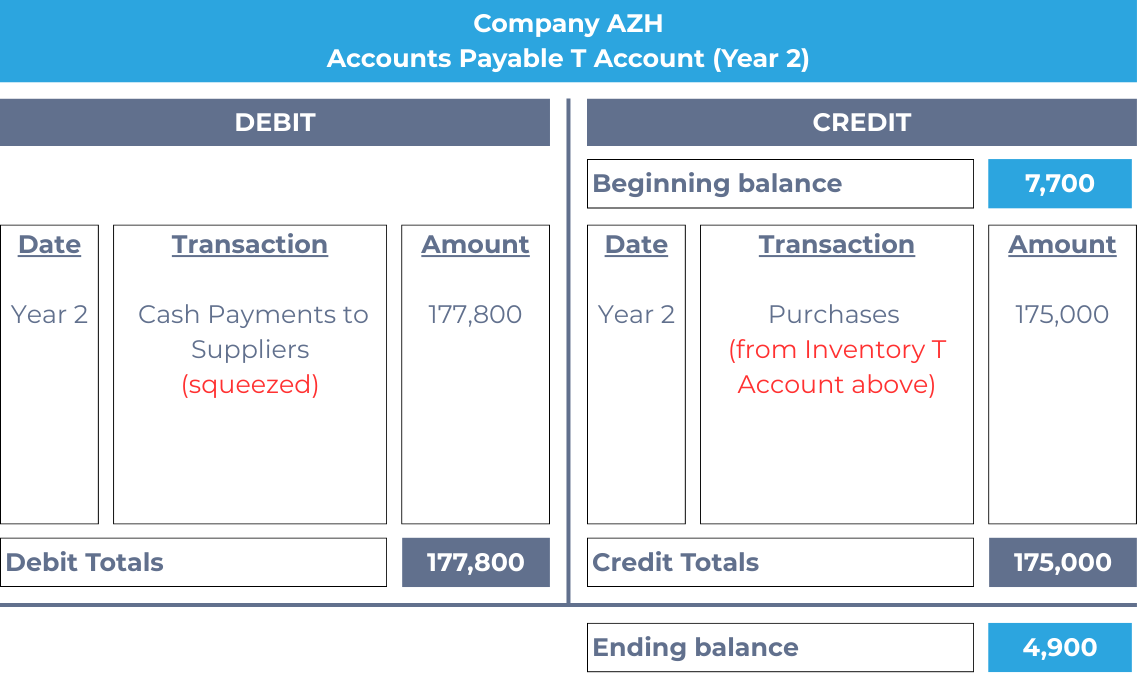
Another useful example would be for the cash payments to other suppliers of goods or services, which requires two T-accounts, one for inventory and one for accounts payable:

Merchandise inventory T-account

From the above template, we can see that the beginning balance of inventory plus purchases during the period is equal to the cost of sales plus the ending balance of inventory (together, these represent the total inventory available for sale). Rearranging this relationship, the amount of inventory purchased during the period is equal to the cost of sales plus the ending balance of inventory, minus the beginning balance of inventory.

However, since the purchases are not always made in cash, we need to use this amount as an input to another T-account for the trade payables to determine how much of the purchases were paid during the period.

Accounts payable T-account

This procedure requires the good availability of information and a proper understanding of the changes in the related balance sheet items.

The schedules above cannot capture all income statement and balance sheet relationships. For example, the changes in allowance for doubtful accounts have to be considered if the accounts receivable are presented at net.

Disclosure considerations

It is always required to present a reconciliation between the net income and the cash flows from operating activities, regardless of the method used (direct or indirect). As in the case of the direct method, entities would have to present it in a different schedule, typically within the notes to the financial statements.

Direct method for operating activities

  • Presents gross cash receipts and payments
  • Key line items:
    • Cash receipts from customers, interest, dividends
    • Cash payments to employees, suppliers, interest, taxes
  • Further breakdown encouraged if meaningful

Steps in preparing direct method cash flows

  • Ideally track actual cash movements by nature
  • In practice, adjust income statement items for related balance sheet changes
    • Use T-Accounts to derive cash flows (e.g., accounts receivable, inventory, payables)
  • Not common due to complexity and indirect derivation

Key formulas and T-Account analysis

  • Cash receipts from customers:
    • Beginning A/R + Revenues – Ending A/R = Cash collected
  • Cash payments to suppliers:
    • Merchandise purchases = Ending Inventory + Cost of Sales – Beginning Inventory
    • Cash paid to suppliers = Beginning A/P + Purchases – Ending A/P
  • Adjust for net presentation (e.g., allowance for doubtful accounts)

Disclosure considerations

  • Reconciliation of net income to operating cash flows required
  • Direct method requires separate reconciliation schedule in notes

Sign up for free to take 6 quiz questions on this topic

Previous
Next  | 1.1.7.3 Investing and financing activities
All rights reserved ©2016 - 2026 Achievable, Inc.

Direct method for operating activities

The direct method presents cash flows more straightforwardly than the indirect method: it reports gross cash receipts and gross cash payments directly, instead of reconciling from net income (the approach used by the indirect method, covered in the next chapter).

Sidenote
Direct method cash flows in the CMA exam

Although the direct method is the preferred method in theory as mentioned in ASC 230, it is not part of the learning outcome statements for the CMA examination. Hence, here we will present only a summary of a pro forma direct method cash flow statement for operating activities and an overview of how certain amounts are computed.

We encourage students to check other resources if they are interested in learning about the specifics of how to prepare direct method cash flows.

This method breaks down the operating activity section of the statement of cash flows into the following items as a minimum:

  • Receipts of cash from customers, including lessees, licensees, and the like
  • Receipts of cash in the form of interests and dividends, except those that are donor restricted for long-term purposes
  • Other operating cash receipts or payments, if any
  • Cash payments to employees and other suppliers of goods or services
  • Cash payments for interest
  • Cash payments for taxes

Entities are encouraged to provide a further breakdown of the gross receipts or payments that are considered meaningful and feasible.

Steps in preparing direct method cash flows

The most accurate way of preparing a direct method of cash flows is to track the actual cash movements so they can be easily grouped into cash receipts and disbursements per nature. However, this proves to be too cumbersome in practice.

Sidenote
Direct method cash flows in practice

In practice, the Codification also mentions that presentation of the operating cash flows using the direct method does not require a separate cash-based accounting system. The major classes of cash receipts and payments can be indirectly derived by using the income statement as a starting point and then adjusting them for movements in the related balance sheet accounts. Hence, in practice, each line in the direct method cash flows can also be derived through the indirect method. This is the reason why this method is not very common in practice.

The following table shows the minimum line items of the direct method cash flows:

In case it is asked in the exam, all the above can be analyzed using the T-accounts.

One example of the cash receipts from customers follows below. The cash collection line is indirectly determined through the T-Accounts as follows:

From the above template, we can understand that the beginning balance of accounts receivable plus the revenues during the period is equal to total receivables available for collection. When we remove the ending balance of accounts receivable from this, we are left with the cash collections that we can include in the statement of cash flows. This process can be represented by the formula:

For example, if beginning accounts receivable is $100, sales during the period are $900, and ending accounts receivable is $150, then cash collected from customers is $100+$900−$150=$850

Another useful example would be for the cash payments to other suppliers of goods or services, which requires two T-accounts, one for inventory and one for accounts payable:

From the above template, we can see that the beginning balance of inventory plus purchases during the period is equal to the cost of sales plus the ending balance of inventory (together, these represent the total inventory available for sale). Rearranging this relationship, the amount of inventory purchased during the period is equal to the cost of sales plus the ending balance of inventory, minus the beginning balance of inventory.

However, since the purchases are not always made in cash, we need to use this amount as an input to another T-account for the trade payables to determine how much of the purchases were paid during the period.

This procedure requires the good availability of information and a proper understanding of the changes in the related balance sheet items.

The schedules above cannot capture all income statement and balance sheet relationships. For example, the changes in allowance for doubtful accounts have to be considered if the accounts receivable are presented at net.

Disclosure considerations

It is always required to present a reconciliation between the net income and the cash flows from operating activities, regardless of the method used (direct or indirect). As in the case of the direct method, entities would have to present it in a different schedule, typically within the notes to the financial statements.

Key points

Direct method for operating activities

  • Presents gross cash receipts and payments
  • Key line items:
    • Cash receipts from customers, interest, dividends
    • Cash payments to employees, suppliers, interest, taxes
  • Further breakdown encouraged if meaningful

Steps in preparing direct method cash flows

  • Ideally track actual cash movements by nature
  • In practice, adjust income statement items for related balance sheet changes
    • Use T-Accounts to derive cash flows (e.g., accounts receivable, inventory, payables)
  • Not common due to complexity and indirect derivation

Key formulas and T-Account analysis

  • Cash receipts from customers:
    • Beginning A/R + Revenues – Ending A/R = Cash collected
  • Cash payments to suppliers:
    • Merchandise purchases = Ending Inventory + Cost of Sales – Beginning Inventory
    • Cash paid to suppliers = Beginning A/P + Purchases – Ending A/P
  • Adjust for net presentation (e.g., allowance for doubtful accounts)

Disclosure considerations

  • Reconciliation of net income to operating cash flows required
  • Direct method requires separate reconciliation schedule in notes

More from Cash flow preparation

  • Indirect method for operating activities
  • Investing and financing activities
  • Net change in cash and cash equivalents