



Investing and financing activities
Cash flows from investing activities
Investing activities are always reported at their gross cash receipts and payments - there’s no indirect method option here; the direct-versus-indirect choice applies only to the operating activities section, which we cover in a later chapter. To prepare the cash flows from investing activities, it is best to be familiar with the movements in the entity’s non-current assets. Examples of items included in investing activities under the codification are listed in the previous chapter.
You need to remember that we only need to include the gross amount of cash received or paid in the transaction in the cash flows from investing activities, however most of the time this will not be directly provided in the examination and you will need to determine it from a variety of inputs similar to the direct method T-accounts discussed prior.
The most common item would be the purchase and sale of long-term fixed assets such as PPE. With this we recommend going back into the basics and knowing the debit and credit impacts of transactions.
The template of the cash flows from investing activities is as follows:
Cash flows from financing activities
Same with the investing activity, cash flows from financing activities are presented at gross cash receipts and payments with no alternative option. To prepare this, it is best to be familiar with the movements in the entity’s non-current liabilities (such as bonds, borrowings and other non-current liabilities) and equity (such as share capital, APIC and Treasury Stocks).
When determining the amount to disclose in the cash flows from financing activities, you need to remember that we only need to include the gross amount of cash received or paid in the transaction. In particular, any gain or loss from the transaction is not presented in the cash flows from financing activities although it may be presented as a reconciling item in the cash flows from operating activities when using the indirect method. An example of the above is any gain or loss on extinguishment of debt when a debt item has been repaid early.
Under US GAAP, dividends paid to shareholders are classified as a financing outflow, while interest paid, interest received, and dividends received are all classified as operating activities - a frequently tested distinction. IFRS allows more flexibility here, permitting these items to be classified as either operating or financing/investing, as long as the classification is applied consistently.
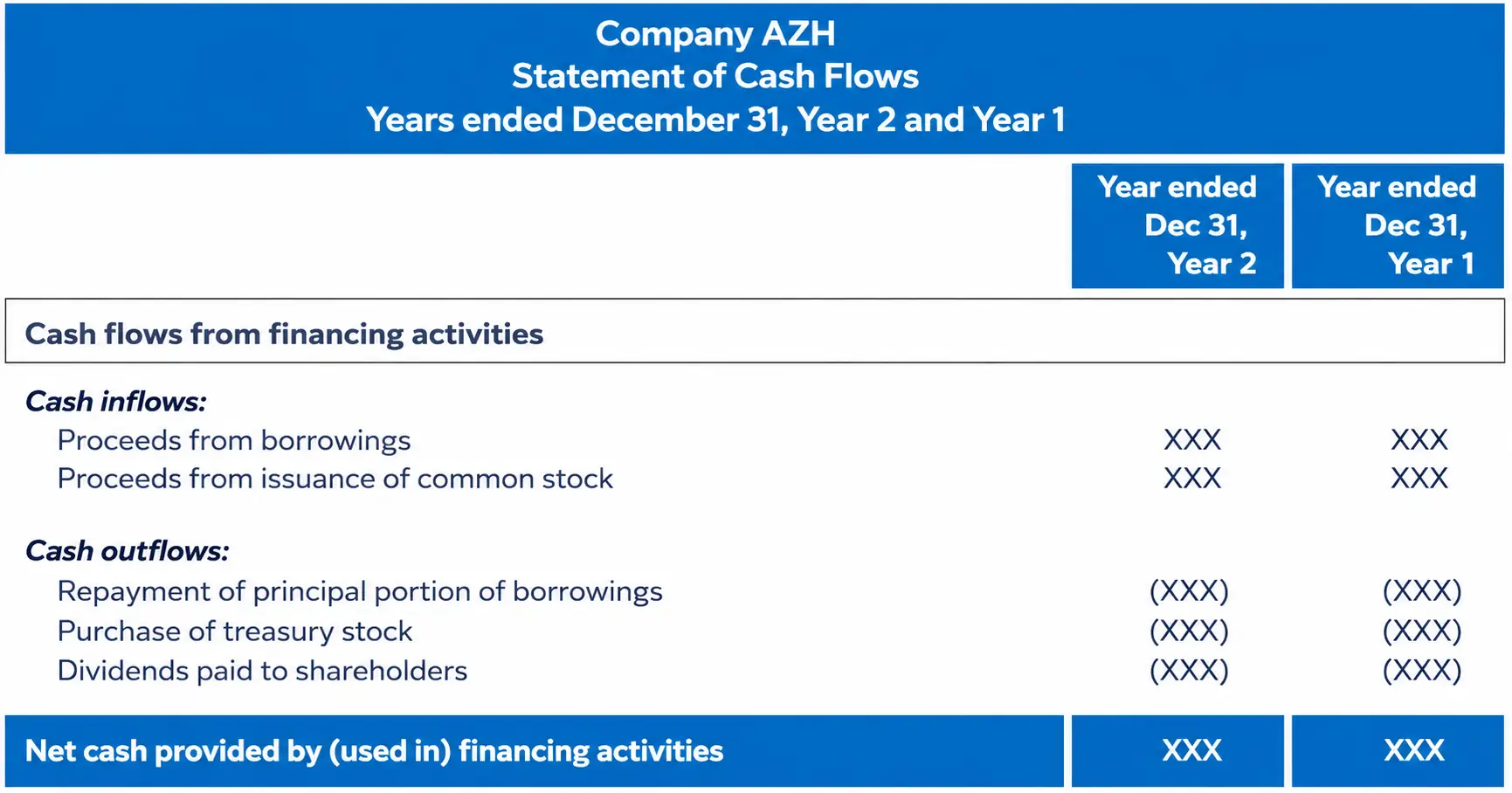
The template of the cash flows from financing activities is as follows:
Non-cash investing and financing activities
Investing activities typically affect non-current assets and financing activities typically affect non-current liabilities and equity. It can normally happen that transactions impact a mixture of these accounts but they do not have cash impacts. These are considered by the Codification as non-cash investing and financing activities.
In addition, some transactions are part cash and part non-cash. In this case, only the cash portion is reported in the statement of cash flows.
These transactions should be disclosed as additional information in the statement of cash flows. The disclosures can either be a narrative of the transaction or summarized in a schedule. In particular, according to the Codification, if there are only a few such noncash transactions, it may be convenient to include them on the same page as the statement of cash flows. Otherwise, the transactions may be reported elsewhere in the financial statements, clearly referenced to the statement of cash flows.
For purposes of the exams, when being asked to prepare a statement of cash flows, we recommend to include them within the statement for a complete presentation. See the next section for the recommended format.