


This browser is too old to run Achievable.

Update it, or open this page in a current version of Chrome, Safari, Firefox or Edge. On an iPhone or iPad, update iOS: every browser there runs on the version of Safari that comes with it.

Achievable logoAchievable logo
CMA Part 1
Sign in
Sign up
Purchase
Textbook
Practice exams
Support
How it works
Resources
Exam catalog
Mountain with a flag at the peak
Textbook
Introduction
1. External financial reporting decisions
2. Planning, budgeting, and forecasting
3. Performance management
4. Cost management
4.1 Measurement concepts
4.1.1 Cost behavior, cost objects, and cost pools
4.1.2 Product and period costs, cost drivers, and cost measurement methods
4.1.3 Inventory cost flow: trading vs. manufacturing
4.1.4 Absorption vs. variable costing: impact on inventory and income
4.1.5 Absorption vs. variable costing: illustrative problem
4.1.6 Joint and by-product costing: key concepts
4.1.7 Joint and by-product costing: cost allocation methods and by-product costing
4.2 Costing systems
4.3 Overhead costs
4.4 Supply chain management
4.5 Business process improvement
5. Internal control
6. Technology and analytics
Wrapping up
Achievable logoAchievable logo
4.1.6 Joint and by-product costing: key concepts
Achievable CMA Part 1
4. Cost management
4.1. Measurement concepts
Our CMA Part 1 course is currently in development and is a work-in-progress.

Joint and by-product costing: key concepts

5 min read
Font
Discuss
Share
Feedback

Learning outcome statements

The learning outcome statements relevant for this section are:

  1. determine the appropriate use of joint product and by-product costing
  2. demonstrate an understanding of concepts such as split-off point and separable costs
  3. determine the allocation of joint product and by-product costs using the physical measure method, the sales value at split-off method, constant gross profit (gross margin) method, and the net realizable value method, and describe the benefits and limitations of each method

Introduction

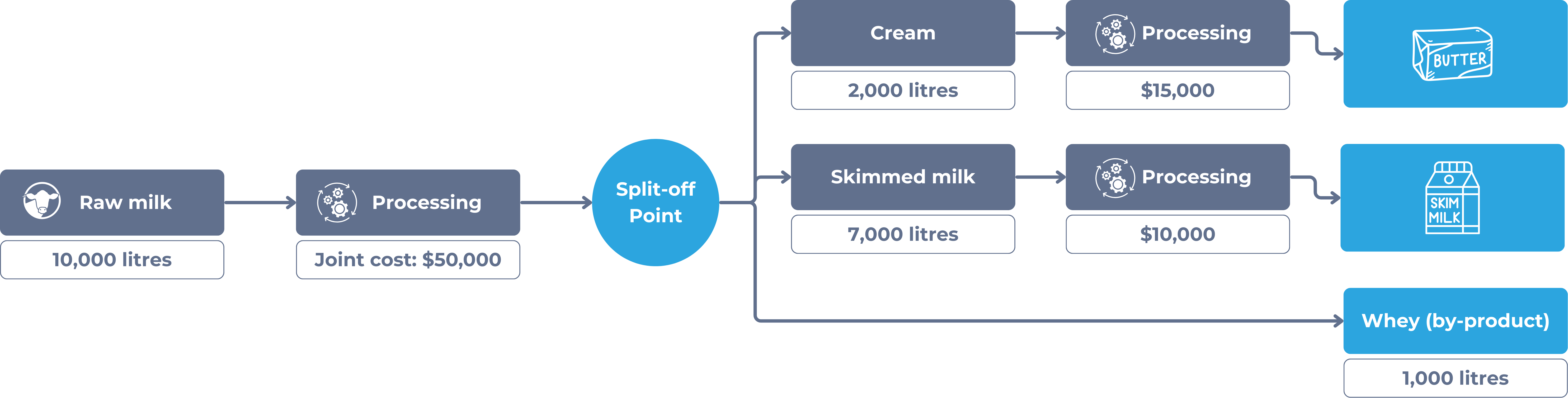
Many manufacturing processes produce multiple outputs simultaneously from a common input and shared processing effort. These outputs, known as joint products and by-products, emerge from a single production process and remain indistinguishable until a specific point in the process, referred to as the split-off point. At this stage, each product becomes separately identifiable and may be further processed or sold.

The challenge for accountants lies in determining how to allocate joint costs (the costs incurred up to the split-off point) among the resulting products. This allocation is required for inventory valuation, cost of goods sold, and financial reporting.

Watch out: Joint costs are sunk at the split-off point. In a sell-or-process-further decision, compare only the incremental revenue from further processing with the separable (incremental) cost; however the joint costs were allocated, that allocation is irrelevant to the decision.

Joint and by-product costing systems are commonly used in industries where multiple outputs naturally arise from a single process. Examples include:

  • Petroleum refining (e.g., gasoline, diesel, kerosene)
  • Meat processing (e.g., various cuts of meat and animal by-products)
  • Dairy production (e.g., milk, cream, whey)
  • Chemical manufacturing (e.g., acids, solvents, and derivatives)

Because joint products often represent significant revenue streams, and by-products can either be sold or reused, organizations must carefully consider how to account for these outputs in a way that reflects economic reality and supports effective decision-making.

Key concepts

Understanding joint and by-product costing begins with a clear grasp of three foundational ideas: joint products, by-products, and the split-off point. These concepts frame how costs are traced, allocated, and reported in multi-output production environments.

Joint and by-product in the production process
Achievable

Joint products

Joint products are two or more products of significant value that are simultaneously produced from a common input and manufacturing process. They share the same production path until a certain stage, after which they are physically distinguishable and may undergo further processing. For example, in crude oil refining, gasoline, diesel, and jet fuel are joint products.

Joint products are not distinguishable until the split-off point, which necessitates the allocation of joint costs, the total cost incurred up to that point, across the products.

By-products

By-products are secondary outputs of relatively minor value that are also generated incidentally during the joint production process. Although by-products can be sold or reused, they are not the primary focus of the production activity.

Outputs are classified by their sales value relative to the other outputs of the joint process: products with high relative sales value are joint (main) products, and those with low relative sales value are by-products. The classification is a management judgment and can change if relative market values change (for example, a by-product whose price rises sharply may become a joint product).

For example, in meat processing, bones and hides may be considered by-products when the main focus is on meat cuts. Unlike joint products, by-products are not typically allocated joint costs in the same way. Instead, they may be recorded as:

  • Other income, or
  • A reduction in the cost of the main products

The choice of treatment depends on materiality and the organization’s accounting policy.

Split-off point

The split-off point is the stage in the production process where joint products (and by-products) become separately identifiable. Costs incurred up to this point are called joint costs, while any costs incurred after this point (e.g., further refining or packaging) are known as separable costs.

Joint costs must be allocated to the main products using a systematic and rational method.

Separable costs

Separable costs are any costs that arise after the split-off point and can be attributed directly to a specific product. These may include:

  • Additional materials or packaging
  • Direct labor specific to a product
  • Transportation or finishing costs

These costs are not part of joint cost allocation and are included in the total cost of the product after allocation.

Example: Joint costs and separable costs in a refinery

A refinery incurs $100,000 refining crude oil up to the split-off point, where the process yields gasoline and diesel. After split-off, diesel requires an additional $8,000 of blending before it can be sold.

The $100,000 is a joint cost: it’s incurred before split-off and must be allocated between gasoline and diesel using one of the allocation methods covered in the next chapter. The $8,000 is a separable cost: it’s incurred after split-off and is charged only to diesel.

Diesel’s total cost equals diesel’s allocated share of the $100,000 joint cost plus the $8,000 separable cost.

The four joint-cost allocation methods (physical measure, sales value at split-off, constant gross margin, and net realizable value) and the by-product accounting methods are covered in the next chapter, Joint and by-product costing: cost allocation methods and by-product costing.

Joint and by-product costing overview

  • Multiple outputs from single process/input, indistinguishable until the split-off point
  • Common in petroleum refining, meat processing, dairy, chemical manufacturing
  • Classification is management judgment based on relative sales value: high value = joint (main) products, low value = by-products
  • Classification can change over time if relative market values shift

Core definitions

  • Joint products: two+ outputs of significant value from common process, share costs until split-off
  • By-products: secondary, minor-value outputs; not primary focus of production
  • Split-off point: stage where products become separately identifiable
  • Joint costs: costs incurred up to split-off point; must be allocated across joint products
  • Separable costs: costs incurred after split-off, directly traceable to a specific product (e.g., extra materials, labor, packaging, transportation)

By-product accounting treatment

  • Not allocated joint costs like main products
  • Recorded either as other income or as a reduction to main product cost
  • Treatment choice depends on materiality and accounting policy

Sell-or-process-further decisions

  • Joint costs are sunk at split-off — irrelevant to further-processing decisions
  • Only compare incremental revenue from further processing vs. separable (incremental) costs

Allocation methods (detailed in next chapter)

  • Four methods: physical measure, sales value at split-off, constant gross margin (gross profit), net realizable value (NRV)
  • Used to allocate joint costs among joint products for inventory valuation and COGS reporting

Sign up for free to take 7 quiz questions on this topic

Previous
Next  | 4.1.7 Joint and by-product costing: cost allocation methods and by-product costing
All rights reserved ©2016 - 2026 Achievable, Inc.

Joint and by-product costing: key concepts

Learning outcome statements

The learning outcome statements relevant for this section are:

  1. determine the appropriate use of joint product and by-product costing
  2. demonstrate an understanding of concepts such as split-off point and separable costs
  3. determine the allocation of joint product and by-product costs using the physical measure method, the sales value at split-off method, constant gross profit (gross margin) method, and the net realizable value method, and describe the benefits and limitations of each method

Introduction

Many manufacturing processes produce multiple outputs simultaneously from a common input and shared processing effort. These outputs, known as joint products and by-products, emerge from a single production process and remain indistinguishable until a specific point in the process, referred to as the split-off point. At this stage, each product becomes separately identifiable and may be further processed or sold.

The challenge for accountants lies in determining how to allocate joint costs (the costs incurred up to the split-off point) among the resulting products. This allocation is required for inventory valuation, cost of goods sold, and financial reporting.

Watch out: Joint costs are sunk at the split-off point. In a sell-or-process-further decision, compare only the incremental revenue from further processing with the separable (incremental) cost; however the joint costs were allocated, that allocation is irrelevant to the decision.

Joint and by-product costing systems are commonly used in industries where multiple outputs naturally arise from a single process. Examples include:

  • Petroleum refining (e.g., gasoline, diesel, kerosene)
  • Meat processing (e.g., various cuts of meat and animal by-products)
  • Dairy production (e.g., milk, cream, whey)
  • Chemical manufacturing (e.g., acids, solvents, and derivatives)

Because joint products often represent significant revenue streams, and by-products can either be sold or reused, organizations must carefully consider how to account for these outputs in a way that reflects economic reality and supports effective decision-making.

Key concepts

Understanding joint and by-product costing begins with a clear grasp of three foundational ideas: joint products, by-products, and the split-off point. These concepts frame how costs are traced, allocated, and reported in multi-output production environments.

Joint products

Joint products are two or more products of significant value that are simultaneously produced from a common input and manufacturing process. They share the same production path until a certain stage, after which they are physically distinguishable and may undergo further processing. For example, in crude oil refining, gasoline, diesel, and jet fuel are joint products.

Joint products are not distinguishable until the split-off point, which necessitates the allocation of joint costs, the total cost incurred up to that point, across the products.

By-products

By-products are secondary outputs of relatively minor value that are also generated incidentally during the joint production process. Although by-products can be sold or reused, they are not the primary focus of the production activity.

Outputs are classified by their sales value relative to the other outputs of the joint process: products with high relative sales value are joint (main) products, and those with low relative sales value are by-products. The classification is a management judgment and can change if relative market values change (for example, a by-product whose price rises sharply may become a joint product).

For example, in meat processing, bones and hides may be considered by-products when the main focus is on meat cuts. Unlike joint products, by-products are not typically allocated joint costs in the same way. Instead, they may be recorded as:

  • Other income, or
  • A reduction in the cost of the main products

The choice of treatment depends on materiality and the organization’s accounting policy.

Split-off point

The split-off point is the stage in the production process where joint products (and by-products) become separately identifiable. Costs incurred up to this point are called joint costs, while any costs incurred after this point (e.g., further refining or packaging) are known as separable costs.

Joint costs must be allocated to the main products using a systematic and rational method.

Separable costs

Separable costs are any costs that arise after the split-off point and can be attributed directly to a specific product. These may include:

  • Additional materials or packaging
  • Direct labor specific to a product
  • Transportation or finishing costs

These costs are not part of joint cost allocation and are included in the total cost of the product after allocation.

Example: Joint costs and separable costs in a refinery

A refinery incurs $100,000 refining crude oil up to the split-off point, where the process yields gasoline and diesel. After split-off, diesel requires an additional $8,000 of blending before it can be sold.

The $100,000 is a joint cost: it’s incurred before split-off and must be allocated between gasoline and diesel using one of the allocation methods covered in the next chapter. The $8,000 is a separable cost: it’s incurred after split-off and is charged only to diesel.

Diesel’s total cost equals diesel’s allocated share of the $100,000 joint cost plus the $8,000 separable cost.

The four joint-cost allocation methods (physical measure, sales value at split-off, constant gross margin, and net realizable value) and the by-product accounting methods are covered in the next chapter, Joint and by-product costing: cost allocation methods and by-product costing.

Key points

Joint and by-product costing overview

  • Multiple outputs from single process/input, indistinguishable until the split-off point
  • Common in petroleum refining, meat processing, dairy, chemical manufacturing
  • Classification is management judgment based on relative sales value: high value = joint (main) products, low value = by-products
  • Classification can change over time if relative market values shift

Core definitions

  • Joint products: two+ outputs of significant value from common process, share costs until split-off
  • By-products: secondary, minor-value outputs; not primary focus of production
  • Split-off point: stage where products become separately identifiable
  • Joint costs: costs incurred up to split-off point; must be allocated across joint products
  • Separable costs: costs incurred after split-off, directly traceable to a specific product (e.g., extra materials, labor, packaging, transportation)

By-product accounting treatment

  • Not allocated joint costs like main products
  • Recorded either as other income or as a reduction to main product cost
  • Treatment choice depends on materiality and accounting policy

Sell-or-process-further decisions

  • Joint costs are sunk at split-off — irrelevant to further-processing decisions
  • Only compare incremental revenue from further processing vs. separable (incremental) costs

Allocation methods (detailed in next chapter)

  • Four methods: physical measure, sales value at split-off, constant gross margin (gross profit), net realizable value (NRV)
  • Used to allocate joint costs among joint products for inventory valuation and COGS reporting

More from Measurement concepts

  • Cost behavior, cost objects, and cost pools
  • Product and period costs, cost drivers, and cost measurement methods
  • Inventory cost flow: trading vs. manufacturing
  • Absorption vs. variable costing: impact on inventory and income
  • Absorption vs. variable costing: illustrative problem