



Total sales variance and sales price variance
Sales variances help managers analyze deviations in total sales by breaking them into two components: sales price variance and sales volume variance. When the entity is selling more than one product, the sales volume variance can be split between the sales mix variance and sales quantity variance. These variances provide insights into whether deviations arise from selling more or fewer units than planned or from selling at higher or lower prices than expected. This distinction enables managers to identify specific areas requiring attention, such as pricing strategies or market demand, and take appropriate corrective actions.
The total sales variance is the difference between actual sales revenue and budgeted sales revenue (from the master budget). This total variance reflects the combined impact of changes in both sales volume and sales price. By breaking the total variance into sales volume and sales price components, managers gain a clearer understanding of the underlying drivers of performance.
Total sales variance
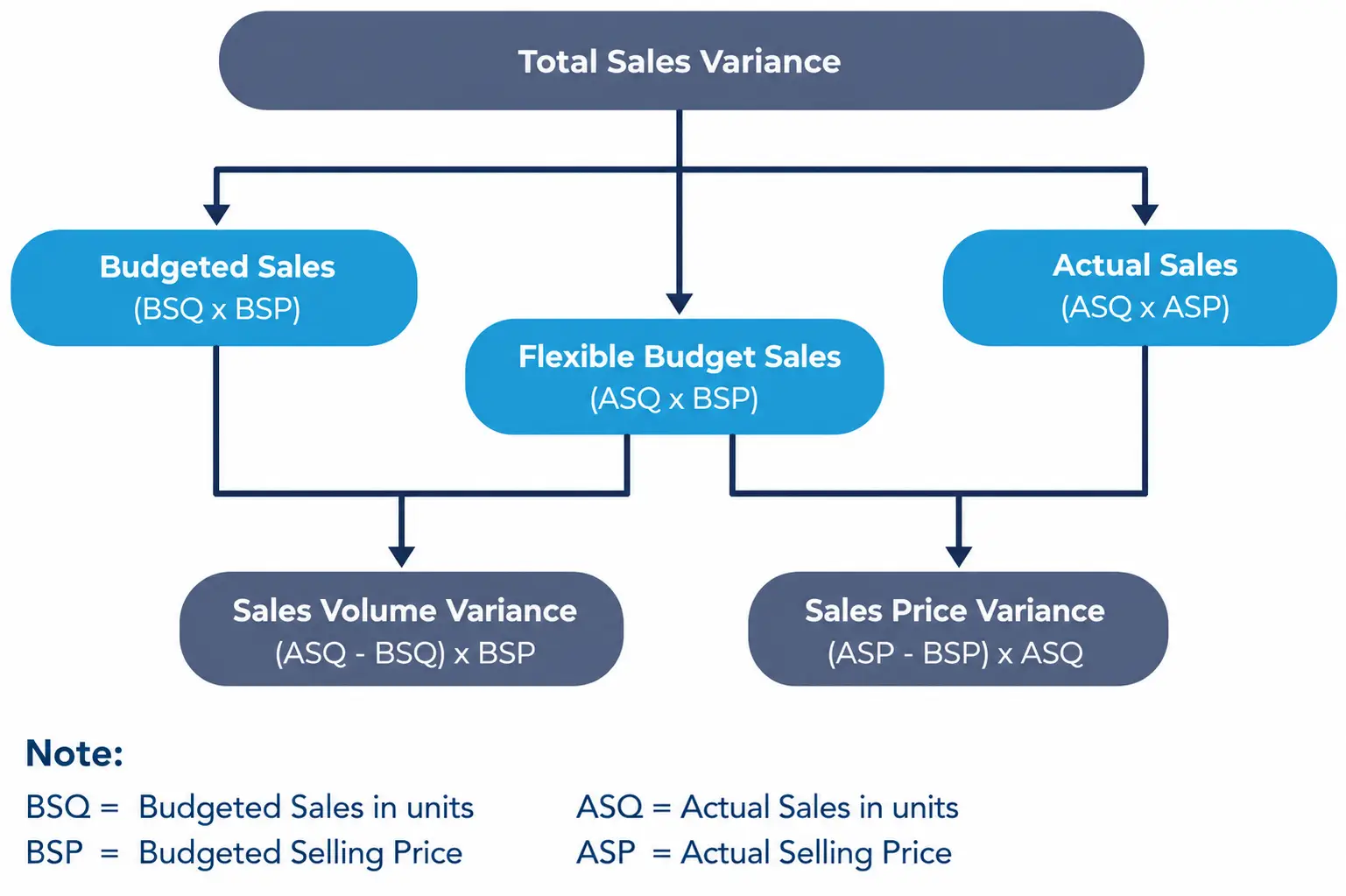
A summary of the relationships of the sales variances can be seen in the figure below:
The total sales variance can be calculated as:
Alternatively, the total sales variance can be expressed as the sum of the sales volume variance and the sales price variance:
The diagram above summarizes these equivalent forms, since which one applies depends on what the CMA exam question provides.
The total sales variance can be broken down into two steps:
- Master budget sales to flexible budget sales:
This step isolates the sales volume variance, showing the impact of selling more or fewer units than planned at the budgeted price. In this step, the formula for sales for the master budget and the flexible budget both use the budgeted selling price (BSP), hence only the sales volume is analyzed. - Flexible budget sales to actual sales:
This step isolates the sales price variance, highlighting the effect of changes in the price per unit while holding volume constant. In this step, the formula for sales for the flexible budget and the actual sales both use the actual sales volume, hence only the sales price is analyzed.
Sales price variance
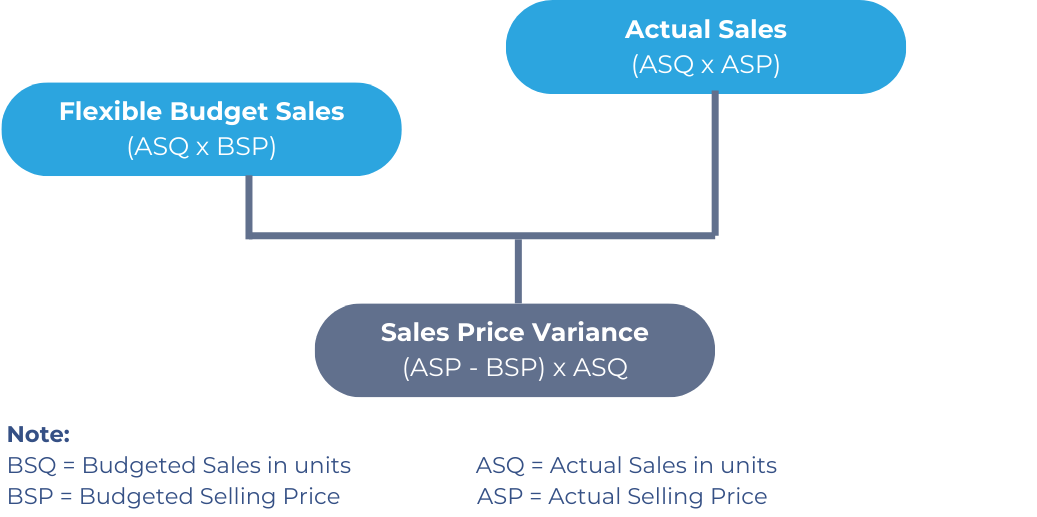
The sales price variance measures the effect of selling products at prices higher or lower than the budgeted price, holding the sales volume constant. It is calculated as:
Since the flexible budget uses the actual units sold at the budgeted selling price, you can also compute the sales price variance on a per-unit basis:
The diagram below shows other ways to compute the sales price variance:
Example: Sales price variance
A company budgets 10,000 units at a selling price of $50 per unit. It actually sells 10,400 units at $48 per unit.
Flexible budget sales:
Actual sales:
Sales price variance:
Answer: $20,800 unfavorable, since the actual price was lower than the budgeted price. (Selling 400 more units than budgeted also produces a sales volume variance, covered in the next chapter.)
A favorable sales price variance occurs when the actual sales price exceeds the budgeted sales price, indicating effective pricing strategies or favorable market conditions. An unfavorable sales price variance occurs when the actual price falls below the budgeted price, which might result from competitive pressures, discounts, or changes in market conditions.